
Stripe: Payment Experience Directly Impacts Black Friday Conversion as AI Agents Open New Possibilities | Black Friday Micro-Interview
【Ebrun Original】Payment is a critical link in the cross-border e-commerce transaction chain and an important infrastructure connecting merchants with global consumers. From consumers choosing payment methods and completing checkout to merchants confirming receipt, processing refunds, and identifying transaction risks, the payment experience runs through the entire shopping journey. Especially during peak sales periods like Black Friday and Cyber Monday, when transaction volumes surge in a concentrated manner, higher demands are placed on payment system stability, the breadth of payment methods, and risk management capabilities.
According to Liu Sicheng, Head of Enterprise Sales for Greater China at Stripe, the global payments ecosystem is also undergoing new changes. On one hand, consumers are increasingly demanding localized payment methods, mobile checkout experiences, and payment flexibility, and payments are transforming from a basic link in the transaction chain into a key factor influencing purchasing decisions and conversion efficiency. On the other hand, AI Agents are beginning to enter product discovery, shopping decisions, and even the payment process, and agentic payments are bringing new possibilities to cross-border e-commerce while also raising higher requirements for merchants' payment infrastructure and risk control capabilities.
As a global payment service provider, Stripe continues to enhance its service capabilities around payment experience, transaction security, and AI payments. This Black Friday, Stripe will further strengthen agentic payment-related services and, through risk control tools such as Stripe Radar, help merchants address risks including credit card and digital wallet fraud, refund and return abuse, improving payment conversion efficiency while safeguarding transaction security.
As the year-end peak shopping season approaches, Ebrun has specially planned the "Pushing Through · 2026 Cross-Border E-commerce Black Friday Peak Season" feature, inviting overseas brands and service providers to participate in a series of interviews to discuss how enterprises should respond to market competition changes, plan for the Black Friday peak season, and convert peak-season traffic into long-term brand value. Below is the interview content between Ebrun and Liu Sicheng, Head of Enterprise Sales for Greater China at Stripe, edited and organized.
Ebrun: What important arrangements or adjustments have you made to prepare for this year's Black Friday peak shopping season?
Liu Sicheng: During last year's Black Friday and Cyber Monday period, the transaction volume processed on the Stripe platform exceeded US$4.4 billion, up 37% year-over-year. Every year, Stripe releases a creative brief on Black Friday itself, disclosing real-time transaction volume on the platform as well as transaction conditions across various regions globally.
In addition, this year the Stripe platform will focus on providing merchants with more convenient services in agentic payments. At the same time, in terms of risk control, Stripe Radar will also strengthen management of credit card and digital wallet fraud, refund and return abuse, and other issues, making every effort to ensure buyers can enjoy a safe and smooth purchase experience, reduce sellers' operating costs, and help merchants achieve efficient growth.
Ebrun: Have you sensed any obvious market changes or changes in the competitive landscape this year?
Liu Sicheng: Judging from transactions on the Stripe platform, there are still growth opportunities in cross-border consumption. Recently, Stripe published "Preparing for the 2026 Shopping Peak Season: Key Insights Based on Holiday Spending Data," which shows that during the 2025 Black Friday and Cyber Monday period, the cross-border transaction value processed on the Stripe platform grew 37% year-over-year, exceeding US$4.4 billion. Based on our analysis of the 2025 shopping season, we believe there are three changes worth noting as merchants prepare for the peak season this year:
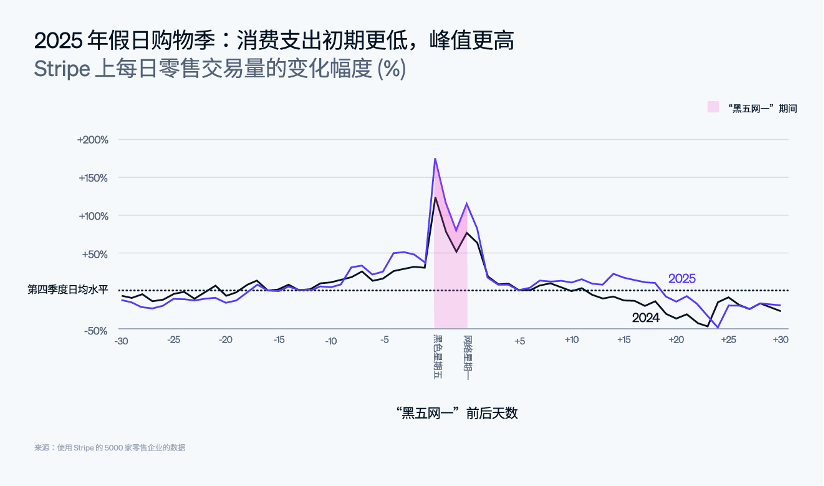
First, consumers are more prudent about when to place orders, and demand is released in a more concentrated manner. Our analysis of 5,000 retail businesses using Stripe found that shopping demand in 2025 rose rapidly about 10 days before Black Friday, and consumer spending during the Black Friday and Cyber Monday period reached nearly 4 times the usual level. Consumers may spend longer comparing products and offers before placing orders in a concentrated manner.
This means merchants need to prepare in advance the processing capacity of their payment systems and checkout flows to keep transactions smooth when demand suddenly surges; during peak periods, response delays, redundant checkout steps, or payment failures can all amplify revenue losses. During the four-day 2025 Black Friday and Cyber Monday period, the Stripe platform processed more than 578 million transactions, with API uptime exceeding 99.9999%. For merchants, reliable payment infrastructure can help teams keep transactions smooth during peak-season surges and focus their energy on products, marketing, and customer experience.
Second, payment flexibility is more directly affecting purchase decisions. Among businesses using Stripe, the share of buy now, pay later (BNPL) transaction volume during the Black Friday and Cyber Monday period rose from 1% in 2024 to 3% in 2025. A survey commissioned by Stripe also found that among respondents who had used buy now, pay later, 53% said they were more willing to shop at retailers that offered this option.
For Chinese overseas merchants, understanding the payment habits of consumers in target markets and providing suitable payment options is an important part of improving the purchase experience and conversion. At the same time, reducing checkout steps also helps consumers complete purchases smoothly. Stripe's digital wallet Link lets consumers check out quickly using saved payment information; during the 2025 Black Friday and Cyber Monday period, consumers using Link saved a cumulative 2.7 million minutes of checkout time, equivalent to more than 5 years.
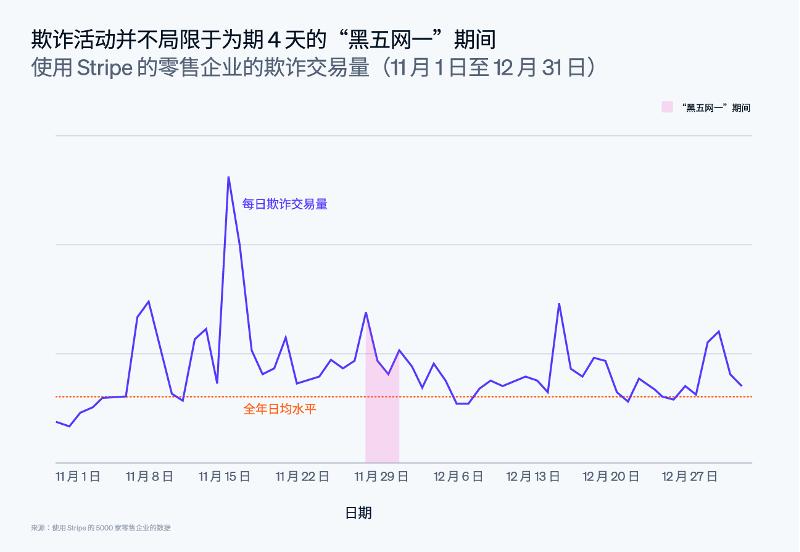
Third, fraud risk runs throughout the entire shopping season, and merchants need to balance risk identification with the approval rate of legitimate transactions. Among the sample of retail businesses analyzed in the report, fraudulent activity in 2025 began rising in early November and continued to peak in December. At the same time, risk forms have become more diverse: in addition to using automation and AI tools to test stolen bank cards, real customers' abuse of refund, return, or promotional policies is also worth attention. Merchants' risk control preparations need to cover the entire peak season and, while blocking fraud, minimize false declines of legitimate customer payments to protect sales revenue and profits. To address payment fraud, Stripe Radar uses AI models trained on data from the global transaction network to identify risk, helping merchants prevent fraud while preserving legitimate transaction opportunities.
Ebrun: Some say that in this year's Black Friday peak season, the "entry ticket" for merchants has become more expensive, requiring more investment and heavier operations. What have you observed?
Liu Sicheng: Whether the "entry ticket is more expensive" needs to be viewed in the context of specific markets, categories, and merchants' operating models. From the perspective of payments and transactions, peak-season input-output needs a more complete calculation: in addition to explicit expenses such as stocking and advertising, checkout abandonment, payment failures, and fraud losses also affect merchants' final returns.
One growth opportunity that is easy to overlook is enabling consumers who have already reached the store to complete payment more smoothly. A controlled experiment published by Stripe in 2025 found that dynamically displaying at checkout at least one payment method other than bank cards that is relevant to consumer needs increased merchants' average conversion rate by 7.4% and average revenue by 12%.
For example, in the experiment, offering BLIK (a Polish local mobile payment tool) to Polish consumers increased average conversion rate by 46%; offering iDEAL (a Dutch local bank transfer payment tool) to Dutch consumers increased average conversion rate by 39%. Digital wallets also performed prominently: in eligible checkout scenarios, merchants offering Apple Pay increased average conversion rate by 22.3%. This shows that optimizing the payment experience for target markets can help merchants generate more revenue from existing traffic and increase the value of upfront customer acquisition investment.
At the same time, merchants also need to pay attention to costs after the transaction. For example, refund abuse may bring refund expenses, inventory depreciation, and return processing costs at the same time; overly aggressive risk control rules may also falsely decline legitimate customer payments. Therefore, when evaluating peak-season performance, in addition to sales, merchants should also consider payment success rates, fraud losses, and refund situations to determine how much return growth ultimately brings.
Technology preparation can use mature tools to improve efficiency. For example, Stripe Checkout provides pre-built checkout pages and supports multiple payment methods, helping merchants reduce the work of developing and continuously maintaining payment flows from scratch. For overseas teams with limited resources, identifying in advance the stages where the most orders are lost and optimizing them in a targeted way is more helpful for directing limited budgets to areas that can improve business outcomes.
Ebrun: Where do you think the biggest highlights and new increments of this year's Black Friday peak season will come from?
Liu Sicheng: What is most worth watching this Black Friday is that the path by which consumers discover products, compare choices, and complete purchases is changing. For Chinese overseas merchants, there are two main directions of growth opportunities worth seizing.
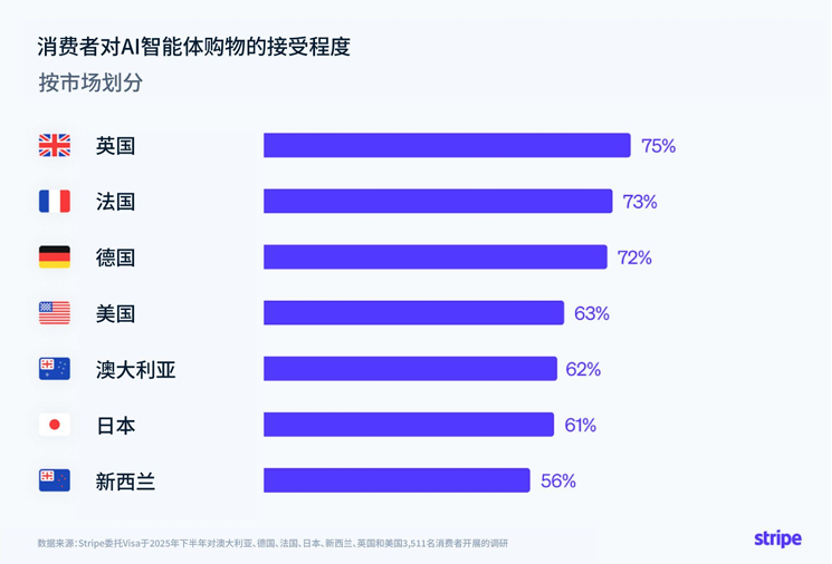
First, AI Agents are becoming a new entry point for product discovery and shopping. Stripe's "Payment Trends Insight Report" published this year shows that more and more consumers are beginning to accept AI agents participating in shopping decisions. The report surveyed 3,511 consumers across 7 global markets, of whom 51% said they were willing to let agents purchase gifts or personalized products on their behalf, which is directly related to gift-giving demand during the year-end shopping season.
Among them, consumers in major overseas markets such as the UK, France, Germany, and the US showed acceptance of agent participation in shopping ranging from 63% to 75%. Adobe also predicts that in the 2026 US holiday shopping season, visits to retail websites through AI recommendation links will grow 130% year-over-year.
Therefore, merchants need to make product, price, inventory, and return information clear and accurate so that AI can understand and recommend them. Stripe's Agentic Commerce solution is also helping merchants prepare for AI shopping entry points around product discovery, checkout, payment, and risk control.
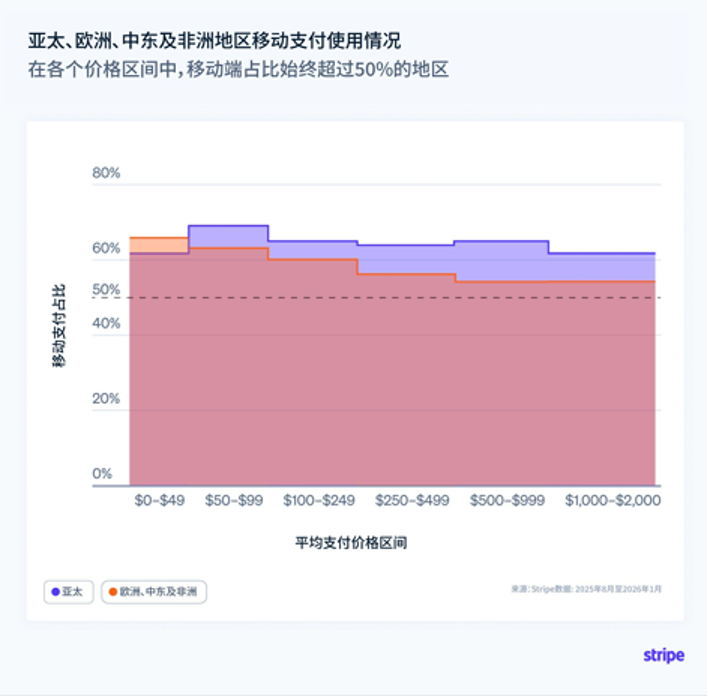
Second, consumer behavior is accelerating its migration to mobile. Stripe's "Payment Trends Insight Report" shows that 65% of small transactions (transactions under US$50) already occur on mobile, and higher-ticket consumption is also accelerating its migration to mobile, with this trend particularly notable in the EMEA market (short for Europe, Middle East, and Africa). This means the payment experience is no longer a supplement to the desktop but has become a core scenario that directly affects conversion efficiency. For platforms, the smoothness and consistency of the mobile experience are important factors determining whether transactions can be completed smoothly.
Ebrun continues to track and report this intelligence. To learn more information related to this article, please scan the QR code to follow the author's WeChat.

This article was first published on the official website of Ebrun.
[Copyright Notice] Ebrun advocates respecting and protecting intellectual property rights. Without permission, no one is allowed to copy, reproduce, or use the content of this website in any other way. If any copyright issues are found in the articles on this website, please provide copyright questions, identification, proof of copyright, contact information, etc. and send an email to run@ebrun.com. We will communicate and handle it in a timely manner.
Translated by AI. Feedback: run@ebrun.com