
When Airbags Enter Child Seats: CYBEX Is Redefining the Boundaries of Family Travel Safety
[Ebrun Original] Bayreuth, in northern Bavaria, Germany, has never been an ordinary border town.
More than 150 years ago, Richard Wagner chose this site to build his own festival theater. Wagner chose Bayreuth not only because it was far from the noise and restlessness of the metropolis, but also because the city naturally possessed an obsessive devotion to extreme artistic precision, immersive theatrical engineering, and idealism.
From Der Ring des Nibelungen to the grand acoustic design of the theater, Bayreuth symbolizes in human cultural history a rationality and passion that pursues absolute perfection and dares to break existing paradigms. A century later, this almost obsessive engineering aesthetics and unconventional innovative spirit found a new home on the same land in Bayreuth—the headquarters of CYBEX, the global leader in child travel safety, is located right here.
If Wagner reconstructed the form of opera with musical notes and theatrical physics, then CYBEX in Bayreuth has redefined the limits of child safety protection with high-precision crash testing, gravitational acceleration algorithms, and cutting-edge materials science.
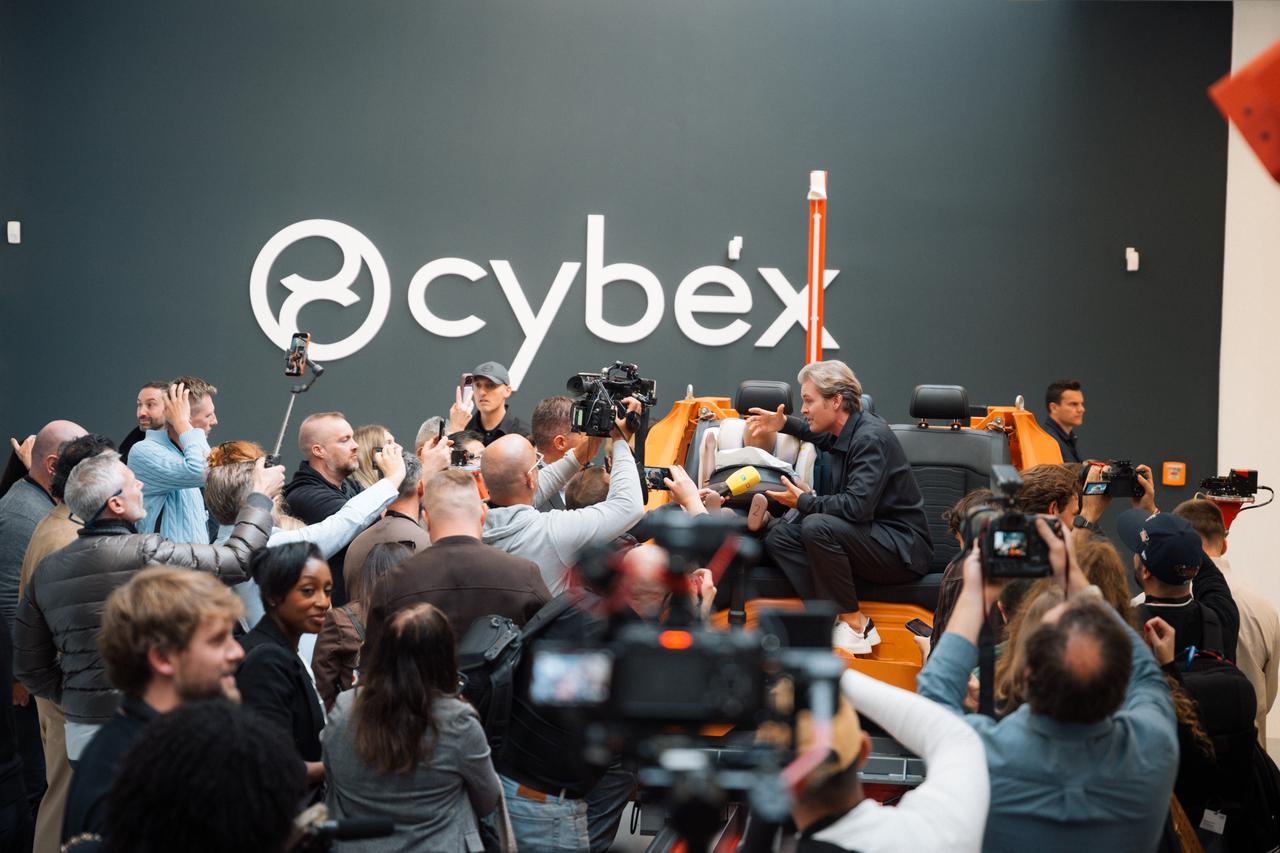
On October 13 local time in Germany, Formula One world champion Nico Rosberg walked into CYBEX's Bayreuth headquarters and witnessed a test sled crashing into a barrier wall at extremely high speed, with the crash test dummy instantly enduring impact forces of dozens of Gs—the boundary between track engineering and everyday travel was completely shattered. As the technical faith of the highest temple of motorsport is injected into child safety seats that concern the daily travel of hundreds of millions of families, a transformation about "technology democratization" and industry reshaping is quietly taking place.
01
From the Extreme Track to Family Protection
When people mention Nico Rosberg, the mark sports history records is his extremely rigorous, almost harsh geek style on the F1 circuit. In a racing world where milliseconds decide victory, he once voluntarily stripped all the paint from his helmet just to save 80 grams—all in order to save two seconds over the course of an entire race. This sensitivity to precision, physical limits, and safety structures formed the underlying mindset of his career.
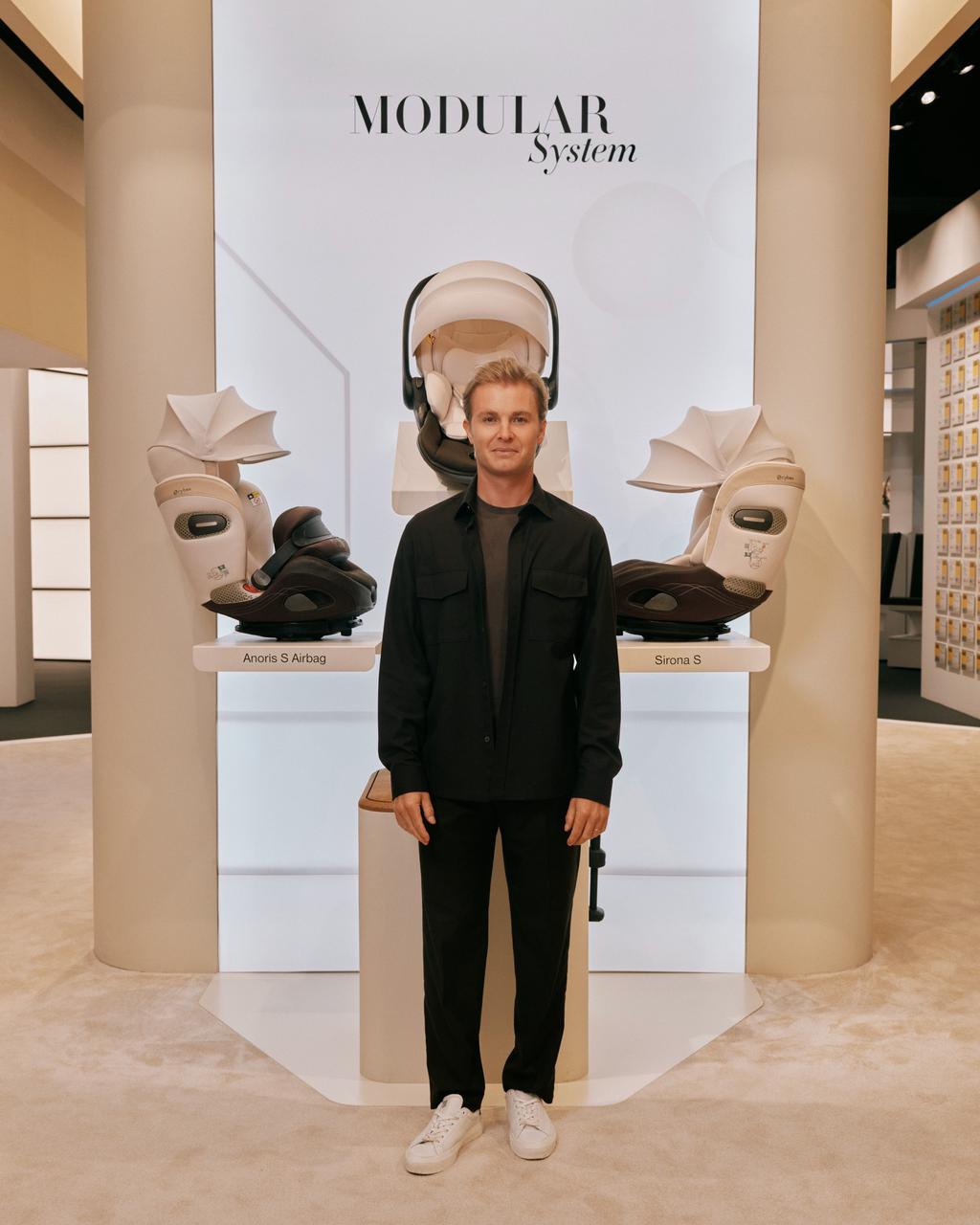
After retiring, Rosberg completed two crucial identity transformations: first, becoming the head of the venture capital fund Rosberg Ventures, focusing on frontier technologies and hardcore innovation that will shape the future; second, becoming the father of two daughters, directly confronting the parenting anxieties and safety hazards inside everyday car cabins.
The intertwining of these three identities makes his partnership with CYBEX far more than a commercial endorsement—it is a deep mutual trust based on shared engineering faith and soul-level ideals.
"On the track speeding at full tilt, technological innovation and millisecond-level response in extreme environments determine success or failure, life or death; but on the streets of everyday travel, we need even more to use racing-level engineering thinking to translate hardcore safety technology into everyday power that protects families," Rosberg said at the new product launch.
For Rosberg, giving up continued racing at the top level stems largely from a profound reshaping of his awareness of life risk after becoming a father. Inside a racing cockpit, the driver has an ultimate physical defense system consisting of the Halo head protection system, the HANS head and neck support system, six-point seat belts, and a high-strength carbon fiber monocoque; but in the back seat of an ordinary family car, children are extremely exposed to crash impact risks.
As a technology investor with a highly forward-looking vision, Rosberg's trust in CYBEX comes from its rigorous data support and engineering logic. When racing-level data-driven analysis is applied to child seat crash experiments, technology is no longer a lofty concept but a real barrier that resolves real-world danger.
02
Racing-Level Engineering Solves Travel Pain Points
For a long time, the child safety seat industry has generally faced an awkward "real-world dilemma": even if a product's safety indicators in laboratory tests are extremely high, once parents install it incorrectly in daily use due to cumbersome operation, or make compromises because the child is uncomfortable riding, the safety line collapses instantly.
A market study conducted by the authoritative organization YouGov in 2025 shows that in Germany alone, as many as 73% of parents, before their children turn two, prematurely switch the safety seat to forward-facing due to practical reasons such as the child crying from car sickness or travel convenience. Yet from the data of crash physics, traditional forward-facing seats reduce protection effectiveness for children's fragile necks and heads in frontal collisions by about 50% compared with rear-facing riding.
Facing this huge contest between "real user behavior" and "extreme safety standards," CYBEX founder Martin Pos said in an exclusive interview with Ebrun that CYBEX has drawn a great deal of underlying inspiration from F1—extreme innovation speed, always delivering on time, and the belief that "nothing is impossible."
CYBEX did not choose to condescendingly educate users, but instead chose to solve pain points with disruptive engineering technology. This problem-solving approach is exactly the same as F1 racing engineering: not asking the driver to adapt to an unreasonable physical environment, but using high-precision technological innovation to create operational possibilities while ensuring extreme safety.
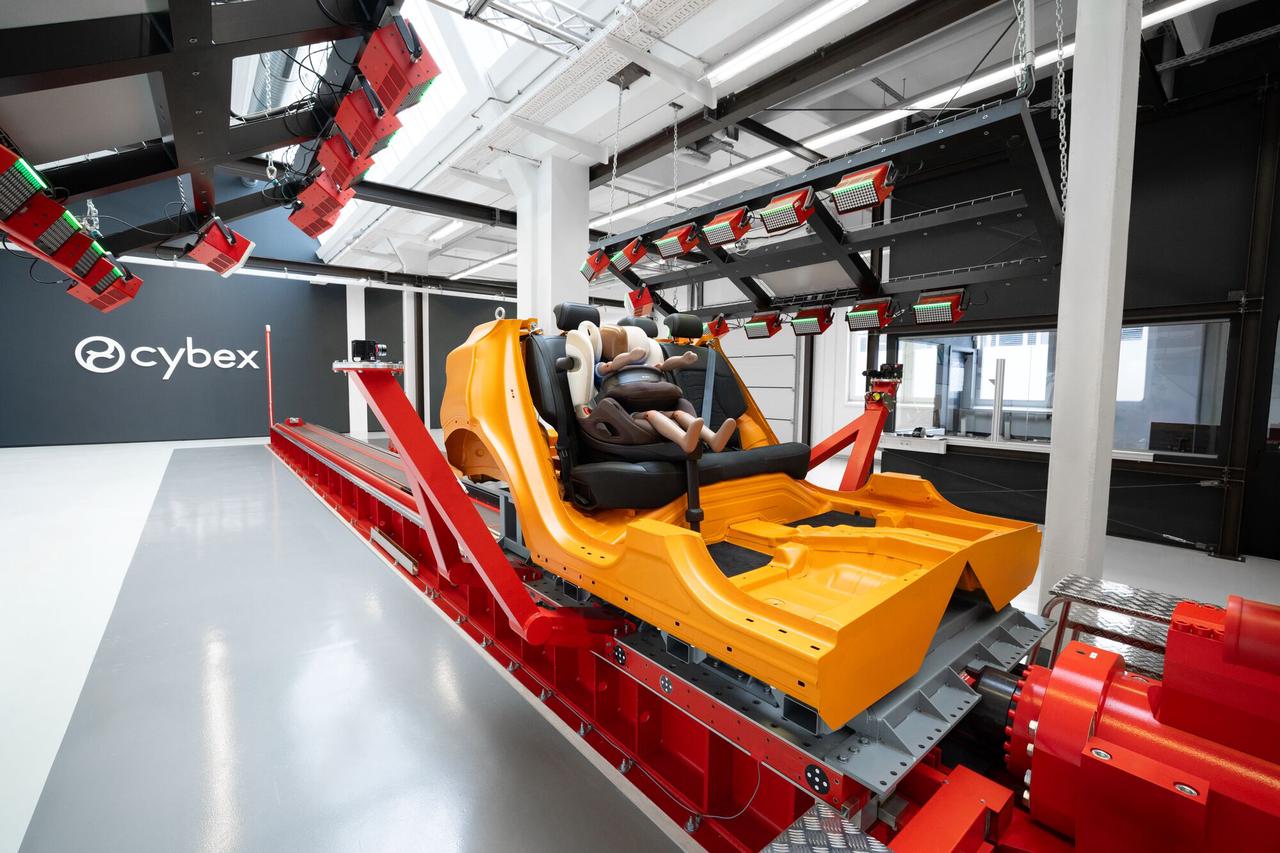
In the new Platinum S series, this racing-level engineering thinking is embodied most vividly, specifically in:
Data-driven absorption and dispersion mechanisms. The core principle of racing crash protection lies in "energy transfer and gradient absorption." CYBEX applies this logic to L.S.P. (Linear Side-impact Protection) and energy-absorbing structures. Through precise material deformation control and a combination of highly absorbent foam, enormous impact forces are stripped away and dispersed from children's sensitive areas at the very first moment of a collision.
A generational breakthrough in smart airbags. In the newly designed Anoris S airbag seat, the integrated full-body airbag can rapidly inflate and deploy within just a few milliseconds after a frontal collision occurs. This innovation, derived from high-end automotive safety technology, greatly improves frontal collision protection performance in forward-facing riding by 50% compared with traditional five-point harness seats. This completely resolves the industry's fatalistic dilemma that "premature forward-facing riding causes a sharp drop in safety," allowing children to enjoy a forward view while obtaining protection comparable to or even beyond traditional rear-facing riding.
Extreme user-friendliness and mistake-proof design. As Rosberg noted at the new product launch, on the F1 track, complex engineering must serve the driver's intuitive operation; in mother-and-baby scenarios, parents likewise have no energy to study thick academic manuals. The new Platinum S series uses a streamlined modular base (Base S) compatible with seat bodies for different stages, and achieves an extremely simple intuitive experience in rotation, buckling, and other steps.
"If a product claims top-level safety performance but its installation is extremely complicated and cumbersome, then that safety is meaningless in real life," he added.
More strikingly, while CYBEX pursues a safety performance improvement of about 10% over the previous generation, through continued use of the modular base, it directly reduces a family's hardware spending on seat replacement and upgrades by about 35%. This shows that iteration in hardcore technology does not necessarily mean an unattainably high threshold; it can achieve an organic combination of extreme safety and commercial accessibility.
03
Reshaping the Competitive Landscape Through Technology Democratization
The current mother-and-baby travel market is undergoing severe homogenized competition and price tug-of-war. A large number of brands are limited to alternating appearances and colors or packaging marketing concepts, while few companies dare to launch fundamental technological innovation against underlying physical safety structures.
When asked how this focus on frontier technology helps the brand stand out, CYBEX brand founder Martin Pos said bluntly to Ebrun: "We love technology, even to the point of obsession. Just like 20 years ago when we founded the company and proposed the airbag idea, everyone laughed at us and thought it was fantasy. We went through countless setbacks and finally found a path to realization. In essence, we are a group of technology geeks."
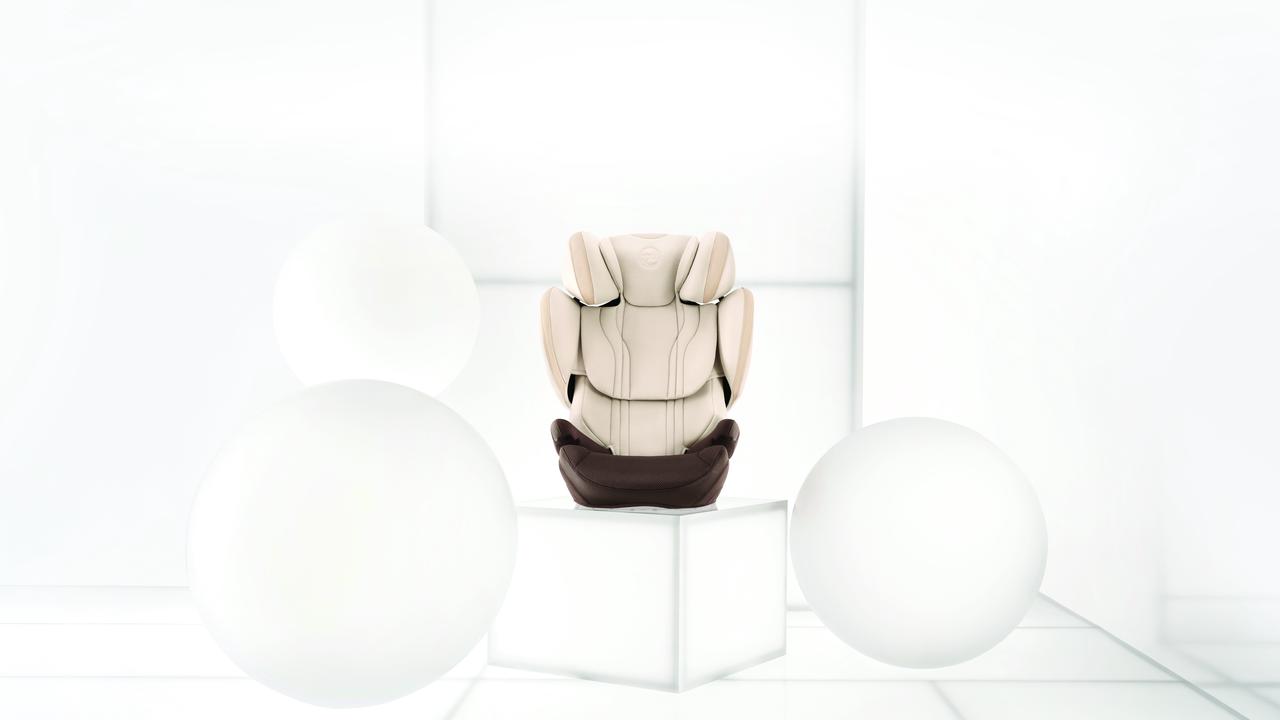
By deeply aligning its R&D system with F1-level engineering standards and establishing deep cooperation with top racers, CYBEX has successfully carved out a towering "technology moat" in an extremely involuted market. This not only establishes the brand mindshare of "track-level safety" in the global consumer market, but also achieves a far-reaching expansion of incremental audiences.
On the one hand, this hardcore technology route precisely activates contemporary "geeky parents" and technology-consuming groups. This generation of young parents advocates logic, believes in data, and pays attention to the underlying R&D background of products. They no longer blindly follow traditional parenting experience propaganda, but are willing to pay for engineering innovation with real technological content. On the other hand, the professional endorsement of an F1 world champion and the seamless embedding of racing culture have successfully converted a large number of car enthusiasts and motorsport fans into loyal believers of the brand, breaking open the narrow customer boundaries of traditional mother-and-baby products.
Just as the promotion of seat belts and the Halo system in racing history encountered resistance but ultimately completely reshaped the racing safety landscape, the evolution and popularization of child airbag technology likewise require a long and determined "technology evangelism."
"True safety should not be the exclusive privilege of a few luxury cars; it should become the basic standard for every child's travel through continuous engineering breakthroughs and structural optimization."
This practice of "technology democratization" constitutes the most humanistic undertone of CYBEX's brand mission. A safety seat is not merely an everyday consumer product; it is a rigorous engineering system that safeguards life and carries every family's entire hope for the future.
From Bayreuth, where the aesthetic faith of Wagner's theater was nurtured, to the ordinary streets of countless households worldwide on their daily travels, the partnership between CYBEX and Nico Rosberg demonstrates the enormous power of top-tier technology crossing over into real-world application.
The extreme pursuit and high-precision engineering physical logic on the track no longer serve only the momentary glory on the podium, but have become every steady brake and every safe journey in the back seat of the car. When track-level safety technology truly enters millions of homes, the value of technology completes its highest form of sublimation—using ultimate engineering craftsmanship to protect every step of the next generation as they explore the world.
This article was first published on the official website of Ebrun.
[Copyright Notice] Ebrun advocates respecting and protecting intellectual property rights. Without permission, no one is allowed to copy, reproduce, or use the content of this website in any other way. If any copyright issues are found in the articles on this website, please provide copyright questions, identification, proof of copyright, contact information, etc. and send an email to run@ebrun.com. We will communicate and handle it in a timely manner.
Translated by AI. Feedback: run@ebrun.com