
From Digital AI to Physical AI: Cainiao Builds Global Infrastructure for Hard-Tech Industry Deployment
【Ebrun Original】As large models evolve rapidly in the digital world, artificial intelligence is reaching a critical point of penetration into the physical economy. Physical AI and embodied intelligence are accelerating from lab demos to real productivity battlegrounds.
"AI has become the core productivity engine of the new generation. Over the past decade, Cainiao has built an open, efficient, and sustainable smart logistics network. Today, as AI and embodied intelligence technologies accelerate from labs to real industries, Cainiao hopes to fully leverage its global network advantages to build an ecosystem with AI and embodied intelligence partners and accelerate the creation of industrial value," said Xiong Wei, President of Cainiao International, at the Hong Kong Smart Port launch event on November 5.
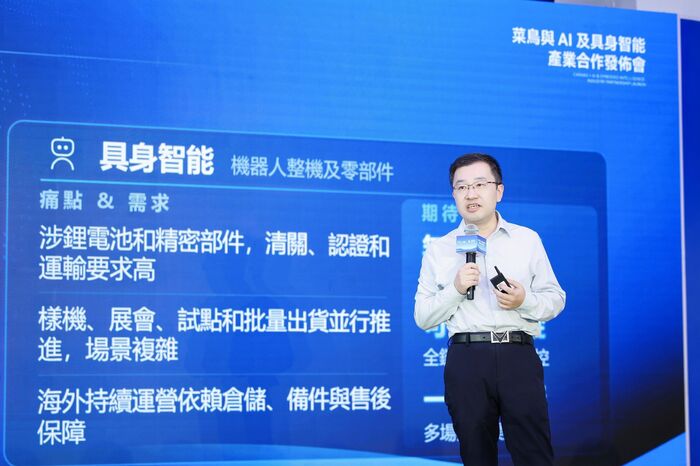
Xiong Wei, President of Cainiao International
This is not an empty slogan but the most direct response of the physical economy to the technology wave. In Alibaba Group's strategic blueprint, AI's potential in computing power and intelligence has over a thousandfold growth space in the future. Mapping this to the physical world, among the billions of workers globally, the penetration rate of professional robots currently stands at only a few hundred thousand units.
This means the growth engine for physical AI in real-world scenarios has only just started. In the next decade, embodied robots are expected to leap from tens of thousands to tens of millions of units, with productivity gains potentially reaching 10x or even 50x. Real, diverse, and large-scale business scenarios are replacing pure algorithm competitions as the core variable determining whether technology can be commercialized.
With its global supply chain network and millions of square meters of production-grade live warehouse networks, Cainiao is taking the lead in systematically advancing deep collaboration with the AI and embodied intelligence industries. This move is not only about the automation upgrade of the logistics industry but also about whether Chinese hard-tech enterprises can achieve scaled breakthroughs in high-barrier global markets.
01 Out of the Lab: Iterating Models on Real Battlefields
The maturity of any cutting-edge hardware technology cannot be separated from high-precision testing environments. For a long time, embodied intelligence and robotics companies have mostly relied on self-built simulation software or lab testing. This model is costly, has long R&D cycles, and cannot truly replicate the complex operating conditions of real business.
Warehouse logistics scenarios are the perfect touchstone for testing the generalization capabilities of physical AI. Here, the differentiated forms of massive SKUs, dynamically fluctuating high-concurrency orders, and highly complex operating environments place extreme demands on robots' visual recognition, hand-eye coordination, and path planning. The sense of friction brought by real physical environments is a hardcore test that virtual code in labs can never simulate.
Facing these industry pain points, Cainiao has chosen to fully open up its coverage of dozens of industries and hundreds of real operating scenarios to partners. From warehouse picking and intelligent navigation delivery to high-altitude inspection, security maintenance, and even auto parts management, Cainiao has built the world's largest real-scenario training cluster for AI and embodied intelligence logistics.
To make technology validation more feasible for deployment, Cainiao has decomposed complex logistics operations into tiers. In short-range repetitive tasks such as feeding and labeling, robots focus on centimeter-level precision and high stability—a area seen as the fastest entry point for commercial explosion; in mid-range precision tasks such as piece picking, millimeter-level hand-eye coordination is opening up market demand at the multi-million-unit level. As for longer-range tasks like container consolidation and complex palletizing, these test AI's long-sequence planning capabilities in three dimensions.
Moving from single-point operations to comprehensive coordination in complex scenarios, Cainiao opens real business battlegrounds to let tech companies' robot bodies iterate algorithms through actual rotation. This path of training physical AI with "real guns and live ammunition" in real operating conditions is significantly shortening the commercialization exploration cycle for Chinese embodied intelligence enterprises.
02 Going Global with Dimensional Reduction: Building "Three-Day Delivery for Tech Going Global"
If real-scenario training solves the question of "whether it can be used," then systematic global supply chain capabilities directly determine whether hard-tech products "can be sold globally." Currently, consumer robots, AI computing equipment, and embodied intelligence complete machines are collectively surging overseas, but traditional cross-border logistics infrastructure is already overwhelmed.
High-value AI computing servers have extremely high thresholds for transport stability and door-to-door white-glove delivery; powered and magnetic embodied intelligence prototypes are frequently blocked by customs compliance in multiple countries; and the explosive popularity of consumer robots demands extreme supply chain elasticity. The overseas competition of high-tech products appears to be a contest of product strength, but the underlying support is a systemic war over global supply chain compliance and delivery experience.
Based on this, Cainiao has deeply restructured its existing global express lines, global air freight, and global warehouse network to launch a "Three-Day Delivery for Tech Going Global" service for hard-tech enterprises. This product runs through the entire lifecycle of enterprises from early prototype testing and mid-stage small-batch validation to later-stage scaled overseas operations.
In the R&D testing and customer demonstration phase, global express lines support flexible multimodal transport—even a single prototype can achieve highly time-efficient end-to-end worry-free fulfillment; for large, high-value, and extremely precise AI computing equipment, global air freight provides customized white-glove services covering scheduled delivery, upstairs placement, and even unpacking handover; and in the large-scale localization phase, the global warehouse network helps enterprises achieve integrated management of regional stocking and local delivery.
Once, Cainiao redefined the standard for cross-border e-commerce logistics with "Global Three-Day Delivery." Now, Cainiao is extending this ultimate time efficiency and stable experience to the high-tech manufacturing sector. Making Chinese intelligent exports as efficient and simple as sending e-commerce parcels is becoming the core trump card for Chinese hard tech to build competitive advantages in global markets.
03 Leveraging Digital Intelligence Accumulation to Define the Underlying Ecosystem of Hard Tech
In fact, Cainiao's ability to take the lead in launching this deep co-building with AI and embodied intelligence enterprises is backed by more than a decade of technological accumulation and digital AI practice.
In the digital AI field, Cainiao has long been a deep beneficiary and technology driver. Currently, among the hundreds of thousands of export sellers served daily by Cainiao, 60% of merchant interactions and exception management are handled by AI digital employees; in customs declaration, AI's millisecond-level processing capability supports customs classification of millions of SKUs within 4 hours; and AI tracking agents handle 60% of daily cross-time-zone tracking work. Digital AI has brought Cainiao tens of millions in actual cost reductions annually, proving the enormous economic value of technology deployment in the physical economy.
Today, Cainiao has brought this ecosystem logic, rich in experience from the digital world, into the world of physical AI. Relying on localized technology integration capabilities in more than 25 countries and millions of square meters of warehouse networks, Cainiao has connected the full-chain closed loop from algorithm training and real validation to global delivery.
This collaboration is not a one-way opening of resources but a profound two-way empowerment. Embodied intelligence enterprises leverage Cainiao's scenarios to reduce R&D and global fulfillment costs; and the widespread application of tens of thousands of intelligent devices and cutting-edge physical AI in Cainiao warehouses continuously feeds back into Cainiao's own productivity efficiency. In the next decade, Cainiao hopes to achieve at least 50% robot-assisted operations in tens of thousands of frontline physical environments and increase single-unit productivity by more than 10x.
From a service provider for tech going global to a co-builder of the physical AI ecosystem, Cainiao is embarking on the underlying evolution of its infrastructure role. As the hard-tech wave sweeps the globe, enterprises that can provide physical hosting space and global delivery channels for cutting-edge technologies will ultimately become the foundational force defining the next industrial era.
Standing on the eve of the global hard-tech industry explosion, the combination of technological innovation and real-world scenarios has never been so tight. Every grasp and every navigation delivery of physical AI and embodied intelligence in the real world is a profound reshaping of traditional industrial forms.
Cainiao's opening of its global warehouse network and launch of tech-going-global infrastructure demonstrates a global logistics tech giant's keen insight into industry trends. By lowering validation thresholds and smoothing cross-border bottlenecks, Cainiao not only escorts Chinese hard-tech enterprises going global but also catalyzes a new productivity paradigm through collisions with real business.
As more and more Chinese intelligent manufacturing rushes overseas through this "global channel," a new hard-tech ecosystem driven by real-world scenarios and supported by global networks is accelerating into being. This is not only the beginning of Chinese technology releasing greater value in the physical economy but also an important milestone in the integrated evolution of the global logistics and technology industries.
Ebrun continues to track and report this intelligence. To learn more about this article, please scan the QR code to follow the author's WeChat.

This article was first published on the Ebrun official website.
[Copyright Notice] Ebrun advocates respecting and protecting intellectual property rights. Without permission, no one is allowed to copy, reproduce, or use the content of this website in any other way. If any copyright issues are found in the articles on this website, please provide copyright questions, identification, proof of copyright, contact information, etc. and send an email to run@ebrun.com. We will communicate and handle it in a timely manner.
Translated by AI. Feedback: run@ebrun.com