
AllyNext Debuts at Cross-Border E-Commerce AI Summit as First AI Digital Assistant Built for Multi-Platform Cross-Border Sellers
【Ebrun Original】Recently, the first FastMoss China Cross-Border E-Commerce AI Summit and AllyNext New Product Launch concluded in Shenzhen. The event brought together leading Chinese investors, overseas top sellers, brands, and industry institutions and other cross-border e-commerce ecosystem stakeholders to discuss how AI is entering cross-border operations and changing the way teams work. The summit was exceptionally well attended: originally planned for 500 people, registrations ultimately exceeded 1,700.
One of the core outcomes of the event was the official launch of AllyNext as the first AI digital assistant for cross-border e-commerce.
At the launch, AllyNext & FastMoss founder Shi Wenlu took the stage and delivered a speech: "Leveraging the company's industry strengths in the United States and China, AllyNext has spent five months building an underlying long-range memory, a proprietary vertical model for cross-border e-commerce, a proprietary data foundation, and a knowledge base that can be shared and accumulated within seller companies. What we want to do is become the cross-border assistant agent for global e-commerce sellers."

According to the on-site introduction, before its official launch, more than 100 customers had already participated in beta testing. Centered on cross-border operations, AllyNext combines industry data, Skills, digital assistants, a knowledge base, and long memory. Operations staff can organize their own working methods into SOPs, specifying what materials are needed, in what steps to execute, and what standards to meet, and then create corresponding skills and assistants.
Specifically, AllyNext targets multiple constraints facing organizational capability and intelligent development in cross-border e-commerce operations:
long hiring cycles, high training costs, and slow onboarding for new employees, which affect team turnover rhythm;
the difficulty of converting professional experience accumulated by top employees into enterprise data assets and organizational assets, with experience lost whenever staff leave;
existing general-purpose large AI models are oriented toward general scenarios and lack professionalism in cross-border e-commerce, lacking cross-border e-commerce-specific underlying models and e-commerce data support, and are complex to operate with high configuration barriers;
the AI tools used by employees are scattered, making it difficult to consolidate them into a unified knowledge system, brand tone, and business cognition boundaries, and impossible to accumulate them as enterprise-level digital assets; multi-platform operations still rely on professional staff and repeated training, and business cognition remains difficult to decouple from dependence on manpower.

Addressing the above pain points, AllyNext has built targeted core capabilities.
It supports users in creating professional cross-border e-commerce digital assistants (Agents) through natural language dialogue, and is equipped with multiple professional Skills and MCPs that highly match the cross-border e-commerce business ecosystem, covering product selection, content, data, store operations, and other links.
In addition, AllyNext changes the way cross-border teams accumulate experience. It supports AI in automatically accumulating the professional experience and practical playbooks of a company's top employees, building data assets, and better empowering other employees. This function relies on AllyNext's core component—long memory of users' business preferences.
At the same time, AllyNext's knowledge base and the Context in conversations can also form context management, creating a company's unique tagging system and cognition boundaries, and ensuring that when AI is invoked, business terminology and brand tone are aligned and constrained across the entire staff.
At the launch event, Shi Wenlu demonstrated applications in multiple typical seller scenarios, such as multi-platform real-time data analysis and product selection, product title writing, one-click generation of listings and e-commerce images, TikTok script breakdown, video generation, influencer screening and outreach, and more.
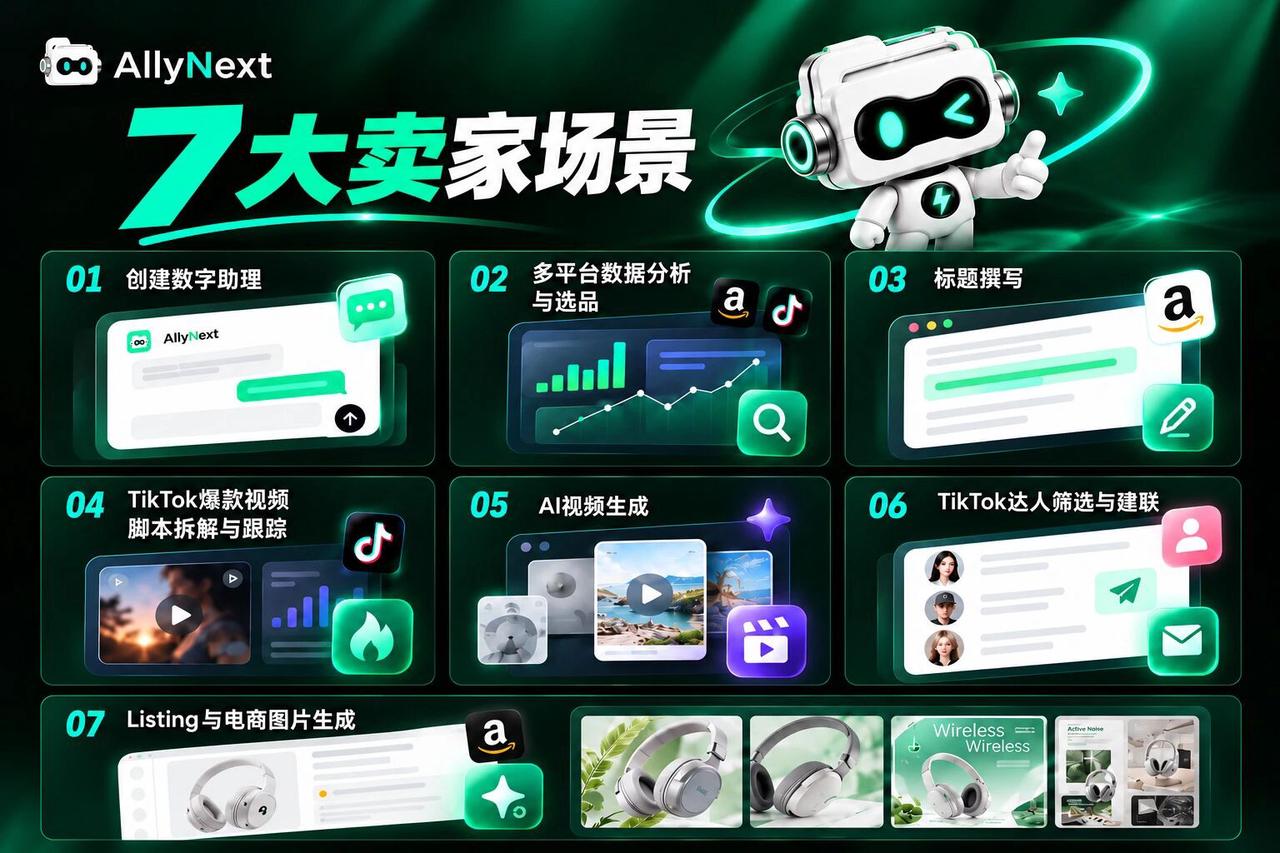
"Many sellers use AI tools to write titles. But you'll find that even titles written by ChatGPT, although very flashy, don't even know basic red lines like Amazon's title character limits. AllyNext's difference is that the titles it writes understand your business. After using it once, the next time you enter, you don't need to tell it who you are, and you don't need to tell it which brand you are; it can automatically generate practical titles. Because our knowledge base, context, and Context have already managed that for you," Shi Wenlu said, using title generation as an example to explain AllyNext's unique value in specializing in cross-border e-commerce operations scenarios.
"We hope to let sellers reproduce what they did right in the right way at the right time," he said.
At the event, Shi Wenlu also shared many views on how AI will change the future landscape of the cross-border e-commerce industry.
"Q&A is accumulation; collaboration is empowerment." He pointed out that AI will reshape corporate internal governance models. "Every conversation in an AI tool should be accumulated into an individual's digital assets and the company's digital assets. In the future, collaboration among people, between people and AI, and between departments within a company will all become a process of one individual empowering another, ultimately leveling up the common collaboration standards of practitioners within the organization."
Regarding industry competition, Shi Wenlu noted that the dramatic changes AI has triggered on the consumer side will quickly transmit to the supply side and sellers' organizational methods on the business side.
"There will be huge changes in the next two years. Whether sellers can survive the competition will definitely no longer depend on single-point advantages like 'doing well on Amazon,' 'doing well on TikTok,' or 'doing well in the U.S. market,' but on whether they can seize the brief window and use AI tools to restructure their organizations, activate internal digital assets, and leverage sustainable compound growth," he said. "When companies truly use AI, you'll find that what AI brings is not a simple equalizing effect, but rather a widening of the gap between those who truly understand AI and those who do not."
At the summit, Ebrun also interviewed Xiao Xiang, a specially invited guest of the summit and a top seller across multiple categories on Temu. From a seller's perspective, he shared his views on how AI applications will profoundly affect the cross-border e-commerce industry.
"From a historical cycle perspective, this is a generational shift in the means of production. What sellers need to do is embrace the change and thoroughly understand it. Precisely because AI is still in an early stage of rapid growth and many applications are not yet mature, startups have the opportunity to overtake on the curve. If the industry were very mature, startups would instead have no opportunity," he said. "Without AI's sudden emergence, I might not have stepped out to start a business in a different industry, and the company could not have quickly risen to become a top seller with very few staff."
On the other hand, he also offered his expectations for productivity tools represented by AllyNext.
"Most AI Agent products today still have problems understanding context, so sellers are not yet very comfortable letting AI take charge of key decisions involving sensitive data, such as how much profit a product should retain or whether tax filing processes can be automated. Such matters still need dedicated people to handle them, and dependence on real employees remains significant," Xiao Xiang acknowledged. "In the future, if AI tools have larger context memory windows, sufficiently high reuse efficiency of a company's historical data, and stronger comprehensive decision-making capabilities, many tasks can be handed over to them; for advanced productive capacity, we are also willing to pay higher subscription fees, and even benchmark AI technology costs against ordinary labor costs."
In response to sellers' demands for continuous evolution of AI tools, AllyNext officials also revealed that AllyNext's model is currently trained independently based on cross-border e-commerce data. Next, it will invest hundreds of millions of yuan to continuously train cross-border e-commerce-specific models and strengthen capabilities in areas such as long-range memory, long-range tasks, and RSI to help more sellers optimize operations.
Ebrun will continue to track and report on this intelligence. If you want to learn more information related to this article, please scan the QR code to follow the author's WeChat.

This article was first published on the official website of Ebrun.
[Copyright Notice] Ebrun advocates respecting and protecting intellectual property rights. Without permission, no one is allowed to copy, reproduce, or use the content of this website in any other way. If any copyright issues are found in the articles on this website, please provide copyright questions, identification, proof of copyright, contact information, etc. and send an email to run@ebrun.com. We will communicate and handle it in a timely manner.
Translated by AI. Feedback: run@ebrun.com