
Taking on the 2026 Black Friday Shopping Season: What Killer Moves Are Cross-Border E-Commerce Platforms Deploying?
The 2026 year-end cross-border e-commerce shopping season, centered on Black Friday, has kicked off. While major cross-border e-commerce platforms differ in their event schedules, the common trend is to link multiple nodes and extend the cycle. For example, AliExpress's Double 11 is closely connected to Black Friday; TikTok Shop has created three consecutive peaks—Black Friday, Thanksgiving, and Christmas; SHEIN's year-end shopping season also covers multiple nodes including Double 11, Black Friday/Cyber Monday, and Double 12.
To seize the biggest business explosion opportunity of the year-end, major platforms began laying out their strategies months in advance, but in this long-distance race, discounts, subsidies, and traffic support have long been merely basic equipment. To this end, Ebrun reviewed the differentiated priorities of some cross-border e-commerce platforms in this year's Black Friday shopping season, to see how they will lead merchants to achieve new incremental growth.
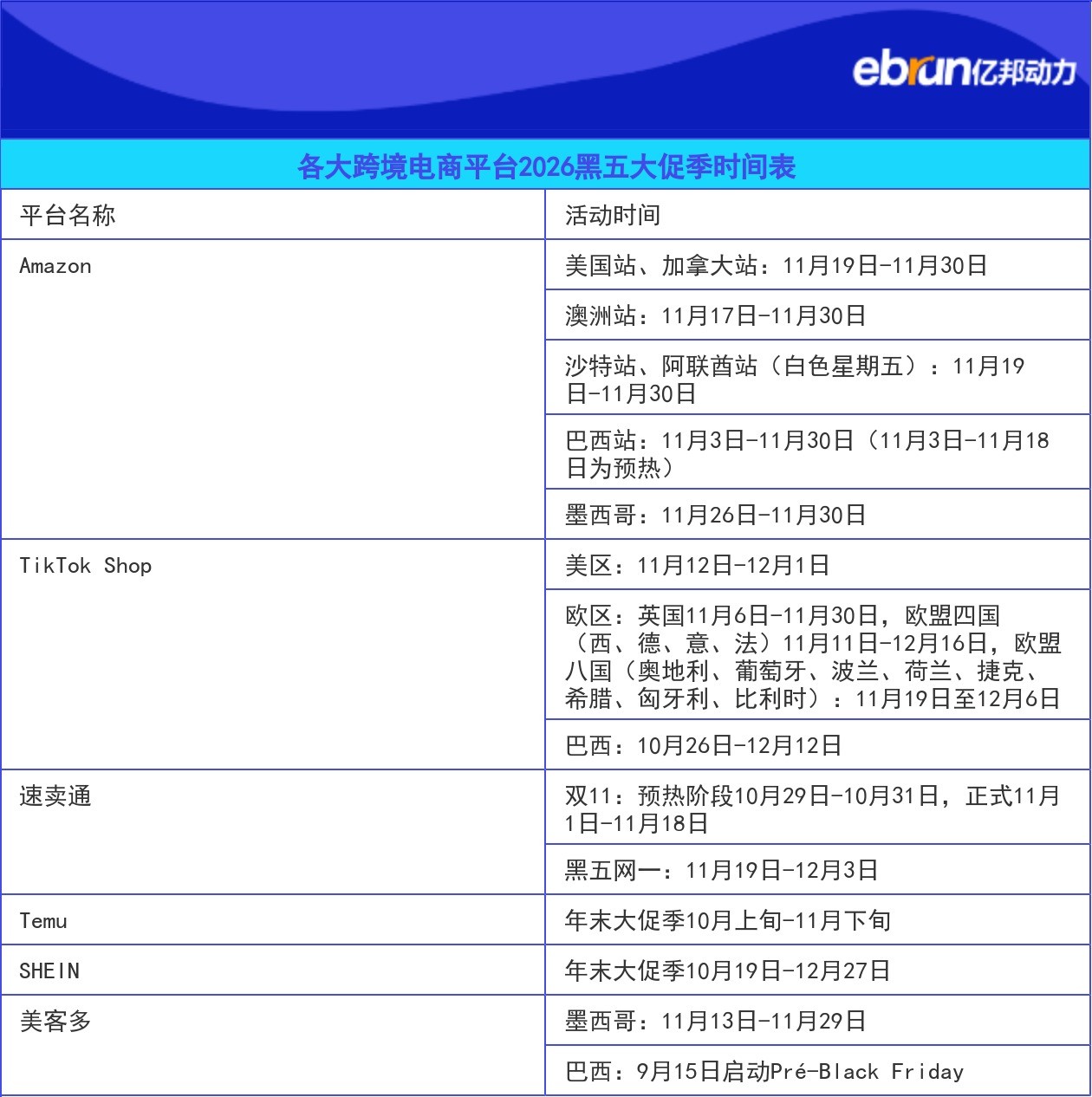
| 2026 Black Friday Shopping Season Timetable for Major Cross-Border E-Commerce Platforms | |
| Platform Name | Event Time |
| Amazon | US site, Canada site: November 19 - November 30 |
| Australia site: November 17 - November 30 | |
| Saudi Arabia site, UAE site (White Friday): November 19 - November 30 | |
| Brazil site: November 3 - November 30 (November 3 - November 18 is the warm-up period) | |
| Mexico: November 26 - November 30 | |
| TikTok Shop | US: November 12 - December 1 |
| Europe: UK November 6 - November 30, EU four countries (Spain, Germany, Italy, France) November 11 - December 16, EU eight countries (Austria, Portugal, Poland, Netherlands, Czech Republic, Greece, Hungary, Belgium): November 19 to December 6 | |
| Brazil: October 26 - December 12 | |
| AliExpress | Double 11: warm-up phase October 29 - October 31, official November 1 - November 18 |
| Black Friday/Cyber Monday: November 19 - December 3 | |
| Temu | Year-end shopping season: early October - late November |
| SHEIN | Year-end shopping season: October 19 - December 27 |
| Mercado Libre | Mexico: November 13 - November 29 |
| Brazil: launched September 15, Pre-Black Friday | |
Amazon: Easing pressure on merchant preparation, AI shopping assistant drives consumption side
On the merchant preparation side, Amazon this year extended the promotion submission window for Black Friday/Cyber Monday from October 20 to November 13; at the same time, the international FBA inbound defect fee policy was temporarily optimized, extending the automatic shipment closure window from 75 days to 90 days, and the warehouse arrival window for associated shipments from 30 days after the first item is received to 45 days. After the adjustment, sellers no longer need to worry excessively about inbound defect fees triggered by logistics delays, and can prepare inventory more confidently amid peak-season capacity fluctuations.
On the consumer side, in addition to regular operations such as Lightning Deals, Best Deals, and Prime member exclusive discounts, Amazon chose to extend the after-sales period to safeguard the consumer shopping experience. For products purchased in November and December on the US site, the return deadline can be extended all the way to January 31 of the following year.
Amazon's newly upgraded AI shopping assistant Alexa for Shopping will also play an important role in the Black Friday/Cyber Monday shopping event. For example, Alexa for Shopping can track historical prices, monitor product discount and price reduction dynamics, and also support over a hundred shopping operations such as new product release information notifications and holiday list creation and management, helping consumers save money while also saving time.
The shopping event is not only for C-end consumers; Amazon also reserves separate promotional resources for business sellers. With Amazon Business Deals, sellers can create limited-time offers visible only to B2B customers, and during the Black Friday/Cyber Monday node, discounts can reach as low as 15%.
TikTok Shop: Amplifying multi-domain advantages in the US, tiered support for merchants in Europe
The shopping event design breaks away from the single-peak model, the fully managed Black Friday shopping season covers 16 country markets for the first time, and hundreds of millions in resources are invested in multiple regional markets... TikTok Shop this year is determined to seize the Black Friday business explosion opportunity, providing corresponding strategies for fully managed and cross-border POP merchants respectively, with different site layouts having different priorities.
In the US, the platform has deployed hundreds of millions in marketing resources, setting an upgraded playbook of "multi-domain multiplication, three-wave explosion, brand breakthrough." Among these, expanding quality content supply to achieve multi-domain multiplication is placed first, with various content formats such as influencer livestreaming, livestream auctions, and merchant graphics and text concentrating their efforts during Black Friday. For brand merchants, the platform invests tens of billions of on-platform impressions and hundreds of millions of US dollars in support, focusing not only on sales volume but also on building brand mindshare.
Specifically, the US cross-border POP Black Friday playbook covers six aspects: products, livestreaming, video and graphics, hotspots, advertising, and brands. This year, livestreaming new product launches in the US are particularly noteworthy; for example, the livestream auction format launched in the first half of the year will also be a highlight of Black Friday. At the same time, on top of the auction format, group buying and bargaining features were added before Black Friday to improve conversion. In addition, the platform launched for the first time a dedicated influencer livestream BAP (Brand Amplification Program) plan, providing merchants with additional influencer livestream incentives to make livestream explosions more certain.
In Europe, the platform covers 13 European markets and invests billions in resources to launch the "Pilot Program," providing tiered support based on different growth stages of POP merchants. Merchants in the new merchant cold-start period, growth period, and mature period will respectively receive direct commission reductions, monthly incubation resource packages, cash rebates, and dedicated accompaniment services.
Facing Europe's complex compliance environment, the platform launched a "compliance gift package," using front-loaded guidance to shorten sellers' compliance trial-and-error costs. In addition, under the trend of merchants operating in multiple countries, the "Pilot Program" supports US merchants to expand into the UK and European markets with one click, and opens influencer interoperability capabilities, so that content assets originally in the US can be reused in Europe, reducing cross-market replication costs.
In comparison, Latin American market shopping event playbooks are more direct. In Brazil, the platform invests 100 million reais (about 120 million RMB) in coupon subsidies; in Mexico, it integrates the local shopping festival and Black Friday shopping event into a Super November event.
AliExpress: Traffic investment expansion, localization strategy leverages growth
AliExpress is pursuing a multi-pronged approach in traffic exposure, user subsidies, and merchant incentives. During the shopping event, the platform plans to collaborate with over 70,000 creators to secure over 1 billion online impressions in more than 45 countries. Traffic delivery adopts a dual-line approach of on-platform and off-platform: on-platform, it builds an AI intelligent delivery system and upgrades "One-Stop Push"; off-platform, PPC ad spend increases by 30% year-on-year, AI refined delivery capabilities are upgraded, and it has reached a global strategic partnership with YouTube, joining the "Shopping Alliance Program" to expand traffic sources.
In terms of offline exposure layout, AliExpress will use outdoor advertising, multi-city tours, business district pop-ups, event sponsorships, and other methods to immersively create a shopping event atmosphere. Facing different markets, AliExpress will set playbooks tailored to local conditions. For example, in South Korea, it uses interactive lotteries to stimulate consumption and lands a pop-up store in Seoul. In addition, the Americas are regarded as this year's core growth engine.
The three major segments—brands, overseas hosting, and EU—will see strategy upgrades during the year-end shopping event. The platform will use top 100 super brands to promote dissemination, increase overseas hosting investment by 20%, and lean toward warehouse shipping and local sites. Furthermore, to help sellers reduce the impact of European tax reforms, AliExpress adopts methods such as borrowing duty-free shops and tax reduction coupons.
Beyond platform support, sellers also face platform assessments. The comprehensive experience impairment rate and the 30-day SAND dispute rate are included in the assessment scope, with the platform-set standards being that the former cannot exceed 40% and the latter cannot be higher than 3 times that of similar category products.
SHEIN: Increasing semi-managed merchant recruitment
Facing a shopping event front lasting more than two months, SHEIN splits its year-end shopping event into three phases, launching special events at the Double 11, Black Friday, Cyber Monday, and Double 12 nodes, so sellers no longer need to bet on event traffic at a single point and can flexibly prepare inventory according to the event rhythm.
In terms of merchant recruitment and support, SHEIN currently focuses more on semi-managed. The recently launched year-end shopping event semi-managed new merchant rapid onboarding plan supports semi-managed new merchants in five aspects: onboarding, warehousing, operations, inventory preparation, and fulfillment. Under the platform's full-cycle growth support, new merchants can open a store in as fast as 3 days, complete operational closed-loop accompaniment in 14 days, lower inventory preparation thresholds, improve inventory preparation precision, and shipping subsidies also reduce seller costs, so merchants can catch the shopping event dividend even with zero experience.
Not only new merchants; SHEIN's shopping event support policies are also leaning toward "excellent" ones. Brand merchants, as high-quality merchant resources, can have an independent onboarding portal, with dedicated account managers accompanying the entire chain of onboarding and brand incubation. Onboarded brand merchants have a separate registration entrance for the shopping event Brand Carnival Week, and can also receive greater subsidies in the dedicated brand marketing channel. For high-demand products, trend products, and other quality products, the platform will open a dedicated submission entrance, and upon approval, they can receive traffic support for up to 7 days.
Beyond financial subsidies and traffic resources, AI technology is also embedded in SHEIN's shopping event to lower operational thresholds. SHEIN's "Business Advisor" product can visualize core quantitative indicators of "people-goods-scenes," and after integrating intelligent diagnosis and action empowerment, it can quickly diagnose and gain insight into the traffic and conversion performance of products in the same price band, discover potential single items, and improve operational efficiency.
Shopee: Competing on fulfillment capability in Brazil, opening new seller resources in Southeast Asia
Issuing coupons, recruiting people, expanding capacity—Shopee is continuously deepening its cultivation of the Brazilian market. On discounts, Shopee will issue 25 million reais in discount coupons on Double 11 and invest 23 million reais on Black Friday, totaling 48 million reais (about 58 million RMB), an increase of over 30% compared to last year's 36 million reais investment.
The Brazilian peak-season competition is also extending to logistics fulfillment; Shopee says it will recruit over 14,000 people in Brazil, mainly for logistics frontline, to safeguard capacity. Logistics infrastructure is also keeping pace; the platform has newly opened four distribution centers in Brazil and will expand the operating area of one distribution center in S?o Paulo state threefold, adding about 2.4 million parcels processable per day. After the layout is completed, Shopee's total distribution centers in Brazil will reach 30, and compared to last year's November peak season, this year's order processing capacity is expected to increase by over 60%.
In Southeast Asia, Shopee is also absorbing content e-commerce seller resources, releasing the "New Channel Plan" to help quality sellers expand shelf e-commerce incremental growth, with dedicated incentives for each country site. In the Singapore site with strong purchasing power, Shopee extends the new store commission-free benefit from three months to six months, supports seller self-broadcasting, influencer livestreaming, and source livestreaming, issues shopping event exclusive joint coupons, and launches the "Shopee VIP Buyer Program" to help sellers reach quality consumers at more favorable prices.
In addition, Shopee Affiliate Marketing (AMS) launches new playbooks: targeted commission campaigns make influencer cooperation more precise and efficient; Meta affiliate ads continue to amplify content value and increase exposure and conversion opportunities; combined with practical tools such as open commission Plus and sample purchase refunds, they can further improve the effectiveness of ad delivery.
Mercado Libre: Heavy bet on logistics fulfillment network, on-platform and off-platform marketing linkage
The local e-commerce platform entrenched in Latin America, Mercado Libre, this year's Black Friday shopping season invests a total of 57 billion reais in Brazil, focusing on expanding its logistics network. By the start of Black Friday, the total number of large warehouse outlets will reach 72, and new outlets will penetrate deep into Brazil's interior, shortening delivery times in remote areas. The platform has also upgraded its express delivery service, with some areas in S?o Paulo able to achieve delivery within 60 minutes after placing an order. In Mexico, Mercado Libre's first intelligent robotic fulfillment center also went into operation before Black Friday.
On the traffic side, Mercado Libre integrates all-channel marketing resources in Brazil, providing content marketing and off-platform promotion opportunities for quality products. Platform joint discounts amplify price advantages while helping products secure multiple exposures, leveraging platform traffic to enhance comprehensive product competitiveness.
Temu: Absorbing off-platform traffic through influencer promotion program
As the first platform to start running in this year's year-end shopping season, Temu, in addition to setting tiered discounts, also leverages the shopping event to promote its original influencer program. Temu's program mainly targets creators on major social media platforms. Since consumers will intensively search for products during the shopping event period, creators promoting Temu products on content platforms during Black Friday can earn commissions of up to 55%, thereby helping the platform bring in off-platform traffic.
This article was first published on the Ebrun official website.
[Copyright Notice] Ebrun advocates respecting and protecting intellectual property rights. Without permission, no one is allowed to copy, reproduce, or use the content of this website in any other way. If any copyright issues are found in the articles on this website, please provide copyright questions, identification, proof of copyright, contact information, etc. and send an email to run@ebrun.com. We will communicate and handle it in a timely manner.
Translated by AI. Feedback: run@ebrun.com