
Qianfeng Interview with Zhang Xiaokun of Zhaogang.com Group: Industrial AI Powers Global Supply Chain Services
【Ebrun Original】Zhang Xiaokun is a managing partner and vice president of Zhaogang.com Group. Zhaogang.com Group is a leading industrial AI service platform in China, with annual platform transaction volume exceeding RMB 150 billion, and its e-commerce, logistics, software subscription and other businesses have long ranked first in the industry. Currently, Zhaogang's monthly large model calls exceed 8 million, Token consumption exceeds 50 billion, and more than 1,400 AI agents automatically execute over 600,000 business tasks each month; in the first half of 2026, AI business directly drove over RMB 1.1 billion in GMV, with overseas revenue share exceeding domestic for the first time. In this Qianfeng Award interview, Zhang Xiaokun shared Zhaogang's practices and judgments around "modal evolution brought by AI and going global."
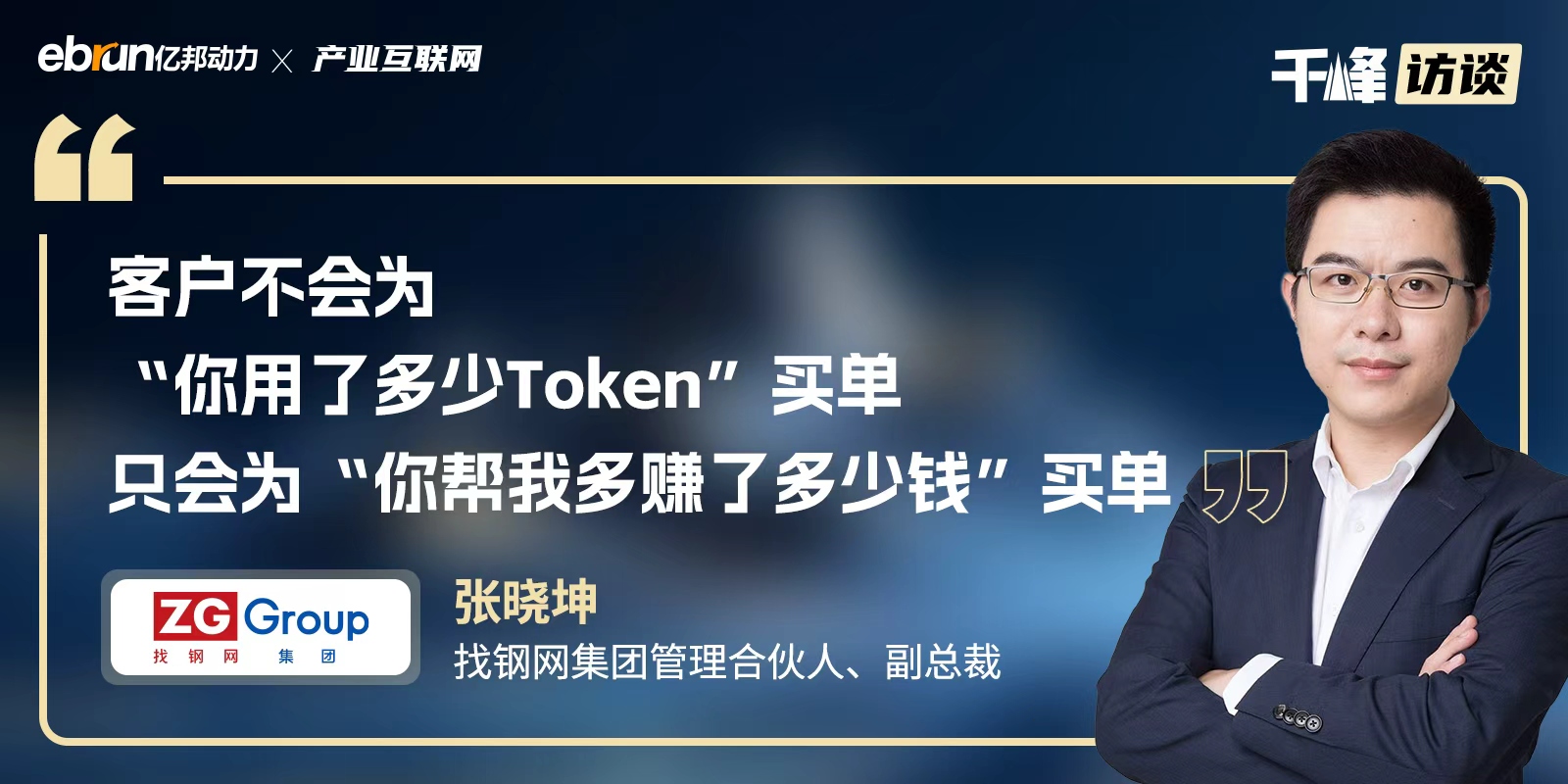
Ebrun: This Qianfeng Award takes "modal evolution brought by AI and going global" as its core theme, focusing on the deep restructuring of industrial capabilities. Combining AI applications with the steel trade circulation industry, how do you understand this round of industrial modal evolution jointly driven by AI and globalization? What are Zhaogang's core strategic layouts? Could you introduce the company's positioning and business model?
Zhang Xiaokun: Zhaogang.com Group's mission is to "connect every link of trade circulation with AI," and its positioning is as a leader in industrial AIization. The essence of this round of modal evolution is that AI has changed from "a tool that assists people" into "productivity that directly does the work"—in the trade circulation industry, a large number of links that rely on person-to-person communication, confirmation, and handoff can, for the first time, be taken over by agents. My biggest and most firm feeling this year is: the stronger the model, the more important the industry becomes. As the capabilities of general large models become increasingly homogenized, and computing power, algorithms, and foundation capabilities are all similar, what truly creates differentiation are three things beyond the model: real industrial scenarios, high-quality closed-loop data, and industry know-how accumulated over many years.
Our strategy is to use our self-developed industrial ontology distiller to continuously clean, distill, and accumulate fourteen years of transaction, communication, fulfillment, and operations data, forming a dynamically evolving industrial ontology graph, and transforming it into reusable Skills, MCPs, and Agentic workflows, driving full-process AIization of the trade circulation industry. There is a key prerequisite here: a high-quality dataset suitable for AI must be closed-loop. Zhaogang is a typical dialogue-driven B2B enterprise, where inquiries, bargaining, and customer relationship negotiations largely take place in IM conversations—information flow comes first, then trade flow. We have connected the IM chat information flow with the industrial trade flow, continuously feeding process information hidden in conversations into the ontology distillation pipeline, supplying agents with complete context. During the reporting period, core digital assets such as AI Agents have begun work on balance sheet recognition, and the group has formed digital assets exceeding RMB 7.759 million.
In terms of products, there are two AI product lines: Zhaogang Lobster serves steel trade circulation enterprises, implemented step by step according to the "five-step method"—three expert roles in business management, business knowledge, and business back-office, plus two modules for sales automation and back-office automation; NextB2B is jointly produced by Zhaogang.com Group and Tencent WorkBuddy, targeting B2B trading enterprises in non-steel industries, providing four AI experts in sales, procurement, back-office, and operations, and is an out-of-the-box AI business workbench. We firmly believe that "joint operations of real people and Agents" will become the organizational standard for all B2B enterprises.
Ebrun: In which core business links has your company currently implemented AI/large model technology? What distinctive AI or digital-intelligence competitiveness system has been formed?
Zhang Xiaokun: We have formed a complete system ranging from internal business intelligence, dynamic evolution of the industrial ontology, to productized output of AI capabilities. These three layers are not a simple stacking of technologies, but a mutually reinforcing, continuously evolving closed loop.
The first layer is the comprehensive intelligence of Zhaogang's own trading platform.
We chose to start from the most complex full-process B2B transaction, letting AI truly enter the business. As of June 30, 2026, Zhaogang Lobster processed more than 19 million pieces of information per day based on AI large models, with parsing accuracy exceeding 95%; it had cumulatively automatically generated and sent more than 1.35 million business documents, processed nearly 6.33 million payment and receipt orders; integrated 286 warehouses, automatically processed more than 107,000 receipt confirmations, completed nearly 190,000 vehicle qualification reviews, and more than 710,000 logistics monitoring operations.
In core middle- and back-office links such as document processing, fund settlement, risk control, and warehousing, efficiency improved by more than 60%. A large amount of repetitive, rule-based work is handed over to AI, while people take on more exception handling, complex decision-making, and customer relationship maintenance.
The second layer is letting real business data continuously and dynamically drive the evolution of the industrial ontology, which then feeds back into the trading platform. This is what we consider our most core and hardest-to-replicate competitiveness.
Over fourteen years, Zhaogang has accumulated hundreds of millions of transaction dialogue samples and millions of full-process closed-loop transaction data. But data scale does not equal AI capability; the key is how to transform continuously generated business data into industrial knowledge that AI can understand and execute.
To this end, we self-developed the industrial ontology distiller, which continuously cleans and distills newly added daily process data such as inquiries, quotations, transactions, fulfillment, and customer communication, accumulating them into a dynamically updated industrial knowledge graph and business ontology. In particular, by connecting IM information flow with transaction flow, industry experience, trading rules, and business logic that were previously scattered in chat records are transformed into capabilities that Agents can call.
More importantly, this is not one-time model training, but a continuously operating feedback mechanism. AI participates in real business, business generates new data, data drives the evolution of the industrial ontology, and the evolved capabilities then feed back into the trading platform, enabling AI to handle more complex tasks and cover more business scenarios.
The third layer is packaging AI capabilities verified by real business into out-of-the-box standardized products.
On the basis of the first two layers, we launched Zhaogang Lobster and the NextB2B AI business workbench, integrating industrial data, business ontology, and Agent capabilities, so that more enterprises can directly apply them to actual business without building AI systems from scratch.
The five modules of Zhaogang Lobster correspond to real job actions in steel trading enterprises. NextB2B further extends the capabilities to more B2B industries. At present, this capability has been validated in industries such as electronic components, achieving intelligent matching of hundreds of millions of SKUs.
I believe that in the future, competition in industrial AI will not be competition among individual models or individual agents, but competition among entire industrial intelligence systems. Enterprises that are the first to achieve deep integration of data closed loops, business ontologies, and Agents will have the opportunity to achieve leapfrog development in this round of industrial change.
Ebrun: Could you share one of the most representative "AI value chain" innovation practice cases? What common industry pain points did it solve, and what perceptible, quantifiable value did it create?
Zhang Xiaokun: The most representative case is a leading pipe and tube steel trader in Tianjin. Steel pipe inquiries have three common industry problems: specifications are written in wildly varied ways, inquiries flood in from all directions on WeChat, and if quoting is one beat slow, the order is gone. After the customer adopted Zhaogang Lobster, through a one-customer-one-group service approach, the automatic quotation rate for complex products reached 76%; from first inquiry to proactive renewal took only 80 days, during which seven rounds of service interactions were completed and several real business problems were solved. The customer was willing to proactively renew because AI was genuinely doing the work for them.
Ebrun: How do you view industrial agents rewriting B2B? Is there a long-term need for vertical large models? Where is the AI moat of industrial internet companies?
Zhang Xiaokun: Let me answer the sharpest question first: is there a need to long-term self-develop vertical large models? My answer is clear—self-develop what should be self-developed, leverage what should be leveraged; understanding the boundaries is more important than blindly building wheels. In June 2026 we made a key decision: rely on mature Agent platforms to solve 80% of general needs, and focus the team on tackling the 20% of high-level industry challenges. We should make electrical appliances, not build generators or lay national power grids—AI is "electricity," electricity is someone else's business, and electrical appliances are ours.
The moat is not in the model, but in three things. The first is data: hundreds of millions of transaction dialogue samples and millions of full-process closed-loop transaction data accumulated over fourteen years constitute a "digital mirror" of the steel industry; whether public-domain placement or private-domain operations, B2B ultimately lands on IM communication, and we have connected the most core "process data" through WeCom—this is real-time, high-frequency data that general large models cannot obtain. The second is scenario-based workflows: general Agents are like Leica cameras, powerful but high-threshold; our products are point-and-shoot cameras, preconfigured with industry frameworks and trading logic, so customers can implement them with simple configuration; NextB2B goes further, preconfiguring task flow between roles—customer inquiry, AI sales order taking, back-office order creation, supervisor approval, ERP write-back, logistics booking, with one action triggering an entire chain. The third is distillation of industry know-how: we use the historical data of top traders to train AI, generate reply drafts, and then have traders review and score them before iterating the model—this is not something money can buy, but something earned through time.
But I believe the deeper change industrial agents bring to B2B is giving traditional enterprises the opportunity to achieve "leapfrog evolution."
In the past, we believed traditional B2B enterprises had weak information technology foundations and needed to go through the long construction cycle of informatization, digitalization, and intelligence in sequence. But in the Agent era, this path may be rewritten. Industries such as steel, chemicals, electronics and electrical, and logistics forwarding are essentially dialogue-driven businesses. As long as these process data can be connected, combined with industry know-how and Agent capabilities, enterprises have the opportunity to bypass some traditional system-building links and directly establish AI-native business processes.
This means that what looked like a weakness—a weak informatization foundation—may not still be a disadvantage in the AI era. What truly matters is no longer who has built more systems, but who can transform real business data into capabilities that agents can understand, execute, and continuously learn from.
Ebrun: Which overseas markets has Zhaogang International currently entered? What core support do AI and digital capabilities provide for cross-border business?
Zhang Xiaokun: Zhaogang International has entered markets including the UAE, Saudi Arabia, Thailand, Malaysia, and Indonesia, cooperating with overseas subsidiaries of central and state-owned enterprises to supply steel and MRO products, and has participated in projects such as the China-Thailand High-Speed Railway, Thailand's Laem Chabang Port, and a Malaysia logistics center. In the first half of 2026, international business revenue was RMB 576 million, up 70.10% year on year, of which Southeast Asia contributed RMB 422 million, up 115.42% year on year; overseas revenue share reached 55.5%, exceeding domestic for the first time.
The support from AI and digitalization is most concretely reflected in two points. First, capturing the supply chain increment brought by global AI computing infrastructure—in the first half of the year we served 27 computing center projects and added 14 new ones, with project revenue up 260.2% year on year, and supply categories expanded from steel to six major mechanical and electrical categories including intelligent electrical equipment, precision valves, and high-grade pipes. Second, using digitalization to flatten the complexity of cross-border fulfillment—customs declaration, logistics, settlement and other multiple links have achieved node digitalization, allowing overseas teams to achieve efficiency even with few people.
Ebrun: Could you introduce the iteration of Zhaogang.com's AI profit model? How do you view the evolution trend of profit models for industrial internet enterprises? How can Token payment become a standard industry revenue model?
Zhang Xiaokun: We have currently formed three AI commercialization charging models: outcome-based payment, annual subscription, and Token usage-based payment.
The first is outcome-based payment. This is currently the most important commercialization model. Taking the AI trading mall and Zhaogang Industrial Products as examples, we charge service fees based on the actual transaction GMV facilitated or matched by AI. This is the easiest way for customers to accept industrial AI commercialization.
The second is annual subscription. For steel trading enterprises, we provide subscription services of "agent foundation + functional modules" through Zhaogang Lobster; for non-steel industries, NextB2B adopts the model of "WorkBuddy official standard version + Zhaogang industry expert value-added services." This model allows AI to further enter enterprises' daily operating processes from single transaction services, forming a continuous service relationship.
The third is Token usage-based payment. Our annual subscription packages already include a certain quota of Tokens and credits; after customers use up the basic quota, they can pay extra according to actual consumption. As Agents move from simple Q&A to complex task execution, enterprises' frequency and depth of use of AI capabilities will increase, and Token will gradually become an important billing dimension for industrial AI services.
But can Token payment become an industry standard? My judgment is: yes, but only on the premise that it must be tied to business value, rather than simply charging based on computing power consumption.
For B2B enterprises, customers will not be willing to pay just because an Agent consumed a certain number of Tokens; what they really care about is how many tasks AI completed, how much efficiency it improved, and how many trading opportunities it created.
This commercialization path has already been preliminarily validated in our actual business. In the first half of 2026, Zhaogang's AI business GMV reached RMB 1.105 billion, up 73.2% year on year; AI business gross profit exceeded RMB 13.3 million, up 63.4% year on year.
As an annual bellwether in the TO B field, the "2026 8th Ebrun Industrial Internet Annual Conference and First Industrial Agent Conference" will be held in Beijing on November 20, 2026. The theme is set as "modal evolution brought by AI and going global," focusing on in-depth deliberation of frontier topics such as industrial agent implementation, AI supply chain value reconstruction, data elements and the TOKEN economy, and new ecosystems for industrial going global. The conference will gather academic authorities, central and state-owned enterprise benchmarks, industrial leaders, investment institutions, and service ecosystem partners, bringing together core industry forces, unpacking the path of industrial digital-intelligent transformation, and sharing frontier practical experience. In parallel, the annual industrial internet report and benchmark cases will be released, and a decision-makers closed-door meeting and the "Qianfeng Award" awards ceremony will be held.

This article was first published on the Ebrun official website.
[Copyright Notice] Ebrun advocates respecting and protecting intellectual property rights. Without permission, no one is allowed to copy, reproduce, or use the content of this website in any other way. If any copyright issues are found in the articles on this website, please provide copyright questions, identification, proof of copyright, contact information, etc. and send an email to run@ebrun.com. We will communicate and handle it in a timely manner.
Translated by AI. Feedback: run@ebrun.com