
Temu Reconnects European Business with Forward Warehouses: The Last Stand for Fully-Managed Sellers?
By Wang Yu | Edited by He Yang
[Ebrun Original] Since the EU's new tariff policy took effect in July, many cross-border e-commerce sellers in Europe relying on direct small-parcel shipping seem to be struggling in a sluggish market: traffic has evaporated, order volumes have plummeted, and a series of "belt-tightening" measures have followed—reducing stockpiling, delisting links, and strictly controlling costs.
But new variables are quietly emerging. Starting in early August, some Temu fully-managed sellers have noticed a new type of stocking order appearing in their back-end: for certain hot-selling product links, the platform suggests sellers stock goods in European forward warehouses. This means the fully-managed model is also entering the era of local fulfillment.
Traditional fully-managed model: sellers ship goods to domestic consolidation warehouses, and after orders are placed, the platform ships them directly from China to overseas destinations in small parcels.
"The platform has found overseas warehouses and arranged head and tail logistics for ordinary fully-managed sellers. Many sellers who previously had no experience in overseas local fulfillment are stocking goods overseas for the first time," a seller told Ebrun. This is also an important step for Temu to revitalize fully-managed products and seller resources in Europe.
In the eyes of many industry practitioners, forward warehouses are an important lever for Temu to boost its European business at this stage—not only concerning the recovery of overall order volumes but also how to re-energize fully-managed sellers' confidence under a new cost structure and find new growth for them.
Of course, the opportunity can tempt a batch of "early adopters" to actively test the waters, but it does not mean all trapped sellers can enter. From launching the new model to sellers actually sending goods into overseas warehouses, how many practical problems need to be solved in between? To what extent will sellers' concerns and expectations be realized? How will European forward warehouses change the way fully-managed sellers operate, and can they replicate the previous growth boom?

European forward warehouses are "going full speed ahead."
Over the past few months, Temu has accelerated its warehouse network layout in multiple European markets including Germany and Poland. According to incomplete statistics from various industry reports, information on at least 10 warehouses suspected to be leased, operated, and managed by Temu itself has surfaced. Among them, Polish warehouses play a major role.
A cross-border logistics industry insider revealed that, considering Poland's lower warehouse real estate prices than major Western European markets, Temu this year concentrated its warehouse leases around logistics hubs such as Lodz, Katowice, and Wroclaw in Poland. This is also corroborated by seller feedback: some platform buyers said most forward warehouse goods are currently sent to Poland.
Previously, Polish industrial and logistics real estate developer Hillwood Polska announced it had signed lease agreements with a "large e-commerce platform covering multiple global markets" for two modern warehouses adjacent to highways in Poland, each with an area exceeding 30,000 square meters. Hillwood did not disclose the tenant's name. Based on the business characteristics described in its announcement, SHEIN and Temu best fit, but considering SHEIN opened a mega logistics center locally earlier this year, the lease is more likely to point to Temu.
On recruitment platforms such as FlAGMA and WIC, multiple posts from Temu recruiting warehouse workers have also appeared, mostly published in Ukrainian and targeting Eastern European laborers. Work locations are concentrated in Lodz, Poland, and cities in the Silesia region such as Zabrze, Chorzów, and Myslowice, with occasional appearances in Dusseldorf and Cologne, Germany. Job duties include routine receiving and inspection, product shelving, picking and packing, as well as preparatory work before the warehouse officially opens.
In addition to frontline warehouse staff, LinkedIn posts also show Temu is looking for senior warehouse supervisors, frontline team leaders, and warehouse engineering and automation managers in multiple locations in Poland. Among them, the warehouse engineering and automation manager's responsibilities include advancing warehouse renovation projects, as well as installing and debugging logistics automation equipment and deploying robot and shuttle systems.
For Temu sellers, forward warehouses are not new. In 2025, Temu had already launched forward warehouses in North America, but mainly by invitation, with internal testing only for a few large sellers. The biggest difference this time is that the relevant option appears directly on some sellers' back-end stocking order interface, and more small and medium-sized sellers have also gained participation opportunities.
Moreover, most sellers report that compared with before, forward warehouse stocking does not add much "extra operation" in terms of operations:
? First, stocking orders are directly linked to existing fully-managed links, with no need to create additional product pages; the platform directly selects products—screening by product sales, quality score, and overall store performance, with no need for merchants to apply on their own.
? Second, the platform calculates stocking quantities based on historical sales of sites covered by overseas warehouses and other conditions, and generates stocking suggestions in the system. Sellers can decide whether to stock and the actual stocking quantity; stocking orders are not mandatory.
The subsequent replenishment process is basically the same as previous fully-managed replenishment—sellers send goods to Guangdong warehouses, and the platform is responsible for all subsequent steps. According to feedback from multiple sellers, the entire process from domestic shipment to final warehousing and shelving takes more than half a month; while local European consumers usually need only 1–3 days from order to receipt, with specific times varying by delivery address.
To attract fully-managed sellers to stock in forward warehouses, the platform has also offered corresponding rights and explained their advantages:
1. Greater front-end price subsidies, and consolidated parcel shipping can avoid the EU's ?3 per HS tariff category small-parcel tariff, ensuring that European warehouse fully-managed products have a price advantage;
2. Local stocking and local direct shipping greatly reduce consumer waiting time, and fast fulfillment helps improve reviews;
3. Enjoy exclusive platform traffic, and product pages are marked with "No import charges, fastest delivery within 5 working days," equivalent to adding extra exposure opportunities for products.
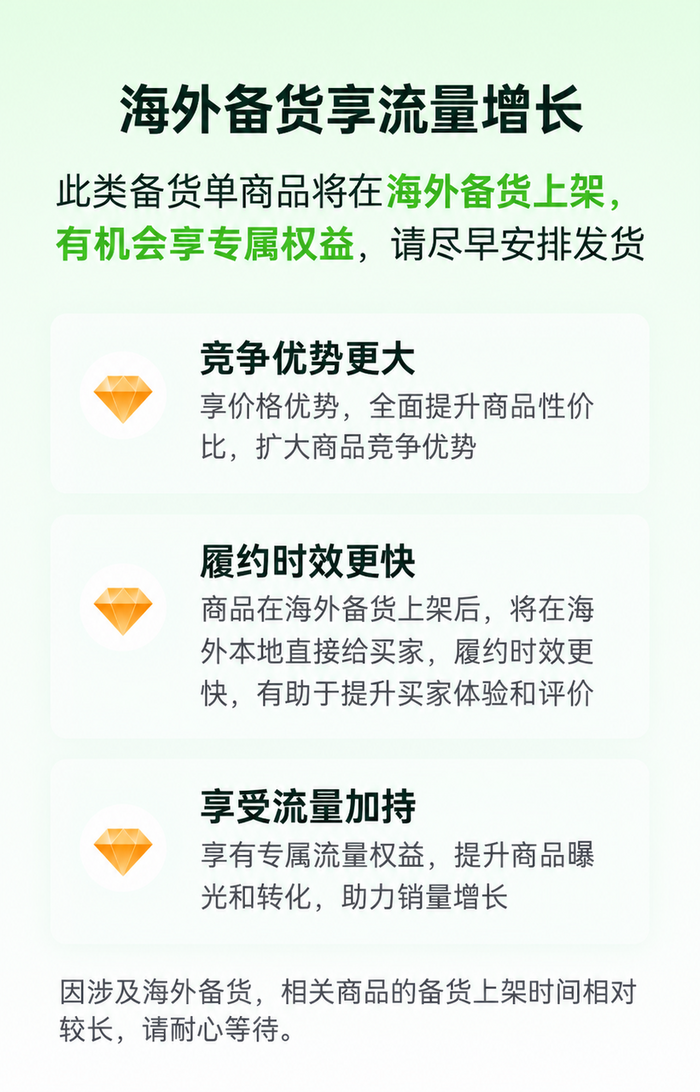
The forward warehouse stocking introduction text appearing in Temu's merchant back-end.
There are not a few sellers willing to try this new model. "(The back-end) often shows that forward warehouse stocking is booming, and usually you can't add a shipping slot; you can only grab one around 2 p.m. when the system centrally releases warehouse capacity," one seller said.

Is Temu aiming at a key breakthrough in the European battle?
Over the past few years, Temu has gradually formed a pattern in the European market in which fully-managed, semi-managed, Y2 direct shipping, and local-to-local models operate in parallel.
Semi-managed model: sellers stock goods in overseas warehouses and ship from overseas warehouses to buyers;
Y2 direct shipping model: essentially a semi-managed model, but sellers do not stock in advance overseas and instead ship directly from China after buyers place orders;
local-to-local model: sellers register with local entities in destination countries and ship from local warehouses in destination countries to local buyers.
After two years of vigorous promotion, the semi-managed model has basically passed its rapid new-merchant growth period.
Against the backdrop of the new tariff policy challenging the survival of direct small parcels, and with platform mobilization, a considerable portion of European fully-managed sellers eligible to switch to semi-managed have completed the migration. Some industry insiders even say that as of June this year, 80% of orders in the European market had achieved local fulfillment. The remaining fully-managed existing sellers who have not yet transformed mostly have real concerns that are difficult to overcome. "In the short term, the space for the semi-managed model to further expand new sellers and new supply in Europe is relatively limited."
The Y2 direct shipping model was once quite popular, but its scope is relatively limited. It is suitable for new product testing and some high-value-added light and small items, and is not the main force supporting long-term business growth.
The local-to-local model has developed relatively steadily over the past year, and the local ecosystem has expanded rapidly, but its total volume is still not large. According to Tech Buzz China data, Temu's global local-to-local business still accounts for less than 5% of GMV. The number of sellers with local European entities is naturally smaller than that of Chinese entity sellers, and attracting locally rooted merchants to join also requires longer-term investment and sustained cultivation.
The fully-managed model, which previously relied heavily on direct small parcels, was directly hit by the EU tax reform. Moreover, because fully-managed products have a higher proportion of low-priced consumable daily necessities, front-end consumers suddenly felt that they "could not find cheap essential products," which to some extent suppressed consumption willingness.
Therefore, for Temu, how to fill this business gap has become key to maintaining growth in Europe—stocking fully-managed goods in local European warehouses and shortening the fulfillment chain is its answer.

In terms of sales performance, some sellers have already achieved early results. According to one seller, Temu buyers once announced a set of data at an offline exchange meeting: after forward stocking, the average daily sales of related products increased by about 14%; more than 60% of products saw sales growth, and more than 10% of products doubled their sales. Many SKUs' daily sales rose from double digits to two to three hundred units.
Sellers' actual experience also aligns fairly well with platform-side data. "After forward warehouse stocking was completed, there was indeed some growth," one seller admitted. "I stocked only long-lasting best-sellers with more than one year of sales and a quality score above 90, and over the past month sales rose by about 10%."
Another seller said in a community group that the first batch sold out within just a few days after being listed, and the platform continued to send replenishment orders; they would consider expanding stocking scale in the future.
Other sellers pointed out that the current forward warehouse product pool is not large enough and SKU richness needs improvement; categories with relatively less supply and those with more supply may perform quite differently. "In another month or two, when the total number of listed links further expands and consumers' browsing and combined ordering effects strengthen, it may bring another round of broad increases."
In the long run, European forward warehouses may mean an important strategic shift for Temu: previously, the platform mostly encouraged semi-managed sellers to go to Europe and stock goods on their own, while aligning logistics ecosystem partners to provide assistance; the platform itself did not make heavy asset investments. Now it is entering the warehouse business itself, operating and managing on its own, entering the "deep water zone" of logistics construction.
Of course, Temu is not the only one increasing its efforts; the other three of the "Four Little Dragons" are also making frequent moves.
For example, SHEIN opened a new 740,000-square-meter mega logistics center in Wroclaw, Poland, last December and opened forward stocking in Polish warehouses to some sellers. AliExpress, meanwhile, is vigorously promoting its "overseas managed model," making "brand going global, overseas managed" a keyword for 2026, continuing to strengthen global logistics infrastructure and warehouse and distribution capabilities in core markets; in the first half of the year, new merchants under the overseas managed model exceeded 20,000. TikTok Shop's FBT (Fulfilled by TikTok) European network is also expanding rapidly, with warehouses opened in Germany, France, Italy, and Spain, covering 13 countries in Western, Central, and Southern Europe as delivery destinations.
In addition, the heat of the European logistics market also reveals the industry-wide trend toward localized fulfillment. Taking the Polish market as an example, data shows that in the first half of 2026, net leasing demand in the local warehouse market surged 58% year on year. Asian e-commerce platforms in particular leased more than 400,000 square meters of warehouse space. In many areas, large warehouse units exceeding 15,000 square meters are now "hard to find."

Not all fully-managed sellers can get a seat at the table.
For many sellers, under the current situation, fully-managed European forward warehouses may be the "last stand" for sprinting sales in 2026. Referring to the early traffic dividends that appeared during the promotion of semi-managed and Y2 models, they believe they may also get a share this time.
However, the forward warehouse model is still in an early stage, and there are many trial-and-error risks in actual operations, which is also something everyone must carefully weigh.
First, current stocking orders are not precise enough and there is information lag. For example, some sellers report that some SKUs already in a declining sales stage were also asked to stock several hundred units.
Second, the data dashboard is not yet mature. For the overseas first-leg transportation of goods, sellers cannot query tracking or warehousing status; after listing and sales begin, because domestic warehouses and European forward warehouses share one data standard, after orders are placed it is impossible to tell which warehouse the order came from, making precise supporting actions impossible.
Third, the disposal of unsold inventory remains unresolved. "It is currently unclear how returns will be handled. If, as in the U.S. region before, they can only be returned to Hong Kong for self-pickup, the burden on small and medium-sized sellers would be too great; even if they can be transferred to other third-party warehouses in Europe, re-inspection, labeling, shelving, and storage all cost no small amount," one seller admitted.
These problems mostly involve the platform's operating mechanisms and supporting capabilities. As relevant systems and services gradually improve, various obstacles are expected to be resolved. But what truly deters many sellers is the structural threshold behind the forward warehouse model: stocking pressure.
The most obvious problem is the long inbound and shelving cycle. "I feel the platform is probably using large-batch full-container sea freight or rail transport. Half a month to be listed and sellable is an ideal situation; many people still have not fully warehoused after more than a month," one seller said. In early September, more than a thousand items were sent over, all warehoused and listed in batches; after a month, only about 60% had been listed.
Another seller revealed that the platform may later allocate goods to warehouses in Frankfurt, Rotterdam, or even Turkey, at which point logistics coordination and inbound management issues brought by multi-warehouse fulfillment may further lengthen the shelving cycle.
Deeper than shelving timeliness is the issue of capital occupation. One seller calculated a "cycle account": the traditional fully-managed model was originally a light-asset business—from shipping to listing took only one week, and payments could gradually be received the following month, with no need to hold inventory; while forward warehouse stocking takes at least about a month before entering the warehouse, and the repayment cycle is longer, greatly increasing pressure on many sellers whose capital chains are not ample, turning it into a "heavy business."
As a result, the forward warehouse model may amplify the polarization among existing fully-managed sellers. Only powerful sellers with larger capital pools and supply chain backing can enter without pressure and eat "the fattest piece of meat"; while small and medium-sized trading sellers with weaker risk resistance may find it difficult to successfully take on the opportunity even if they see a good one.
"In the future, it may become increasingly difficult for ordinary links of small and medium-sized (fully-managed) sellers to gain volume. Goods from semi-managed, forward warehouses, and Y2 are all competing for the traffic pool, and their priority is higher," one seller expressed concern.
However, Temu is also continuously adjusting the operating mechanism of fully-managed forward warehouses, trying to provide greater stocking autonomy and create flexible operating space for willing sellers. Recently, some sellers reported that in addition to stocking orders automatically pushed by the platform, sellers can now also independently apply for overseas warehouse stocking orders, and the relevant function is currently in gray-scale testing. From back-end pages shared by some sellers, SKU links marked with "shipping enjoys European traffic growth" have opened an entry for independent application for European stocking, with application hours from 15:00 to 24:00 daily.
"Actually, everyone very much wants to grasp the platform's olive branch," the above seller said, expressing expectations. "If Temu later loosens restrictions on the European fully-managed forward warehouse model, launches some time-limited price comparison protection and return solutions, and optimizes issues such as the data dashboard and inbound logistics timeliness, then this model still has considerable imaginative growth potential."
Ebrun will continue to track and report this intelligence. If you want to learn more information related to this article, please scan the QR code to follow the author's WeChat.

This article was first published on the Ebrun official website.
[Copyright Notice] Ebrun advocates respecting and protecting intellectual property rights. Without permission, no one is allowed to copy, reproduce, or use the content of this website in any other way. If any copyright issues are found in the articles on this website, please provide copyright questions, identification, proof of copyright, contact information, etc. and send an email to run@ebrun.com. We will communicate and handle it in a timely manner.
Translated by AI. Feedback: run@ebrun.com