
AhaCreator's Peng Shan: As Creator Videos Pile Up, Why Are Brands Still Starting from Scratch?
【Original by Mati Society】After a round of overseas creator partnerships ends, companies typically get back only a data report and a string of video links. As for the more important answers—who is worth re-engaging, which assets can run as ads, how the next budget should be spent—these tend to scatter across employees' emails and chat records once the project ends.
So videos keep multiplying, and teams keep getting busier. Every time a company switches to a new product or enters a new market, everyone still has to start from scratch: finding people, writing emails, explaining requirements, negotiating prices, and chasing progress. Money has been spent, content has been published, but the company's understanding of consumers has not grown in tandem.
Meanwhile, brand spending on creators keeps rising. The latest report from IAB (Interactive Advertising Bureau) forecasts that U.S. creator ad spending will reach approximately $44 billion in 2026, more than tripling from $13.9 billion in 2021 over five years. As creator partnerships gradually become routine procurement, the challenge companies face has shifted from "whether to do it" to "how to do it consistently."

Peng Shan, Co-founder and CGO of AhaCreator
On October 23, 2026, at the fourth session of the "Foreign Trade Blue-Green Program · Brand Leap" held in Xiaoshan, Hangzhou, Peng Shan, Co-founder and CGO of AhaCreator, addressed this issue by breaking down the full chain of overseas creator marketing—from creator selection and content to delivery and re-engagement.
This series of training events was guided by the China (Hangzhou) Cross-Border E-Commerce Comprehensive Pilot Zone and the Hangzhou Xiaoshan District Commerce Bureau, and hosted by the Global Cross-Border E-Commerce Knowledge Service Center and Ebrun's Mati Society. It targets quality foreign trade enterprises in Xiaoshan to help them build up the strategic and operational capabilities needed for the transition from "product going global" to "brand going global."
In Peng Shan's view, creator marketing is by no means about piling up "partnership numbers"; it must return to the essence of business—why do consumers buy? Who is most credible to endorse? What carries the content? How does data feed the next budget round? Along this main line, every partnership is a market test. Creator selection validates scenarios; content validates expression; delivery and rights determine the reuse value of assets; and review data directly determines what stays and what goes.

Videos Went Out—Why Didn't Growth Stay?
When consumers scroll past a piece of content, they rarely follow the path the brand designed straight to purchase.
They may first remember the product, then search for the brand on Google days later; or move to YouTube to find a full review, then to Amazon to compare reviews, prices, and delivery. For high-ticket or feature-rich products, official websites, tutorials, and after-sales information are also needed to help consumers confirm risk.
This means that even if a video did not generate many clicks at the time, it does not mean it failed to enter the purchase process; and a video with massive views does not prove that the product page and fulfillment have already captured that interest.
Different content plays different roles along this path.Short videos are better at attracting attention with a specific scenario; lifestyle content helps consumers imagine how a product fits into daily life; long videos can explain complex features and real experiences; and search content, product pages, and reviews provide validation when users are close to purchase.
Many projects run into problems at the disconnect between content and business. A creator clearly explains a use case, but the product page has no corresponding explanation; a video sparks interest in a certain market, but inventory and delivery do not cover that area; the team wants creators to drive sales, but the brief only specifies product appearance and posting time.
Therefore, before a partnership begins, the more important step is to narrow down the questions this round needs to answer: Which product tests which market? How did consumers previously solve the problem? What reason might make them change their choice? Is this batch of content responsible for attracting, explaining, comparing, or driving action? After viewing, which page and purchase conditions continue to carry the user?
When product, market, price, and page are kept as stable as possible, the team has a chance to determine whether results come from content, audience, or changes in other conditions. Otherwise, testing Europe and the U.S. at the same time, comparing short videos with long reviews, discounting on one side while keeping original prices on the other, will still yield nothing but a set of total views that are hard to explain.

Why Is an Angling Creator a Better Fit Than a Home Appliance Creator for a Vacuum Sealer?
When brands look for creators, they often start with labels. Beauty, home, tech, outdoor—plus follower count, country, and quote—and a candidate list quickly takes shape.
The problem is that labels only tell a brand roughly what a person talks about; they cannot explain why he would use this product. A creator may live in the U.S., but his main audience may not be in the U.S.; an account that regularly posts automotive content does not mean he owns a vehicle compatible with the product; and someone good at shooting beautiful visuals may not be able to accurately complete an operating tutorial for a complex product.
Peng Shan broke down a case involving a vacuum sealer in class. According to platform categories, it is a small kitchen appliance, and brands easily lock candidates into home cooking and meal prep. But the best-performing creator in this round of creator marketing was "a great choice that is entirely reasonable yet unexpected"—an angling and outdoor cooking creator found by the AhaCreator platform through AI multimodal precision matching.
After fish are caught, they need to be processed, portioned, and preserved. The vacuum sealer entered an activity the creator was already doing. He did not need to temporarily play the role of an appliance reviewer; as long as he filmed the real process, viewers could understand what problem the machine solved.
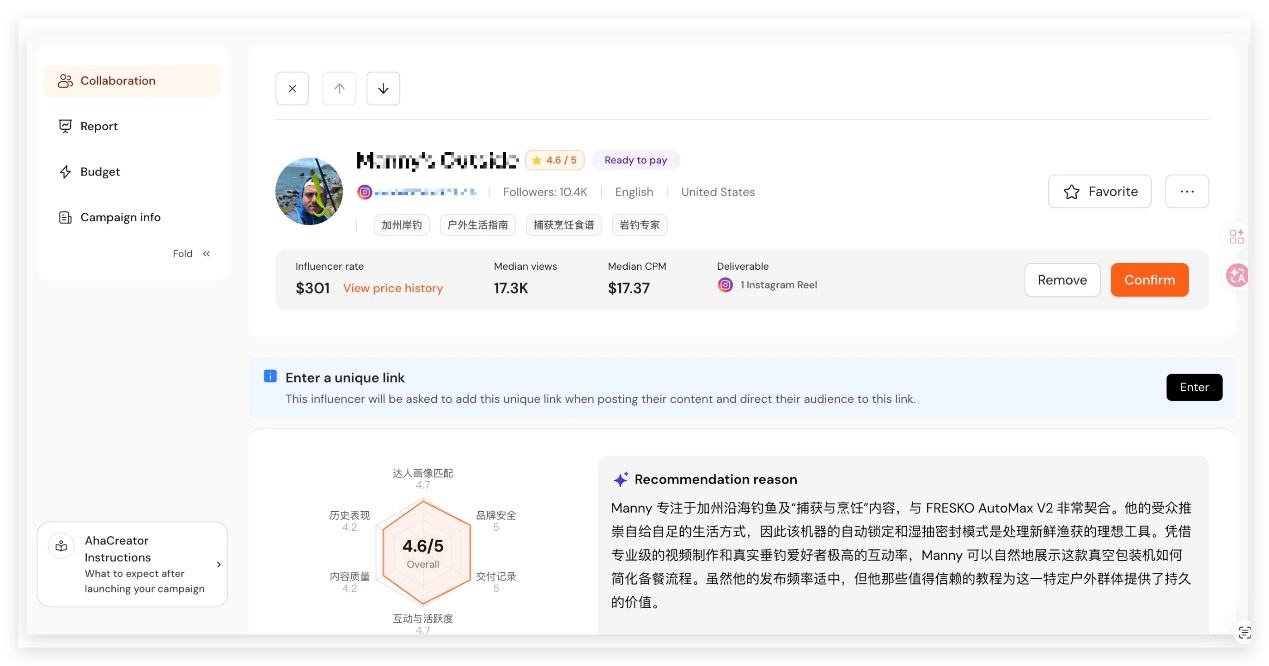
The AhaCreator platform precisely matched this "unexpectedly good candidate" through AI.
This case does not mean all kitchen products are suited to outdoor creators. What Peng Shan emphasizes is the entry point of creator selection: moving from "which content vertical does he belong to" to "why would he genuinely use this product." Meal prep, camping, and outdoor catch processing belong to different labels, but behind them lies the same product capability.
A case involving in-car electronics reveals another waste in "creator selection." If the vehicle model and product do not match, even highly professional creator content cannot deliver a real experience. If the team only discovers after reviewing the account, negotiating the quote, and shipping the product that the creator lacks a compatible vehicle model, all prior work must be scrapped and redone.
Therefore, conditions such as vehicle model, equipment, dimensions, logistics region, account permissions, and delivery time need to be confirmed at the front end of screening. Whether the product can be used is a hard threshold; visual style, follower scale, and vertical labels—if not yet proven by results—can be treated as preferences and tested with small samples.
This distinction also changes how teams record feedback. A judgment like "this creator is not good" cannot help the next round of screening; reasons such as "audience not in the target market," "lacks real usage conditions," "content task does not match account capability," and "rights and quote exceed budget" are what platforms and teams can use to keep refining.
The choice between top-tier and mid-to-long-tail creators likewise needs to return to the task. Concentrated reach, community influence, and high-level production may be better suited to top-tier creators; breaking down use cases and increasing content samples can be delegated to more mid-to-long-tail creators.It is important to note that although small creators charge less per video, hidden work such as communication, sample shipping, script review, and licensing does not decrease with follower count. Therefore, when brands scale up spending, they must not fall into the trap of "looking only at follower count and quote." Follower count only answers how big an account is; whether a creator has "a reason to genuinely use the product" determines whether the content they produce can be believed by consumers.

Peng Shan, Co-founder and CGO of AhaCreator

How Does One Accidental Hit Become Consistent Delivery?
Between choosing the right creator and consistently producing a batch of usable content lies a collaboration system that is easily overlooked.
Peng Shan suggests calibrating the sample first for new directions. The first batch of content needs to validate scenarios, purchase reasons, and expression styles. A standout video can be used to discover leads; only when similar purchase reasons are interpreted by different creators and still receive effective feedback does the brand gain the basis for expanding partnerships.
The brief is responsible for turning judgment into delivery.Many briefs run several pages and are full of requirements like "young, premium, textured," yet creators still do not know what exactly to shoot after reading them; other briefs are precise down to every second, leaving creators who know their audience with nothing to do but follow the script.
Take the vacuum sealer: "shoot a young person's lifestyle" is hard to execute, while "record a weekend meal prep, showing ingredient portioning, machine operation, and preservation" is a clear task. Brands need to explain clearly who uses the product under what circumstances, which value this round most wants to prove, which actions and facts must appear, and what will be delivered, when, and how it will be accepted. As for who appears on camera, how to open, and what tone to use, these can be left to creators who know their audiences better.
Review should also not mix all opinions together.Incorrect feature descriptions, missing key shots, and compliance violations require clear revisions; visual style and expression preferences should return to the sample confirmed before the partnership; adding scenarios, versions, or publishing platforms after content is completed has already changed the procurement scope and requires reconfirming fees and scheduling.
Another issue often dragged to the end is asset rights.Organic posting, reposting on brand accounts, re-editing, product page use, and paid ad placement correspond to different rights. Completion of content delivery does not mean the brand can use it permanently and across channels. Waiting until content performs well to discuss licensing means the brand faces another negotiation, and the creator has reason to requote based on added value.
Therefore, when assets enter the content library, a video link alone is not enough. Creator, raw footage, edited versions, licensed channels, usage period, and subsequent performance need to be linked together. When the team mentions "that outdoor scene from last time" again, it should be able to immediately find the asset and rights, and know how it performed in organic posting versus ad placement respectively.
As partnership volume grows, brands also need to separate decision-making from execution.Market, goals, budget, content standards, and key candidates are confirmed by the brand; matching, outreach, price negotiation, progress tracking, and delivery records can be continuously advanced by the platform and processes; if unexpected exceptions arise during execution—for example, a creator receives a sample but cannot experience the product due to environmental or equipment mismatch, rights change midway, or fees exceed boundaries—these situations requiring re-decision are handed back to authorized people at the brand.
This is also the realistic position of AI in creator marketing.As an AI-native global creator marketing platform, AhaCreator covers creator resources across more than 140 countries and regions, with a pool of more than 5 million genuinely reachable overseas creators, over 170,000 active overseas creators onboarded who have completed commercial collaborations here, and support for scaled campaigns by more than 600 enterprise clients. It was named "Best Influencer Marketing AI Agent 2026" by Influencer Marketing Hub. AhaCreator has become Feishu's first overseas creator marketing AI Agent partner, formed a deep partnership with BlueFocus, and entered a strategic collaboration with MiningLamp Technology.
At such a massive business scale, AI is best suited to take on repetitive screening, email outreach, progress reminders, record organization, and brief pre-checks, leaving teams time for product value, content judgment, and budget decisions. Once processes run faster, what companies should gain first is judgment quality, not just a longer creator list.

After Views Are Achieved, Where Should the Next Dollar Go?
As creator partnerships gradually increase, the price per video easily becomes the most visible metric. But it only shows how much was spent on content procurement. Samples, logistics, ads, page production, review, and team collaboration costs combined come closer to the total investment of a project.
CPM answers how much was spent per thousand impressions, CPC answers how much was spent per click, and CAC further addresses the cost of acquiring a customer. The three metrics correspond to three questions and cannot substitute for one another. Cheap views do not necessarily bring low-cost customers; increased clicks do not prove that all orders in the same period came from creators.
After viewing content, consumers may search for the brand themselves, or switch devices to complete a purchase. Tracking links, discount codes, brand-term searches, and post-purchase surveys can help teams reconstruct the path; these records show where orders are attributed, but they are not enough to answer whether orders would still have occurred without this round of partnership.
For most brands just beginning to build a system, first accurately mapping costs, content, rights, and results is more important than building a model that looks complex but cannot actually be compared. In review, beyond totals, teams should also look at the median performance of individual content pieces, the proportion of content that hit targets, and whether results are highly concentrated among a few creators. A single hit provides a lead; only when similar purchase reasons repeatedly prove effective across multiple samples does it come closer to a judgment that supports re-engagement.
Where the next dollar should be added should also be checked back along the purchase path. If content fails to generate effective views or clicks, the problem may lie in audience, use case, purchase reason, and opening expression; if people click but do not buy, the focus should shift to page, price, inventory, delivery, and trust information; if orders rise but refunds are high, verify whether content raised expectations too much and whether product experience and fulfillment delivered on promises.
Only when multiple creators consistently generate effective feedback around similar scenarios and asset rights also support reuse is the team ready to increase similar partnerships and follow-up ad placement in batches. Adding more creators can supplement content supply, but it cannot solve review backlogs, page conversion, product experience, and fulfillment problems for the brand.
Only at this point does a round of partnership truly leave behind four types of assets: effective scenarios, openings, scripts, assets, and usage rights; experience in matching which products suit which people, platforms, and quotes; feedback formed by consumer questions and business results; and organizational capability formed when these experiences enter briefs, reviews, budgets, and team collaboration.
What AhaCreator hopes to solve is precisely how these experiences move from one partnership into the next. It connects matching, communication, delivery, and records into a single workflow, allowing brands to retain key judgments while gradually making repetitive execution an accumulating foundation. Companies can first build one product and one market solidly, then gradually increase partnership frequency, countries, platforms, and product lines.
As overseas creator marketing moves toward scale, the gap between companies may not first appear in who partners with more creators.Teams that form content judgment, matching experience, and re-engagement criteria earlier will do fewer ineffective actions in the next round and be clearer about what their budgets actually bought.(Original by Mati Society / October 26, 2026)
The 2026 Xiaoshan District Government Work Report of Hangzhou states that Xiaoshan's cross-border e-commerce export scale has ranked first in Zhejiang Province. To deeply empower high-quality development of foreign trade enterprises in its jurisdiction and help traditional foreign trade upgrade from "product going global" to "brand going global," the Hangzhou Xiaoshan District Commerce Bureau, with support from the China (Hangzhou) Cross-Border E-Commerce Comprehensive Pilot Zone, based itself on the local foreign trade and manufacturing foundation, relied on platforms such as the Global Cross-Border E-Commerce Knowledge Service Center, and launched the "Foreign Trade Blue-Green Program · Brand Leap" series of training events for quality foreign trade enterprises in the district with annual revenue in the hundreds of millions.
"Foreign Trade Blue-Green Program · Brand Leap" is hosted by the Global Cross-Border E-Commerce Knowledge Service Center and Ebrun's Mati Society. The series responds to the practical difficulties foreign trade enterprises encounter when moving from "product going global" to "brand going global," focusing on solving problems such as some enterprises emphasizing supply chains over brand building, price competition, and insufficient market pricing capability. It helps enterprises fill gaps in brand strategy understanding, make good use of digitalization, AI, and other tools, strengthen their competitiveness going global, and cultivate more local Xiaoshan brands going global.
This article was first published on the Ebrun official website.
[Copyright Notice] Ebrun advocates respecting and protecting intellectual property rights. Without permission, no one is allowed to copy, reproduce, or use the content of this website in any other way. If any copyright issues are found in the articles on this website, please provide copyright questions, identification, proof of copyright, contact information, etc. and send an email to run@ebrun.com. We will communicate and handle it in a timely manner.
Translated by AI. Feedback: run@ebrun.com