
67 Billion Yuan Revenue, Net Profit Doubles: Re-evaluating the Long-Term Value of the Cross-Border Direct-to-Consumer Shipping Track from Yanwen's IPO Prospectus
【Ebrun Original】The implementation of new tariff policies in Europe and the US has triggered market concerns about the cross-border direct parcel model.
Looking back at 2025, when the US eliminated the $800 de minimis exemption, it also caused a short-term decline in parcel volumes. However, from the latest IPO prospectus released by Yanwen Logistics, we can see that in 2025, its parcel revenue to North America did not decrease, but instead surged by approximately 31.5% year-over-year to 3.397 billion yuan.
In 2025, Yanwen Logistics shipped over 80 million parcels to the US, ranking second in the industry. In Q1 2026, its total cross-border express parcel volume continued to increase by 14.3% year-over-year.
By revenue, Yanwen Logistics is China's second-largest third-party B2C cross-border e-commerce logistics service provider. As a representative of the cross-border direct parcel model, its performance is in stark contrast to market concerns.
In the face of the global trend of tightening tax exemptions for small parcels, how should we see through short-term shocks and re-evaluate the long-term value of the cross-border e-commerce logistics direct shipping track?
01
Double-Digit Growth Validates the Resilience of the Cross-Border Direct Shipping Model
From the prospectus, it is evident that over the past year, Yanwen Logistics achieved double-digit growth in both revenue and parcel volume.
In 2025, Yanwen Logistics' cross-border e-commerce express service revenue grew 22.7% year-over-year to approximately 5.74 billion yuan, handling over 120 million cross-border express parcels, up 12.9% from 2024.
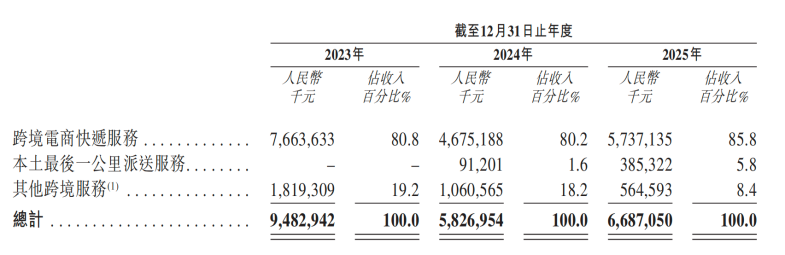
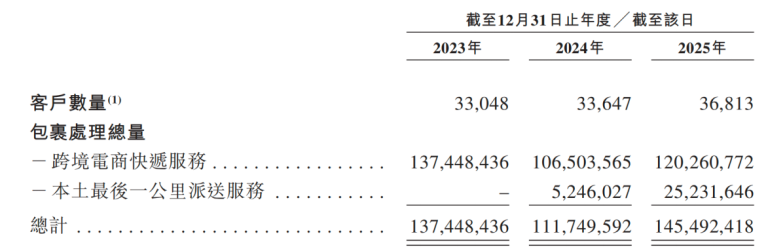
Among these, dedicated line parcel volume surged 23.5% year-over-year to approximately 115 million pieces, with its share of total parcel volume rising from 88% to 96%. The higher average order value of dedicated lines drove revenue per parcel up to 47.7 yuan.
Unlike the traditional impression of postal small parcels, Yanwen Logistics has become a typical representative of the cross-border direct shipping model, primarily focused on dedicated line parcels, supplemented by postal small parcels and commercial express.
In 2025, when the US eliminated the $800 de minimis exemption, Yanwen Logistics achieved double-digit growth in both revenue and parcel volume, especially with over 30% revenue growth from North America, reflecting the resilience of the cross-border direct shipping model.
The original typical representative of the cross-border direct shipping model was postal small parcels, and Yanwen started in 1998 by providing postal small parcel services. From small-amount foreign trade B2B represented by DHgate, cross-border C2C represented by eBay, to B2C exports represented by Amazon, postal small parcels, characterized by low prices, convenient customs clearance, and global reach, once dominated China's cross-border e-commerce.
The drawback was low timeliness, requiring 30 to 60 days in the early days.
To address this pain point, cross-border e-commerce logistics service providers like Yanwen innovatively launched cross-border dedicated line parcel services, building their own domestic collection networks, integrating international air capacity and destination country last-mile delivery resources, and shortening the door-to-door cross-border direct shipping service time to 7–15 days.
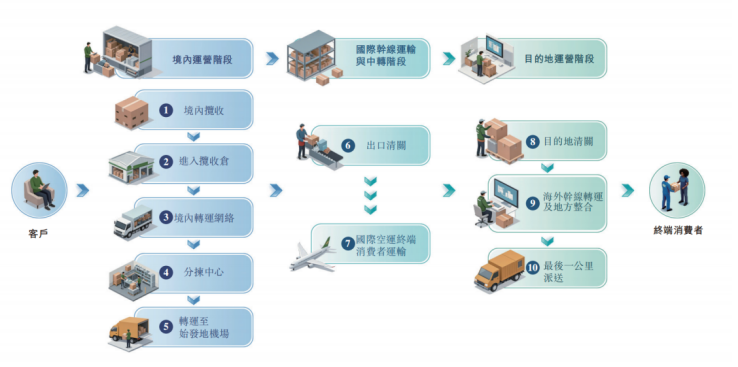
Cross-border dedicated line parcels are slightly more expensive than postal small parcels but offer significantly improved timeliness. They are slightly slower than commercial express but much cheaper. They precisely captured the vacuum between postal small parcels and commercial express, differentiated their positioning, and reshaped the competitive landscape of the cross-border direct shipping market.
To date, dedicated line parcels have surpassed postal small parcels in cross-border direct shipping, occupying an absolutely dominant position. They have also expanded from primarily air transport to sea freight, sea-land intermodal, and truck-air intermodal, with routes extending from North America and Europe dedicated lines to emerging markets such as Latin America and Africa. For mainstream categories like apparel, beauty, and 3C, deeply customized solutions have emerged.
For example, Yanwen Logistics offers general cargo and special cargo dedicated lines, as well as dedicated lines for cosmetics, sensitive goods, clothing, and large items. For products like down jackets and quilts that are bulky and light, Yanwen's dimensional-weight-free dedicated line customizes the billing method, significantly reducing logistics costs. For sensitive categories with batteries or magnetism, there are dedicated sensitive goods lines.
In 2025, Yanwen Logistics' net profit doubled to 106 million yuan; the gross margin of direct shipping services increased by 1.5 percentage points to 8.7%. The dual increase in profit and gross margin is the market's affirmation of the cross-border direct shipping model.
02
High Turnover, Low Threshold: Building the Underlying Rigid Value of Cross-Border Direct Shipping
The characteristic of the cross-border direct shipping business is shipping after orders are generated, without the need to pre-stock overseas, featuring low thresholds and flexible services. This is extremely friendly to cross-border e-commerce novices and small and medium-sized sellers with small average order volumes.
In the cross-border e-commerce industry, small and medium-sized sellers constitute the absolute majority in number. Taking Amazon as an example, of its approximately 1.9 million active sellers in 2025, about 100,000 had annual sales exceeding $1 million, accounting for only about 5%. According to the Ministry of Commerce, China's cross-border e-commerce export enterprises have exceeded 120,000, most of which are small and medium-sized enterprises.
The massive long-tail enterprise distribution is a structural characteristic of the consumer industry. SMEs generally lack capital and resources. According to market research institutions, most Amazon sellers start with less than $5,000 in business capital, and 25% start with less than $1,000.
Compared to overseas warehouses, which require upfront payment for procurement stocking, first-leg logistics, warehousing rent, import tariffs, and other upfront costs, direct shipping is often the most suitable first choice for small and medium-sized sellers.
The direct shipping model is also the most cost-effective choice for new sellers to enter the market, test new products, and expand into new markets.
Data from Qichacha shows that in 2025, the number of registrations of China's cross-border e-commerce-related enterprises surged 131.71% to 20,000, setting a dual peak in both registration volume and growth rate. A continuous stream of new sellers is pouring into the cross-border e-commerce industry.
The direct shipping model supports flexible product and market testing, avoiding the risk of rash stocking. After a product is listed, direct shipping can complete the first batch of order fulfillment and collect real market feedback within 7–15 days, whereas overseas warehouses require 30–45 days of first-leg stocking before sales can start, resulting in long trial-and-error cycles and high sunk costs.
The value of cross-border e-commerce B2C lies in directly connecting global consumers, reducing layers of traditional foreign trade agents, lowering trade thresholds, and enabling small, medium, and micro enterprises to participate in global trade anytime and anywhere. This gives cross-border e-commerce an "infinite shelf," and the indispensable logistics foundation for an infinite shelf is direct shipping.
Platforms have hundreds of thousands of SKUs; the top 20% are always the hit or standard products worth deep stocking, while for the remaining 80% long-tail supply, direct shipping is the optimal solution compared to stocking capital costs and inventory risks.
However, the most valuable rigid-demand scenario for the cross-border direct shipping model is its deep support for the competitiveness of China's flexible supply chain.
Small-batch rapid response represented by SHEIN compresses demand signal discovery, design and production, and global fulfillment efficiency into 2–3 weeks, achieving 4,700 new styles per day. By beating slow with fast and old with new, it has formed a dimensional competitive advantage over the traditional apparel industry. Its inventory turnover days of only 36 resolves the death curse of inventory in the apparel industry.
To keep up with trends and capture rapidly changing global consumer demands, the cross-border direct shipping model is indispensable. To fully leverage China's fast-intelligent manufacturing supply chain advantages, direct shipping is also indispensable. Besides apparel, high-frequency innovation and iteration scenarios such as jewelry accessories, 3C digital products, and beauty also require direct shipping dedicated lines.
Compared with these rigid-demand scenarios, the elimination of the small-amount tax exemption policy removes the low-price arbitrage space, but instead clarifies the true value of the direct shipping model. The cross-border direct shipping model is the rigid-demand infrastructure for solving the overseas expansion of small, medium, and micro enterprises, and a key support for leveraging the supply chain advantages of cross-border e-commerce B2C.
03
Two-Wheel Drive Pattern: The New Competitive-Cooperative Niche of Direct Shipping and Overseas Warehouses
Before Amazon Global Selling entered China in 2015, the cross-border e-commerce logistics method was absolutely dominated by the direct shipping model.
Chinese sellers, using eBay and AliExpress as their bases, sold light and small items such as electronics, clothing, and jewelry to the world via postal small parcels and international express. The 9610 regulatory model introduced by the General Administration of Customs in 2014 established the compliant market position of the cross-border e-commerce direct shipping model.
Thereafter, the US raised the tax exemption amount to $800, completely igniting direct shipping. Dedicated lines then harvested the era's dividends with low thresholds and higher timeliness, and market share climbed rapidly.
The germination of overseas warehouses can be traced back to large-item home brands like Ziel Home, which built their own overseas warehouses to solve their cross-border logistics cost problems. Driven by demand for large items and Amazon FBA, a group of freight forwarders transformed into overseas warehouses, gradually upgrading from serving Amazon FBA transit warehouses to drop-shipping overseas warehouses, serving top sellers' large-volume overseas stocking needs.
In 2020, the General Administration of Customs' 9810 export overseas warehouse regulatory method officially established the market position of the overseas warehouse model. During the pandemic, international logistics chains were disrupted, which conversely promoted the explosive growth of the overseas warehouse model. The number of warehouses quickly exceeded 1,000, and warehouse area surpassed 10 million square meters.
After the pandemic, the fully managed models of TEMU and TikTok Shop brought a new round of explosive growth in dedicated line business. The direct shipping model also evolved from being dominated by postal small parcels in the early days, with dedicated lines and international express as supplements, to being dominated by dedicated line direct shipping, with postal small parcels and commercial express as supplements.
Through alternating development, cross-border e-commerce logistics ultimately formed a market pattern driven by both direct shipping and overseas warehouses.
The change occurred in 2025, when the US eliminated the small-amount tax exemption, and subsequently Europe and other countries tightened tax exemption policies one after another. The tariff price differential advantage of the direct shipping model was wiped out, and doubts about the model's prospects became rampant.
As a third-party think tank that has observed the cross-border industry for over twenty years, the Ebrun Think Tank believes that the elimination of tax exemption policies only levels the advantage of direct shipping and overseas warehouses in one link—tariff costs—without affecting the unique value of the model itself. For sellers, the ultimate consideration is the overall supply chain efficiency and optimal comprehensive cost, not the price of a single link.
Supply chain efficiency depends on turnover. The fulfillment chain of the direct shipping model is order—domestic warehouse—air freight—consumer, with capital occupation cycles measured in days. In contrast, overseas warehouses require 30–40 days for sea freight, and after warehousing, sales performance and sell-through must be considered, with capital occupation measured in months.
Turnover efficiency determines the speed of making money. With the same amount of capital, faster turnover means one more cycle and one more profit. For small and medium-sized sellers, the cost increase brought by tariff policies is lower in priority compared to cash flow safety and money-making efficiency, which determine a company's survival.
Comprehensive supply chain cost depends on inventory.
For retail enterprises, inventory is the biggest risk leading to death. Global E-commerce, once a top cross-border enterprise with annual revenue exceeding 10 billion yuan, was dragged down by massive inventory backlog in overseas warehouses, leading to a broken capital chain and ultimate bankruptcy.
Overseas warehouse stocking inventory also faces punitive fees; once unsold, warehousing fees, age surcharges, clearance discounts, and disposal fees stack up layer upon layer, all of which are hidden supply chain costs.
The low inventory risk and high cash flow safety margin of the direct shipping model have irreplaceable rigid value. This gives the business model an irreplaceable position in cross-border e-commerce over the long term.
According to Frost & Sullivan estimates, in 2025, in China's B2C cross-border e-commerce logistics service industry, the direct shipping model market size was 325.2 billion yuan, accounting for approximately 51.3%; by 2030, it is expected to reach 540.6 billion yuan, accounting for approximately 49.8%, with a compound annual growth rate of 10.7%. According to this forecast, the market share of the direct shipping model and overseas warehouses will be roughly 50-50.
04
Four Structural Dividends Supporting Long-Term Growth of the Direct Shipping Track
The Ebrun Think Tank believes that the cross-border e-commerce logistics direct shipping model has four future growth points:
1. Expansion of the cross-border e-commerce market; global services cannot do without cross-border direct shipping.
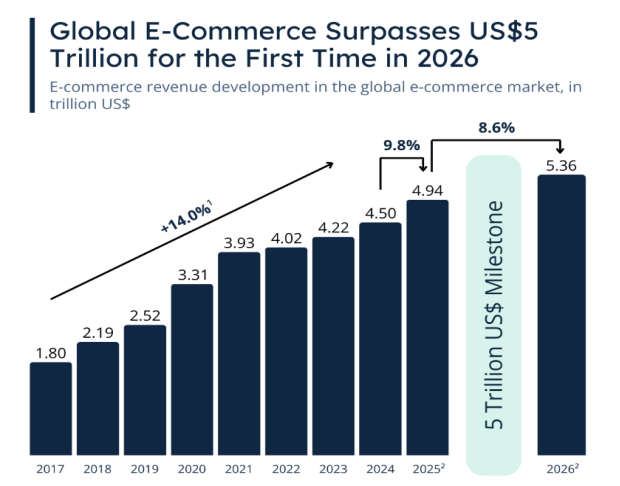
ECDB data shows that global e-commerce revenue reached $4.94 trillion in 2025 and is expected to exceed $5 trillion for the first time in 2026. As global e-commerce penetration continues to rise, the cross-border e-commerce market is still expanding, which will drive synchronous growth in logistics direct shipping.
According to China Customs statistics, in 2025, China's cross-border e-commerce exports hit a new historical high of 2.27 trillion yuan, up 5.4%. However, its share of total goods trade exports was only 8.4%, leaving much room for growth.
Cross-border e-commerce export goods are mainly consumer goods, accounting for 97.3%. Among them, apparel, footwear, bags, and jewelry accessories account for the highest share at approximately 21.8%; mobile phones, computers, and various digital products and accessories account for approximately 16.5%, and their share is still rising.
By category, the core categories of cross-border e-commerce are precisely the light and small items most suitable for the direct shipping model, supporting a solid market base.
2. Expanding into emerging markets; the direct shipping model is the preferred choice.
Emerging markets are the driving engine leading China's foreign trade growth. According to customs statistics, in the first five months of this year, China's exports to ASEAN reached 2.21 trillion yuan, up 16.4% year-over-year. From January to July, exports to Central and Eastern European countries reached 564.13 billion yuan, up 12.1% year-over-year.
E-commerce in emerging markets started late and is currently in a stage of rapid growth. Third-party data shows that in 2025, e-commerce growth in emerging markets such as Latin America, Southeast Asia, the Middle East, and Eastern Europe was in double digits.
According to Statista forecasts, the Eastern European e-commerce market revenue in 2025 will be approximately $57.12 billion, expected to reach $81.58 billion by 2029. A report jointly released by Endeavor and Mercado Libre predicts that the Latin American e-commerce market will reach $215.31 billion in 2026, with a growth rate about 1.5 times the global average.
Chinese sellers are leveraging platforms to comprehensively expand into emerging markets. TikTok Shop opened Eastern European sites such as Poland, Czech Republic, and Hungary in 2025. eMAG, the largest e-commerce platform in Eastern Europe, also launched a Chinese seller recruitment plan, aiming to recruit 20,000 Chinese sellers by 2028.
Infrastructure such as warehousing and logistics in emerging markets is often inadequate, with high policy risks, significant differences in regulatory rules, and fragmented purchasing power. The low-threshold, asset-light direct shipping model is undoubtedly the first choice for sellers to explore markets. It is understood that cross-border e-commerce logistics service providers represented by Yanwen Logistics have opened dedicated line services to emerging markets such as Eastern Europe, supporting sellers in exploring emerging markets.
3. New categories and R&D-driven products require the efficiency support of cross-border direct shipping.
High-growth categories with batteries and magnetism bring new growth to cross-border direct shipping, such as AI glasses, smart earphones, smart watches, portable fans, car mounts with magnetic attachment and wireless charging, protective cases, etc.
For such special cargo, many leading cross-border logistics companies have launched special cargo dedicated lines. For example, Yanwen Logistics' pure battery dedicated line supports lithium-ion batteries, button batteries, and accompanying batteries, and its sensitive goods dedicated line can ship items with internal batteries, magnetism, gels, liquids, powders, etc.
The Ebrun Think Tank observes that more and more small and medium-sized enterprises, leveraging China's engineer dividend and supply chain manufacturing resource advantages, are evolving into R&D-driven SMEs. They form competitive premiums with rapidly iterating innovative products. Direct shipping dedicated lines are precisely the efficiency support for such innovation.
4. Policy and compliance trends drive increased logistics concentration.
From the US eliminating the small-amount tax exemption to Europe and other countries and regions tightening small parcel regulation one after another, compliance thresholds are rising, and non-compliant small players are being squeezed out of the market. Leading enterprises like Yanwen Logistics with comprehensive compliance systems, digital customs clearance capabilities, and economies of scale advantages are instead taking over the squeezed-out market share.
The prospectus shows that after the US eliminated T86 in 2025, Yanwen Logistics' revenue in the US market actually increased from 2.584 billion to 3.397 billion yuan, a substantial increase of approximately 31.5%.
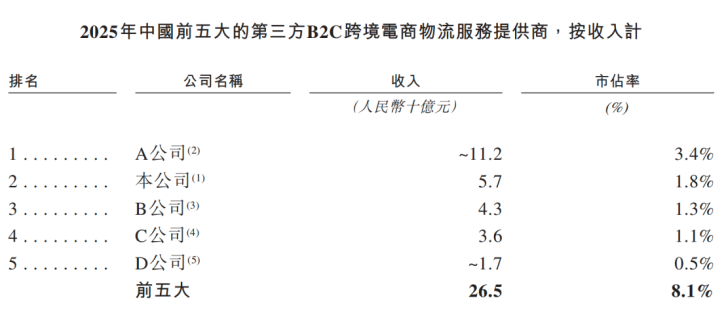
The competitive landscape of the cross-border e-commerce logistics market is still fragmented. According to Frost & Sullivan data, in 2025, the total revenue of China's top five third-party cross-border export e-commerce logistics service providers was approximately 26.5 billion yuan, with a market share of only 8.1%. A leading enterprise like Yanwen Logistics, ranking second, had a market share of only 1.8%.
The Ebrun Think Tank believes that in the new stage of cross-border e-commerce logistics moving towards intensification, industry concentration will further increase, and leading enterprises will gain more market share.
▎Conclusion: Piercing the Short-Term Fog, Re-evaluating the Long-Term Value of the Track
Overall, tariff policies will cause certain short-term shocks and disruptions to the market. However, re-evaluating the cross-border direct shipping model over the long term, the Ebrun Think Tank believes that its unique rigid-demand scenarios, supply chain cost, and efficiency advantages are irreplaceable. In the future, the direct shipping model will serve as an indispensable logistics infrastructure for global services.
Ebrun will continue to track and report on this intelligence. To learn more information related to this article, please scan the QR code to follow the author's WeChat.

This article was first published on the official website of Ebrun.
[Copyright Notice] Ebrun advocates respecting and protecting intellectual property rights. Without permission, no one is allowed to copy, reproduce, or use the content of this website in any other way. If any copyright issues are found in the articles on this website, please provide copyright questions, identification, proof of copyright, contact information, etc. and send an email to run@ebrun.com. We will communicate and handle it in a timely manner.
Translated by AI. Feedback: run@ebrun.com