
Chinese Robotic Mowers Race Overseas: Who Will Have the Last Laugh?
【Ebrun Original】At the recently concluded IFA, numerous Chinese smart robotic mower manufacturers turned the exhibition into a "launch event." New products from companies such as ANTHBOT, Dreame, Ninebot, Mammotion, and White Horse Technology were showcased in force, actively demonstrating intelligent mowing solutions for different operating scenarios, from home gardens to commercial lawns.
In addition, many new players entered this track this year. Power tools and energy storage brand Litheli kicked off its smart robotic mower debut at CES earlier this year, upgrading its garden equipment products from electric to intelligent; global commercial service robot leader Pudu Robotics launched three robotic mowers at the beginning of September, venturing outdoors into garden operation scenarios for the first time; Beatbot, the pool cleaning robot brand under Xingmai Innovation, moved onto land and exhibited its first robotic mower at GaLaBau in Germany...
Developments in the capital market also signal the heat of this industry. LDROBOT, whose robotic mower product line has become a core growth engine, listed on the Hong Kong Stock Exchange in May and was highly favored by investors during its global offering, with subscription heat ranking third among Hong Kong IPOs of the year; White Horse Technology, Muxin Intelligent, and Hanyang Technology have seen one financing after another this year, with amounts almost all in the hundreds of millions of yuan.
Why are various players crowding into robotic mowers? As the track becomes increasingly crowded, what capabilities has everyone shown? Who is more likely to have the last laugh?
01
Robotic mowers enter the "boundaryless" era, with domestic manufacturers dividing the market into three camps
Since Ninebot launched the world's first batch of commercial boundaryless robotic mowers in 2021, the entire robotic mower track has entered the intelligent era, and industry development has accelerated. As a pioneer, Ninebot surpassed a mass production scale of one million units in less than five years. After Ninebot, Dreame also launched a robotic mower project, and AgileX Robotics incubated sub-brand Mammotion, with related technologies also upgrading from RTK (real-time kinematic positioning) to multi-technology fusion solutions.
Note: Boundaryless means no buried wire is needed to set the working area; instead, navigation, radar, vision, and other positioning technologies are used to autonomously identify obstacles and plan paths.
IDC survey data shows that in 2025 global robotic mower shipments reached 1.992 million units, up 63.8% year-on-year, making it the fastest-growing track among all smart robot subcategories. Among them, boundaryless models were highly popular in the market, with shipments surging 182.4% year-on-year to 1.318 million units, accounting for 66.2% of total shipments.
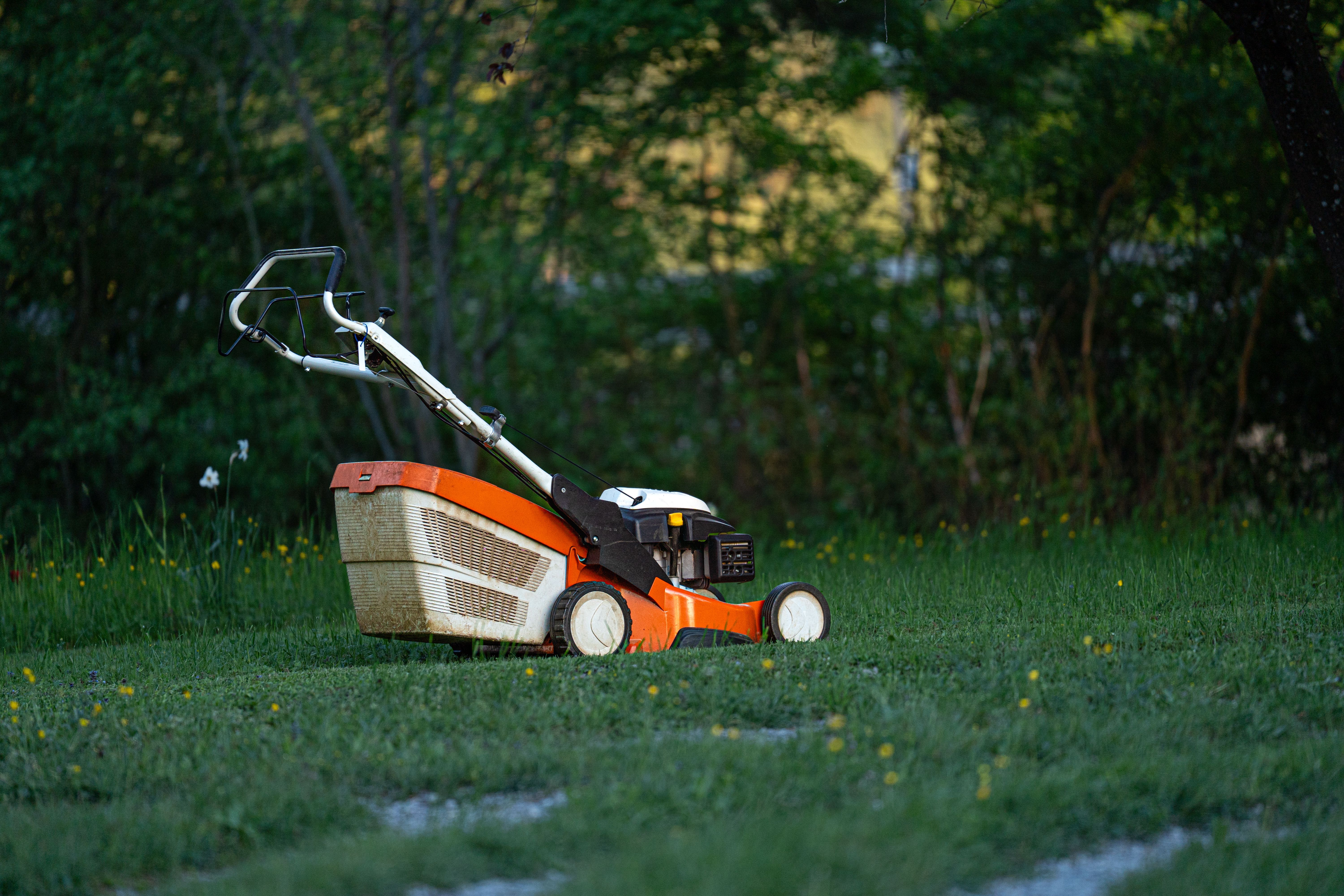
Compared with buried-wire mowers, boundaryless robotic mowers have higher mowing efficiency while also reducing the cost of manual wire burial, creating a strong substitution effect on traditional products. The huge market space has made the boundaryless smart robotic mower track a must-contest battleground: crossover players such as Dreame and Ecovacs are migrating related technologies from their original products to robotic mowers; some start-up robotic mower companies are also responding flexibly and following up in time; and although traditional garden tool brands are moving somewhat slower, they are also transforming and upgrading in the same direction. It can be said that the industry currently broadly presents a situation of "three camps dividing the market."
1. Traditional garden tool companies: "Old guard" catching up with new products
In the outdoor power equipment field, traditional garden tool companies are quite experienced. In the era of buried-wire mowers, they relied on supply chain and channel accumulation to firmly control the market. Take Positec as an example: it has entered overseas markets for nearly 30 years and has become the world's second-largest mower company. However, with the application of new technologies, if these traditional mower players do not actively transform and iterate, they will be unable to break through quickly when boundaryless models sweep the industry, and a reshuffle could happen in an instant.
In terms of the timing of launching their first boundaryless robotic mowers, traditional garden tool companies did not achieve first-mover advantage thanks to their deep cultivation of the track. Most of their first launches came after 2023, lagging at least two years behind Ninebot. For example, the first boundaryless robotic mower products of Positec and White Horse Technology both launched in 2023, those of Greenworks, Zhongjian Technology, and Sanfeng Industrial all launched in 2024, while Chervon Holdings and Daye Technology only launched their first boundaryless models in 2025.
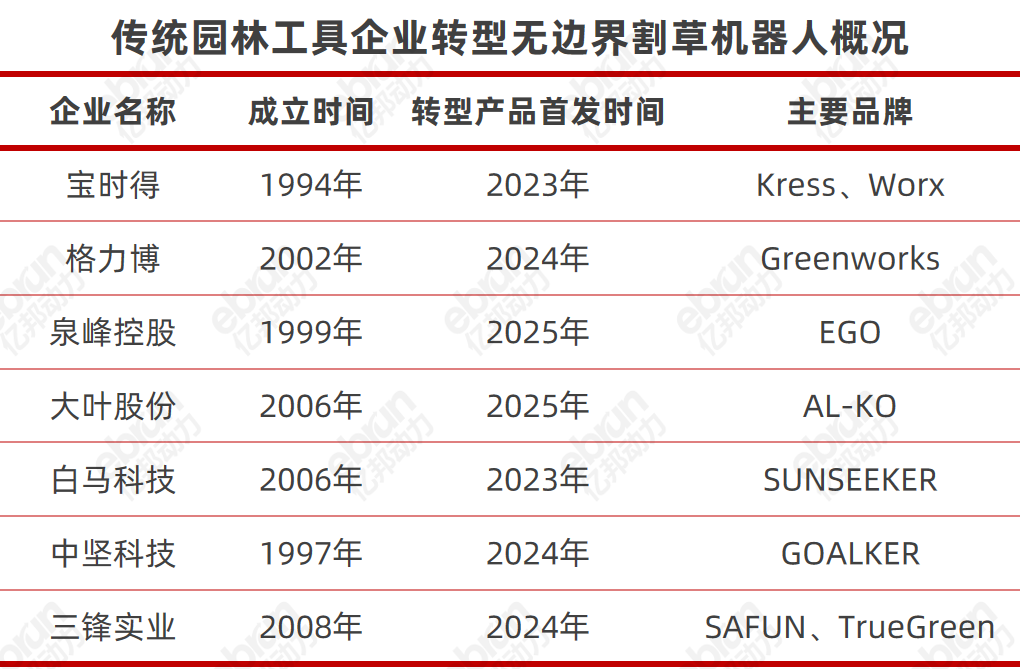
Among them, Daye shares adopted an acquisition approach for transformation, taking over German veteran company AL-KO Ger te GmbH and assuming its existing core technologies, mid-to-high-end brand image, sales resources, overseas factories, and more. Zhongjian Technology established a new robot company focused on boundaryless robotic mower R&D. White Horse Technology and Sanfeng Industrial, meanwhile, are pursuing gradual transformation relying on their existing advantages in three-electric technologies and other areas.
2. Crossover players: Reusing technology and channels to penetrate the mass market
Companies coming from crossover sectors have been exceptionally active in the robotic mower track in recent years, with Ninebot, Dreame, Ecovacs, and Roborock being typical representatives. They often do not start from scratch but instead extend from existing businesses or existing technologies. Either they originally operated products similar to robotic mowers, or they built their foundations on relevant technical solution capabilities, and the underlying technologies involved, such as perception, positioning, and mobility, all have opportunities to be migrated into robotic mower product R&D.
Relying on inherent technological accumulation and avoiding head-on confrontation with the buried-wire robotic mower business where garden tool companies are strong, these crossover players hit market demand with rapid innovation. Shipments of robotic mowers under Dreame's outdoor garden unit have exceeded 500,000 units and are sprinting toward 1 million units this year; Mammotion's robotic mower products once topped the category rankings on Amazon in the United States, France, and Germany; Hanyang Technology's design of "body plus multiple modules" makes consumers willing to pay, and this year's new product crowdfunding campaign raised tens of millions of yuan within six hours of launch.
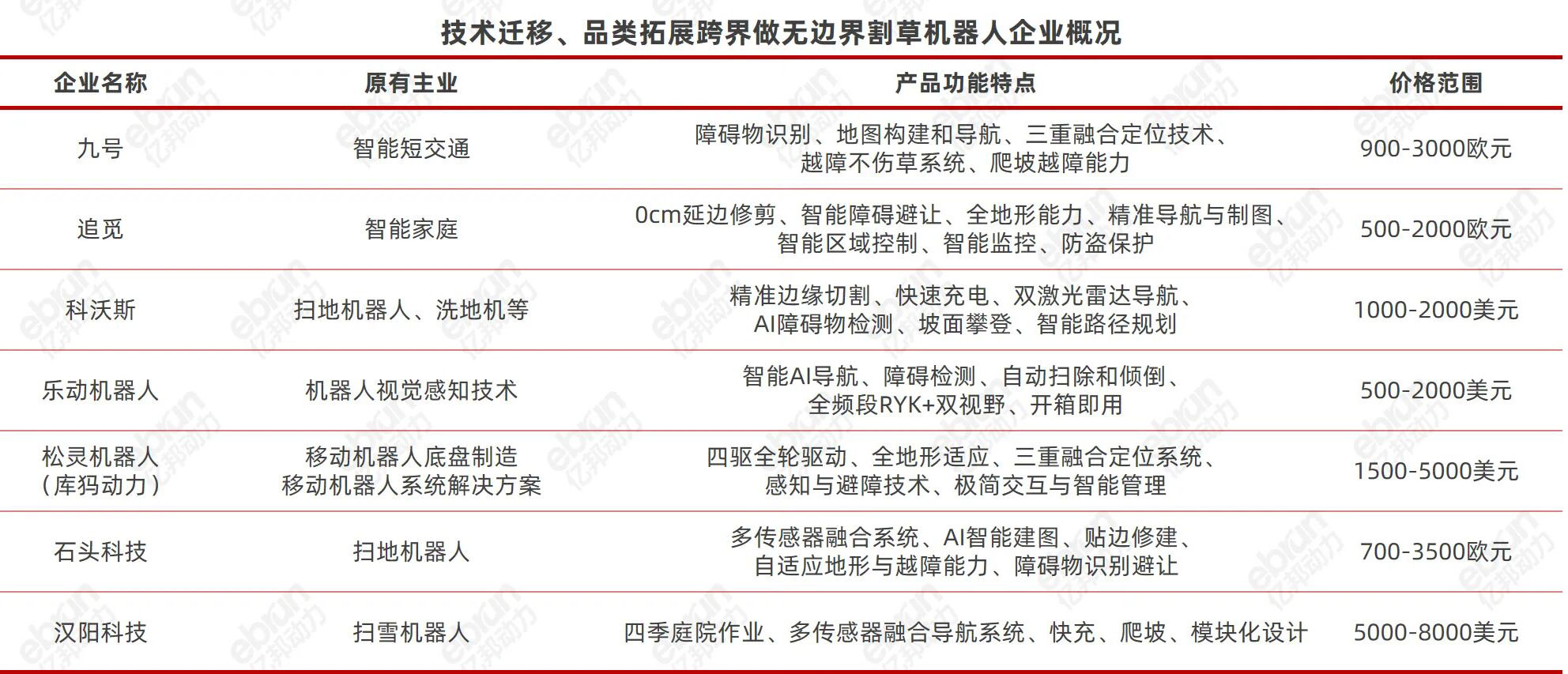
Under the "smart" label, crossover players' product price bands cover the full range, from entry-level to high-end. Moreover, as technology continues to optimize and product performance becomes increasingly stable, price competition is inevitable; consumers can experience products from leading companies for less than 1,000 euros, which helps penetration into the mass market.
3. Start-ups: Capital darlings pursuing differentiation, but also prone to rapid rise and rapid death
Start-ups that have targeted smart robotic mowers since inception mostly have teams composed of R&D-oriented talent with rich experience, and most come from the consumer electronics and internet industries rather than the garden tool manufacturing industry. To compete on the same stage with more experienced professional mower players, they choose a differentiation route. For example, Changyao Innovation, founded in 2022, adopted a pure vision solution relying on cameras when the industry generally used RTK and LiDAR for obstacle avoidance, and pioneered a four-wheel independent drive system in the industry.
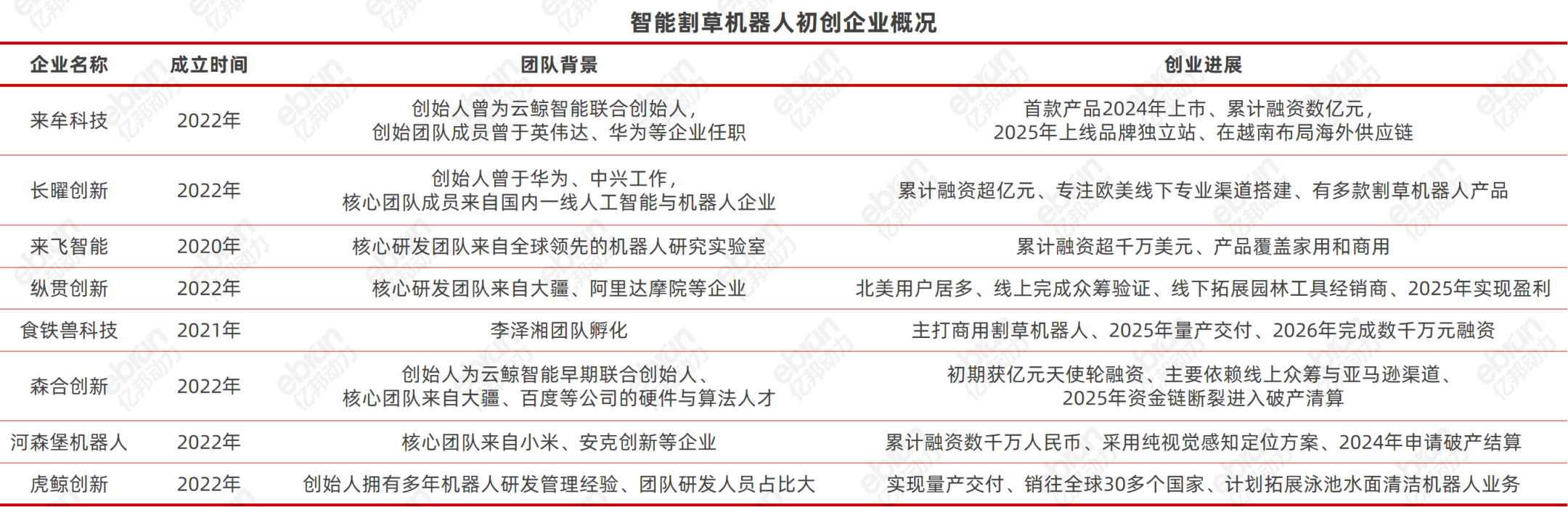
These young players do not have ready-made channel networks or brand power to rely on, and in the cold-start phase they often launch new products through crowdfunding. Compared with offline channels, entering online is faster and has a lower threshold, and selling through independent sites and platforms such as Amazon is also less difficult. However, from R&D to finished product and then to subsequent mass production and delivery, every step can be a life-or-death test for start-ups that rely heavily on financing.
Orca Innovation, for example, once faced mass production difficulties and channel pressure due to a lack of continuous financing. Senhe Innovation considered product performance but ignored cost; R&D and production investment quickly consumed financing funds, short-term profitability was not achieved, existing orders could not be delivered, and even a seemingly strong team R&D background could not withstand trial and error, ultimately leading to bankruptcy liquidation.
02
Technology dividends move toward monetization, underpinning the "cash-generating" logic of robotic mowers
Mowing is not a new demand, and the market for household mowers has always existed overseas. The reason various companies are betting on this cycle is that they see the product potential after technological upgrading. The hand of capital has also added fuel to the fire.
Of the world's 250 million private gardens, Europe and North America together account for 72%, and these regions also have a lawn culture stretching back hundreds of years, creating enormous daily maintenance demand. If someone is hired to mow the lawn, the annual cost may be in the thousands of dollars. At the same time, as overseas environmental policies tighten, electrification of garden equipment has become a major development trend.
Overseas market demand is not limited to "usable"; consumers are pursuing "easy to use." Compared with buried-wire robotic mowers, boundaryless robotic mowers incorporating smart technologies perform better in "out-of-the-box usability," with zero emissions, labor savings, and high efficiency, substantively improving the mowing experience.
Langhan Technology, a crowdfunding service provider that has served seven robotic mower brands, believes: "The less manual intervention required, the stronger the reason to buy." Huaxi Securities research also shows that applications such as boundaryless technology greatly improve the robotic mower experience and are expected to drive about three times the global sales growth space. In addition, overseas giants such as Husqvarna have been slow to shift to the boundaryless route, giving many Chinese brands opportunities to overtake on the curve.
In just over five years, boundaryless robotic mowers have evolved from early RTK self-built base stations to the adoption of visual fusion technology, and then to multi-sensor fusion solutions of "RTK plus LiDAR plus AI stereo vision," with positioning accuracy and obstacle avoidance capabilities both improving. After competing on technology, companies are also paying increasing attention to mowing results, and edge trimming has become a new competitive point. Companies such as Ninebot and Dreame all plan to make products "grow" robotic arms, while Anker is exploring solutions using built-in edging accessories.
The maturation of various application technologies in boundaryless robotic mowers, as well as gradually declining upstream component costs, is also making it easier for more companies to enter this track. LiDAR has dropped from tens of thousands of dollars to the current hundred-dollar level; modules such as RTK positioning can now be obtained for just tens of dollars. This undoubtedly brings down the prices of complete machines. Therefore, balancing cost and profit is also one of the assessment items in this race.

For example, a relevant person in charge at Dreame's outdoor garden unit said it will "adhere to a value-first pricing strategy" in order to achieve "healthy and sustainable profitability," and the profits obtained will also "feed back into technology iteration and localized service development, forming a positive cycle of R&D, service, and market."
From a financing perspective, robotic mowers are the category with the highest capital attention in the garden tool field. Companies' financing amounts range from tens of millions to hundreds of millions of yuan, and financing frequency is sufficiently high. In addition, the three types of competitors—traditional garden tool companies, crossover players, and start-ups—can all rely on external funding at different stages of development to maintain R&D investment, supply chain optimization, and market channel expansion.
Companies in the early financing stage have many financing rounds, with each round generally injecting around tens of millions of yuan. For example, from 2025 to date, Laimu Technology has gone through five financing rounds, rapidly advancing from Pre-A to B round, and its market performance has not disappointed: last year, its independent site achieved sales exceeding 100 million yuan within one month of launch. For companies that have already received initial market validation, financing amounts are larger. For example, Hanyang Technology and Muxin Intelligent reached B-plus and B round financing stages respectively this year, with single-round financing amounts both exceeding 100 million yuan.
Some companies' financial data also shows why they are betting on boundaryless robotic mowers. In 2025, Ninebot's service robot segment, dominated by robotic mowers, accounted for no more than 10% of total revenue, but its revenue growth rate was 104.26%, and gross margin was as high as 52.35% (the company's overall gross margin was 29.6%). Ecovacs and LDROBOT are similar: although robotic mowers are not the main revenue source, their growth potential cannot be ignored.
For these companies with scale effects, the markets of their original main businesses are approaching saturation, and they need to find a second growth curve. Therefore, robotic mowers, with higher average selling prices and mainly targeting overseas markets, have become a breakthrough point.
In crowdfunding, robotic mowers are also a popular category. Among products that have participated in crowdfunding in the past few years, there is no shortage of examples where crowdfunding amounts grew rapidly and far exceeded expectations shortly after launch.
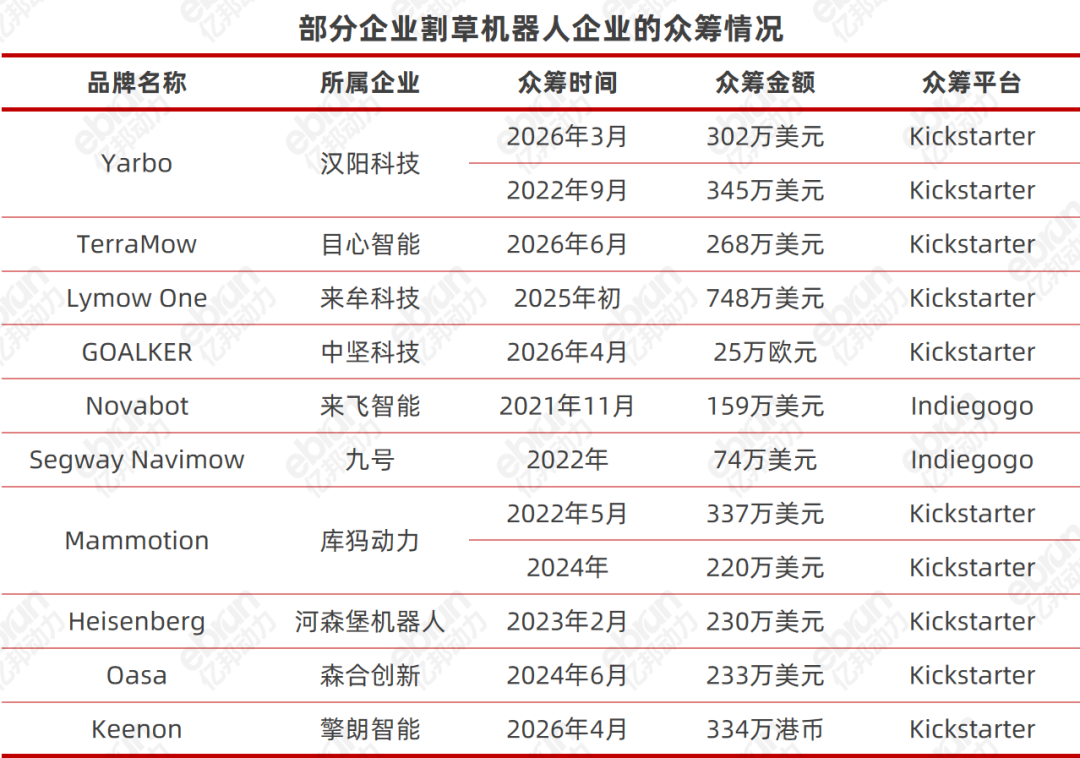
However, Wang Runlong, founder of Langhan Technology, said that in the past two years he would be more cautious in recommending robotic mowers for crowdfunding. When existing leading players continue to ship, later products participating in crowdfunding need to answer one question clearly: consumers can buy products in stock, so why should they pay in advance and wait for a new brand to deliver? In his view, robotic mower projects planning to participate in crowdfunding must have something truly worth users waiting for; relying only on a few individual parameters or a slightly cheaper price is far from enough.
03
Europe's "high stock" vs. North America's "fast growth": Which side should companies choose for overseas expansion?
Europe and North America occupy important weight in the global robotic mower market, but the two differ in market development stage and consumer demands.
Among them, Europe is regarded as the largest stock market for robotic mowers, accounting for 45%-52% of global robotic mower shipments; its growth logic is mainly the replacement of the existing stock of traditional buried-wire models, and consumers are also more likely to pay for a better product experience. In North America, lawns are larger, and consumers prefer products with large operation coverage, strong off-road capability, and long battery life. The penetration rate of smart mowers is far lower than in Europe, the popularity of boundaryless models is even lower, and the market is still in a product cultivation period.
The markets chosen by various overseas expansion companies are also mainly concentrated in these two battlegrounds. Facing differences between the two markets in climate, grass types, and garden conditions, Langhan Technology offered practical advice: "First fully penetrate one typical scenario, then expand outward."
Apart from a few companies (such as Laimu Technology and Hanyang Technology) that regard North America as their core market, more players regard Europe as the base for their robotic mower business. Dreame's outdoor garden unit, which prioritizes deep cultivation of the European market, told Ebrun that because of diverse working conditions such as steep slopes, standing water, and grass types, European gardens place higher demands on product stability and intelligent algorithms. This, in turn, helps temper technology and polish products, and the competitive advantage can still be maintained when entering other markets.
In addition, after holding the European market, Changyao Innovation began slowly expanding into the U.S. market this year. Greenworks, which originally treated North America as its main battlefield, is currently making a full landing in Europe.

The characteristic that the robotic mower "market is overseas" dooms industry development to be closely tied to changes in external policies. Over the past year, from the EU to the United States, Chinese robotic mower companies have experienced several ups and downs. Under external challenges that may continue in the future, everyone is also trying every means to build advantages that are difficult to replace.
Dreame's outdoor garden unit believes that outdoor scenario perception and AI algorithm capabilities, scenario-based product definition capabilities, and localized service capabilities are the core competitive points for robotic mowers in the future. Going overseas is not merely product export; it is the systematic landing of technology, products, services, and brands.
According to the introduction, the channel side of Dreame's outdoor garden business adopts a two-way online and offline drive. Online channels such as Amazon and independent sites are used to complete market penetration and reputation accumulation, while offline it covers local distributor resources by entering core global retail chains. To win entry into traditional distributor channels, product quality and technological innovation capabilities must be strictly controlled. To this end, Dreame's outdoor garden unit is also proactively exploring the future form of smart gardens—for example, the robotic arm mentioned earlier is one such example.
Langhan Technology emphasizes that, in addition to real product use scenarios, it is also necessary to focus on how to convert technological competitiveness into content trust. In its view, new products in mature categories must have delivery and service ready: "When consumers buy a machine they plan to use for several years, they will consider whether the brand will still be around and whether parts will still be available." "To dispel such concerns, Chinese teams, besides making the product, must also be willing to spend time in users' yards," Wang Runlong said, because only on site can one see the details that affect purchases and reputation.
Product R&D and production, sales and delivery—doing these well can pave a good starting point for robotic mower manufacturers going overseas. But whether they can build a long-term business depends on how much they can deliver after the promise is handed to users. In the overseas race of Chinese robotic mower manufacturers, product value and brand reputation are both indispensable.
Ebrun will continue to track and report this intelligence. To learn more information related to this article, please scan the QR code to follow the author's WeChat.

This article was first published on the official website of Ebrun.
[Copyright Notice] Ebrun advocates respecting and protecting intellectual property rights. Without permission, no one is allowed to copy, reproduce, or use the content of this website in any other way. If any copyright issues are found in the articles on this website, please provide copyright questions, identification, proof of copyright, contact information, etc. and send an email to run@ebrun.com. We will communicate and handle it in a timely manner.
Translated by AI. Feedback: run@ebrun.com