
Qianfeng Interview: Shuku's Huang Shuyu on the Integrated Chain of Data, AI, and Automation
[Ebrun Original] Huang Shuyu (nickname: Banxian) is the rotating CEO of Shenzhen Shuku Information Technology Co., Ltd. Shuku started with data collection, then entered the VOC and customer experience domain, and later expanded into RPA and automation, building a chain capability of "data acquisition — AI understanding — business judgment — automated execution." Currently, through MCP, Skill, and API, Shuku opens its data, analysis, and automation capabilities for AI Agent invocation, with overseas business covering key markets including North America, Europe, Japan, and South Korea. In this Qianfeng Award interview, Huang Shuyu discussed Shuku's practices and insights in the integration of data, AI, and automation, focusing on the modal evolution driven by AI and going global.
Ebrun: This year's Qianfeng Award centers on "Modal Evolution Driven by AI and Going Global," focusing on the deep restructuring of industrial capabilities. From the perspective of the software services industry, how do you interpret this round of industrial modal evolution driven jointly by AI and globalization? What are Shuku's core strategic layouts in AI capability building and global expansion? Could you introduce the company's positioning and business model in detail?
Huang Shuyu: We interpret this wave of "AI + globalization" not as two suddenly emerging new business lines for Shuku, but as a re-combination of capabilities accumulated over the past decade or so. Shuku started with data collection, addressing the question of "where does data come from"; later, we entered the VOC and customer experience domain, addressing "what does the data indicate"; then we moved into RPA and automation, addressing "how to execute after knowing." After the emergence of large models and Agents, these three types of capabilities began to truly form a chain: data acquisition — AI understanding — business judgment — automated execution. Therefore, our current positioning is not just a single-point software tool, but to combine data, AI, and automation into business capabilities that enterprises can directly invoke. Globalization follows the same logic. We have been serving global users through online SaaS for a long time. Now, AI further reduces the costs of product localization, content operations, and serving global markets, while also creating new demand for data and Agents.
Ebrun: In which core business processes has your company implemented AI/large model technology? What distinctive AI or digital intelligence competitiveness system has been formed?
Huang Shuyu: Currently, the deepest AI implementation at Shuku focuses on three scenarios highly related to our original businesses. First is VOC and consumer insights. Yunting CEM processes a large volume of unstructured data daily, including reviews, customer service conversations, surveys, and social media content. Previously, much of this work relied on rules and manual labeling. Now, large models can directly understand what users are saying, why they are dissatisfied, and how their needs are changing. Second is automation for e-commerce and enterprise operations. Bazhuayu RPA itself addresses repetitive processes. Now, we are enabling AI to handle judgment while RPA handles execution. For example, AI first identifies issues and judges tasks, then automation completes the follow-up operations. Third is Agent invocation of enterprise capabilities. Through MCP, Skill, and API, we are opening up the data, analysis, and automation capabilities previously encapsulated within software, allowing different AI Agents to call them directly.
Ebrun: You mentioned the cross-border auto parts customer Sangzhu. Could you specifically explain how RPA, AI, and business alerts are combined into a complete chain?
Huang Shuyu: In the business of Sangzhu, a cross-border auto parts customer, we integrated RPA, AI, and business alerts into a complete chain: RPA continuously collects data from Amazon such as prices, reviews, rankings, buy box status, and competitor promotions; AI is responsible for anomaly noise reduction, classification, and distribution; then robots push different levels of alerts to corresponding operations staff; finally, humans make key business decisions such as price adjustments and restocking. Therefore, our AI approach is not to create a standalone AI product, but to gradually Agentize our original CEM, RPA, and data capabilities.
Ebrun: Could you share a representative "AI value chain" innovation practice case? What industry common pain points does it solve, and what perceivable and quantifiable value does it create?
Huang Shuyu: A typical case is Xiaolv AI, a domestic e-commerce customer. Previously, from product selection to listing, operations staff had to manually search market data, find keywords, review competitors, then designers created visual materials based on operations requirements, and finally product information was manually assembled and listed. After the transformation, the customer introduced 7-8 digital employees: RPA automatically collects keyword trends, competitors, sales, and advertising data across all categories over the past year in the early morning; AI judges keyword trends, category volume, competition level, and profit margins, with humans making final judgments; then in the visual and listing phase, AI assists in generating proposals, and RPA completes the assembly and listing of product information and visual materials. The most direct change is that a process that once required three people to collaborate can now be run by one person alone; weekly new listings per store increased from about 10 to 50. This highlights an important aspect of AI value for us: it is not about how many models or Agents are used, but whether it truly changes business capacity and people's work patterns.
Ebrun: Regarding token and computing power costs, what is Shuku's stance?
Huang Shuyu: Regarding token and computing power costs, internally we focus more on the business value created per unit of model cost. If AI does not reduce manpower, improve conversion, or shorten decision-making cycles, then mere token consumption, no matter how large, is meaningless.
Ebrun: In the process of scaling AI implementation, what supportive role does the data element play? Does Shuku focus more on deep cultivation of proprietary industrial data, or on promoting cross-entity, cross-industry data collaboration? What is the core challenge?
Huang Shuyu: Data is a clear differentiator between Shuku and many pure AI companies. We did not start studying enterprise data only after the emergence of large models. Over the past decade, we have been addressing one problem: how to turn dispersed, unstructured, and constantly changing data on the internet into data that enterprises can use. Therefore, we have accumulated a comprehensive set of capabilities from webpage data acquisition, cleaning, and structuring, to analysis of unstructured data such as reviews, customer service conversations, and social media text. In the era of large models, the importance of this capability has actually increased. Models are becoming more general, but what enterprises truly lack is two types of data: internal real business data and external market data that is changing in real time. Shuku's advantage lies in the ability to help enterprises understand internal VOC while also connecting external market information. We believe that the true competitiveness of enterprise AI in the future is not about "whether a certain model is integrated," but about whether the enterprise can continuously provide high-quality, real-time, and business-relevant data to the model.
Ebrun: How do you view industrial agents rewriting B2B? Is there a long-term need for vertical large models? Where is the AI moat for industrial internet companies?
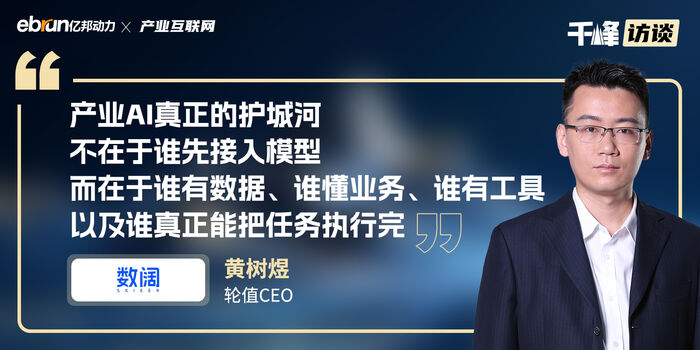
Huang Shuyu: Our judgment on vertical large models is relatively cautious. We do not believe that every industry needs to retrain a foundational model; foundational model capabilities will become stronger and more convergent. The truly valuable combination is likely to be: large models + accurate data and data that AI can understand + industry know-how + Agents. This is why we are currently paying more attention to Agents. Previously, a customer using Yunting or RPA had to enter the software, learn the interface, and configure tasks. In the future, users may only need to tell the Agent: "Help me see why recent negative reviews are rising," "Find the newly added selling points of competitors," or "Sync eligible products into the system," and the Agent will invoke different tools such as data services, CEM, and RPA behind the scenes. Therefore, we believe that the true moat of industrial AI is not about who connects to a model first, but about who has data, understands the business, possesses tools, and can truly complete tasks.
Ebrun: You mentioned that Shuku is internally rethinking "what form software should take." Traditional SaaS is menus, pages, and buttons—users must learn the software. What will it become in the Agent era? What does this mean for Shuku's capability openness?
Huang Shuyu: Over the past two years, we have seen a clear shift internally: we are rethinking "what form software should take." Traditional SaaS is menus, pages, and buttons—users must learn the software. The Agent era may become "users propose goals—Agent understands tasks—invokes different tools—returns results or executes directly." This is particularly important for Shuku because many capabilities we have accumulated—data collection, VOC analysis, RPA—are inherently well-suited to serve as Tools for Agents. Therefore, we are continuously advancing open capabilities such as API, MCP, and Skill. Our goal is not to lock users within a single product interface, but to enable Shuku's capabilities to appear within the AI platforms and workflows that users are already using.
Ebrun: Regarding overseas expansion, which key overseas markets has Shuku entered? What critical localization adjustments have been made?
Huang Shuyu: A distinctive feature of Shuku's overseas business is that we entered the global market early on through online SaaS, rather than establishing extensive local offices overseas before conducting business. Currently, we focus on key markets including North America, Europe, Japan, and South Korea. The core team remains in China, but dedicated operations staff are assigned for North America, Europe, Japan, and South Korea, continuously researching local user needs, search habits, content systems, competitive environments, and product feedback. This approach suits our business model: product development, technical support, and operations teams are concentrated in China, so market feedback can quickly reach product and development teams; at the same time, different markets have dedicated personnel, not simply translating English content into other languages. We understand that true localization does not necessarily mean "people being on the ground," but rather that products, content, acquisition methods, and user experience truly align with the local market.
Ebrun: In building deep value chains in overseas markets, what model has Shuku formed? What are the core capabilities?
Huang Shuyu: Over a long period in our overseas business, we have increasingly realized that the capability structure for digital product globalization is completely different from that of traditional manufacturing going global. We do not need overseas warehouses, nor do we have complex logistics. What truly determines efficiency is three things. First, whether the product can be standardized—the same underlying product must be able to serve users in different countries. Second, whether the entire business chain can be completed online—users should complete the journey from search, learning about the product, registration, trial, payment, to renewal as much as possible online. Third, whether we can continuously conduct market-specific operations—traffic structures, user awareness, and product demands vary greatly across countries. Once this set of capabilities is formed, the marginal expansion cost will be significantly lower than traditional globalization. Now, we are taking the next step: gradually evolving from "one user uses one SaaS" to "AI Agents can directly invoke our capabilities." I believe this may be a significant change in software globalization in the next phase.
Ebrun: In the overseas expansion process, what core support do AI and digital capabilities provide for cross-border business?
Huang Shuyu: AI's impact on our overseas business has two layers. The first layer is improving global operational efficiency. Since we do not deploy extensive local teams overseas, digital operations are particularly important. AI can assist with user feedback analysis, content production, localization, SEO, customer service, and market research for different markets, enabling a team based in China to manage multiple regional markets. However, the second layer is actually more important: AI is creating new overseas demand. In the past, customers used data collection tools primarily for market research, price monitoring, marketing, or building databases. Now, a large number of global AI Agents and AI applications face a common problem: models know a lot of knowledge but lack real-time, structured, and continuously available external data. This aligns closely with the data capabilities we have accumulated over the long term. Therefore, for Shuku, AI serves both as a tool to improve overseas operational efficiency and as a potential major driver for the next phase of overseas business growth.
Ebrun: You mentioned that Chinese software going global may create a new path—not necessarily every enterprise needs to build a new sales and service system in every country, but rather turn its core capabilities into foundational capabilities that the global AI ecosystem can directly invoke. How should this judgment be understood?
Huang Shuyu: Over the past few years, we have gained deep insights into Chinese software going global. In the past, the core of software globalization was "how to sell a Chinese software to overseas users." However, in the Agent era, a change may occur: in the future, not only humans use software—AI will also use software. A software product, in addition to having an interface for humans, also needs to be discoverable, understandable, and callable by Agents. This is why we increasingly emphasize API, MCP, and Skill. For Chinese SaaS companies, this may open a new path for globalization: not every enterprise needs to build a full sales and service system in every country; they can instead turn their core capabilities into foundational capabilities that the global AI ecosystem can directly invoke. We believe this will be a highly noteworthy opportunity in the coming years.
As the annual bellwether of the B2B sector, the "2026 8th Ebrun Industrial Internet Annual Conference & First Industrial Agent Conference" will be held in Beijing on November 20, 2026. The theme is "Modal Evolution Driven by AI and Going Global," focusing on deep discussions of cutting-edge topics such as industrial agent implementation, AI supply chain value reconstruction, data elements and token economy, and new ecosystems for industrial going global. The conference will bring together academic authorities, central SOE benchmarks, industry leaders, investment institutions, and service ecosystem partners to gather core industrial forces, deconstruct digital transformation paths, and share cutting-edge practical experience. Concurrently, the annual industrial internet report and benchmark cases will be released, along with closed-door meetings for decision-makers and the "Qianfeng Award" ceremony.

This article was first published on the official website of Ebrun.
[Copyright Notice] Ebrun advocates respecting and protecting intellectual property rights. Without permission, no one is allowed to copy, reproduce, or use the content of this website in any other way. If any copyright issues are found in the articles on this website, please provide copyright questions, identification, proof of copyright, contact information, etc. and send an email to run@ebrun.com. We will communicate and handle it in a timely manner.
Translated by AI. Feedback: run@ebrun.com