
Ebrun Research and LianLian Digital Jointly Release "New Growth in Foreign Trade: B2B Business Opportunities in Emerging Markets"
[Ebrun Original] On October 15, 2026, the 140th China Import and Export Fair (Canton Fair) opened at the Pazhou Complex in Guangzhou. Known as a barometer of China's foreign trade, the Canton Fair has seen a steady shift in the composition of its international buyers in recent years. According to the organizer's data, as of May 4, 2026, the 139th Canton Fair attracted 314,000 overseas buyers from 220 countries and regions. The growth in new buyers primarily came from countries participating in the Belt and Road Initiative, with particularly rapid increases from Latin America and Africa. This shift in buyer demographics further underscores the changing center of gravity in China's foreign trade.
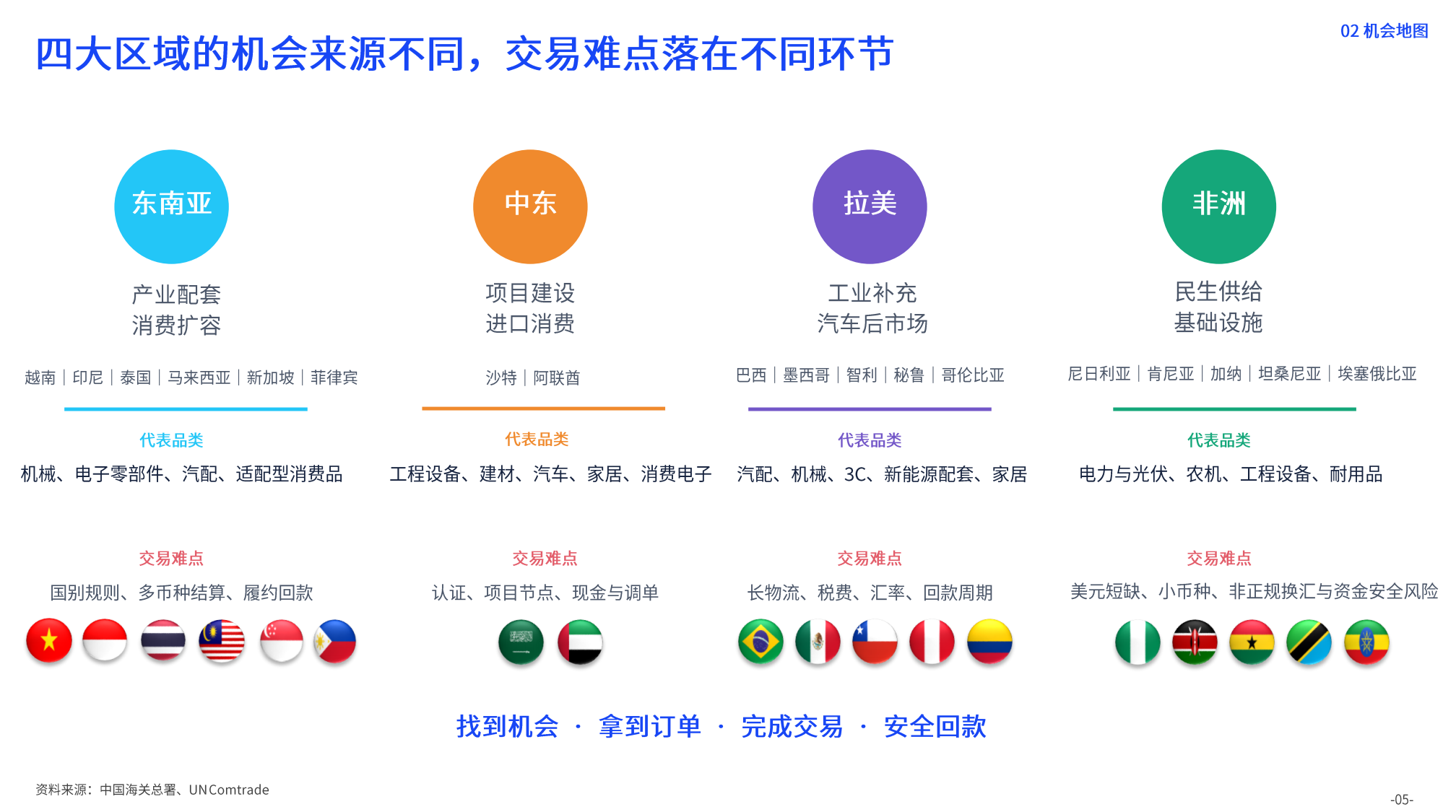
On the same day, Ebrun Research and LianLian Digital jointly released "New Growth in Foreign Trade: B2B Business Opportunities in Emerging Markets" (hereinafter referred to as the "Insight Report"). The report points out that incremental growth in emerging markets stems from the simultaneous alignment of upgrading demand, China's supply chain advantages, and institutional dividends. It maps out four key regions—Southeast Asia, the Middle East, Latin America, and Africa—as an "opportunity map," clarifying the representative product categories and transaction challenges in each region. Through four merchant practice case studies, it presents complete pathways for ensuring secure payment recovery under different market trading environments.
01
Why Are Emerging Markets Becoming the New Engine of Foreign Trade?
1. Demand Side: Strong Import Growth and Higher Procurement Standards
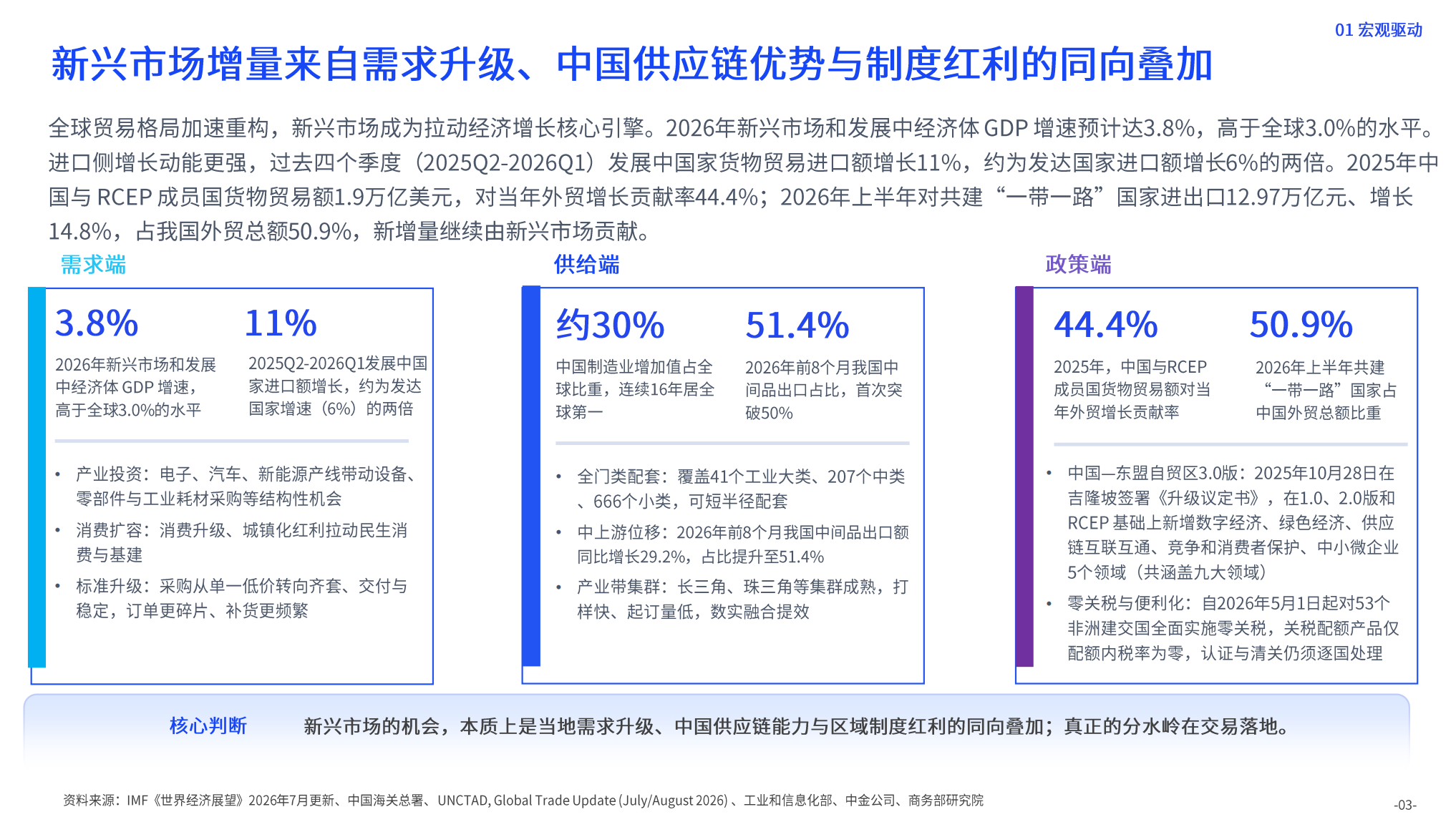
According to International Monetary Fund data, GDP growth in emerging markets and developing economies is expected to reach 3.8% in 2026, higher than the global average of 3.0%. Import-side growth momentum is even stronger: per UNCTAD data, over the past four quarters (2025Q2–2026Q1), goods trade imports in developing countries grew by 11%, roughly double the 6% growth rate of developed economies. Procurement demand is shifting from purely low-cost considerations to requirements for complete product assortments, stable delivery, and upgraded standards. Fragmented orders and high-frequency replenishment have become the new normal.
2. Supply Side: China's Supply Chain Advantage Moves Upstream
China's manufacturing value-added accounts for approximately 30% of the global total, ranking first worldwide for 16 consecutive years. It possesses full-spectrum supporting capabilities covering 41 industrial categories, 207 subcategories, and 666 specific product classes. In the first eight months of 2026, China's intermediate goods exports grew by 29.2%, with their share rising to 51.4%—surpassing half for the first time. Mature industrial clusters in the Yangtze River Delta and Pearl River Delta regions offer rapid sampling, low minimum order quantities, and continuous efficiency gains from digital-physical integration.
3. Policy Side: Sustained Release of Institutional Dividends
Regional trade agreements and tariff policies are paving the way for emerging market trade. In 2025, China's goods trade with RCEP member countries reached $1.9 trillion, contributing 44.4% to the year's foreign trade growth. In the first half of 2026, imports and exports with Belt and Road partner countries totaled 12.97 trillion RMB, up 14.8%, accounting for 50.9% of total foreign trade. Additionally, the Protocol for the 3.0 Version of the China–ASEAN Free Trade Area has been signed, and starting May 1, 2026, zero tariffs are fully implemented for 53 African countries with which China has diplomatic relations (quota products are zero-tariff only within quota limits).
02
Opportunity Map and Transaction Challenges in Four Regions
1. Southeast Asia: Accelerated Localization of Industrial Chains Unleashes Dual Opportunities
Market Opportunities: In the first half of 2026, China–ASEAN trade totaled $626.14 billion, up 22.5% year-over-year, with exports to ASEAN reaching $396.23 billion, up 22.9%. Demand structures exhibit a coexistence of industry investment drivers (electronics, automotive, new energy production lines), consumption expansion drivers (home appliances, 3C electronics, home furnishings), and infrastructure/energy drivers (electricity, photovoltaics, energy storage).
Transaction Challenges: Fragmented country-specific regulations (varying labeling and importer registration rules), multi-currency settlement and exchange rate fluctuations affecting quoted profit margins, and long approval times from traditional banks that increase working capital tied up.
2. Middle East: Non-Oil Economy Drives Procurement Diversification
Market Opportunities: In Q1 2025, non-oil activities accounted for 73.2% of the GCC's real GDP. In the first half of 2026, China–Arab non-oil trade reached approximately $49.2 billion, up about 18%. Demand is extending from infrastructure project construction to channel consumption: project-based procurement covers engineering equipment, construction materials, and photovoltaic/energy storage accessories; channel-based procurement covers automotive and parts, consumer electronics, and adapted consumer goods.
Transaction Challenges: Supplier registration and destination-country certification come first (e.g., SASO/SABER, ECAS); staged payments and acceptance/warranty milestones determine cash flow; cash payments and third-party settlements are common, requiring local corporate accounts and compliant tax records.
3. Latin America: Industrial Supplement and Automotive Aftermarket Expansion
Market Opportunities: In Q1 2026, regional imports grew 9.7%. In the first half of the year, China's exports to Latin America reached $159.43 billion, up 12.8%. The region has over 85 million vehicles, and China accounts for 35–40% of its finished brake parts imports. Mexico's nearshoring is driving demand for supporting parts, while Brazil, Chile, Peru, and Argentina each present structural opportunities.
Transaction Challenges: Long transportation chains, port congestion, and high transshipment fee volatility; combined customs HS classification, import tariffs, and local taxes; high volatility of local currencies like BRL and MXN; extended credit periods for dealers, making working capital a bottleneck for expansion.
4. Africa: Simultaneous Growth in Demand for Essential Goods and Infrastructure
Market Opportunities: Africa is the youngest continent globally, with a median population age of just 20.3 years in 2025 and an urbanization rate of about 45% (roughly equivalent to China's level around 2007). In the first half of 2026, China–Africa trade reached $203.55 billion, up 24%, including exports to Africa of $130.01 billion, up 26.2%. Demand is concentrated in electricity and new energy, construction materials and urbanization, and essential goods supply.
Transaction Challenges: Verification of buyer payment capability and the ultimate payer; limited dollar quotas in some countries; prevalent settlement in minor currencies; informal currency exchange that risks account freezing; long settlement cycles that constrain order-taking and replenishment.
03
Lessons and Insights from Merchant Practices
The four practice case studies come from Southeast Asia, the Middle East, Latin America, and Africa. The markets differ, and the pain points vary, but all point to the same critical factor: after securing an order, whether local payment collection, compliant FX conversion, and capital turnover can be smoothly linked directly determines whether the transaction can truly be completed.
Southeast Asia | Shenzhen Yueyang Optoelectronics Co., Ltd.: A manufacturer of electronic components and LED light sources, heavily reliant on cash payment for raw materials, requiring extremely high timeliness for advance payment arrival. Exchange rate fluctuations affect quoting and profits, and capital speed directly impacts ability to secure inventory.
LianLian provides local accounts in Singapore, Thailand, Philippines, and Indonesia, with direct receipt in six local currencies, supporting flexible FX hedging and locally staffed customer service, enabling centralized management of collection, conversion, and payment, with real-time settlement, greatly improving working capital turnover and order execution efficiency.
Middle East | A Dubai Dragon Mart trading company: Purchases goods on behalf of foreign buyers without corporate accounts and advances payment. After receiving payment, they cannot directly convert to RMB through settlement, and informal exchange poses risks of account freezing and compliance violations.
LianLian offers a local Dubai account, with dirhams arriving in 1–2 hours at the fastest, instant conversion and settlement, full online traceability, tax compliance, and on-site local team service. The entire commission-based procurement payment chain is unblocked, upgrading the enterprise to a LianLian channel partner, with growth in both business and revenue.
Latin America | Yuxinfeng Group: A leading OEM in LED automotive lighting. With payments spread across five Latin American countries, minor currency conversion costs are high, exchange rate volatility poses capital safety risks, and slow payment recovery constrains R&D and production capacity investment.
LianLian provides local collection accounts in Brazil, Mexico, Argentina, Peru, and Colombia, with five currencies channeled into transparent accounting, 7×24 real-time FX conversion, and one-stop multi-currency management. Local accounts, local currency receipts, and real-time conversion form a complete chain, where recovered funds directly support production capacity and R&D investment.
Africa | Ant Car: An authorized used car dealer for Sinotruk, with 2025 export revenue of 360 million RMB, more than tripling in one year. Buyers often struggle with payment outbound due to insufficient dollar quotas; wire transfers take 3–7 days and are prone to posting delays; third-party payments risk triggering risk control freezes; and multiple accounts raise reconciliation costs.
LianLian enables rapid receipt in twelve African local currencies, 7×24 real-time FX conversion, and direct dollar payments to suppliers, adapting to local settlement rules in various countries, with fully compliant transaction chains and complete audit trails.
For more details, please click the link to access the full version of "New Growth in Foreign Trade: B2B Business Opportunities in Emerging Markets."
Originally published on the official Ebrun website.
[Copyright Notice] Ebrun advocates respecting and protecting intellectual property rights. Without permission, no one is allowed to copy, reproduce, or use the content of this website in any other way. If any copyright issues are found in the articles on this website, please provide copyright questions, identification, proof of copyright, contact information, etc. and send an email to run@ebrun.com. We will communicate and handle it in a timely manner.
Translated by AI. Feedback: run@ebrun.com