
Geek Tool Becomes Kids' Toy: Is 3D Printing 'Killing It' in Niche Markets?
By Han Xiao Edited by He Yang
[Ebrun Original] A 3D printer costs a few thousand yuan, an experience class costs 200 yuan per session, and a summer camp runs over 2,000 yuan. Once the machine is running, filament consumption adds a continuous drain on the wallet—no wonder some joke that "even the wealthiest middle-class families are being emptied by 3D printing." Yet parents of the new era, who firmly believe in "instead of buying toys for kids, let them build their own," are confidently paying the bills. During this year's JD.com 618 shopping festival, sales of children's 3D printers surged over 8 times year-on-year, backed by the real money of these parents.
Major 3D printing manufacturers are not letting this blue ocean slip away. In its latest mid-year report, Creality explicitly stated it would launch a new series of children's-specific printers in the second half of the year, focusing on the convenience and stability of 3D printing for kids aged 4 to 15. Anycubic has set up brand zones at children's amusement parks like NEOBIO and Panxiaobao to precisely target parent-child users. Bambu Lab, meanwhile, has been promoting market education among family users through offline stores offering experience classes, partnering with education institution Xueersi to launch 3D printing courses, and collaborating with family entertainment brand meland to create offline 3D printing spaces.
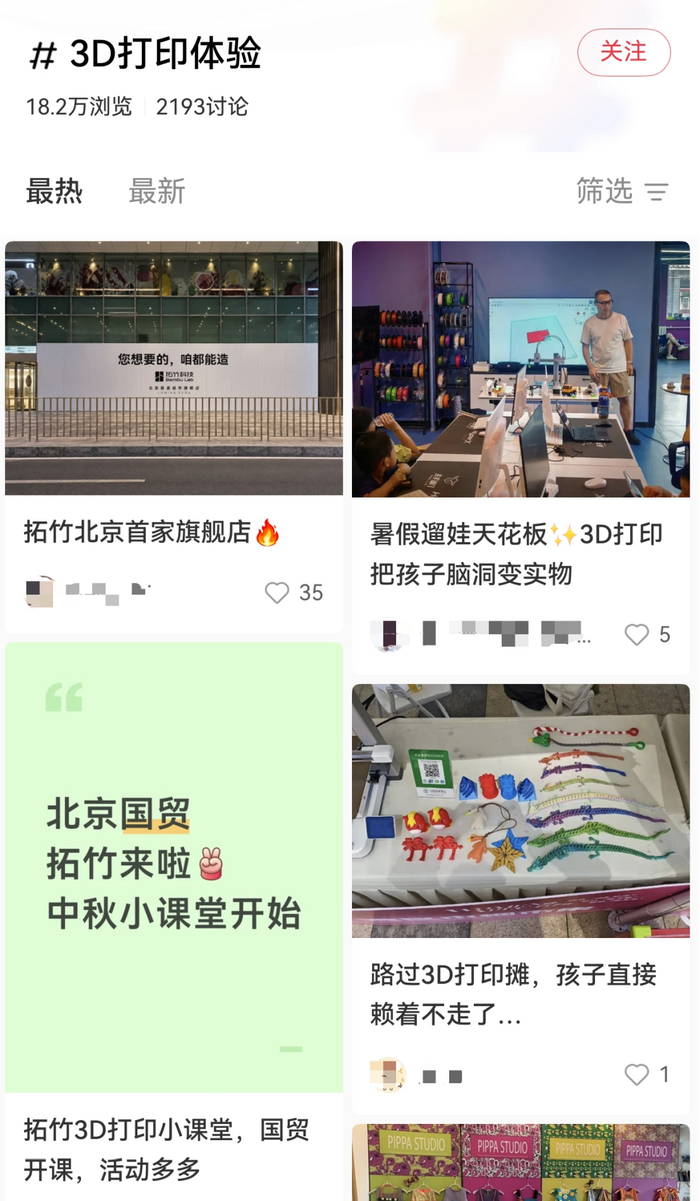
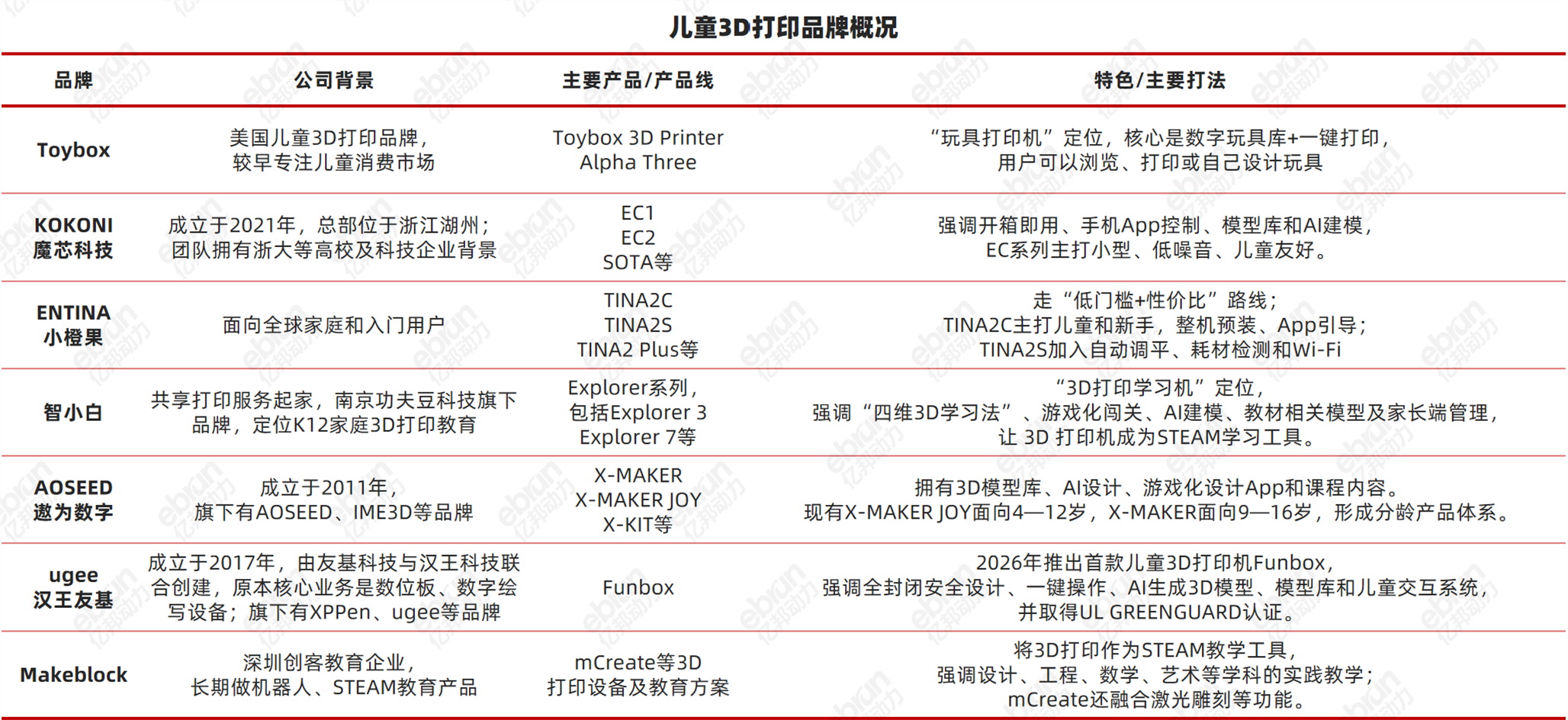
At the same time, more brands dedicated to children's and home-use printers are emerging: Hanwang Youji, KOKONI (Magic Core Technology), ENTINA (Xiaochengguo), Zhi Xiaobai, AOSEED (Aowei Digital)… Given 3D printing's solid positioning as a "productivity tool," can children's 3D printing, which targets a niche market, carve out a viable path?

Children's 3D Printing Surges: Old Players and New Entrants Compete
According to JD.com data, since the start of this year, sales of 3D printers and related accessories and filament have grown over 100% year-on-year. Among them, parent-child households have become a new growth point for consumer-grade 3D printing, with 37.5% of respondents purchasing their first 3D printer for their children's tech enlightenment and STEAM education.
Leo's mother shared her child's experience with the Bambu Lab A1 mini on social media: As a 7th birthday gift, Leo is obsessed with the printer, printing at least one creation daily, and even attempting his own 3D modeling—his first original model was a counter resembling an abacus. She noted that while excessive tablet time is concerning, this gift brings "creative joy," and so far it's been well worth it. She plans to take Leo to a local market to sell his creations, hoping he learns about pricing and sales.
The Bambu Lab A1 mini is an entry-level printer that offers a compact size, auto-calibration, and a price around 1,200 yuan. Products like the A1 mini or Creality's SPARKX i7, launched this year, have become popular choices for many households—affordable and backed by a rich model ecosystem. An industry insider told Ebrun that his 5-year-old daughter also uses the A1 mini to start prints and remove objects. He believes kids lose interest in toys quickly, so models like the A1 mini, which can double as a child's toy and a work tool, are ideal.
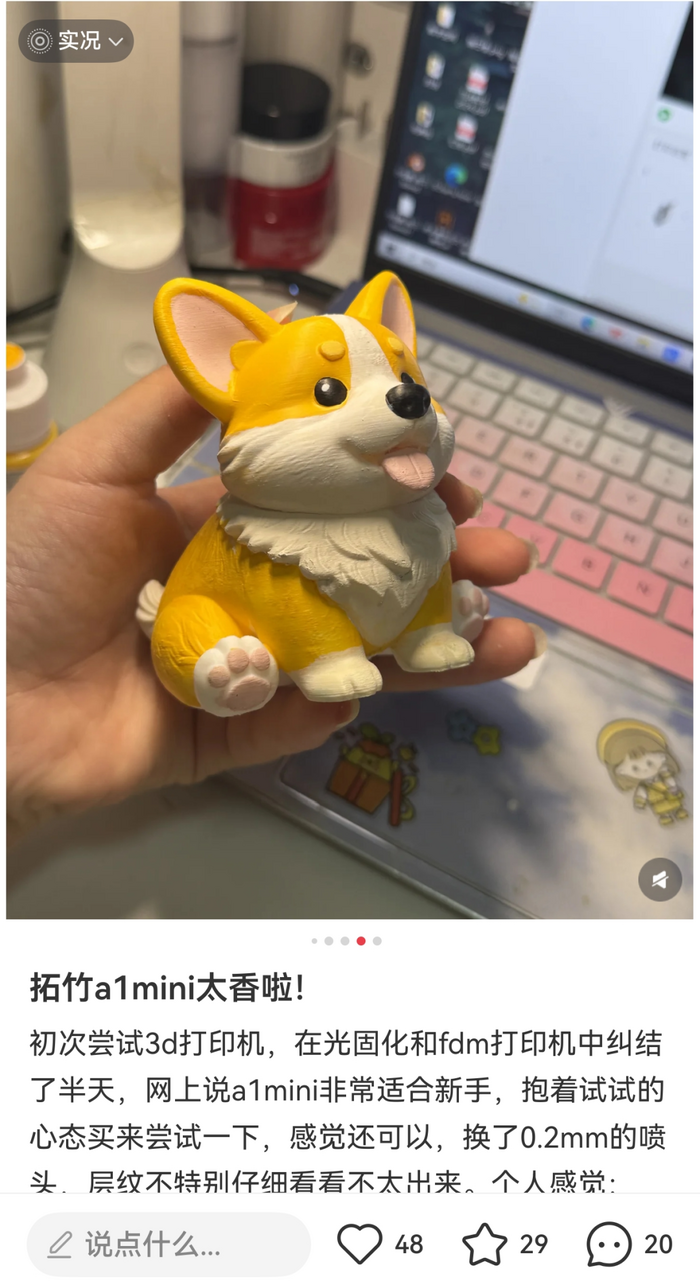
Image source: Yezi
However, the A1 mini features an open-frame design with exposed nozzle, heated bed, and moving parts. For professional users, this design helps control costs and simplifies manual nozzle cleaning, part adjustments, and troubleshooting. But for children, an enclosed model might be safer, preventing accidental contact with the hot nozzle and heated bed, avoiding burns or pinching. Therefore, some parents opt for higher-priced enclosed models like the Bambu Lab P1S for safety.
Perhaps the gap left by leading brands' entry-level products has become a key opportunity for specialized children's and home-use manufacturers. WeBest, founded in 2014, has officially launched its home printer brand ENTINA in the Chinese market this year. According to founder Cao Jie, ENTINA's home 3D printers feature a semi-enclosed design, ready to use out of the box without manual configuration, while ensuring safety. "Professional users might need fully enclosed designs for toxic filaments, but we use PLA eco-friendly filament, so full enclosure isn't necessary," he explained. ENTINA's pricing is also friendly—standard configurations cost around 800-900 yuan, slightly lower than the Bambu Lab A1 mini. During the 618 sales period, its single-product online sales approached 3,000 units, ranking first in 3D printer sales under 2,000 yuan on Tmall.
Brands like ENTINA, dedicated to children's printers, are increasingly emerging, offering households a wider range of choices. The most recent buzz surrounds Deli Group, a stationery and office supplies giant, entering the market. Although currently only confirmed through job postings, market observers widely believe Deli—which already offers children's 3D printing pens—will develop children's 3D printers, leveraging its offline channels to reach potential users. Additionally, Hanwang Youji's digital drawing brand ugee officially launched its first children's 3D printer, Funbox, in July, bundled with the ArtPlay Pad drawing tablet—with AI assistance, young users can quickly generate printable 3D models via voice, text, or hand-drawn sketches.
Nanjing Kung Fu Bean Technology, which started in shared printing services, leveraged its technical expertise and channel advantages to enter the home education market, launching its children's 3D printing brand Zhi Xiaobai this year. Even upstream material suppliers are joining the fray. Shengjialun, a TPE material manufacturer with nearly 30 years of history, launched "Line & Dot" (Xiantiao Bōdiǎn), a material brand for home creation, educational practice, and artistic expression. Brand head Wang Yu explained that Shengjialun has established multiple automated production lines dedicated to children's products, with strict separation of personnel and logistics flows to avoid cross-contamination with industrial materials.

Breaking Through: Price, Usability, and Safety
Children's 3D printing isn't a brand-new category. Before it, products like 3D printing pens and AI sticker printers validated market potential. A 3D printing pen is essentially a "handheld 3D printer" that replaces the nozzle with a pen tip; it still uses fused deposition modeling (FDM), just drawing objects in the air. In 2013, American company WobbleWorks launched the world's first such product, 3Doodler, via Kickstarter, selling over 5 million units to date. Prices range from tens to 200 yuan, far below the thousand-yuan printers, and they don't require modeling skills, making them a no-brainer toy purchase.
3D printing pens once trended among students, with many models selling over 10,000 units monthly on e-commerce platforms, and top sellers exceeding 100,000 cumulative units. Another successful children's product is the AI printer from U.S. company Stickerbox. Priced around $100, it's a voice-activated printer for kids—press a button, speak an idea, and receive a colorable sticker within seconds. It sold out 13 times in nine months post-launch, demonstrating remarkable demand. Stickerbox also excels at child-safety compliance, adding a self-developed "child safety filter layer" that blocks violent, pornographic, and profane content. If a sensitive word is detected, it prints a safe, related, and slightly vague image—e.g., if the prompt includes "chest," Stickerbox might print a cartoon of an ordinary girl.
Compared to 3D printing pens, the main barriers to 3D printers entering the children's market were high prices and the learning curve for modeling. As technology matures, price barriers are shrinking. China Youth Net data shows consumer-grade 3D printer prices have dropped 60% over three years, with mainstream brands focusing on the 2,000-3,000 yuan range, while children's and entry-level products typically cost around 1,000 yuan.
Usability is another area where children's 3D printing brands strive for "out-of-the-box" experiences. Standard printers often require platform leveling, nozzle height calibration, and filament parameter settings before use. Children's and entry-level models automate leveling, calibration, and presets, simplifying the slicing software, so users just load filament and models. For instance, Zhi Xiaobai's machines preset five quick-print options, selectable via a physical dial without phone connectivity; filament loading/unloading uses physical buttons, not screen controls.
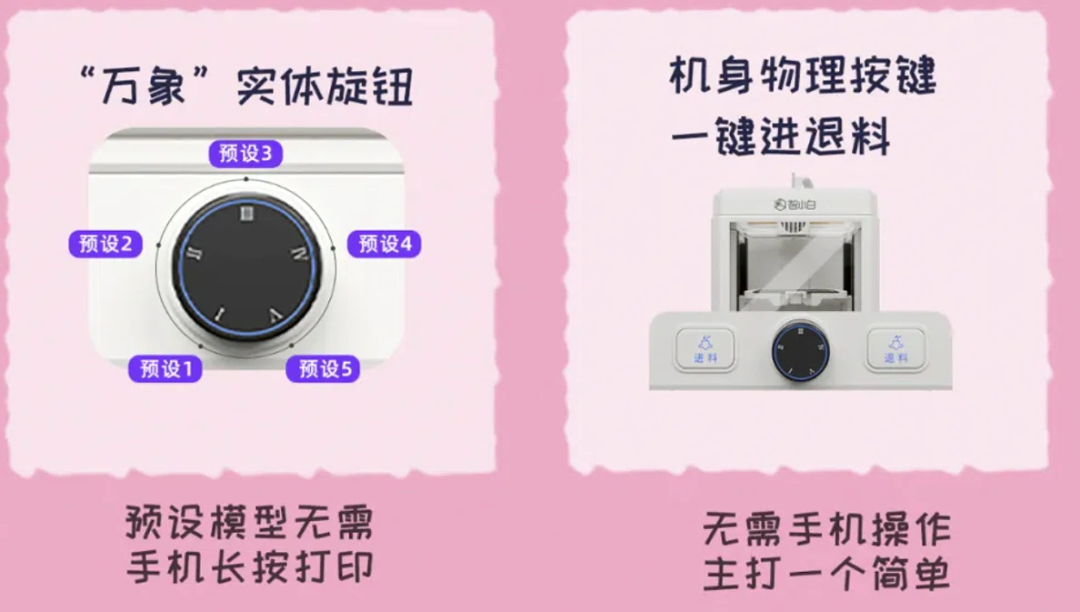
"To make a device simple to use, the backend technology is actually more complex than for a professional device, just like Apple's smooth experience hides hard-to-imitate design and manufacturing. We also aim to use complex technology to deliver excellent user experience," said ENTINA founder Cao Jie. Beyond hardware simplification, software—rich model libraries and AI-assisted modeling—greatly lowers barriers. U.S. company Toybox, one of the earliest children's 3D printing brands, integrated a vast library of adapted toy models; users select and print. To date, over 10 million toys have been printed, with 7,000+ digital models, and Creator Space and AI tools lower design barriers for kids.
For home scenarios, Cao Jie said ENTINA sacrifices high-speed and performance features to emphasize ease-of-use and safety. Safety is also a major concern for parents. In 2022, a Korean research team reported sarcoma cases in three high school teachers who used 3D printers long-term, though no direct causation was established. Safety can be addressed through technical routes and filament choice. FDM (fused deposition modeling) remains the primary choice for home and children's products, as resin-based photopolymerization offers better precision but risks air pollution and fumes. Filament quality is crucial—poor quality can harm health and cause machine issues. Children's filament uses PLA, an eco-friendly material also used in straws. Shengjialun's Wang Yu noted a "flour costlier than bread" situation: children's filament commands higher prices due to vibrant colors, smaller packaging, and better machine compatibility. To suit children's lower strength and usage amounts, the "Line & Dot" brand launched a 250g small-spool set—four spools for 128 yuan, or 32 yuan each. Generally, if filament drops below 30 yuan per kilogram, it's best to avoid for kids due to potential filler or safety risks.

From Overseas to Domestic, From B2B Teaching Aids to C-end Households
In Cao Jie's view, the term "children's 3D printer" is essentially a domestic variant of home 3D printers. "Overseas, we target home scenarios; many users create household items. But domestic e-commerce is so convenient, and there's less home-making culture, so we shift focus to children's education." ENTINA's overseas users are predominantly women, mothers, and seniors, unlike typical geeks. "Daily items, decorations, kitchen goods—like cookie molds or cake molds—rarely get made at home here, but foreigners love it," Cao added.
3D printing originated in the West. In China, professional markets for farmers, studios, and makers developed well, and entering households is seen as the next step, though market size remains small. Industry reports suggest that, compared to robot vacuum penetration curves, 3D printing's shipment volumes are akin to 2015-2016, still early stage. ENTINA has focused on home markets for years, but revenue still largely comes from overseas. Domestically, ENTINA only runs conversion-focused promotions like social media ads, skipping brand-focused events like trade shows. "The U.S. is at least five years ahead; their consumer sales are already significant," Cao noted.
Unlike overseas home usage, domestic sales lean on school procurement. "Previously, demand only came from education, similar to current humanoid robots—mainly schools, no real demand elsewhere." According to Cao, China's first 3D printing boom started in 2014, the year his company was founded, when schools began building STEM curricula, making 3D printers standard equipment. "3D printers and drones were must-haves. In Jiangsu and Zhejiang schools, most 3D printers were ours, while drones came from DJI." The downside of relying on education was "orders follow school procurement trends." Post-pandemic, school orders declined as procurement shifted to AI and robotics; "everyone who wanted one already bought it," pushing education into a stock phase. Data confirms this shift: China's 2025 education and research robot procurement budget is expected to grow 36.2% year-on-year, covering over 12,000 primary/secondary schools and 260 universities. In contrast, the global educational 3D printing market is about $501 million in 2025, projected to reach $679 million by 2032, a CAGR of about 4.5%—significantly slower than education robots.
Sales channels have also transformed. Initially, schools bought via distributors with special funds—a single printer could cost over 10,000 yuan, and a lab purchase might reach hundreds of thousands. Now, printers cost a few thousand yuan, and a lab setup may just be tens of thousands, purchasable directly on e-commerce platforms. There's also a divide between 3D printer makers in Jiangsu-Zhejiang and Shenzhen in terms of channel DNA. "Shenzhen companies started with e-commerce self-operation; we (WeBest, based in Nanjing) relied more on overseas distributors," Cao recalled. He noted Creality as the first brand to scale rapidly via e-commerce, setting an industry benchmark. WeBest began Amazon sales in 2021 during the cross-border e-commerce boom and now sells on Amazon, Walmart, Temu, TikTok, with Amazon leading volume and Temu also significant due to value-for-money. Domestically, ENTINA is listed on JD.com, Tmall, Pinduoduo, Xiaohongshu, and Douyin, with Tmall seeing the most shipments; JD.com's official channel heavily promotes 3D printing, so this year they moved from POP store to JD's self-operated store.
While the education market cools, the home market is just warming up. With more entrants, children's 3D printing products and ecosystems will enrich. "The home market is huge, but domestic penetration is very low and needs long-term cultivation; it's hard for any single player to dominate," Cao pointed out. As more families complete their first print, this track's story is just beginning.
Ebrun continues to track this intelligence. For more information related to this article, scan the QR code to follow the author's WeChat.

This article was first published on Ebrun's official website.
[Copyright Notice] Ebrun advocates respecting and protecting intellectual property rights. Without permission, no one is allowed to copy, reproduce, or use the content of this website in any other way. If any copyright issues are found in the articles on this website, please provide copyright questions, identification, proof of copyright, contact information, etc. and send an email to run@ebrun.com. We will communicate and handle it in a timely manner.
Translated by AI. Feedback: run@ebrun.com