
Temu's Localization Push in Europe: A Year of Strategic Moves
[Ebrun Original] Temu is presenting a new development posture in Europe. Not long ago, Temu filed an appeal against a ?200 million fine imposed by the European Commission under the Digital Services Act (DSA). The Commission had determined in May that Temu failed to adequately identify and assess the systemic risks of illegal goods on its platform. This is not the first time Temu has been under the scrutiny of European regulators. Over the past two years, low-cost cross-border e-commerce platforms, led by Temu, have rapidly entered the daily lives of European consumers, becoming a focal point of societal concern. However, looking back over the past year, another parallel trajectory emerges: starting in late 2025, Temu has been actively working to reshape its relationship with the European market and improve its public image. It has begun engaging more frequently with European regulators, industry organizations, local merchants, and third-party service providers. From seller compliance and product testing to environmental responsibility and local fulfillment, and onward to local merchant recruitment and seller education, its actions have become increasingly specific. Temu seems to be answering a critical question through more local partnerships, deeper compliance investments, and broader industry connections: How does it intend to transform from a "foreign e-commerce platform" into a long-term participant and builder within the European business ecosystem?
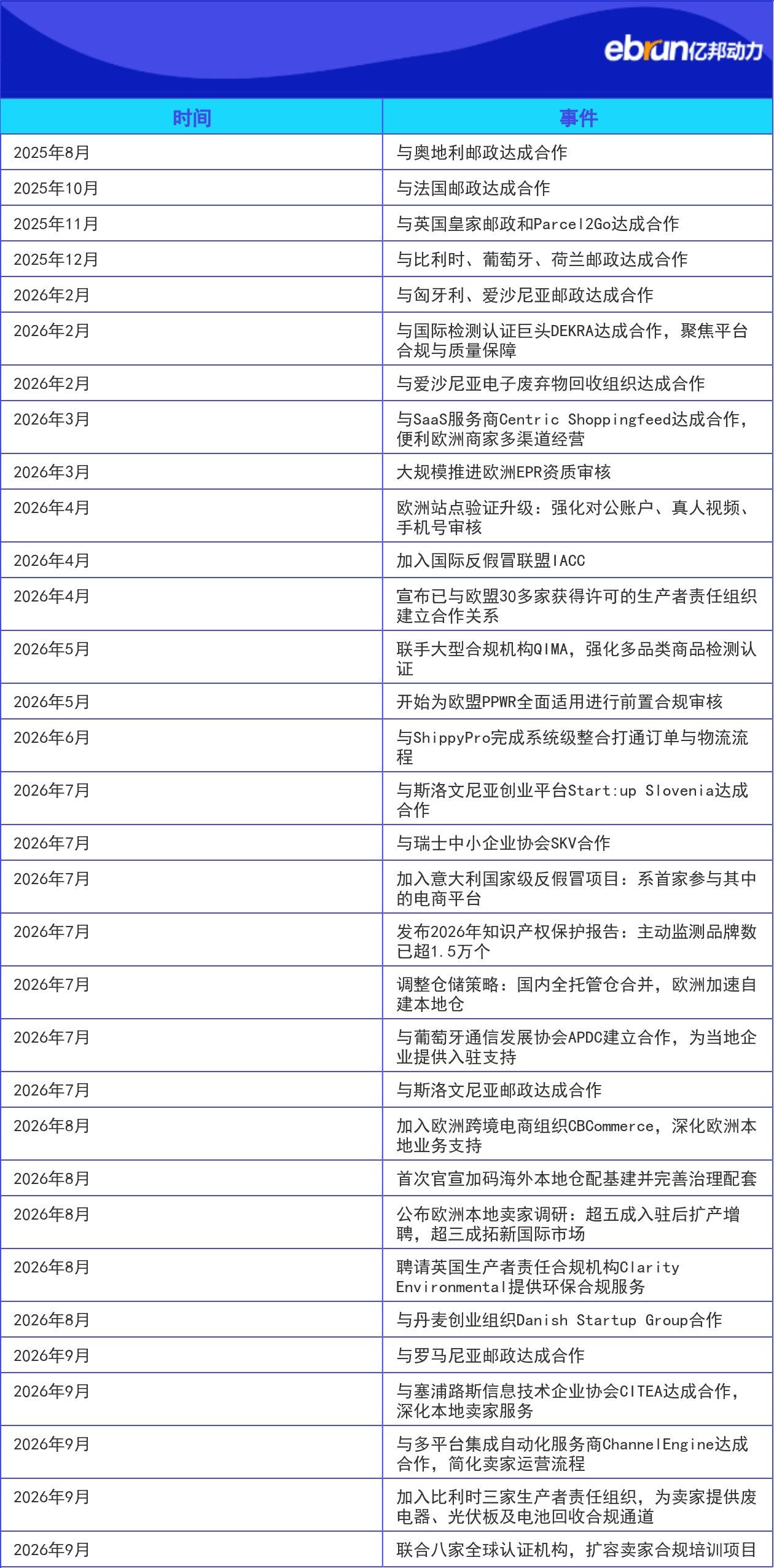
| Timeline of Key Events | Details |
| Aug 2025 | Partnership with Austrian Post |
| Oct 2025 | Partnership with La Poste (France) |
| Nov 2025 | Partnership with Royal Mail and Parcel2Go (UK) |
| Dec 2025 | Partnership with postal services in Belgium, Portugal, and the Netherlands |
| Feb 2026 | Partnership with postal services in Hungary and Estonia |
| Feb 2026 | Partnership with DEKRA, a global testing and certification giant, focusing on platform compliance and quality assurance |
| Feb 2026 | Partnership with an Estonian e-waste recycling organization |
| Mar 2026 | Partnership with SaaS provider Centric Shoppingfeed to facilitate multi-channel operations for European merchants |
| Mar 2026 | Large-scale advancement of EPR qualification audits across Europe |
| Apr 2026 | Upgraded verification for European sites: enhanced corporate account, live video, and phone number checks |
| Apr 2026 | Joined the International AntiCounterfeiting Coalition (IACC) |
| Apr 2026 | Announced partnerships with over 30 licensed producer responsibility organizations across the EU |
| May 2026 | Collaborated with QIMA, a major compliance firm, to strengthen testing and certification across multiple product categories |
| May 2026 | Initiated pre-compliance audits for the full application of the EU's Packaging and Packaging Waste Regulation (PPWR) |
| Jun 2026 | Completed system-level integration with ShippyPro, streamlining order and logistics processes |
| Jul 2026 | Partnership with Start:up Slovenia, a Slovenian startup platform |
| Jul 2026 | Partnership with SKV, the Swiss Association for Small and Medium Enterprises |
| Jul 2026 | Joined a national anti-counterfeiting project in Italy, becoming the first e-commerce platform to participate |
| Jul 2026 | Released the 2026 Intellectual Property Protection Report: proactive brand monitoring surpassed 15,000 brands |
| Jul 2026 | Adjusted warehousing strategy: consolidated domestic full-fulfillment warehouses and accelerated the construction of local warehouses in Europe |
| Jul 2026 | Partnership with APDC, the Portuguese Communications Development Association, to support local businesses in onboarding |
| Jul 2026 | Partnership with Slovenian Post |
| Aug 2026 | Joined CBCommerce, a European cross-border e-commerce organization, to deepen local business support in Europe |
| Aug 2026 | First official announcement of increased investment in overseas local warehousing and distribution infrastructure, along with enhanced governance measures |
| Aug 2026 | Published a survey on European local sellers: over 50% expanded production and hiring after joining; over 30% ventured into new international markets |
| Aug 2026 | Hired Clarity Environmental, a UK-based producer responsibility compliance firm, for environmental compliance services |
| Aug 2026 | Partnership with Danish Startup Group, a Danish entrepreneurship organization |
| Sep 2026 | Partnership with Romanian Post |
| Sep 2026 | Partnership with CITEA, the Cyprus Information Technology Enterprises Association, to enhance local seller services |
| Sep 2026 | Partnership with ChannelEngine, a multi-platform integration automation service provider, to simplify seller operations |
| Sep 2026 | Joined three Belgian producer responsibility organizations, providing sellers with compliance channels for e-waste, solar panels, and battery recycling |
| Sep 2026 | Expanded seller compliance training programs in collaboration with eight global certification bodies |
01 Starting with Fulfillment: Temu and European National Postal Services - A Mutual Attraction
Temu's latest push toward European localization began with logistics. Starting in the second half of 2025, Temu significantly accelerated partnerships with European national postal groups. From Austria, France, and the UK to Belgium, Portugal, and the Netherlands, and further to Hungary, Estonia, Slovenia, and Romania, a postal partnership network covering Western, Central, and Eastern Europe is taking shape. The cooperation focuses on practical areas: warehousing, last-mile delivery, parcel locker networks, cross-border transport, and local logistics infrastructure—resources accumulated over years by national postal systems. For Temu, this is perhaps the easiest path to find common ground after entering Europe's "deep waters." For a platform known for cost-effectiveness, logistics costs are integral to its business model. Securing stable, scalable, and cost-controlled local delivery capabilities not only improves the fulfillment experience but also determines whether low-price advantages can be maintained. Additionally, having a stable group of local postal partners gives Temu more bargaining power when negotiating bulk shipping rates with major commercial couriers. More importantly, postal groups are not ordinary logistics providers. They often have government backing, nationwide networks of outlets, parcel lockers, and last-mile delivery infrastructure, and they also support significant employment and public service functions. For Temu, aiming to transition from a "cross-border platform" to a "local business participant," establishing relationships with these established players in the European business ecosystem offers numerous benefits. For postal groups, Temu is an attractive client. In recent years, commercial couriers have eroded traditional postal parcel volumes; now, the EU's removal of the ?150 import duty exemption has further raised the cost of cross-border direct-mail small parcels. An e-commerce platform with stable order volumes and continued expansion is naturally worth courting. Temu is not putting all its chips on "borrowing a boat to sail." It has accelerated heavy-asset investments. In July, seller circles reported that Temu is adjusting its domestic full-fulfillment warehousing system while accelerating the setup of local forward warehouses in Europe, with popular items from some sellers already being stored. By August, PDD Holdings' co-chairman and co-CEO, Chen Lei, made a rare public statement: for certain overseas markets, the company will selectively invest in the development and operation of transit warehouses to help local merchants simplify fulfillment processes and lower logistics barriers—widely interpreted as a "high-profile announcement of a European self-operated warehouse strategy." The emergence of self-operated warehouses signals Temu's transition into a "ground battle" in Europe, marked by a long-term commitment.
02 Strengthening the Compliance Ecosystem and Cracking Down on Internal Seller Governance
If fulfillment localization is about "taking root" in Europe, compliance is the "ticket" Temu is scrambling to secure. Temu might be one of the fastest-expanding cross-border e-commerce platforms in history. Launched in October 2022, it had essentially rolled out across major global markets by early 2025. In Europe, it extended beyond mainstream markets like the UK, France, Germany, Italy, and Spain to include Poland, the Netherlands, the Czech Republic, and even peripheral markets like Cyprus and Malta. Such speed inevitably led to a relatively rough-and-ready management style. In recent years, sellers have often joked about its approach: "board the ship first, buy the ticket later" and "fix the car while driving." But by 2026, this is changing rapidly. One track involves seeking external professional partners. Over the past year, Temu has forged intensive partnerships with testing and certification agencies, producer responsibility organizations, compliance service providers, and intellectual property bodies, aiming to gradually incorporate previously outsourced compliance resources into its own service network. Currently, Temu has partnered with over 60 PROs (Producer Responsibility Organizations) across the EU, covering categories such as packaging, batteries, electronic and electrical equipment, and solar panels. It has also connected with more than 130 IP-related associations, nearly double the previous year's figure, and integrated over 200 ERP system interfaces, allowing sellers to connect their existing management software directly to Temu's backend. But expanding the external ecosystem is not enough; Temu is also "turning inward," intensifying internal governance. Starting early this year, the platform has launched targeted audits for European sellers' EU Representative, EPR, and PPWR qualifications, and tightened account and phone number verification. Compliance requirements are being pushed forward and tightened, from onboarding to existing sellers. For sellers who have long operated in compliance gray areas, the barriers are rising; those who remain must possess more complete entity qualifications, product certifications, and local compliance capabilities. In the intellectual property domain, Temu's 2026 IP Protection Report shows that over the past year, the number of brands proactively monitored by the platform has surged from over 5,000 to more than 15,000. The ratio of proactively removed listings for potential IP infringement to passively removed ones has risen from approximately 200:1 to 331:1. The platform's detection database now holds over 47 million images and 9.5 million keywords, with image coverage growing more than 8-fold year-over-year. The average processing time for IP complaints has been reduced to under 24 hours. The platform has also moved review processes earlier into the seller onboarding stage. Over the past year, more than 40% of new onboarding applications were rejected during verification; over 16,000 stores were removed for repeated IP violations. Concurrently, Temu launched the "Brand Guardian Program," allowing brands to embed their trademarks and other IP information into the platform's monitoring system. Over 3,000 brands have joined, with around 500 being micro, small, or medium enterprises. Another shift is "hand-holding" sellers through compliance. In September, Temu expanded its seller compliance training program in collaboration with eight global top-tier testing and certification bodies. Courses are delivered live via the Temu Seller Academy, where sellers can consult experts across fields about regulatory requirements for specific products and apply for testing, certification, and support services. The initial courses launched in August have already gained over 4,000 views and more than 2,000 interactions.
03 "Joining the Club": Temu Extends an Olive Branch to Europe's Local Business Circles
The fulfillment network and compliance ecosystem are still largely serving Chinese cross-border sellers. But Temu's ambitions clearly extend further. For a platform aiming to establish a long-term presence in Europe, what truly matters is not just getting more Chinese goods into Europe but also enabling more European businesses to sell on Temu. Only by fostering the growth of local businesses and contributing to local economies and employment can Temu transition from an "outsider" to a participant in the European business ecosystem. Over the past year, Temu has frequently reached out to European local business circles, seeking collaborations with numerous associations and startup platforms. Data shows that in the first half of this year, Temu held over 100 exchange activities with consumer protection organizations, industry associations, chambers of commerce, and investment promotion agencies across Europe, and participated in 30 industry conferences, attempting to penetrate local "business circles." At the same time, the platform is upgrading the "toolbox" local businesses need. Since March, Temu has partnered with SaaS providers like Centric Shoppingfeed, ShippyPro, and ChannelEngine, enabling European merchants to more easily manage multi-site product catalogs, automate order imports, sync inventory and pricing, and handle logistics information transmission and returns. These seemingly mundane backend features directly determine whether a European SME is willing to treat Temu as a long-term sales channel. Compared to learning an entirely new platform rulebook, allowing existing ERP, order management, and logistics systems to connect directly lowers the migration cost for local merchants. These efforts are beginning to yield positive feedback. A survey Temu released this year among European local sellers, including over 150 respondents in Germany, France, Spain, Italy, Poland, and the UK, found that 50% of them had expanded production or increased hiring after joining Temu, or both; 34% had entered new international markets; and 75% viewed Temu as a valuable supplementary or core sales channel. Temu is evidently working to redefine its role in the European market. It can be more than a platform that lowers consumer shopping costs; it can also become a new channel for local businesses to find orders and expand markets. And that latter narrative, when facing regulatory headwinds, is clearly more valuable than the former.
Ebrun will continue to provide in-depth coverage of this story. For more related information, please scan the QR code to follow the author on WeChat.

This article was originally published on the Ebrun website.
[Copyright Notice] Ebrun advocates respecting and protecting intellectual property rights. Without permission, no one is allowed to copy, reproduce, or use the content of this website in any other way. If any copyright issues are found in the articles on this website, please provide copyright questions, identification, proof of copyright, contact information, etc. and send an email to run@ebrun.com. We will communicate and handle it in a timely manner.
Translated by AI. Feedback: run@ebrun.com