
Liang Guoyong: Bridging the AI Investment Gap Through International Cooperation
[Ebrun Original] On September 24, at the 'Silk Road E-Commerce Day' launch ceremony and 'Silk Road E-Commerce' resource matchmaking meeting during the 5th Global Digital Trade Expo, Liang Guoyong, Senior Economist at the United Nations Conference on Trade and Development (UNCTAD), released the report 'Investment and Enterprise Development in Artificial Intelligence: Global Trends and China's Experience.'
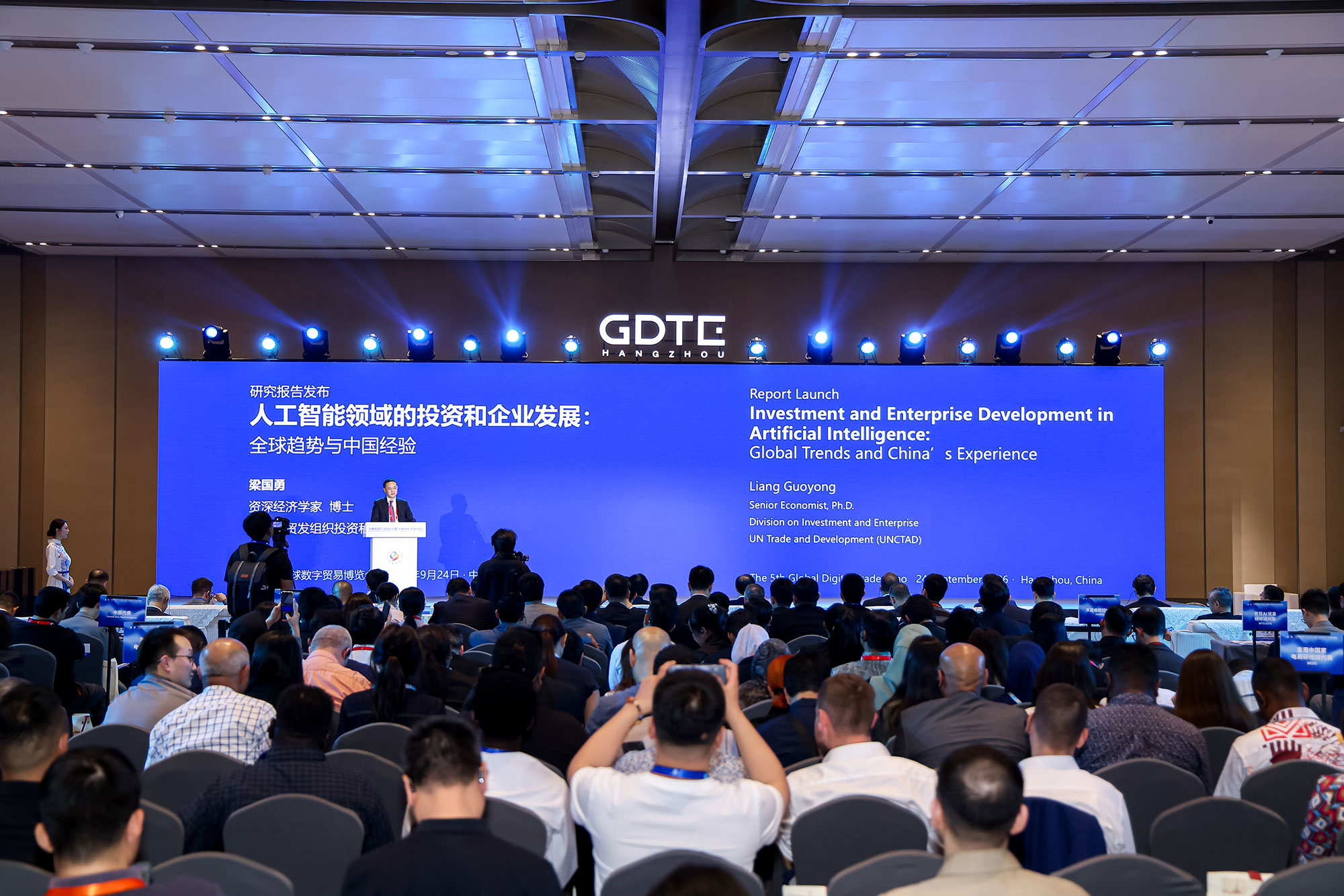
Liang noted that AI is reshaping the global economy and industries, with related investment growing rapidly, but the distribution of capital, computing power, and infrastructure remains highly uneven, leaving many developing countries grappling with weak infrastructure and insufficient investment.
In his view, China's AI development experience can be summarized as factor matching, inclusive diffusion, industrial adaptation, and institutional adjustment. For developing countries, there is a need to guide investment with policies that balance scale and efficiency, expand the scope of benefits through capacity building, and bridge the AI investment gap through international cooperation.
This article is compiled based on the guest's on-site speech transcript and presentation materials, with some modifications without affecting the original meaning.
Below is the full text of the speech:
01
Surge in AI Investment Intensifies Data Center Resource Constraints
AI is a revolutionary general-purpose technology in human history, profoundly reshaping the global economy and industries. Over the past few years, global AI investment has grown rapidly, with technology applications accelerating across various sectors, but the distribution of investment is highly uneven. Leading AI countries and large tech companies continue to increase capital investment, while most developing countries still face weak infrastructure and serious underinvestment.
This disparity means that while AI brings development opportunities, it may also widen the digital divide between nations. The report analyzes five areas: AI infrastructure investment, foundational models and technological frontiers, intelligent agents and AI applications, international investment in AI, and China's experience with policy recommendations.
Global data center construction is entering an accelerated expansion phase. According to data used in the report, in 2024, the United States, China, and Europe accounted for approximately 45%, 25%, and 15% of global data center electricity consumption, respectively. Meanwhile, major emerging economies such as Brazil, India, Thailand, and Malaysia are becoming destinations for large-scale data center investment projects.
Faster data center investment has also made constraints on electricity, materials, and water resources more prominent, with electricity supply emerging as a key limiting factor. In some data center clusters, related electricity consumption can account for 20% to 30% of local power usage. Therefore, evaluating AI infrastructure investment requires attention not only to construction scale but also to energy supply, usage efficiency, and long-term sustainability.
02
AI Competition Shifts from Scale to Systemic Capability China Forms a Differentiated Path
China's computing power development is transitioning from scale expansion to systemic coordination. Practices such as the 'East Data, West Computing' project, the national integrated computing network, and 'computing-electricity synergy' are promoting more coordinated layouts for computing power, energy, networks, and data centers. This shift indicates that competition in AI infrastructure is not just about individual computing hardware but depends on whether multiple factors can achieve systemic matching.
In terms of foundational models and technological frontiers, model parameter scales have entered the trillion-level era, but 'bigger' does not mean 'more advanced.' The criteria for evaluating models are shifting from a sole focus on parameter scale to capability, efficiency, and governability.
In the competitive landscape between China and the U.S. in foundational models, the performance of China's leading models is rapidly approaching U.S. frontier levels, while the U.S. retains advantages in the number of significant models, capital investment, and cutting-edge computing power. China, leveraging its massive user market, digital platforms, manufacturing system, and rich application scenarios, has created conditions for rapid iteration.
Open-weight models are an important pathway for China to expand the influence of its foundational models. By lowering the barriers to model access, deployment, and secondary innovation, open models help promote the broader diffusion of AI capabilities. However, it must also be acknowledged that advanced chips and other critical components remain practical constraints.
03
Rapid Growth in International Investment Opportunities and Challenges Emerge Simultaneously
In terms of international investment, from 2016 to 2025, global cross-border greenfield investments in the AI industry have cumulatively reached 4,420 projects, with capital expenditures of approximately $430 billion, flowing to over 120 economies. These investments bring significant opportunities for the digital transformation of developing countries, but investment sources remain relatively concentrated, and capital intensity characteristics have become more pronounced.
Cross-border M&A in the AI field is also accelerating notably. Investment focus is shifting from single technologies like speech and vision to AI chips, large models, AI security, and overall enterprise innovation capabilities. Venture capital, private equity funds, and sovereign wealth funds are deeply involved. At the same time, AI is increasingly becoming a focus of foreign investment security reviews in many countries, with related reviews extending from foreign access to outbound investment management.
This means that international AI investment brings new opportunities for the flow of capital, technology, and innovation capabilities, while also facing multiple challenges related to security, regulation, and uneven development. Therefore, while focusing on capital flows, the report also emphasizes infrastructure, talent, industry, and institutional capacity building as important topics.
04
China's Experience Lies in Coordination Policy Priorities Include Inclusiveness and Cooperation
China's rapid AI development offers noteworthy experiences. First, the growth of the digital economy has laid a foundation for data, algorithms, and computing power, serving as an important basis for AI breakthroughs. Second, the development of the AI industry depends on the coordination of technology, capital, and talent, as well as the alignment of R&D investment, business models, and application scenarios.
The report summarizes China's experience into four aspects: first, factor matching, promoting coordinated planning of computing power, energy, and networks; second, inclusive diffusion, lowering AI usage barriers through open weights, architectural optimization, and platform services; third, industrial adaptation, relying on real industrial scenarios to form validation and data feedback, guiding capital investment; and fourth, institutional adjustment, responding to changes in the investment environment through open cooperation, non-equity collaboration, and capacity co-building.
Based on these observations, we propose three policy recommendations. First, guide investment direction with policies that balance scale and efficiency, coordinating computing power, electricity, and digital infrastructure construction, and promoting investment facilitation. Second, expand the scope of benefits through capacity building and skill enhancement, enabling more entities to access and effectively use AI. Third, bridge the investment gap through continuously expanded international cooperation, increasing the participation of developing countries in rule-making, providing technical assistance through multilateral mechanisms, innovating digital infrastructure financing mechanisms, narrowing the intelligence divide, and promoting global development.
This article was originally published on the official Ebrun website.
[Copyright Notice] Ebrun advocates respecting and protecting intellectual property rights. Without permission, no one is allowed to copy, reproduce, or use the content of this website in any other way. If any copyright issues are found in the articles on this website, please provide copyright questions, identification, proof of copyright, contact information, etc. and send an email to run@ebrun.com. We will communicate and handle it in a timely manner.
Translated by AI. Feedback: run@ebrun.com