
"Silk Road E-commerce" Cooperation and Development Report 2026 Released: High-Quality Expansion of the "Silk Road E-commerce" Partnership Circle
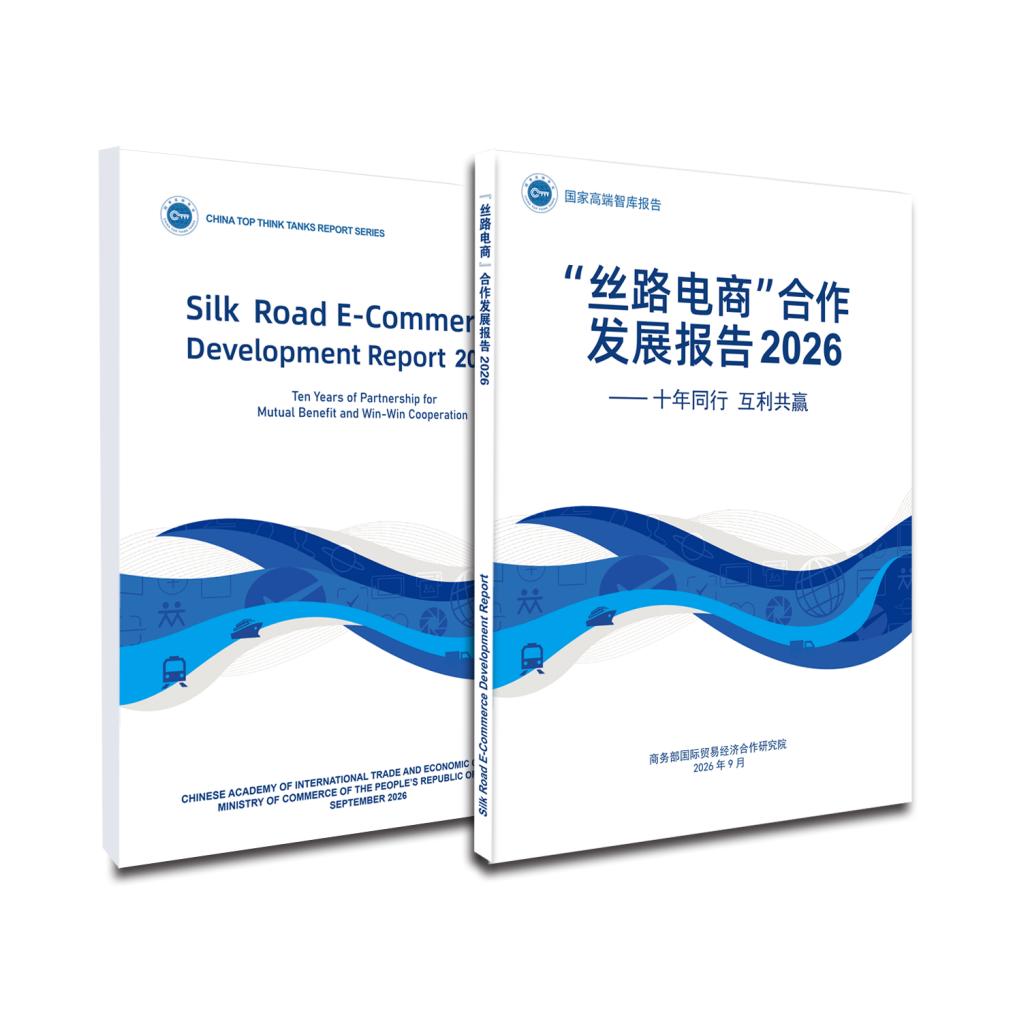
[Ebrun Original] On September 24, the Chinese Academy of International Trade and Economic Cooperation under the Ministry of Commerce officially released the "Silk Road E-commerce" Cooperation and Development Report 2026: A Decade of Partnership, Mutual Benefit and Win-Win (hereinafter referred to as the "Report") at the launch ceremony of the "Silk Road E-commerce Day" during the 5th Digital Trade Expo. The Report systematically presents the practical achievements since 2025 in policy exchanges, industrial collaboration, capacity building, and local cooperation between China and its "Silk Road E-commerce" partner countries, offering a comprehensive view of the cooperation landscape. This paragraph details the release context and the Report's scope, emphasizing the ten-year journey and mutual benefits.
01
Four Core Chapters Systematically Present the Decade-Long Achievements of "Silk Road E-commerce"
The Report is structured into four core chapters, covering the latest progress, development outcomes, current situation, and future outlook.
The "Progress" chapter systematically reviews new developments in the high-quality expansion of the partnership circle, deepening institutional innovation, joint efforts to build a global e-commerce market, and continuous improvement of the multi-dimensional compliance system, presenting the integrated "four-in-one" cooperation framework of "Silk Road E-commerce." The Report points out that "Silk Road E-commerce" cooperation accommodates least developed countries, developing countries, and developed countries alike, creating a broad-coverage, multi-tiered pattern of international e-commerce cooperation. The pilot zones for "Silk Road E-commerce" cooperation fully leverage their role as platforms for reform and experimentation, focusing on key areas such as interoperability of cross-border e-invoices, mutual recognition of digital identities across borders, and collaborative cross-border customs clearance. These zones have generated a series of institutional innovation results and replicable, scalable practices.
The "Outcomes" chapter uses detailed data to demonstrate that "Silk Road E-commerce" has effectively expanded the space for e-commerce cooperation, unleashed the dividends of a win-win ecosystem, and strengthened the endogenous momentum of partner countries. According to the Report, as of the end of 2025, nearly 200 online and offline national pavilions and over 100 product pavilions have been established nationwide, precisely promoting agricultural specialty products, light industrial consumer goods, and specialty processed items from approximately 85 countries to Chinese consumers. This creates an e-commerce express lane for high-quality, distinctive overseas products to enter the vast Chinese market. The "Silk Road E-commerce Benefits the World" themed campaign has achieved significant results, with a range of distinctive cooperation brands—such as the "Silk Road E-commerce" National Pavilions, the "Cloud Lecture Hall," "Silk Road Cloud Products," and "Silk Road E-commerce Day"—flourishing. These initiatives have effectively facilitated "Chinese e-commerce going global and partner-country products entering China," jointly painting a new picture of inclusive, mutually beneficial digital trade cooperation.
The "Situation" chapter analyzes the development landscape facing "Silk Road E-commerce" cooperation, examining opportunities from the expansion of the global e-commerce market, the strong impetus of AI empowerment, the solid industrial foundation fostered by digital-physical integration, and the enriched institutional connotations brought by diversified governance models. It also identifies challenges, including uncertainty stemming from sluggish global economic growth, institutional hurdles from stalled multilateral digital rules, external pressures from tightened cross-border regulations, and rising performance risks due to heightened geopolitical tensions.
The "Outlook" chapter states that as AI technology deeply empowers e-commerce development, the next decade will be a critical phase for "Silk Road E-commerce" to transition from foundation-building to quality leap. It calls for firmer resolve, more concrete actions, and a more open stance to advance inclusive and mutually beneficial international e-commerce cooperation, promote the high-quality development of "Silk Road E-commerce," and contribute China's wisdom and solutions of greater weight to global e-commerce growth.
02
Steady Progress Across the Four Core Cooperation Areas of "Silk Road E-commerce"
The Report notes that in terms of policy exchanges, the Chinese government attaches great importance to international cooperation and policy dialogue in e-commerce. By establishing regular platforms for policy exchange, it promotes the alignment of global e-commerce rules and practical cooperation. Since 2025, under the framework of "Silk Road E-commerce" cooperation, China has hosted liaison officer meetings of the e-commerce cooperation mechanism partner countries, exchange meetings among partner countries, and roundtable discussions on international e-commerce cooperation. These events have strengthened strategic alignment with partner countries' e-commerce development plans, shared policy experiences in digital infrastructure, logistics system development, and payment settlement, and created a favorable environment for the e-commerce growth of all parties.
The Report highlights that in terms of industrial collaboration, guided by the actual needs of partner countries, "Silk Road E-commerce" has built a regular docking system connecting Chinese purchasers and mainstream e-commerce platforms with producers and traders from partner countries. This has effectively addressed pain points such as cross-border information asymmetry, inefficient supply-demand matching, and fragmented channels. The Chinese government has fully opened up a new cross-border import pathway from overseas origins directly to the domestic market, establishing an end-to-end import distribution system—covering direct sourcing, online display, efficient customs clearance, and nationwide distribution—significantly lowering the entry barriers for goods from partner countries into China.
According to the Report, in the area of capacity building, the "Silk Road E-commerce" Cloud Lecture Hall helps partner countries cultivate e-commerce talent, enhance digital skills and employment competitiveness, narrow the digital divide, and address real concerns and development pain points related to the North-South gap. Since 2025, the Cloud Lecture Hall has held overseas hands-on training sessions in Thailand, Laos, Egypt, and Morocco, reaching over 150 representatives from governments, industries, and SMEs. In July 2026, a new Arabic-language session was launched, inviting major e-commerce platforms to deliver practical training on localized operations and digital transformation, with special modules on artificial intelligence, cross-border logistics, cross-border e-commerce, and livestream e-commerce. A dedicated and highly anticipated segment on "AI in E-commerce" was added, attracting nearly 1,000 e-commerce practitioners from 21 Arab countries. As of July 2026, the "Silk Road E-commerce" Cloud Lecture Hall has successfully hosted 137 sessions for multi-lateral and bilateral country groups, covering over 80 countries across Europe, Asia, Africa, and South America, cumulatively benefiting nearly 110,000 participants.
The Report suggests that in local cooperation, various regions are actively promoting the joint construction of tangible e-commerce cooperation projects, fostering a viable and sustainable cross-border cooperation ecosystem. Guangxi has built the "Guihai Shangfang" platform, establishing 10 overseas training bases in Thailand, Malaysia, Indonesia, Laos, Vietnam, and Singapore, training 14,000 local e-commerce professionals in ASEAN cumulatively and helping over 400 enterprises localize capabilities in livestream operations, AI-powered product selection, and cross-border customer service. This supports the realization of the "ASEAN production, Guangxi distribution, China sales" model. Jiangsu, together with North Brabant in the Netherlands, has co-developed the "Showcase First, Warehouse Behind" two-way trade project. Leveraging the China-Europe Railway Express route from Nanjing to Tilburg, the project has set up a "Made in Jiangsu" exhibition and sales center and smart warehousing in the Netherlands, achieving the principle of "exhibits as inventory, exhibitors as sellers." This has already facilitated a photovoltaic order exceeding one million euros for a Nanjing new energy enterprise and introduced high-quality Dutch products such as flowers and dairy into the Jiangsu market.
This article was originally published on the official website of Ebrun.
[Copyright Notice] Ebrun advocates respecting and protecting intellectual property rights. Without permission, no one is allowed to copy, reproduce, or use the content of this website in any other way. If any copyright issues are found in the articles on this website, please provide copyright questions, identification, proof of copyright, contact information, etc. and send an email to run@ebrun.com. We will communicate and handle it in a timely manner.
Translated by AI. Feedback: run@ebrun.com