
Where Are Cross-Border E-Commerce Service Providers Headed in the AI Era? Three Core Tasks Point the Way
[Ebrun Original] In the AI era, service providers need more than just immediate capability gaps and efficiency gains—they need a long-term evolutionary direction and value proposition. From a deep restructuring of organizational DNA, to a profound reshaping of service models, to deep collaboration within synergistic networks, the ultimate transformation for service providers is a comprehensive evolution from "traditional service providers" to "AI-native service providers," establishing an irreplaceable core competitiveness in the AI era. The "Winning the New Cycle—AI Development Report for Cross-Border E-Commerce Service Providers" (hereinafter the "Report"), jointly released by Ebrun Think Tank and the Amazon SPN Service Provider Network, proposes that service providers must accomplish three long-term tasks to navigate the new cycle: evolve into AI-native enterprises, upgrade to "AI growth partners," and move deeper into a globally intelligent service collaboration network. (Click the link to download the full report)
01
Task One: Evolve into AI-Native Enterprises
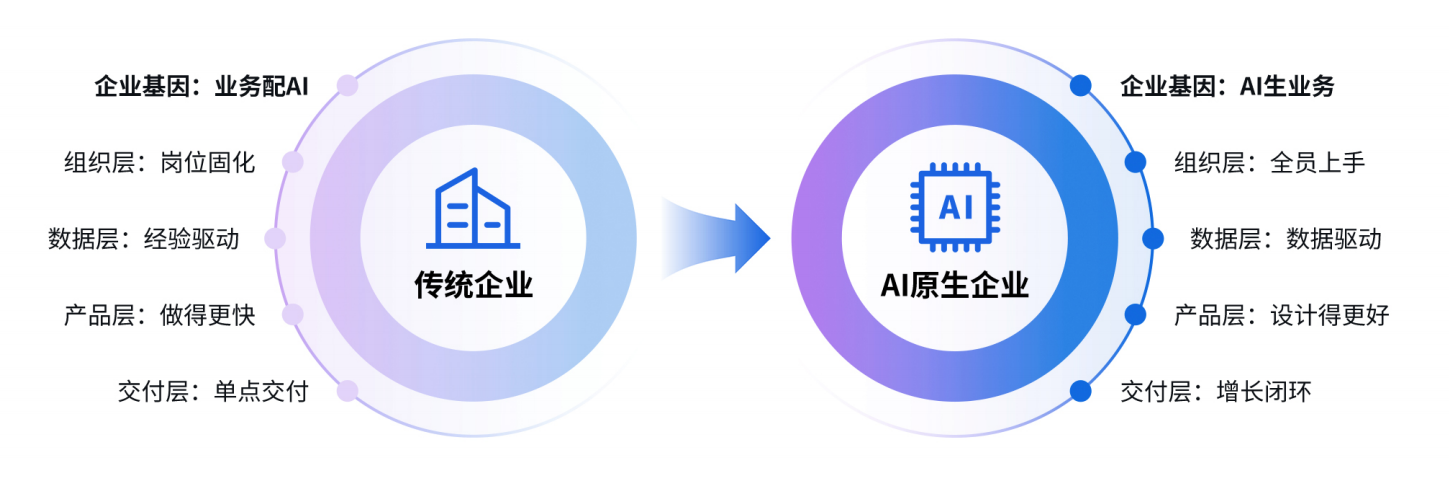
Unlike traditional enterprises that follow a "business first, AI later" logic, AI-native enterprises embed AI deeply into their corporate DNA from inception or at the strategic foundational level, naturally giving them faster response times, higher resource efficiency, and stronger adaptability to complex scenarios. For service providers, the key to future competition lies not just in adding AI tools, but in achieving a fundamental leap from "business with AI" to "AI generating business" through a comprehensive reconstruction of organization, data, products, and delivery systems. The concrete implementation path is reflected in four levels:
At the organizational level, service providers need to shift from "role-fixed" to "all-hands-on-deck," building an agile collaboration system where everyone can call on AI, processes can be broken down, and steps can be coordinated. AI should no longer be a tool exclusive to a specific department or tech team, but rather a foundational capability running through the entire business process. In the past, service providers relied on the expertise of specialized personnel for tasks like product selection judgment, ad optimization, and market analysis, with capabilities often embedded in individuals and teams. AI-native enterprises, however, transform personal experience into organizational capability through intelligent tools, knowledge bases, and automated processes, enabling faster responses to market changes.
At the data level, service providers need to shift from "experience-driven" to "data-driven," reshaping business processes with an intelligent operational loop. By accumulating, analyzing, and feeding back data, they enable self-circulating and self-optimizing business processes, making data the central nervous system of enterprise operations. Cross-border e-commerce services involve multiple stages—product selection, marketing, logistics, customer service, compliance—and the vast business data accumulated over time is a critical foundation for service providers to build differentiated capabilities. However, if data is scattered across departments and business systems without forming a unified data asset, the value of AI cannot be fully unleashed. Therefore, service providers need to establish more robust data governance systems, turning business experience, customer needs, and operational results into iterable data assets. By optimizing models through data feedback and using models to enhance business decision-making efficiency, they form a "data—model—business" cyclical improvement mechanism.
At the product level, service providers need to upgrade from "doing things faster" to "designing things better." By injecting industry expertise and years of accumulated experience into AI products, they can improve the alignment between solutions and business scenarios, creating professional capabilities distinct from generic tools. AI tools are rapidly proliferating, and basic features are becoming increasingly commoditized. In the future, a service provider's value lies not in simply calling large models, but in leveraging its industry understanding to convert AI capabilities into solutions tailored to specific business scenarios.
At the delivery level, service providers need to shift from "single-point delivery" to "growth loops." By using quantifiable results to increase customer satisfaction and repeat purchase rates, they can continuously expand the boundaries of service capability. Being AI-native is not about deploying more tools; it's a systematic reconstruction around core enterprise capabilities, making AI a part of how a company operates.
02
Task Two: Upgrade to an "AI Growth Partner" Service Model
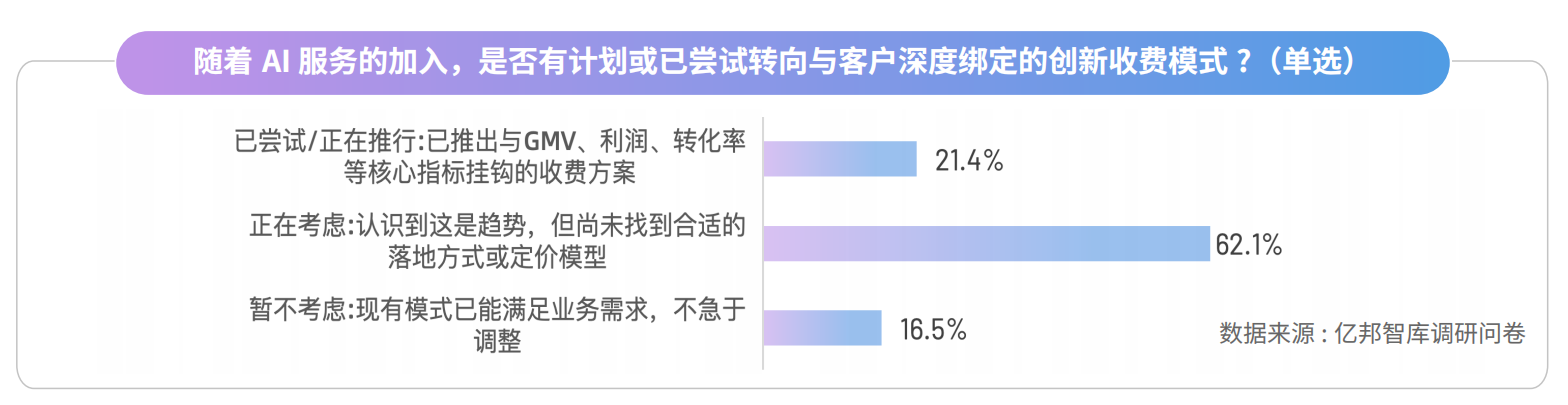
Sellers are shifting their AI investment from purchasing tools to purchasing outcomes, and service providers' roles are evolving from completing individual tasks to jointly bearing operational metrics. Capability evaluation no longer focuses solely on whether a feature is implemented, but on whether it delivers quantifiable business results; pricing models are moving from hourly billing, project-based, and fixed subscriptions to outcome-based RaaS (Result-as-a-Service). According to IDC forecasts, by 2028, 70% of software vendors will charge based on business outcomes, transaction volumes, or automation results.1 The Report's survey shows that 21.4% of service providers have already attempted to link fees to core metrics like GMV, profit, and conversion rates, while 62.1% agree with the outcome-based pricing trend but have not yet found suitable implementation methods or pricing models. RaaS is not just a simple change to the price list. It requires service providers to possess deep industry insight, business experience, and operational capability, and to be able to jointly define growth baselines, track AI actions, establish attribution models, and manage delivery risks. Only by continuously embedding data, models, and products into sellers' businesses can service providers form long-term relationships with clients characterized by shared growth and shared outcomes.
03
Task Three: Move Deeper into a Globally Intelligent Service Collaboration Network
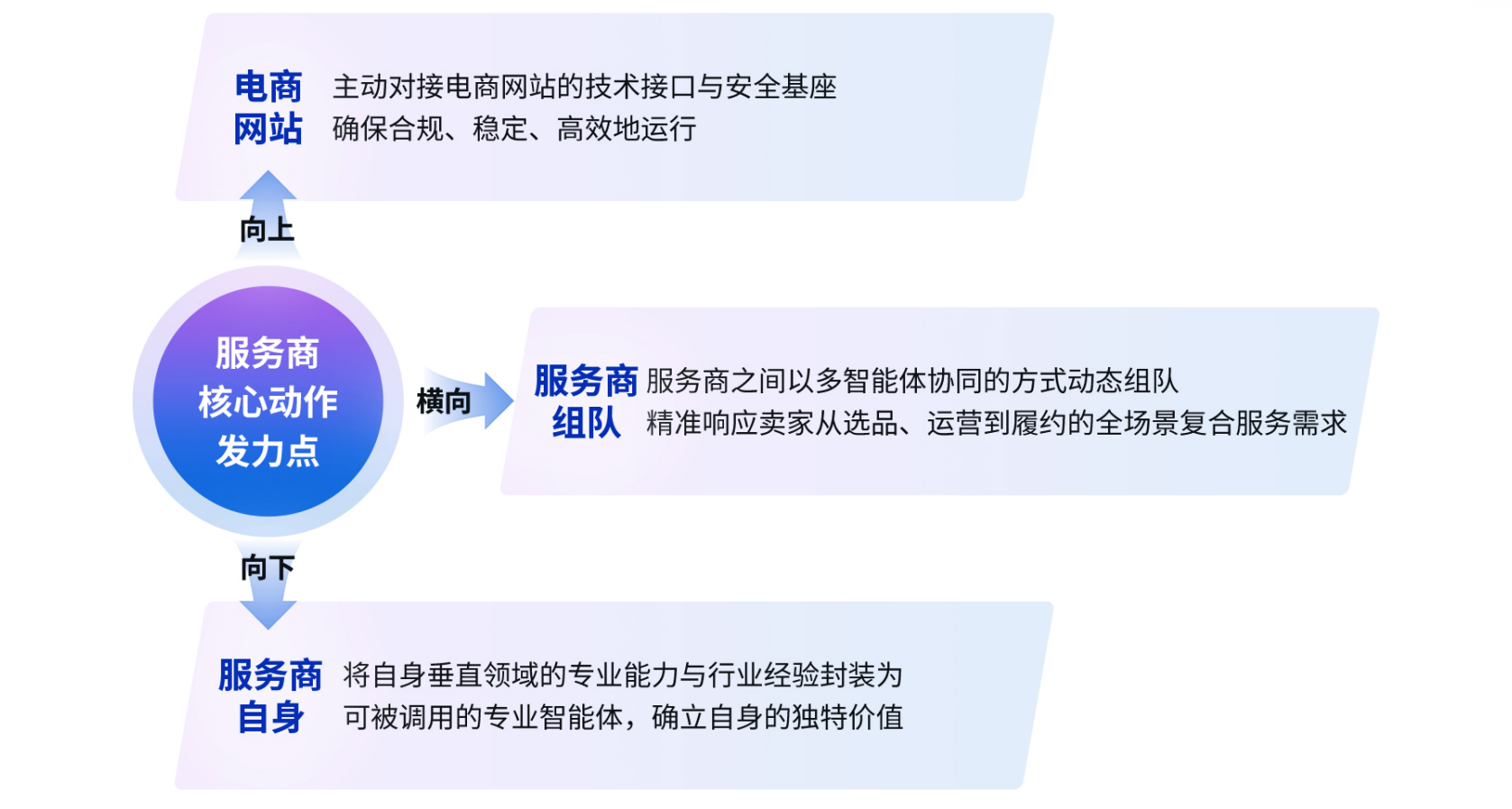
In the AI era, the capability boundaries of individual service providers are becoming limited, and open collaboration is emerging as a key direction for industry development. The Report points out that in the new cycle, e-commerce platforms are becoming critical hubs for AI service providers to access compliant data, traffic, training, and technical support. The survey reveals that up to 83.5% of service providers believe the "e-commerce platform + AI service provider" collaboration model will become mainstream.2 The core question for service providers has shifted from "whether to integrate" to "how to integrate deeply." To build competitive advantages within the collaboration network, service providers need to make sustained efforts in three directions: upward, by proactively aligning with e-commerce platform technical interfaces and security foundations to ensure AI services run compliantly, stably, and efficiently; downward, by packaging their vertical expertise and industry experience into callable professional agents to establish their unique value; and horizontally, by dynamically forming teams through multi-agent collaboration among service providers to precisely respond to sellers' composite service needs across the entire scenario—from product selection and operations to fulfillment. Through open interfaces and continuous evolution, the ultimate goal is to build a globally intelligent service collaboration network based on trust, marked by greater efficiency, resilience, and innovative vitality.
AI is driving the cross-border e-commerce service ecosystem into a new development phase. For service providers, future competition is no longer a contest of single service capabilities, but a comprehensive competition involving organizational capability, data capability, product capability, delivery capability, and collaborative capability. From traditional service providers to AI-native service providers is a systematic upgrade centered on core enterprise capabilities. Only by completing AI-native transformation, building growth partnerships, and deeply integrating into the global intelligent service collaboration network can service providers establish long-term competitive advantages and sustain growth momentum in the new cycle.
References:
[1]https://sanieinstitute.substack.com/p/agentic-ai-is-not-a-feature-it-is
[2]2026 Cross-Border E-Commerce Service Provider AI Capability Survey, valid samples N=206
This article was originally published on the Ebrun official website.
[Copyright Notice] Ebrun advocates respecting and protecting intellectual property rights. Without permission, no one is allowed to copy, reproduce, or use the content of this website in any other way. If any copyright issues are found in the articles on this website, please provide copyright questions, identification, proof of copyright, contact information, etc. and send an email to run@ebrun.com. We will communicate and handle it in a timely manner.
Translated by AI. Feedback: run@ebrun.com