
Building a System of Certification, Training and Technical Support, Amazon SPN Drives AI Capability Upgrades for Service Providers
[Ebrun Original] The AI transformation of cross-border e-commerce service providers is shifting from standalone tool adoption to systematic capability building, yet providers at different growth stages face distinct capability bottlenecks. Early-stage players lack clear benchmarks for technology selection; growth-stage providers grapple with cross-border data compliance pressures and high R&D costs; mature-stage players need to formalize their domain expertise into trainable models and enable multi-agent collaboration. Amid the fast-evolving technology landscape, service providers can hardly close gaps in technology, talent and implementation capacity on their own in the short term.
The report *Winning in the New Cycle: AI Development Report for Cross-Border E-Commerce Service Providers*, jointly released by Ebrun Think Tank and the Amazon Service Provider Network (SPN), identifies organizational capability, data capability, product capability and delivery capability as the four core pillars for service providers’ AI capacity building. Building on this framework, Amazon SPN has rolled out coordinated support across AI capability certification, tiered training and graduated technical solutions, delivering systematic support tailored to providers at different development stages to drive the tiered upgrade of AI capabilities from "awareness building" to "product development" and eventually to "deep collaboration".
01
"AI Capabilities Become a Core Competency for SPN Service Providers
SPN’s capability certification sets higher requirements for service providers. Against the backdrop of deep AI penetration across cross-border e-commerce, the report finds that Amazon SPN is driving service providers’ AI capability improvement on two fronts: First, it has launched an AI-powered intelligent search experience, which uses natural language conversational search to improve the precision of matching between sellers and service providers. Second, it has introduced an AI capability tagging system, which grants exclusive badges to service providers with qualified AI service capabilities, helping sellers quickly identify and screen professional service providers.
These two measures have significantly reduced sellers’ screening costs, making service providers’ AI capabilities visible, comparable and filterable. Being "seen" is only the first step; being "selected" ultimately depends on a service provider’s own track record of delivering AI-powered solutions.
02
Systematic Support for AI Capability Building
AI capability building is not a single-point technology application, but a systematic project covering talent cultivation, technology tools, product development and commercial implementation. In the process of building AI capabilities, service providers widely face pain points including insufficient technical capacity and a shortage of specialized talent. Research shows nearly 70% of service providers hope to receive support in "AI technology training, capability certification and talent cultivation". Meanwhile, service providers face differentiated core challenges at different stages of AI implementation:
- Early-stage service providers lack clear selection benchmarks and face unstable tool performance: 58.5% of providers lack selection standards when first adopting AI tools, and 48.3% worry that unstable tool performance will undermine service quality and client trust.
- Growth-stage service providers are constrained by cross-border data compliance and high R&D costs: 56.3% cite concerns over cross-border data compliance, intellectual property and security risks, and 35.9% flag overly high algorithm and R&D costs.
- Mature-stage service providers have an urgent need for model-based knowledge retention and componentized network access: 61.5% hope to convert their proprietary expertise into knowledge graphs or custom models, and 57.7% want to integrate their AI services into multi-agent collaborative networks.
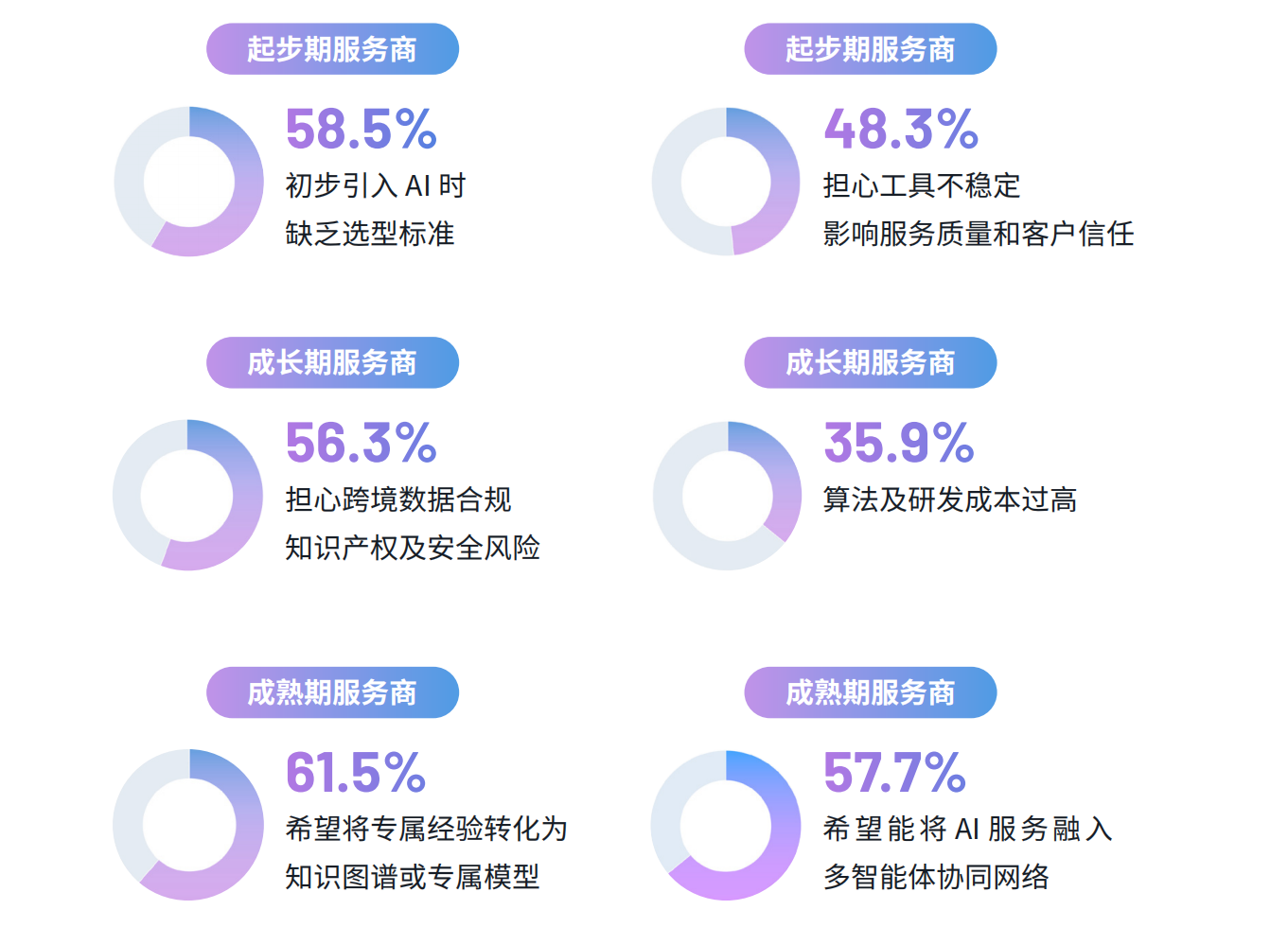
Targeting capability bottlenecks across stages, Amazon SPN focuses on two core levers — "AI training" and "technical support" — to help service providers progress from awareness building and product development to deep collaboration.
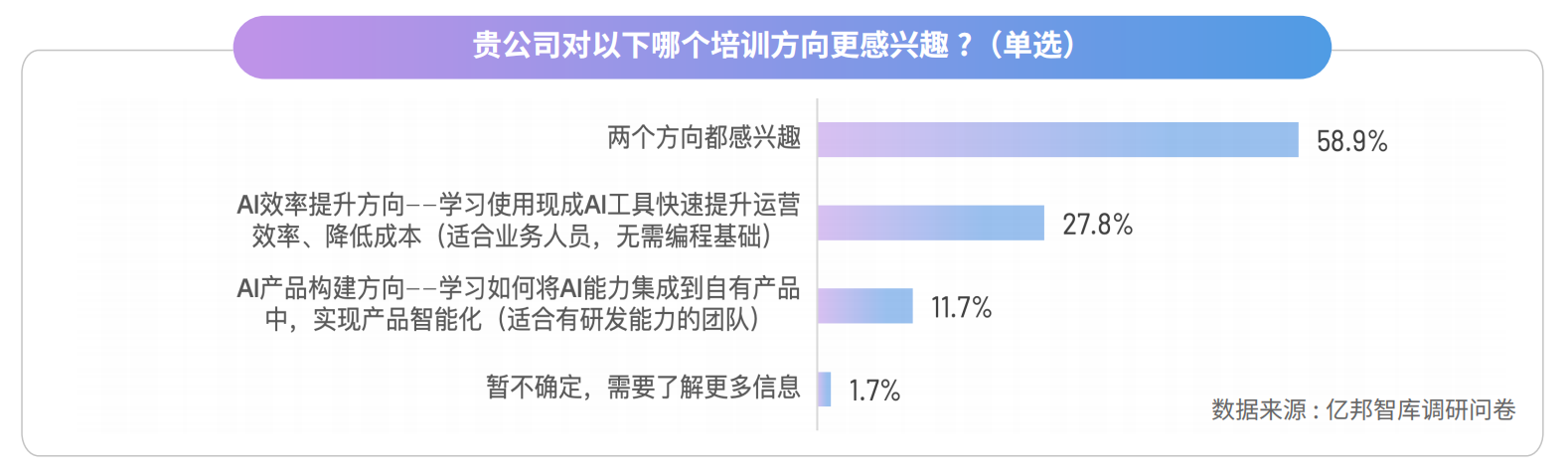
AI training systems close capability gaps for service providers. The report finds nearly 60% of service providers’ training needs are concentrated in two areas: "AI-driven efficiency improvement" and "product building", as single-dimensional training can no longer meet providers’ development needs. In response, Amazon SPN has built a three-stage training system, covering awareness alignment for early-stage players, vertical scenario deepening for growth-stage players, and scaled output for mature-stage players, to help providers address capability shortcomings at each development phase.
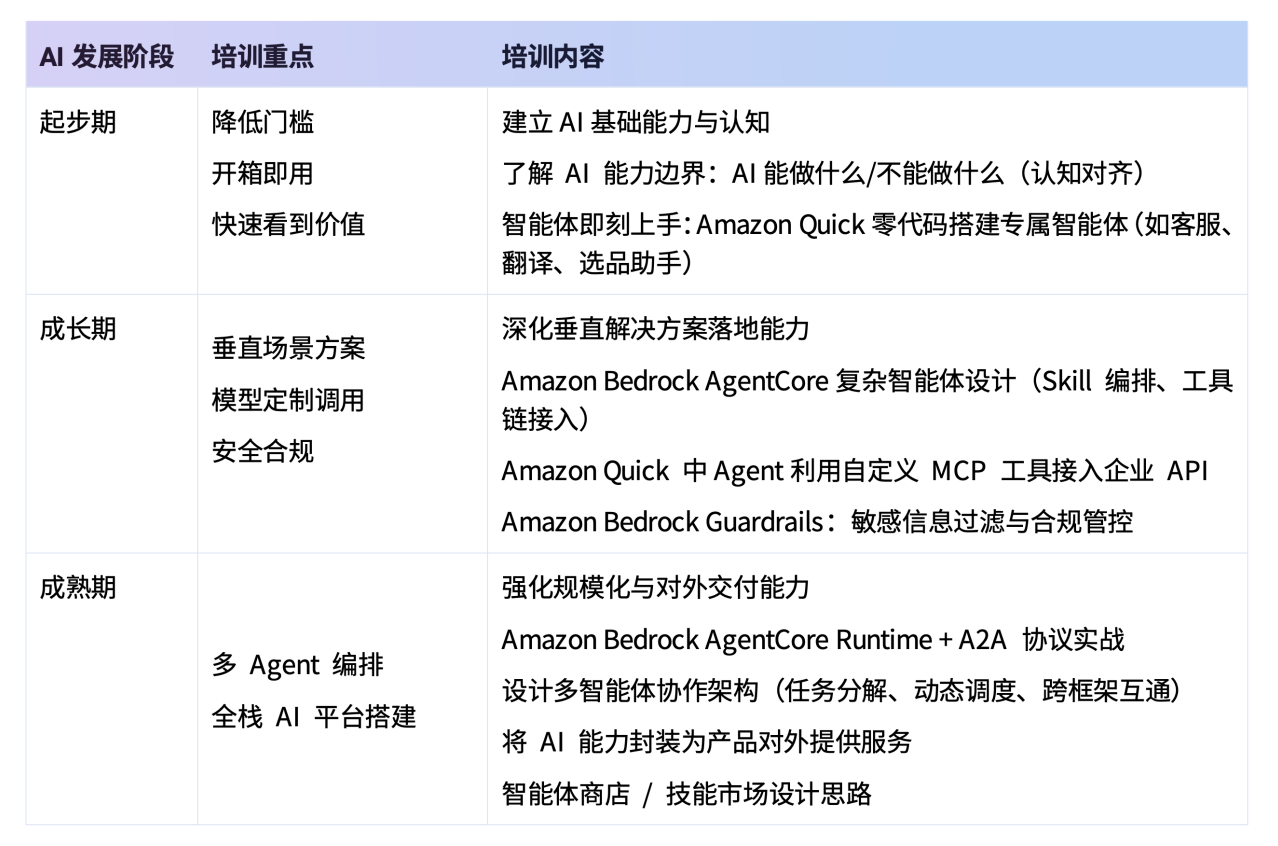
For early-stage service providers, training focuses on lowering the threshold for technology use, enabling out-of-the-box tool access and rapid validation of business value. Through sessions on foundational AI awareness alignment, explanations of AI capability boundaries, walkthroughs of applicable scenarios and limitations of tools, and zero-code practical tutorials, the training helps service providers quickly build dedicated agents for customer service, translation, product selection and other use cases via Amazon Quick, enabling technical staff to get started with minimal ramp-up time.
For growth-stage service providers, training shifts to vertical solution implementation, custom model invocation, and cross-border operation compliance control. Content covers complex agent design based on Amazon Bedrock AgentCore, including skill orchestration and tool access; tutorials on how to connect enterprises’ proprietary business APIs via custom Model Context Protocol (MCP) tools in Amazon Quick, to realize integration between AI and internal operation systems; and supporting training on the Amazon Bedrock Guardrails compliance module, which guides service providers to automatically identify, isolate and filter customers’ sensitive information, to mitigate risks related to cross-border data and intellectual property.
For mature-stage service providers, training focuses on multi-agent collaborative architecture building and full-stack AI-powered e-commerce site development. Through practical training on Amazon Bedrock AgentCore Runtime and the Agent-to-Agent (A2A) interoperability protocol, the program helps providers build multi-agent collaborative networks capable of automatic task decomposition, dynamic scheduling and cross-framework interoperability. It also covers how to encapsulate internally mature AI capabilities into standardized services for external delivery, as well as the full design and operation framework for agent skill stores and agent trading marketplaces, supporting service providers in building sustainable AI service businesses.
Graduated technical solutions support service providers’ AI product launch. Beyond talent cultivation, technical support is another critical pillar for service providers’ AI capability building. Amazon SPN has rolled out tiered technical support packages, including "out-of-the-box lightweight solutions", "vertical scenario expansion solutions" and "co-development deep customization solutions", to lower the threshold for AI R&D and implementation, and help service providers scale AI products from pilot projects to large-scale commercialization.
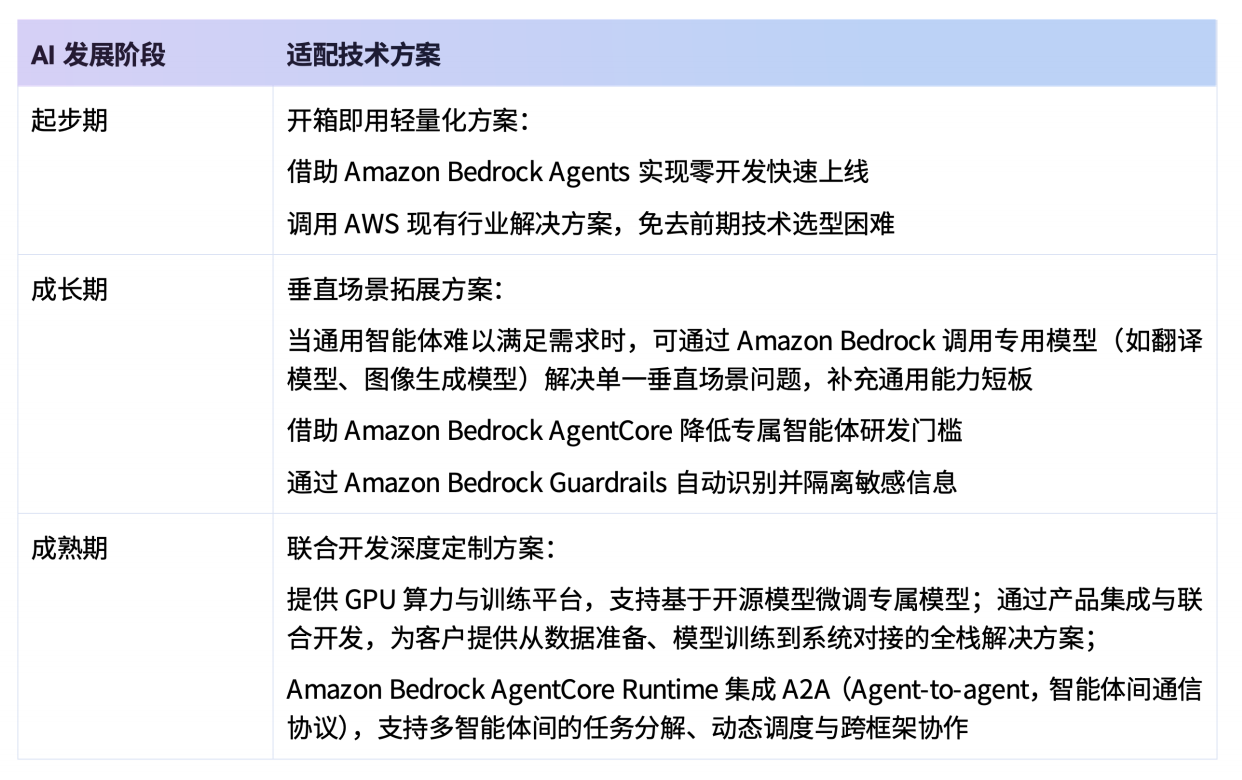
For early-stage service providers, the out-of-the-box lightweight solution leverages Amazon Bedrock Agents to enable zero-deployment rapid launch, with access to AWS’s existing industry solutions to reduce the difficulty of early-stage technology selection.
For growth-stage service providers, the vertical scenario expansion solution supports the use of Amazon Bedrock to invoke specialized models to address single vertical scenario pain points, lowers the threshold for complex agent R&D via Amazon Bedrock AgentCore, and enables sensitive information identification and compliance control through Amazon Bedrock Guardrails.
For mature-stage service providers, the co-development deep customization solution provides GPU computing power and training support to help providers carry out model training, product integration and joint development, building full-stack capabilities covering data preparation, model training and system delivery. Meanwhile, Amazon Bedrock AgentCore Runtime integrates the A2A protocol to support task decomposition, dynamic scheduling and cross-framework collaboration across multiple agents.
From being "seen" to being "selected", Amazon SPN has laid out a clear AI evolution path for service providers through capability certification, phased training and graduated technical solutions. As AI capabilities become a core competitive advantage, service providers will not only be able to respond to sellers’ needs more precisely and efficiently, but also build hard-to-replicate moats across technology, talent and compliance dimensions. As the systematic support continues to deepen, service providers will further upgrade their capabilities, drive the in-depth integration of professional services and cutting-edge AI, and collectively cement long-term advantages in global competition.
This article was first published on the official website of Ebrun.
[Copyright Notice] Ebrun advocates respecting and protecting intellectual property rights. Without permission, no one is allowed to copy, reproduce, or use the content of this website in any other way. If any copyright issues are found in the articles on this website, please provide copyright questions, identification, proof of copyright, contact information, etc. and send an email to run@ebrun.com. We will communicate and handle it in a timely manner.
Translated by AI. Feedback: run@ebrun.com