
Danni Zeng, Head of Marketing and Ecosystem at Tianyi Group: Preparing for Multichannel Sales — How Cross-Border Sellers Can Secure Capital to Fund Growth
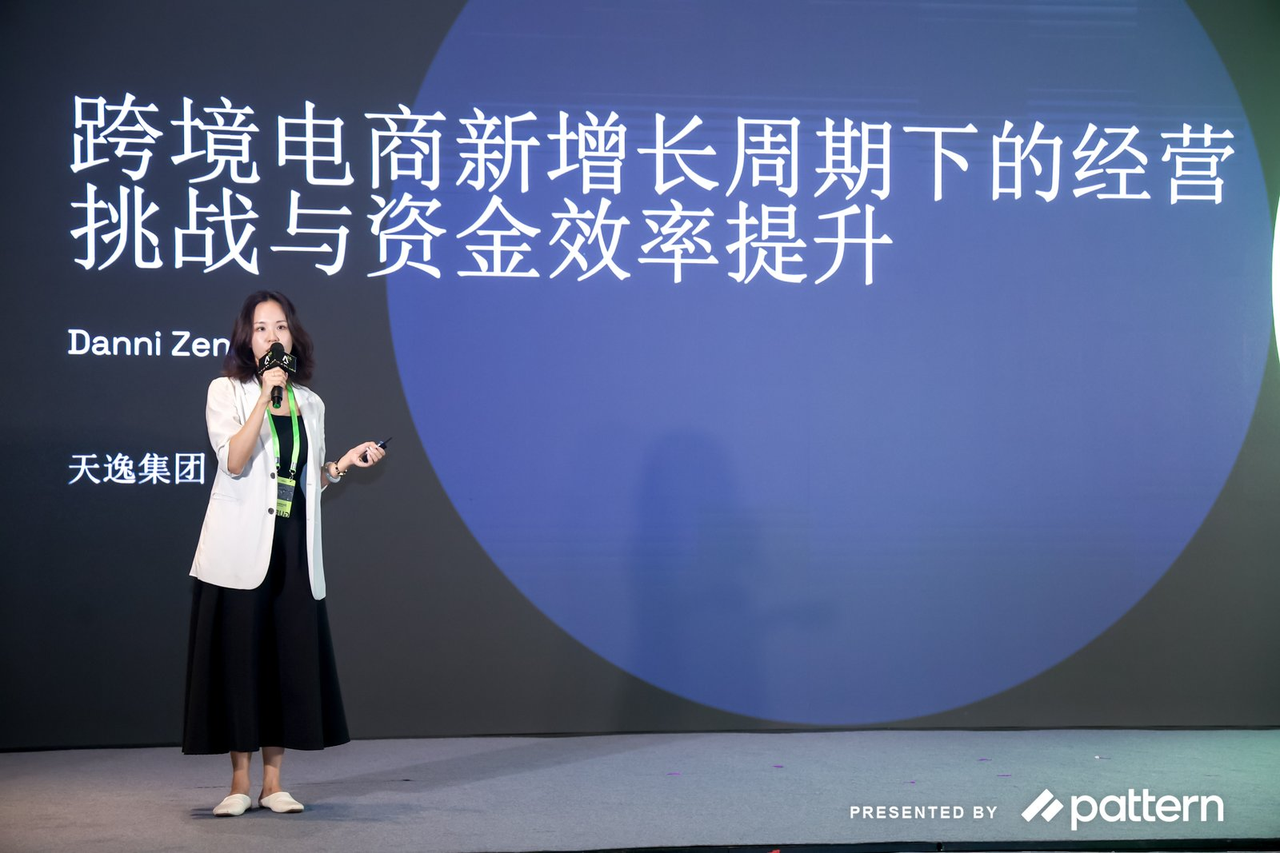
【Ebrun Original】On September 17, Danni Zeng, Head of Marketing and Ecosystem at Tianyi Group, delivered a speech titled "Preparing for Multichannel Sales: Where Does Growth Capital Come From?" at the second thematic forum of Accelerate26 Cross-Border Ecosystem Acceleration Summit · China Edition, hosted by Pattern with Ebrun as the strategic partner.
Zeng noted that as sellers scale, their core challenges extend far beyond driving more orders: they must also support financing across the entire operational chain, including procurement, inventory stocking, logistics, advertising, and platform payment collection.
In her view, three concurrent trends are squeezing businesses’ deployable cash reserves: the growing number of scaled sellers, rising customer acquisition costs (CAC) during major promotional periods, and shifting platform payout timelines. The next phase of competition will not only test sellers’ ability to move merchandise, but also their capacity to sustain operations with higher capital efficiency.
Zeng stated that a cross-border company’s growth potential should be measured across at least four dimensions: traffic, product offerings, supply chain resilience, and capital efficiency. Capital efficiency is not a siloed responsibility of the finance department; at its core, it is operational efficiency. The value of financial services should not be limited to providing capital when businesses face cash crunches. Instead, it should help companies bridge the timing gaps between procurement, inventory buildup, ad spend, and revenue collection.
This article is compiled from the guest’s on-site speech, with minor edits made without altering the original intent.
The following is the full transcript of the speech:
01 Operational Challenges and Capital Efficiency Improvement in the New Cross-Border E-Commerce Growth Cycle
The cross-border e-commerce sector is currently defined by three key trends: a sustained rise in the number of scaled sellers; higher CAC during major promotional events, requiring more granular allocation of operational and advertising budgets; and extended platform payout cycles that lengthen the wait time for receivables.
As a result, upfront front-end investments are rising while back-end payouts are slowing, compressing the cash buffer businesses can deploy. Going forward, competition will not just reward sellers who excel at moving goods, but those who can sustain operations with greater efficiency.
According to official data released by Amazon, in the first 10 months of 2025, the number of Chinese sellers generating over $10 million in annual sales grew nearly 30% year-over-year. This indicates that more sellers are moving from small and medium-sized operations to higher revenue tiers.
Why does the growth of scaled sellers matter? When a company scales from generating millions of dollars in annual revenue to tens of millions, it faces challenges far beyond simple top-line growth. Where a business might once have needed to hold RMB 1 million in inventory, it may now require RMB 5 million or even RMB 10 million in stock. At the same time, advertising budgets expand, along with warehousing, logistics, and labor costs. As business scale grows, operational complexity rises.
The most easily overlooked question in this phase is: can cash flow keep pace with this growth? In my view, evaluating a cross-border company’s growth capacity requires assessing four core pillars: traffic, products, supply chain, and capital efficiency. The first three are widely recognized, but the fourth — capital efficiency — is often mistakenly viewed as the sole purview of the finance department. This is not the case.
A company may have strong products and solid ad conversion rates, but if inventory is tied up for too long and platform payouts are slow, growth will still hit a wall. For this reason, capital efficiency is, in essence, operational efficiency.
02 Sales Revenue Does Not Equal Cash Flow: Inherent Timing Gaps in Cross-Border Operations
When you break down a cross-border business transaction, there is a natural timing mismatch in cash flows. Payments for procurement, production for inventory, and logistics all occur before sales are made. Even after an order is fulfilled, platforms process settlements per their own rules before funds are actually transferred to the seller’s account.
Take Amazon’s D7 policy as an example: after an order is marked as delivered, the relevant funds are subject to a seven-day hold period before becoming available as usable balance. Businesses need to pay attention not just to the extra days of waiting, but to the total length of the operating cycle from when they pay suppliers to when funds land back in their accounts.
We frequently see scenarios where a new round of procurement, inventory stocking, and ad spend has already kicked off, but cash from the previous sales cycle is still in transit. Even when sales revenue is growing, businesses may feel increasingly cash-strapped. This is exactly the problem caused by the misalignment between top-line sales and actual cash flow.
For this reason, we believe financial services should not only step in when businesses are short on cash. A more optimal approach is to map out a company’s operating cycle in advance, and arrange capital appropriately to bridge gaps between procurement, inventory buildup, ad spend, and platform payouts.
Financing itself is not the end goal. It delivers real value only when it helps businesses fulfill orders, shorten waiting periods, and improve capital utilization efficiency.
Many sellers ask why traditional financing methods often fail to keep pace with the operational rhythm of cross-border e-commerce. The reason is that traditional financing was not natively designed for cross-border e-commerce scenarios. Traditional credit underwriting tends to prioritize evaluating financial statements, credit history, and collateral. For cross-border sellers, however, the truly valuable operational assets are often reflected in data points such as store sales performance, payout track records, and inventory turnover cycles.
Additionally, e-commerce operates on very narrow business windows, especially during peak seasons. If approval speeds and credit line flexibility cannot keep pace with seasonal demand, even approved funds may arrive too late to be useful. This is not a criticism of traditional banks; rather, there is a fundamental mismatch between the traditional financial system and cross-border e-commerce in terms of credit evaluation methodologies and information structures.
The key to resolving this mismatch is integrating real operational data into credit underwriting decisions. With seller authorization, systems can sync real-time store sales and payout data, and combine that with metrics on business growth, inventory levels, return rates, and the corporate entity’s credit standing to generate assessments that more closely reflect actual operating conditions.
Judging a business’s operational quality cannot rely solely on GMV; operational stability is equally critical. For asset-light sellers, this means they can access capital support aligned with their actual business performance by leveraging verifiable operational data.
03 Tianyi E-Commerce Bao, a Cross-Border Exclusive Credit Service: Proprietary Capital, Fully Online Process, Data-Driven Underwriting, and Scenario-Specific Expertise
Drawing on this logic, we launched "Tianyi E-Commerce Bao" to target the specific operational scenarios of cross-border e-commerce, ease seller pressure from long export payment terms, and improve overall operational efficiency.
Currently, our services cover entities in Chinese mainland, Hong Kong SAR, and select overseas markets, and support multi-currency financing including RMB, offshore RMB, USD, and JPY. Our goal is to structure capital solutions that align with a business’s operating cycle, rather than forcing businesses to adapt their operations to rigid, one-size-fits-all financing products.
This solution has three core features:
First, our business uses proprietary capital, which allows us to maintain relative stability in funding sources and deployment arrangements.
Second, the product is highly flexible to use. We support fully online multi-currency operations, require no collateral, and assess credit lines primarily based on a company’s operational data. Based on our current actual business performance, we have provided financing of up to RMB 200 million for eligible clients.
Third, efficiency is driven by streamlined processes and data integration. For applications with complete documentation and eligible qualifications, disbursements of up to RMB 10 million can be processed as fast as same-day (T+0) receipt. That means after a seller confirms their required credit line and associated fees in the morning, funds can arrive in their account as early as the same afternoon.
We have built two product lines tailored to different operational needs: "Tianyi Trade" for B2B sellers, and "Tianyi Credit" for B2C sellers.
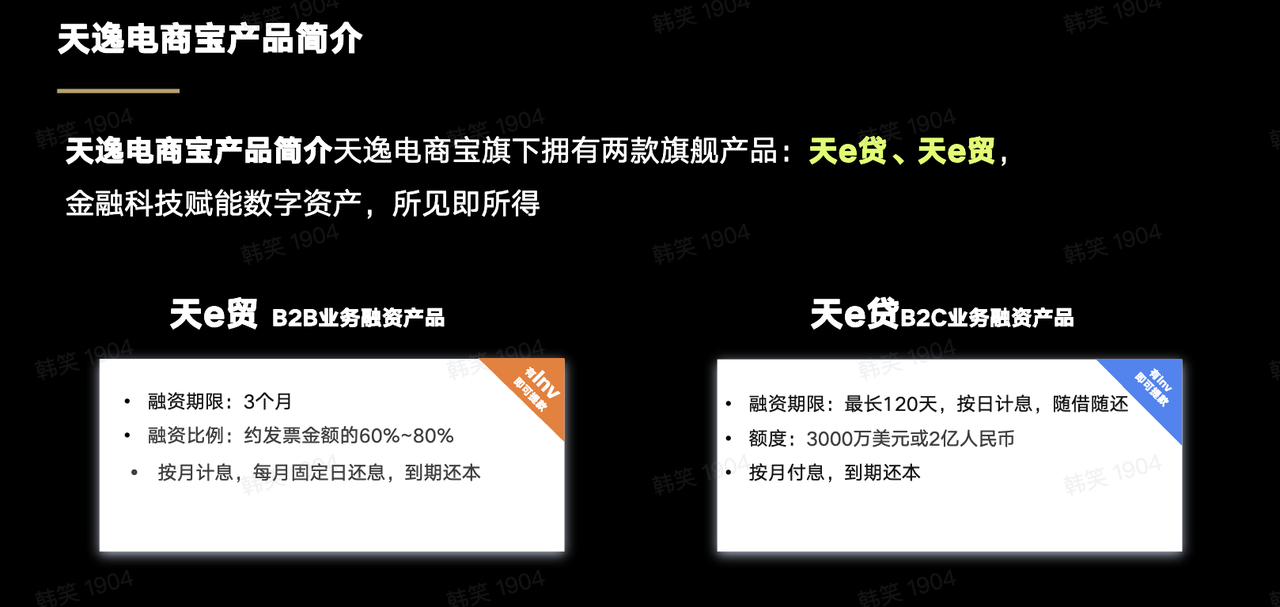
Tianyi Trade uses a factoring model. Take Amazon Vendor Central (VC) sellers as an example: they often face long operating cycles, with goods delivered but payments not yet received. For this scenario, we assess credit lines based on a client’s average monthly payouts over the past six months, with a maximum line equal to three times the average monthly payout, structured with monthly interest payments and principal repayment at maturity.
Tianyi Credit is designed primarily for B2C sellers, addressing capital needs for peak season inventory stocking, new product launch scaling, inventory turnover, and expansion to new platforms. It offers greater flexibility in use, with a maximum term of 120 days, daily interest accrual, and the option to borrow and repay on demand.
To put it simply: Tianyi Trade is suited for resolving payment term gaps, while Tianyi Credit addresses inventory stocking and working capital turnover needs.
The entire application process — from registration, credit line approval to final disbursement — can be completed fully online. Our goal is to make required documentation clear and application progress fully transparent. For eligible sellers, agreement signing for the process can be completed as fast as the same day.
Of course, when selecting a long-term capital partner, businesses do not only look at product features and parameters; they also consider service sustainability. Cross-border e-commerce is a highly volatile industry, and whether a capital provider understands the sector’s operational rhythm directly impacts the long-term partnership experience.
Tianyi Group has deep expertise in supply chain finance and technology services spanning more than 25 years. In the past, we have served over 100 banks and supply chain finance institutions, providing them with system solutions and risk control services. In 2023, our global transaction volume reached $33.4 billion, and our work has been featured in a special report by CCTV News.
For us, Tianyi E-Commerce Bao is not an isolated product. It integrates Tianyi’s accumulated expertise in supply chain finance, data-driven risk control, cross-border services, and capital arrangement into the real operational scenarios of cross-border sellers.
Different funding channels suit different needs. Banks hold advantages in terms of capital cost and institutional scale, while other cross-border capital service providers each have their own product strengths. What Tianyi aims to complement is the high-frequency, digital, fast-paced operational scenarios of cross-border e-commerce.
We consistently emphasize our use of proprietary capital because funding stability is critical for sellers. Some financing intermediaries and technology firms in the industry rely on external capital. When market conditions or trade policies shift, external funders may become conservative or even halt lending due to insufficient understanding of the sector, creating funding gaps for sellers.
Between March and April 2025, impacted by China-U.S. trade frictions, a number of banks and financial institutions in the market paused e-commerce financing services, leaving some sellers facing capital pressure. Because Tianyi acts as a direct capital provider, we are able to directly assess our clients’ specific operating conditions, and we continued to provide uninterrupted capital support to cross-border businesses during that period.
The core features of Tianyi E-Commerce Bao can be summarized as: proprietary capital, fully online processes, data-driven underwriting, and scenario-specific expertise.
When selecting capital partners, sellers are advised to compare four key factors: whether funding sources are stable; whether approval speeds can keep pace with critical business windows; whether product tenors align with payout cycles; and whether total financing costs can be covered by corresponding operational returns. As businesses scale, they need to manage not just top-line sales, but also the speed at which capital flows through their entire operational chain.
This article was first published on the official website of Ebrun.
[Copyright Notice] Ebrun advocates respecting and protecting intellectual property rights. Without permission, no one is allowed to copy, reproduce, or use the content of this website in any other way. If any copyright issues are found in the articles on this website, please provide copyright questions, identification, proof of copyright, contact information, etc. and send an email to run@ebrun.com. We will communicate and handle it in a timely manner.
Translated by AI. Feedback: run@ebrun.com