
Rob Hahn, COO of Pattern: Cross-Border Supply Chains Face Systemic Overhaul — Mastering Complexity Is the Key to Winning Competition
【Ebrun Original】On September 17, 2026, at the themed forum of "Accelerate26 Cross-Border Ecosystem Acceleration Conference · China Stop" hosted by Pattern, with Ebrun as the strategic partner, Rob Hahn, Chief Operating Officer of Pattern, delivered a speech titled "Crossing Borders: How Platform Sellers Can Navigate the Complex Challenges of Global Supply Chains".
Rob Hahn pointed out that e-commerce competition today is no longer just about products and advertising. As platform fulfillment networks continue to regionalize, whether a brand can place the right volume of inventory in the right warehouses directly impacts delivery speed, conversion rates, advertising returns, and final transactions. Platform complexity will not decrease, so brands must treat marketing, demand forecasting, warehousing entry, inventory distribution, and replenishment as an interconnected system.
In his view, forecasts can never be 100% accurate; the real competitive edge does not lie in avoiding mistakes, but in being able to recover from mistakes faster. To this end, brands need to shift from large-batch, low-frequency shipping to small-batch, high-frequency replenishment, reduce the dwell time of goods in multi-level warehouse networks, and retain control over inventory allocation.
Rob Hahn also demonstrated how Pattern leverages its automated warehousing, software systems, and global fulfillment network in the U.S. to speed up product entry to platforms via less-than-container load consolidation, automated warehouse onboarding, intelligent sortation, and multi-channel fulfillment. He stressed: "Complexity on platforms will not decrease; you must have the ability to navigate that complexity."
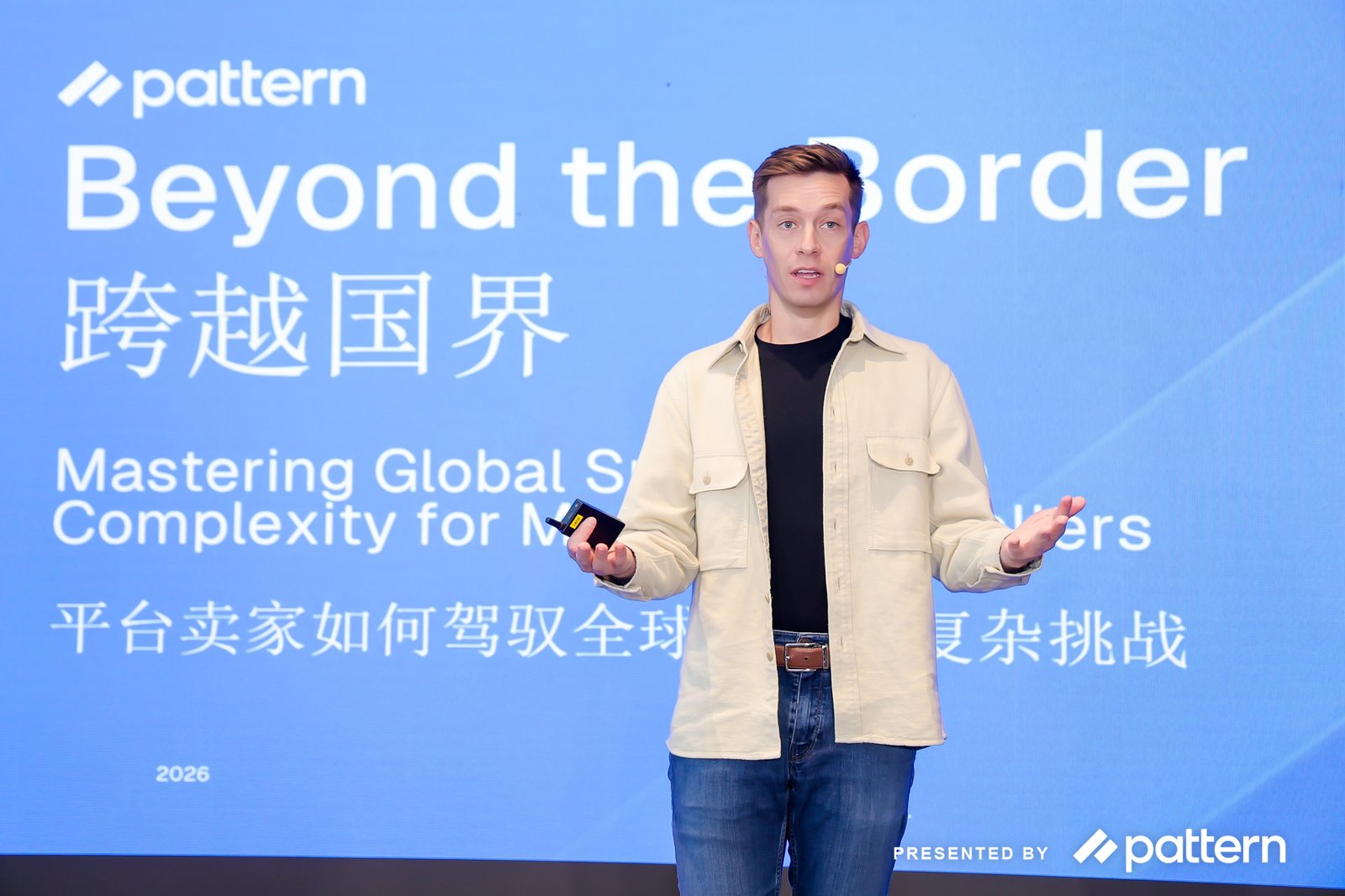
(This article is compiled from the speaker's on-site speech, with minor edits and deletions made without altering the original intent.)
The following is the full transcript of the speech:
01 Where Inventory Is Placed Now Determines Delivery Speed and Sales Conversion
Good afternoon, everyone. Thank you very much for joining Pattern Accelerate China. The topic I want to cover today is logistics and supply chains, which is critical for every e-commerce practitioner.
Let me start with a quick background on myself. I am the COO of Pattern, and I have been with the company for four years. Prior to that, I spent many years at Amazon, where I led a wide range of process and operational work.
Over the past 15 to 20 years, I have witnessed the tremendous growth of cross-border e-commerce as it has evolved into a mature sector. Today, I want to share with you how we navigate the complex challenges of global supply chains across platforms and brands, while building global brand ecosystems.
We will use Amazon U.S. as the primary case study, and also reference other platforms, to look at what has changed in recent years and how brands should respond.
For any brand or e-commerce practitioner to win in the market, they have to excel across the entire value chain of sales, logistics operations, and last-mile delivery.
When we work with Chinese brands, the speed of innovation coming out of China is especially evident. But brands still have to answer one question: how to strike a balance between building better products and meeting consumer demands. Platforms operate by a vast set of rules, and they are a completely different space than they were 30 years ago.
Thirty years ago, you might have been a factory that shipped goods to destination markets such as the U.S. or Europe, sold to distributors, who then placed the goods on physical store shelves. The scenario today is entirely different. Take Amazon Europe as an example: after goods enter one destination country, they may still need to be shipped to multiple other countries.
In recent years, the e-commerce landscape has continued to evolve. The number of new sellers entering Amazon has been declining, seller concentration has been rising, and supply chain complexity has kept increasing.
The greatest complexity lies within the supply chain. Roughly three years ago, if you were selling on Amazon U.S., a single container could enter one Amazon facility, and Amazon would handle the outward sortation. That is no longer the case today; now sellers have to ship goods to at least five regional zones.
The selling model has changed dramatically from the past, and very few players can easily cope with this rising complexity. In fact, Amazon is not the only platform doing this. Similar shifts are underway at Walmart and other global platforms; Amazon was simply an early mover in restructuring its supply chain network. For Chinese sellers on global platforms, this is a challenge they must understand and address.
But platforms are not intentionally making things harder for sellers; they are solving their own problems.
Take Amazon U.S. as an example: American consumers expect extremely fast delivery. Amazon began rolling out next-day delivery around 15 to 20 years ago, and now it is pushing further into same-day delivery. This is not an easy problem to solve in the U.S., where the population is unevenly distributed, some regions are geographically remote, and logistics challenges are significant.
To address this, Amazon has rapidly expanded its fulfillment facilities in recent years, forming different types of network configurations, including inbound nodes, cross-dock nodes, and fulfillment centers. Fulfillment centers store inventory and ultimately distribute products to consumers; cross-dock nodes primarily handle consolidated receiving and re-sortation. Distinguishing between the two is critical.
Amazon's fulfillment centers have seen explosive growth across the U.S., which has also increased operational complexity for brands. Suppose you have been selling for five years and have 10,000 units that need to be consolidated into a single container. In the past, you could hand the container over to Amazon, pay a sortation fee to Amazon, and let Amazon handle the subsequent distribution to five zones, without having to ship five times a week yourself.
For many brands, this creates a complex trade-off. While it seems to make inventory management easier, the inbound placement costs are also very high. Suppose you originally planned to ship 50,000 units, but now you only have 10,000, and you need to control how these goods enter different regions of the U.S. If products are not placed in the right zones, it may take longer to reach end consumers, dragging down conversion rates and actual sales. That is why inventory location matters. Brands need to balance more frequent, efficient shipping with broader regional coverage.
We can draw a comparison between Amazon and Walmart. Walmart is a massive U.S. retailer; a standard supercenter covers roughly 17,000 square meters, carries around 120,000 to 140,000 SKUs, and holds 1.5 million to 3 million units of in-store merchandise. A unique advantage of Walmart in the U.S. is that it can reach 90% of U.S. residents within a 30-kilometer radius. It is very close to consumers, with relatively limited per-store footprint and SKU count.
Amazon is different. A single facility can span 80,000 square meters, carry 6.5 million to 7.5 million SKUs, and hold up to 40 million units of inventory. Therefore, Amazon has to solve the problem of how to allocate inventory across each warehouse in regions like New Jersey to speed up delivery and drive sales. Amazon is further from consumers, and the problem it solves is different. As sellers, the challenges we face are different from those of brick-and-mortar retailers, and far more complex.
Why is inventory distribution so important? In the U.S., Amazon already offers same-day delivery. A consumer places an order at 10 a.m., and the product may arrive at their door after lunch. Compared to next-day delivery, this convenience is stark. When products are available for same-day delivery, view-to-conversion rates and average order value both rise.
To enable same-day delivery, brands must ensure Amazon places inventory in the right locations. Otherwise, if a competitor can offer same-day delivery and you cannot, you risk losing customers. Even if your total inventory is sufficient, if goods are not distributed across the right fulfillment centers, you will not see strong results. Even in the U.S., many domestic brands fail to get this right; cross-border sellers are even more prone to missteps.
Amazon's ecosystem is a velocity-based system. You need to keep shipping inventory to it, so the platform can allocate inventory more accurately based on fresher, closer-to-real-time data. The closer inventory is to end consumers, the shorter the fulfillment time.
Delivery speed also impacts advertising ROI. Marketing and supply chain operations are strongly interconnected, not two siloed departments. About three months ago, Amazon started releasing reports to every brand, allowing them to view view-to-conversion rates and click-to-purchase rates for same-day and next-day delivery, so they can adjust their operations accordingly. This feature may not be available in other markets yet, but it is accessible on the U.S. site at minimum.
In the system we have built, same-day delivery delivers a 12% higher conversion rate than next-day delivery. That gap is exactly where supply chain advantage lies.
Of course, forecasts will always have deviations; they can never be 100% accurate. If your forecast is very close to actual demand, that is great; but being able to recover faster from forecasting errors is also a core competitive advantage.
02 Small-Batch, High-Frequency Replenishment Matters More Than One-Time Shipping to Destination Markets
Next, let's look at Amazon's inbound network. As mentioned earlier, Amazon has cross-dock centers and fulfillment centers. Goods first enter the cross-dock network before being sent to the final fulfillment centers. Two years ago, Amazon launched a separate national cross-dock network. Because there are so many fulfillment centers, a brand usually can only ship directly to a limited number of them; sometimes, brands have to pay Amazon to route goods through the national cross-dock centers first, before they are distributed to different fulfillment centers. You can imagine how many tiers, how many nodes, and how much cost that creates.
Inventory is first consolidated then dispersed, moving from national nodes to regional distribution centers — a highly complex process. It is somewhat similar to brands using third parties or platforms to ship goods first to national warehouses, then to regional warehouses. You may have heard of AWD (Amazon Warehousing and Distribution) and GWD (Global Warehousing and Distribution), which can be understood as the global version of the service. In China, sellers can already ship goods to GWD. In many cases, this is a reasonable and suitable solution, but it does not solve all inventory problems.
Not long ago, Amazon launched a third cross-dock option: regional distribution centers. If sellers send too much inventory to Amazon, or ship long-tail products, goods may first enter regional storage centers. This delays the time it takes for products to reach consumers, because goods have to enter fulfillment centers first before they can be shipped out after a customer places an order.
Many brands only ask: "Do I have inventory? Am I out of stock?" But that is not enough. You not only need to have stock available, but also ensure stock is in the right fulfillment centers. The emergence of the regional cross-dock model has a huge impact on brand operations.
Under the 3P (third-party seller) model, sellers have to forecast and estimate shipment volumes on their own. Suppose you plan to send 1,000 units; Amazon will tell you how to split the shipment across different fulfillment centers. Whether you operate Amazon in the U.S. or other markets, you will face similar issues.
Take data from February 2024 as an example: if you were a seller back then, many shipments only needed to be sent to one facility. On-site data shows 89% of goods were sent to a warehouse in Indiana, with another nearby FWA warehouse handling a portion of the volume, combining for 94% of total shipments. Whether products were manufactured in China or Kentucky, U.S., most goods entered these centralized nodes. Later, Amazon shifted to a regionalized structure, with more cross-dock centers being added. When sellers shipped goods, they saw more destination options, which once reached 24 in total. Of course, you could pay Amazon to handle sortation, but that extends the entire chain and ties up cash flow. That is the change brought by the shift from national cross-dock centers to regional cross-dock centers.
A year later, Amazon rolled out another 40 cross-dock centers, making the network increasingly complex. By March 2025, the number of various cross-dock centers had exploded, creating the new reality brands must navigate.
What exactly should brands do? I have five recommendations.
First, adopt small-batch, high-frequency shipping and replenishment. Sellers cannot wait for long periods after a single shipment, and this is especially critical for Chinese sellers. In the past, I saw many factory-based sellers operate on very long shipping cycles, believing the only major cost was getting goods to the destination country. But now, brands and factories must find ways to implement small-batch, high-frequency replenishment. If you do not have enough volume to consolidate, or do not have a dedicated warehouse to help manage inventory, you have to balance cost, frequency, and inventory location.
Second, try to avoid national central warehouses and regional cross-dock warehouses to reduce inventory dwell time. Storing goods in multi-tier warehouses not only slows down inbound timelines, but also increases the risk of cargo damage or loss. Brands need to get inventory into the fulfillment centers that actually serve consumers faster.
Third, shorten the overall weeks of supply for Amazon. This sounds counterintuitive, and many people find it hard to believe when they first hear it. The reason is: when you supply goods to Amazon, products may be allocated to warehouses with low conversion efficiency. Amazon will not proactively move products from one fulfillment center to a more suitable one just because they are placed in the wrong location. The result is slower delivery, lower conversion rates, and reduced actual sales. Shortening overall weeks of supply makes replenishment more flexible and allows decisions to be made with fresher data. Even after goods enter Amazon warehouses, the platform may not prioritize slow-moving inventory. Therefore, brands must also calculate how much inventory across the entire network is at risk of becoming aged or slow-moving.
Fourth, avoid unnecessary Inbound Placement Service Fees. If you ship goods to a small number of warehouses and let Amazon handle placement for you, those fees are ultimately borne by the seller and will continuously erode profits. Brands must find alternative approaches, as relying on this model long-term is unsustainable.
Fifth, for brands with extremely high sales volume and significant room for supply chain optimization, I recommend cautious use or even avoidance of AWD. Using AWD means handing over more inventory control to Amazon, rather than letting the brand decide how to ship goods. This is not to say no brand should use AWD; instead, brands should decide what methods to use to support their business based on their own sales volume, turnover, and optimization potential.
03 Platform Complexity Will Not Decrease; Brands Need to Improve Error Correction Speed
Next, I would like to show a video of Pattern's warehousing facilities and how we help brands cope with surging shipment volumes during peak seasons. This set of capabilities serves both U.S. domestic brands and brands shipping from China to the U.S.; no matter what inventory model is used, the core logic remains the same.
Our warehousing facilities are designed for scaled operations, capable of shipping millions of units per week. We focus on quality and scalability, minimizing manual operations and human judgment, and instead relying on proprietary technology to handle heavy lifting.
After goods arrive at the warehouse, Pattern completes inbound check-in and labels each carton with an inbound shipment tag to track cargo throughout the entire inbound process. Employees place cartons on conveyor belts, and different workstations process goods simultaneously, distributing workload across dozens of staff.
At workstations, employees scan the barcode on cartons, take out products, scan them and complete quality checks, while entering key information required to create shipments. The software guides employees through preparation work such as labeling, multi-pack, and mixed-pack assembly. Once completed, employees attach Pattern carton labels, marking the goods as officially checked into inventory.
After packages enter the output conveyor belt, the system creates shipments via API integration and determines the destination fulfillment center in milliseconds.
In the sortation area, the system automatically prints platform carton labels and shipping labels. Cartons then travel along more than 1,000 feet of conveyor line into the vision tunnel. The vision tunnel conducts five-sided scans of cartons, while simultaneously weighing, dimensioning, assigning destinations, and automatically diverting cartons to the correct shipping lanes. The system also maximizes use of every cubic foot of space in each truck. Because we can consolidate shipments from multiple seller accounts into a single load, we increase loading density and help different sellers jointly reduce transportation costs.
There are several key takeaways from the video. First, Pattern is one of the largest service providers shipping to Amazon warehouses. We send goods into Amazon, which are then fulfilled via FBA. Whether a brand is based in the U.S. or China, they can first ship goods from China to our warehouses. We have omni-channel capabilities, so we can allocate goods from the same container to warehouses in different regions and across different channels.
Second, we use our own software, and all inbound plans are created by our proprietary system. Decision-making flexibility allows us to serve global brands across regions and get products into Amazon warehouses faster.
Demand forecasts will always have deviations, but in today's market, fulfillment speed has become a core competitiveness. Speed matters not only for consumers, but also for getting products smoothly onto platforms and into a purchasable state for consumers. Whether goods need to be shipped to Walmart, Amazon, or other platforms in the U.S., or to different platforms in Europe, we can provide support.
Our inbound speed is 5 times faster than the average Amazon seller's direct inbound process. In the U.S., we can get goods to Amazon's regional cross-dock warehouses in roughly two days; within seven days, goods can be shelved in Amazon warehouses. The average seller takes about 40 days to complete this process. What does that mean? The faster and more frequent your shipments are, the faster you can correct course when forecasts deviate.
We are building our own global network and continuously developing faster transportation systems to get goods to destination markets such as the U.S. and Europe as quickly as possible. Based on these capabilities, we have built an end-to-end, one-stop replenishment and fulfillment platform that serves brands directly. As an intermediate service provider, we can help brands ship goods to different destinations. For goods manufactured in China, we can pick up directly from factories and transport them to Pattern or Amazon warehouses.
More frequent shipping must be paired with lower-cost transportation methods. We have consolidation points across multiple regions in China, allowing sellers to ship via less-than-container load and enjoy freight rates close to full container load rates. This is extremely important for Chinese sellers.
Brands can also send goods to our centers in full containers, after which our warehouses will distribute them to Amazon, Walmart, eBay, channels across different European countries, or DTC independent site fulfillment centers in the U.S.
Through this network, we can reduce inventory dwell time, complete inbound processes faster, and fulfill orders at lower cost and with simpler processes than if brands handled LCL consolidation on their own. We will continue to optimize this solution, consolidate shipments for global brands, and deliver goods to markets around the world at higher frequency.
In closing, I want to say that complexity on platforms will not decrease. Whether you are in China, the U.S., or Europe, you must have the ability to navigate complexity. For brands going global, this should not be viewed solely as a massive obstacle. Complexity will not disappear, but brands can find the right service partners to solve this problem together.
This article was first published on the official website of Ebrun.
[Copyright Notice] Ebrun advocates respecting and protecting intellectual property rights. Without permission, no one is allowed to copy, reproduce, or use the content of this website in any other way. If any copyright issues are found in the articles on this website, please provide copyright questions, identification, proof of copyright, contact information, etc. and send an email to run@ebrun.com. We will communicate and handle it in a timely manner.
Translated by AI. Feedback: run@ebrun.com