
Rex Yang, VP of China Operations at Pattern: From Multi-Platform Deployment to AI Visibility, How Can Brands Accelerate Global Growth?
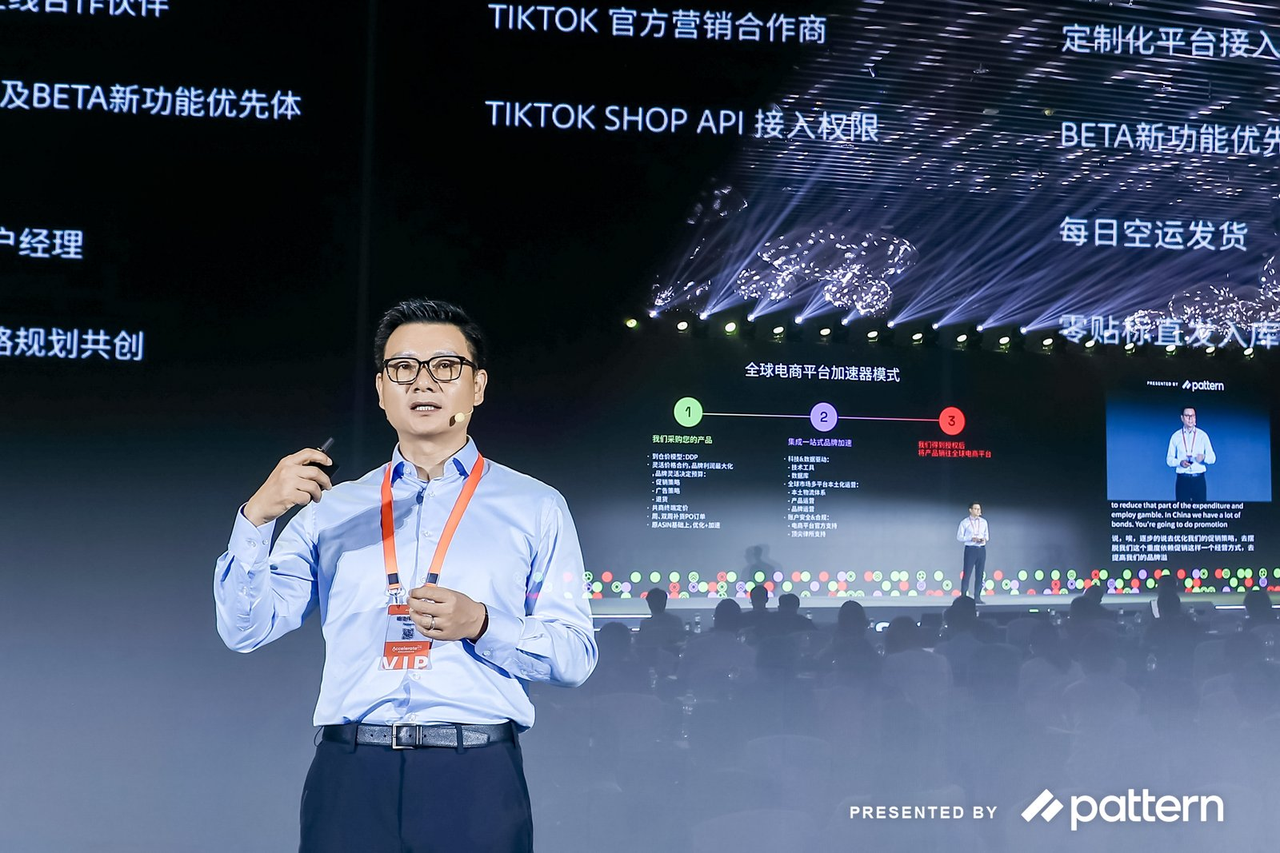
[Ebrun Original] On September 17, Rex Yang, Vice President of China Operations at Pattern, delivered a keynote speech titled "Evolving Global Go-To-Market Landscape: New North America Cycles and Fresh Growth Opportunities for Chinese Brands" at Accelerate26 Cross-Border Ecosystem Summit · China, an event hosted by Pattern with Ebrun as the strategic partner.
Yang argued that Chinese brands cannot achieve global expansion solely by opening stores on a single platform or continuously ramping up ad spend. After entering new markets, brands still need to address a full spectrum of challenges including cross-platform synergy, advertising and promotion efficiency, inventory management, local compliance, content production, and creator operations. In his view, real "acceleration" stems from two core pillars: first, an operational system covering diverse regions and sales channels; second, continuous analysis of platform data, consumer behavior, and content conversion performance. Particularly as TikTok Shop and generative AI reshape consumer decision-making pathways, brands must not only identify what content resonates with their target audiences, but also monitor whether they appear in AI recommendation results and how they are presented in those results. "Pattern aims to help brands accelerate sales growth while driving meaningful profit expansion," Yang noted.
(This article is an initial draft compiled from the speaker's on-site remarks, with minor edits made without altering the original intent. The full transcript of Yang’s speech follows below.)
01 Multi-Platform Deployment: The Core Is Driving Both Sales and Profit Growth
Good morning, everyone. It’s great to see so many old friends and new faces at the first-ever Pattern Accelerate Summit. When you walked into the venue today, did you notice the most prominent theme running through everything? It’s one single word: Accelerate. Why did we choose this word? For more than a decade since its founding, Pattern has been focused on figuring out how to help brands complete global expansion faster, accelerate sales growth, and deliver sustained profit increases. That has been our core mission and founding purpose all along.
That purpose boils down to a very simple, sincere wish. We genuinely hope to use Pattern’s business model, tools, and data to support brands—not just U.S. brands, but also a growing number of Chinese cross-border brands—to quickly build a global footprint, ramp up sales, and grow profits.
Deep partnerships with platforms are non-negotiable for global expansion. Over the past 10-plus years, Pattern has built in-depth strategic partnerships with more than 70 leading e-commerce platforms worldwide. Take Amazon as an example: many brands have run into issues like sudden account anomalies, delisted ASINs, or compliance problems. Brands are desperate to resolve these issues quickly, but resolution is often slow—after reaching out to Amazon, they may wait for weeks with no response, losing massive business opportunities in the process. Pattern holds regular senior-level meetings with Amazon and has access to faster, real-time coordination channels. We have priority access for account strategy services, ad placement, and promotion support. We have numerous cases where we helped brands resolve account health issues even before formal partnership contracts were signed.
As John (Pattern’s Chief Revenue Officer) mentioned earlier, advertising costs are becoming a major pain point for brands. Many brands pour huge sums into advertising each year, and in our conversations, almost all of them complain about extremely high ACoS. They know there is waste in their ad budgets, but they cannot pinpoint exactly where that waste occurs. Pattern’s proprietary ad placement tools help brands improve advertising efficiency. We rank among the top five ad spenders on Amazon, with the highest ad delivery efficiency in the industry. We are also one of Amazon’s largest shippers.
Beyond Amazon, we have established strategic partnerships with Walmart, TikTok Shop, Coupang, as well as domestic Chinese platforms including Tmall and JD.com. These partnerships help brands solve three key pain points: first, faster product listing on shelves; second, access to greater platform support; third, faster issue resolution when problems arise. With this speed and support, brands can expand across multiple platforms and regions more smoothly, completing their global layout faster.
In the video played earlier, my colleague mentioned that brands can rest assured selling inventory to Pattern. Let me elaborate on our partnership model. In short, it is an authorized reseller model. We first negotiate and agree on a purchase price with the brand, then the brand authorizes Pattern to sell its products across different platforms. Brands can authorize us to sell on Amazon in the U.S. or Europe, or to enter channels like Walmart and Target in the U.S.
Brands often ask: How exactly is Pattern’s purchase price calculated? We know Chinese brands face steep operational challenges. In conversations with hundreds of brands, we have seen that intense competition usually leaves them with razor-thin margins. For that reason, when setting contractual purchase prices, we aim to leave as much profit as possible with the brand.
The purchase price has two components: The first is relatively static fixed costs, including transparent platform commissions for marketplaces like Amazon, last-mile FBA logistics costs, and part of the operational costs borne by Pattern, all of which are factored into the purchase price. The second component is dynamic costs, which cover three main areas: ad spend, promotions, and returns. These budgets are covered by the brand, but all plans and strategies are developed by Pattern and implemented only after brand approval.
Once a brand partners with Pattern, we carry out end-to-end optimization across ad delivery, marketing strategy, promotion planning, and returns management. By continuously adjusting these dynamic budgets, brands will see steady improvements in operational efficiency year over year.
Pattern is responsible for day-to-day operations across all platforms for our partners. For example, we use tools and data analysis to improve ad efficiency, optimize promotions, and reduce return rates. We also handle listing creation and maintenance—testing how to present images, titles, and bullet points to drive the highest conversion rates. Local operations, logistics, and brand management are all managed by Pattern as well. The account health issues I mentioned earlier, along with local legal risks that come with operating in the U.S. and Europe, are also handled by our team. Brands no longer need to worry about lacking local teams, or being unfamiliar with local regulations and platform rules.
Once all these preparations are in place, Pattern can publish products to multiple platforms with a single click. Many of our brand partners finalize a coordinated go-to-market plan covering Amazon, Walmart, Target, Best Buy and TikTok Shop right at the start of our collaboration. The entire model can be summed up in one sentence: Pattern purchases products from brands, brands authorize Pattern to sell across platforms, and Pattern takes on associated operational risks. It is a highly accountable sales model.
Over the years, Pattern has partnered with many leading global brands. Since entering the Chinese market, we have also welcomed many outstanding Chinese partners. As you can see, brands including SONY, Bose, Pura, and Tumi are all long-term partners. After working with us, these brands have seen higher sales, increased profits, and gradually improved retail pricing. So Pattern’s goal for brands is not just top-line sales growth, but real, tangible profit expansion.
02 Driving TikTok Shop Growth: From Audience and Content Data to a Closed-Loop Affiliate Marketing Ecosystem
Everyone is very used to scrolling through Douyin in China, and global consumers are equally engaged with TikTok. Many brands want to enter TikTok Shop, but when they actually start, they often have no clear roadmap. I have spoken with many brands: some have built businesses worth RMB 1 billion or even RMB 2 billion on domestic Douyin, and have tried launching on TikTok several times—either running operations in-house or working with agencies, investing millions of RMB, but failing to achieve expected results. Other brands have massive scale in China but are unsure how to navigate overseas TikTok; they have not yet started testing, but are eager to enter the market.
Pattern already serves many TikTok Shop brands in the U.S. and Europe. We have distilled operational insights from these partnerships and built a suite of internal tools for the platform. For a brand to succeed on TikTok Shop, robust data tools are indispensable. Just as we have a full set of operational tools for Amazon, we rely on data insights to guide content and operations on TikTok Shop.
Brands can certainly spend heavily producing and running short videos, and aim to reach as broad an audience as possible when starting out. But before launching campaigns, brands first need to answer a few core questions: Who exactly is the target audience for the product? What structure should short videos use? What kind of content will make consumers click through, watch the full video, and ultimately make a purchase to drive GMV? Many brands fail to answer these questions rigorously at the start, and just default to allocating budget first.
Pattern’s internal data insight tools can analyze what short video structures perform best in a given category, what content keeps viewers watching all the way through, and what drives purchase conversion. We also analyze the demographic profile of video viewers: their age range, gender, geographic location, and approximate income bracket.
Let me share an example (shown on the screen). This is a case study for a health product. The first target audience for this product was middle-aged consumers. When videos used an "educational warning" structure, the cost per conversion was 5 cents; for "inspirational" content, it was 3 cents; for "real product test" content, it was 4 cents. Why this difference? I am middle-aged myself. When someone tells me, "You need to exercise, you should take supplements, otherwise you might develop health issues," I feel concerned, then use AI to research what supplements I need.
But if the product targets Gen Z, younger consumers, or millennials, the best-performing content structure changes. From the data shown on site, "authentic sharing" content had a conversion cost of $0.11, "emotion-driven" content was $0.14, and "expert explanation" content was 9 cents. For younger consumers, pure warnings may not work; they prefer to see practical, hands-on content. So if brands use the same video structure and narrative for products targeting different audience groups, they will waste massive business opportunities.
With data analysis tools, brands can clearly identify who their target consumers are, and what short video structure will resonate most. But analyzing video structure is not the end goal. It is equally critical to ensure subsequent content creation guidance and livestream operation guidance can be actually implemented. Pattern first uses tools to identify the right audience for a product, then supports brands in generating short videos, or provides video planning, creation guidance, and livestream operation support. This process does not stop at analysis and content generation—it covers end-to-end execution to form a closed operational loop.
Pattern also has an internal Q&A-based tool, similar to ChatGPT, Gemini and Claude. Brands can use it to ask questions like: Which subcategories in the health category are seeing strong growth trends right now? Are there new emerging subcategories? Which brand has the highest sales in this category? The tool pulls in third-party data to answer these questions: for example, that a certain health subcategory is seeing annual growth of 10%, 20% or even 30%; what a given brand’s annual sales are, and whether its growth rate hits 80%. Brands can use this data to build a complete, holistic view of the entire category.
Let’s look at the household cleaning category. This category is growing very fast on TikTok Shop in the U.S. right now. Brands can also use Pattern’s tools to check: How is the household cleaning category growing overall? Which product types are performing best? We ran a data crawl across the broader household cleaning category. The data shows that among household cleaning products, cleaning agents are one of the fastest-growing segments, with a market size of nearly $39 million over the past 180 days. There is one critical data point here: affiliate marketing contributes 81.1% of sales. That means the vast majority of sales do not come from brand-owned accounts, but from affiliate partners. Video-driven revenue accounts for roughly 18% to 22% of total category revenue, and $7.8 million of that, or 71% of video revenue, comes from affiliate content. The category has more than 3,400 active stores. The top 10 stores hold a 45% market share. What does that mean? The category has a sizable market, but the top 10 stores hold less than half of the share, with more than 3,400 active stores operating in the space. The market is relatively fragmented, so new brands still have ample opportunity to enter.
Based on these data insights, we partnered with Scrub Daddy in the U.S. Chinese consumers may not be familiar with Scrub Daddy, but it is a household name in cleaning products in the U.S., as recognizable as Blue Moon is to Chinese consumers. After gathering category data, we spoke with the brand: the cleaning product segment has a large market size and fast growth, so the brand should build a dedicated growth plan for TikTok Shop. Final results showed that over the past 180 days, the project generated nearly $480,000 in revenue. Of that, affiliate marketing contributed 90.4% of revenue, while brand-operated accounts accounted for just 0.6%, with an average order value of $17.61.
This dataset gives us two key takeaways: First, in our earlier category crawl, 81.1% of sales came from affiliate marketing. That means even brands with strong existing recognition will struggle to gain quick traction on TikTok Shop if they rely solely on self-operated accounts. The initial strategy Pattern designed for Scrub Daddy focused heavily on affiliate marketing, which ultimately made up 99.4% of sales. Second, average order value is critical. Scrub Daddy’s products are priced between $10 and $20, a price range that converts particularly well on TikTok Shop. This case shows that we can first use data crawling and analysis to identify fast-growing subcategories, then identify suitable brand partners, develop tailored plans for them, and ultimately drive growth. The entire process is built on tooling and structured data analysis. Growth on TikTok Shop is not simply about churning out more content, or spending money first and waiting for results. Brands need to first identify category opportunities and target audiences, understand what content structures drive higher conversion, then connect short videos, livestreams, creators, affiliate marketing and day-to-day operations to form a complete closed loop.
03 AI Is Moving Purchase Decisions Earlier in the Funnel; Brands Need to Manage Both "Visibility" and "Sentiment Score"
I have noticed that both at home and abroad, consumers are increasingly accustomed to asking AI for recommendations before making a purchase. I often use Doubao in China, and when I am in the U.S., many friends use Gemini, Claude and ChatGPT. Consumer behavior is changing. After talking to many sellers, we have identified two clear trends. First, conversion rates for branded keywords and long-tail keywords on Amazon have increased significantly. Second, the time consumers take to add a product to cart after making a decision has shortened notably. In the past, consumers might browse many product pages. Now, before they even visit Amazon, they may have already completed a round of information research via AI. For example, when a consumer plans to buy a projector, they might first ask AI: "I need a high-definition projector, which brand is right for me?" Consumers currently have a relatively high level of trust in information provided by AI. After getting an answer, they already have a near-purchase decision before they go to Amazon. When they land on Amazon and see the brand recommended by AI, they confirm their judgment: “That’s the one,” and quickly add the item to their cart.
For that reason, brands need to think through: which data points in AI interactions actually matter for their business? I want to highlight two core metrics here.
The first metric is "visibility." You have likely all had a similar experience: you ask ChatGPT or Gemini, "I want to buy a high-definition projector," and AI recommends multiple brands. Some brands rank first, some rank second, and many brands do not appear in the results at all. We once tracked the brand Vela through Pattern’s system. Data showed its AI visibility was 81%, a relatively strong score. In the AI visibility rankings, Vela hit 81% and had risen several percentage points, with five other brands ranked below it. Between November and December 2025, the brand’s visibility steadily increased. What did it do to achieve that? It likely increased content exposure in authoritative media, or adjusted content on its own website to formats that are easier for large language models to parse. For example, Q&A formats are relatively easy for large models to understand. Brands may also increase reviews on consumer review sites, or add more product testing content on Reddit. Pattern analyzes these factors to tell brands why they received a given score, and how to improve it. All this information is captured in Pattern’s GEO Scorecard, our Generative Engine Optimization scorecard.
The other key metric is Sentiment, or user sentiment scores for the brand. We can generate a GEO Scorecard for every brand, with one dimension being brand visibility in AI results, and the other being user sentiment towards the brand. Brands can get a clear view: of the content about them online, is there more positive or negative feedback? What aspects do positive reviews focus on? What are the negative reviews? And how can those pain points be addressed? This tool helps brands increase their product exposure on AI platforms, and understand how to earn more positive reviews and reduce negative feedback.
Consumers’ e-commerce purchase decisions are now being frontloaded to the AI Q&A stage. In the past, brands primarily focused on search rankings, ad placements on e-commerce platforms, and product page conversion. Now, brands also need to pay attention to whether they appear in AI answers, what rank they hold in those answers, and how AI describes them.
There is also very exciting news in this space. As John mentioned earlier, ChatGPT has launched its Ads service. Pattern has also rolled out a ChatGPT Ads offering. There are three key points to share here: First, Pattern has direct API integration with OpenAI, and builds ad campaigns through our deeply integrated technical system, which makes the process more effective, direct and fast. Second, OpenAI provides dedicated support for partners like Pattern. Leveraging its latest technology developments and supporting resources, we can launch and manage ad campaigns at scale. Third, Pattern has an extremely large third-party database, containing 91 trillion data points. We have already explained how we connect that 91 trillion e-commerce dataset to individual brands. We will continuously optimize campaigns through technologies like GEO to further improve ad performance. That is Pattern’s competitive advantage. Both GEO and ChatGPT Ads point to a new shift: AI is not only an entry point for consumers to access information, but is gradually becoming a new channel for brands to reach consumers, influence purchase decisions, and drive conversions.
Finally, I want to quickly share three cases to illustrate how Pattern supports brands across different stages of global operations.
The first case is tool brand Leatherman. Within one year, Pattern helped Leatherman expand to 17 new e-commerce platforms. If a brand were to expand to a new platform or new region on its own, it would take at least six months, sometimes longer, and it would likely take more than six months to start seeing meaningful results. Expanding to each new platform typically requires an investment of $100,000 to $200,000. Brands also need to understand local consumer purchasing habits, local languages, platform rules and tax policies, making the entire process extremely complex. If a brand relied on its own team to enter 17 markets, it would be an incredibly painful and difficult undertaking. Pattern already has partnerships with more than 70 e-commerce platforms globally, so this kind of expansion is far simpler for us. Brand content and operational assets can also be standardized, so brands do not need to build separate sets of assets for Amazon, TikTok Shop and Walmart. After partnering with us, Leatherman’s conversion rate increased by 12%. For a company that has operated for many years with a very clear brand positioning, that is an exceptional result.
The second case is Board Buddy. As I mentioned earlier, Pattern’s deep partnerships with platforms help products get listed faster. After partnering with Board Buddy, the average time to get products listed on shelves was 2.2 days. That is an extremely strong figure. If brands ship inventory to Amazon and wait for listings on their own, they often face days of extra delays, with no clear point of contact to resolve issues. Leveraging Pattern’s logistics and operational system, the brand achieved an in-stock rate of 99.2%, nearly 100%. I have spoken with many brands: some have an out-of-stock rate as high as 18%, and it is common to see out-of-stock rates above 10%. Keeping out-of-stock rates at 5% to 6% is already considered excellent performance. Pattern relies on our backend sales forecasting system and real-time inventory management system to hit that 99.2% in-stock rate.
The third case is CeraVe. As I noted earlier, creator networks are critical on TikTok Shop, where more than 90% of sales can come from affiliate marketing. After partnering with Pattern, CeraVe saw its monthly revenue grow tenfold, with the number of shoppable videos reaching 45,000. If each creator produces three to four videos, that means the project leveraged more than 10,000 creators. Managing 10,000-plus creators tests capabilities across multiple dimensions: First, brands and service providers need a sufficiently large creator pool, and the ability to build long-term cooperative relationships with creators, so that creators respond quickly when new collaboration requests are sent out. Second, the sample shipping network must be robust enough. Running creator marketing on TikTok Shop requires continuous, efficient sample delivery to creators across different regions. Third, the commission settlement system must be reliable. Large-scale creator collaborations are impossible to sustain long-term without a stable settlement system. Fourth, the compliance system must be robust, to avoid violations during TikTok Shop operations.
These three cases—Leatherman, Board Buddy and CeraVe—respectively cover multi-market expansion, logistics and inventory management, and TikTok Shop creator network operations, all core components of global brand building. When Chinese brands enter global markets, they are not just solving the problem of "selling products abroad"—they need to continuously address questions of where to sell, how to get products listed quickly, how to manage inventory, who will produce content, how to manage creators, and how to improve ad efficiency and profit margins.
In closing, I sincerely wish all Chinese brands growing sales and rising profits as you pursue cross-border expansion and global market presence. Thank you all.
This article was first published on the official website of Ebrun.
[Copyright Notice] Ebrun advocates respecting and protecting intellectual property rights. Without permission, no one is allowed to copy, reproduce, or use the content of this website in any other way. If any copyright issues are found in the articles on this website, please provide copyright questions, identification, proof of copyright, contact information, etc. and send an email to run@ebrun.com. We will communicate and handle it in a timely manner.
Translated by AI. Feedback: run@ebrun.com