
From AI Tool Adoption to Capability Building: How Four Action Pillars Help Service Providers Deliver AI Transformation
【Ebrun Original】As AI becomes a core infrastructure, competition among cross-border e-commerce service providers has shifted from isolated efficiency gains to a contest of comprehensive capabilities. While AI unlocks new growth potential in the cross-border e-commerce service market, that potential does not translate into tangible dividends automatically. Faced with tiered seller demands and rapid technology iteration, fragmented tool trials and siloed feature stacking are insufficient to build differentiated competitive moats or sustain long-term market position.
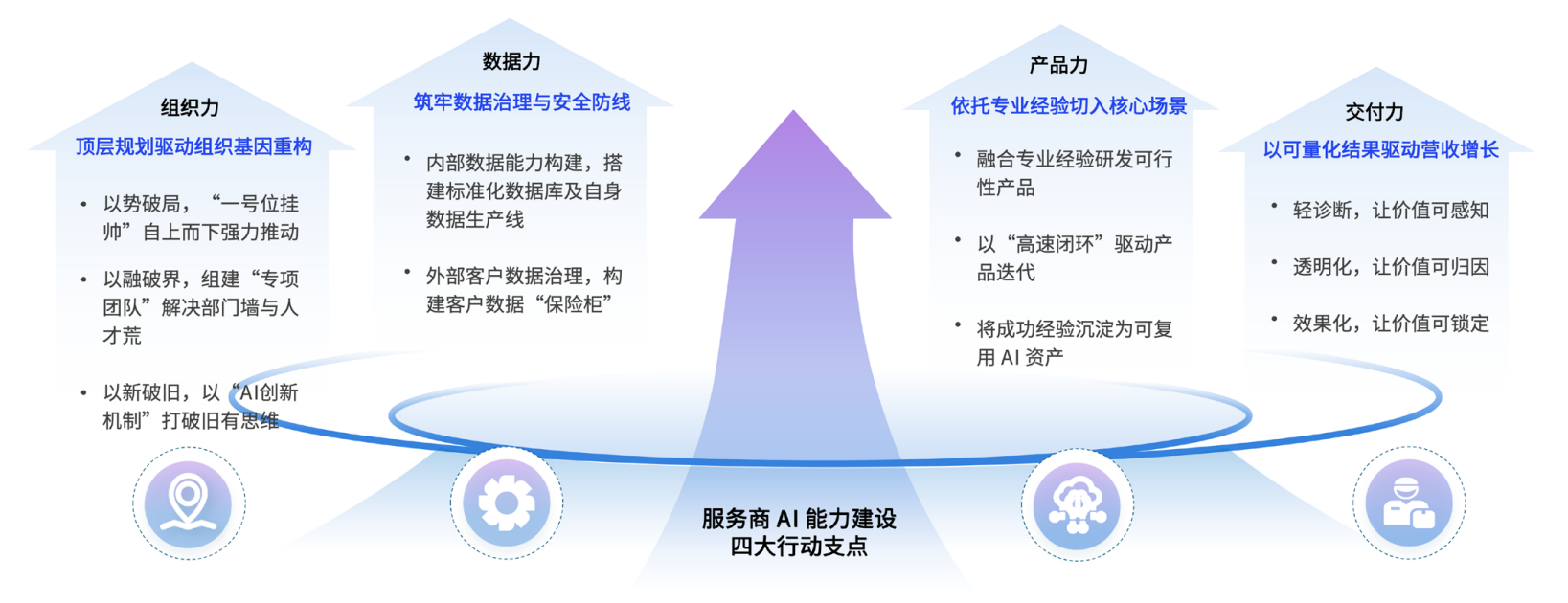
According to the *Winning in the New Cycle: AI Development Report for Cross-Border E-Commerce Service Providers*, jointly released by Ebrun Think Tank and Amazon Service Provider Network (SPN), service providers must make the leap from "using AI tools" to "building in-house AI capabilities". Organizational capability, data capability, product capability, and delivery capability are the four core action pillars that turn technological dividends into measurable growth outcomes.
01
AI Organizational Capability: Top-Down Planning to Rebuild Corporate DNA
Service providers that take the lead on organizational change will accelerate their AI transformation. Deploying AI applications is not simply a matter of rolling out tools; it requires aligned adjustments to organizational mechanisms, business processes, and talent systems. The report finds that service providers at different stages of maturity prioritize distinct organizational change priorities: 53.5% of early-stage providers identify "unclear strategic direction from leadership" as the top barrier to AI implementation; 48.4% of growth-stage providers rank "difficulty driving team upskilling and transition" as their primary challenge; and 34.6% of mature providers cite overreliance on past successful playbooks as the biggest obstacle to AI-driven organizational change.
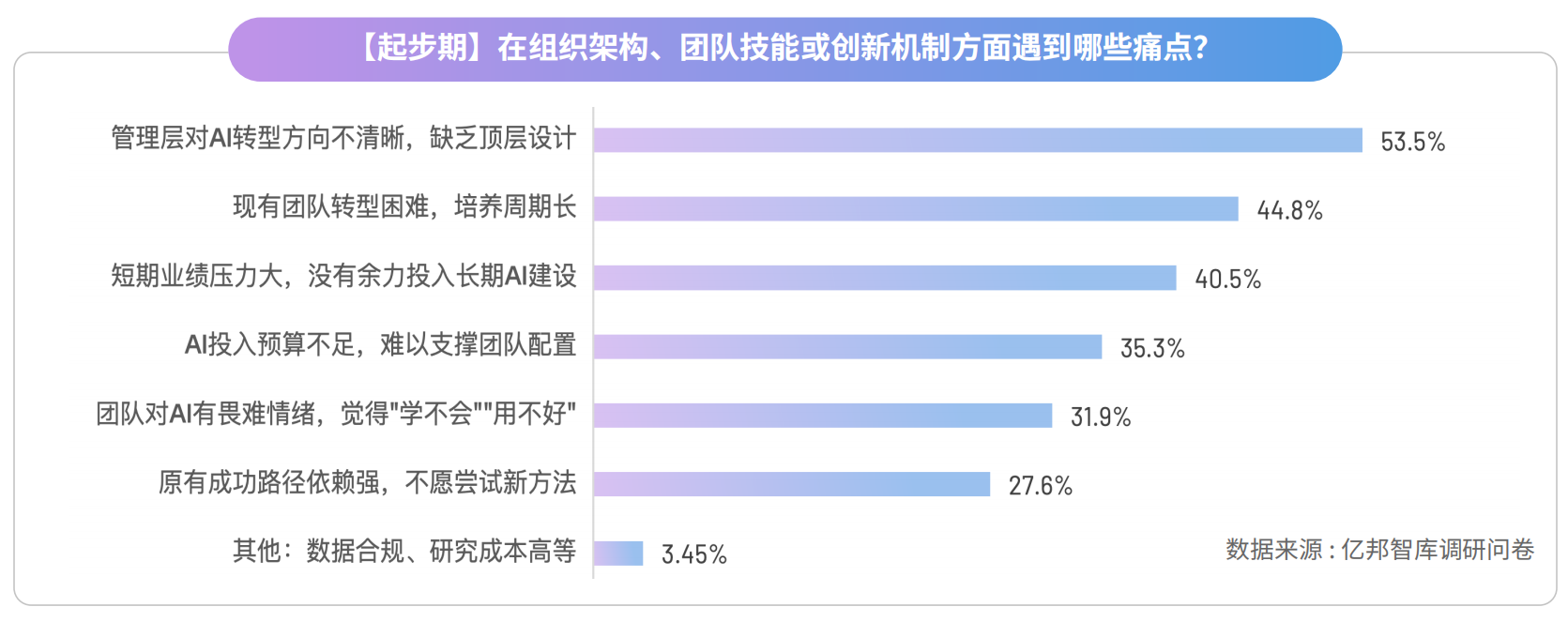
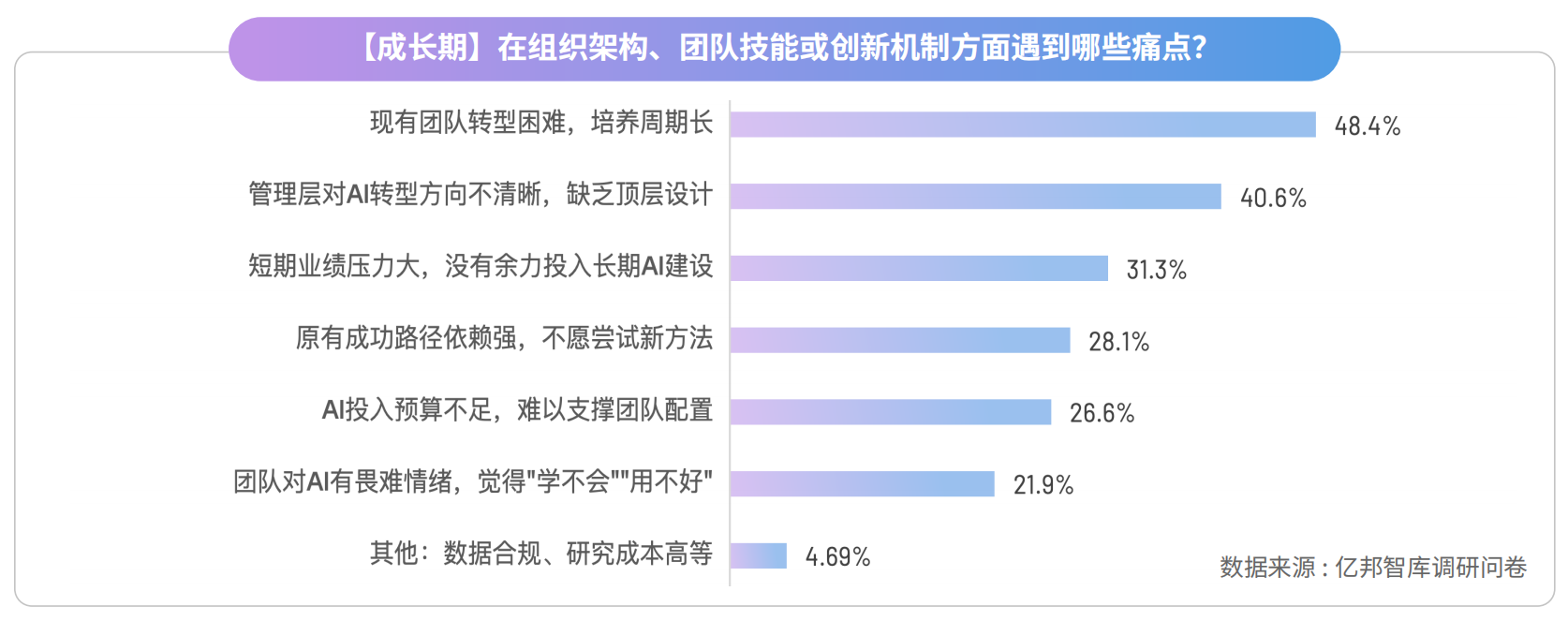
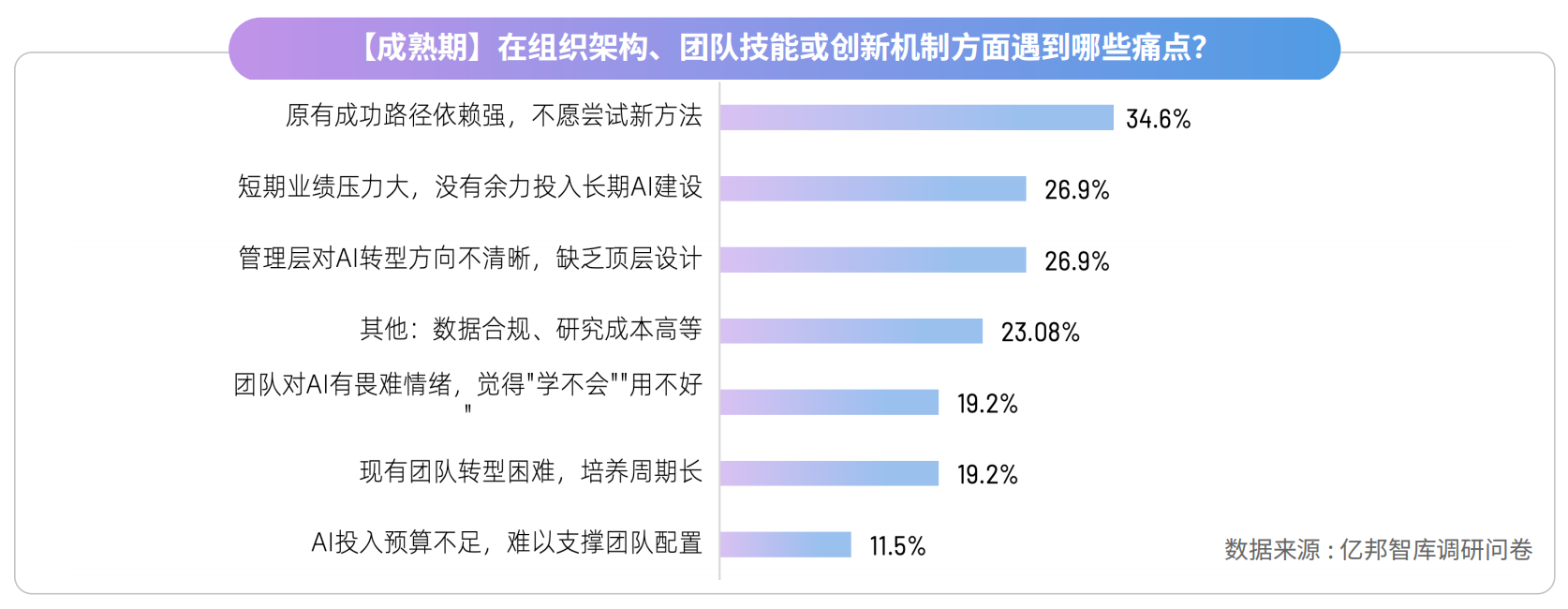
As AI adoption deepens, service providers need to move beyond ad-hoc individual experimentation to systematic organizational capability building, scaling AI from isolated pilots to company-wide deployment.
Action strategies:
- Break inertia with top-down mandate: Appoint C-level leadership to drive execution from the top. AI has evolved from a point efficiency tool to a core driver of P&L optimization, which requires consistent leadership engagement across all stages: setting strategic direction, allocating budget, delegating decision-making authority, and revising operational processes. Implementation should follow an "iterate fast, validate value, scale proven use cases" rhythm to maintain strategic balance between short-term operational survival and long-term AI investment.
- Break silos with dedicated cross-functional teams: Assemble cross-departmental task forces with close collaboration between business and technical staff to break down departmental barriers. Ensure AI investments are directly aligned with real business scenarios, avoid misalignment between R&D and frontline operations, and hold the joint team accountable for final scenario outcomes. Teams should codify actionable methodologies from collaborative projects, and regularly deploy validated AI talent across business units.
- Break legacy mindsets with structured AI innovation mechanisms: At the organizational level, allocate independent budgets and allow room for calculated risk-taking, encourage frontline employees to identify high-frequency pain points and propose AI solutions, then translate individual learnings into organizational capabilities via knowledge sharing and incentive programs. At the business level, first launch AI-powered new business scenarios to capture incremental growth, and use proven, quantifiable ROI from these initiatives to drive transformation of legacy business lines.
02
AI Data Capability: Uphold Both High Quality Standards and Security Compliance
High-quality data and regulatory compliance are the foundational bedrock for unlocking AI value. Vertical deepening of AI products is essentially the process of acquiring, refining, and accumulating category- or scenario-specific proprietary data. Per IDC research, 88% of AI pilot projects never reach full production deployment, with the core barrier being unreliable data rather than technical limitations1. The report finds that 32.8% of early-stage service providers struggle to generate AI value due to weak data foundations; 40.6% of growth-stage providers face model optimization constraints caused by poor data quality. Meanwhile, 56.3% of growth-stage providers are exposed to cross-border data compliance, intellectual property, and cybersecurity risks. For cross-border e-commerce service providers, AI can only deliver reliable, consistent results by upholding both strict quality standards and non-negotiable security compliance baselines.
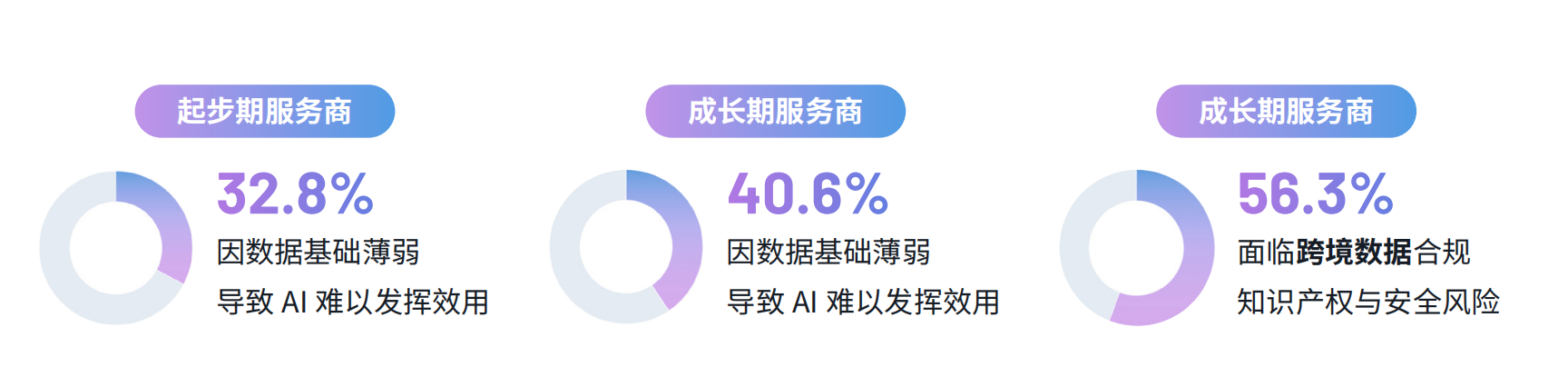
Action strategies:
First, build internal data capabilities:
Build a standardized data warehouse: Integrate and aggregate data across all business lines, apply unified cleansing and consolidation processes to create a structured, standardized data foundation for AI applications.
Develop an in-house data production pipeline: Design a tiered data aggregation framework drawing on internal operational data, legally sourced public data from external e-commerce platforms, and synthetic data, to form an end-to-end data pipeline covering ingestion, desensitization, processing, and reuse, to continuously supply AI models with high-timeliness, traceable, high-quality training data.
Second, implement robust client data governance:
Build a "data vault" for client information: Apply tiered authorization management across the full lifecycle of client data to ensure clear data provenance, defined rights and responsibilities, and full security and regulatory compliance. Deploy dedicated isolated storage infrastructure with end-to-end encryption, to give clients the confidence to share deeper, more granular data for collaborative AI co-innovation with service providers.
03
AI Product Capability: Integrate Domain Expertise with Model Capabilities to Build Product Moats
Supported by agile organizational structures and high-quality data capabilities, service providers need to embed years of accumulated domain expertise and forward-looking market judgment into their AI products, to build deep understanding of seller pain points and deliver precise, targeted solutions. Survey data shows AI is already penetrating a wide range of cross-border e-commerce operational scenarios, and the next stage of competition will center on which provider can first close the loop of "domain expertise – AI model – precise response – problem resolution", to pull ahead on product performance and user experience and build durable product moats.
Action strategies:
Develop minimum viable products by integrating deep domain expertise: Select high-frequency, quantifiable pain points with direct impact on business performance, deeply integrate vertical operational experience and proprietary business data with foundation models to deliver agile product development. For single-point, high-frequency tasks, provide lightweight, standardized AI skills; for multi-step, cross-system complex objectives, design and deploy AI agent solutions to ensure alignment with real user problems and needs.
Drive product iteration via a high-speed closed feedback loop: Traditional SaaS products follow a "feature feedback" loop: collect requirements, schedule development, deploy code, with iteration cycles measured in weeks or months. AI products instead follow a "data feedback" loop: after validation in real-world scenarios, product development is driven by data feedback; application-layer teams can skip traditional coding processes to directly fine-tune prompts and adjust strategy rules, cutting iteration cycles to days or even hours2, forming a high-speed loop of "validation – data ingestion – iteration – re-validation" to ensure products stay closely aligned with business needs and deliver consistent practical value.
Codify successful outcomes as reusable AI assets: After each project delivery, package proven prompt strategies, standardized workflow nodes, domain-specific skills, and AI agent solution templates into a professional knowledge base. For future similar scenarios, teams can directly call these assets for fast configuration, building a durable AI product moat through repeated reuse and continuous iteration.
04
AI Delivery Capability: Drive Revenue Growth with Quantifiable Outcomes
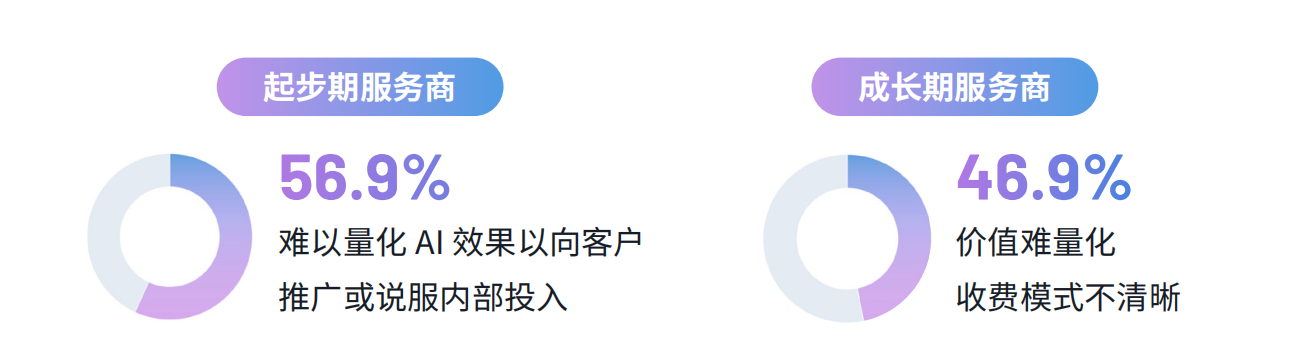
Delivery capability represents the critical final leap from AI investment to revenue monetization. The core of delivery capability is translating a provider’s AI value into tangible, attributable, reusable business outcomes, with AI value quantification as the central enabler. Survey data shows 56.9% of early-stage providers struggle to quantify AI impact for client outreach or to secure internal investment; 46.9% of growth-stage providers are hindered by hard-to-measure value and unclear monetization models; 53.9% of mature providers list "transition to performance-based pricing" as a key priority, with 61.5% focused on building quantifiable AI value assessment and performance tracking systems. Clearly, value quantification is a core priority for providers across all three maturity stages: tangible value demonstration serves as an entry point to help sellers see AI value and be willing to trial solutions; attributable impact builds trust, convincing sellers of AI value and making them willing to pay for proven results; reusable, scalable value creates lock-in, encouraging sellers to form habit-based reliance based on clear ROI, and commit to deep, long-term partnerships.

Action strategies:
Lightweight diagnostics to make value tangible: Offer free AI-powered store health diagnostics for small sellers, running low-cost pilot validations in targeted scenarios using non-sensitive client data, and delivering problem lists and diagnostic reports within hours.
Transparent tracking to make value attributable: Replace periodic progress reports with real-time delivery dashboards, where sellers can view ongoing AI-executed tasks, current metric health status, and risk events mitigated by AI at any time.
Performance-based alignment to make value sticky: Co-design "incremental revenue share" models with sellers, clearly defining growth baselines, attribution models, and revenue split ratios.
References
[1]https://www.dataradar.io/blog/what-88-of-failed-ai-projects-have-in-common/?trk=public_post_comment-text
[2]https://www.hr-soft.cn/blogkeji/2026051541221.html
This article was first published on the official website of Ebrun.
[Copyright Notice] Ebrun advocates respecting and protecting intellectual property rights. Without permission, no one is allowed to copy, reproduce, or use the content of this website in any other way. If any copyright issues are found in the articles on this website, please provide copyright questions, identification, proof of copyright, contact information, etc. and send an email to run@ebrun.com. We will communicate and handle it in a timely manner.
Translated by AI. Feedback: run@ebrun.com