
Victor Yuan, General Manager of Marketing at Payoneer: How Can Finance Become the Growth Hub for Chinese Companies Going Global?
[Ebrun Original] On September 17, 2026, Victor Yuan, General Manager of Marketing at Payoneer, delivered a keynote speech titled "Connecting the Globe, Driving Growth: A New Full-Stack Financial Paradigm for Chinese Brands Expanding Overseas" at the "Accelerate26 Cross-Border Ecosystem Acceleration Conference · China Edition" forum, hosted by Pattern with Ebrun as the strategic partner. Yuan noted that three converging forces — new traffic channels, new markets, and brand value — are propelling Chinese enterprises to shift from simply exporting products to operating as truly global businesses. Meanwhile, corporate capital flows have evolved from basic payment collection and withdrawal into a global capital network spanning multiple entities, channels, currencies, and scenarios.
In his view, when selecting financial partners, companies no longer focus solely on payment collection capabilities and fee rates; instead, they prioritize the ability to centrally manage global capital, improve capital turnover and operational efficiency, and deliver local compliance support as they enter new countries and regions.
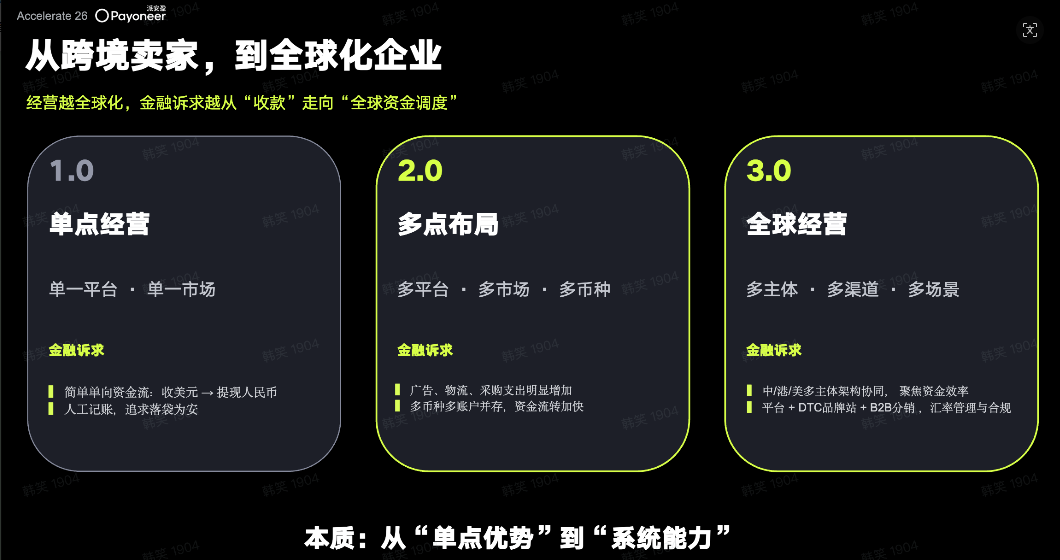
He outlined three phases of Chinese enterprises’ global expansion: Phase 1.0 "single-point operation" focusing on a single platform and single market, Phase 2.0 "multi-point presence" covering multiple platforms, markets and currencies, and Phase 3.0 "global operation" requiring global capital scheduling, cost control and compliance capabilities. The essence of this evolution is the shift from relying on single-point advantages to building systematic capabilities.
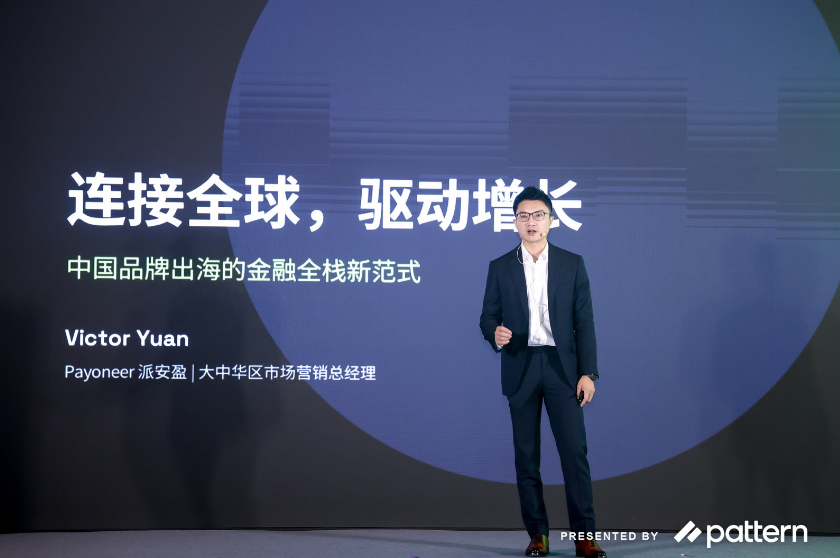
This article is compiled from the speaker’s on-site remarks, with minor edits made without altering the original meaning.
The following is the full transcript of the speech:
01 From single-point operation to global operation: Capital flow evolves from a "line" to a "network"
Hello everyone, I’m Victor from Payoneer, responsible for marketing and partner ecosystem development across Greater China. Today I want to discuss the changes underway for Chinese brands expanding globally, and why finance is playing an increasingly critical role in this process.
China’s cross-border e-commerce sector is approaching the 3 trillion RMB milestone, entering a new cycle of high-quality growth, driven by three concurrent forces:
The first force is new traffic channels. Content commerce platforms represented by TikTok Shop are growing rapidly, with global GMV surging 94%. From product discovery and brand perception to purchase completion, the entire consumer decision-making journey is being reshaped. Content commerce is redrawing the traffic landscape and emerging as the second growth curve for cross-border business.
The second force is new markets. In the past, companies were all jostling on the same highway; today, more and more businesses are discovering new roads, channels and routes. E-commerce in emerging markets including Southeast Asia, Latin America and Africa continues to grow at a fast clip. A growing number of Chinese firms are no longer fixated on mature Western markets, but are targeting emerging markets as new growth drivers.
The third force is new value. Chinese cross-border independent sites’ market size is projected to grow 62% year-over-year, as DTC brand building becomes a core growth path. Companies are no longer pursuing sales scale alone, but placing greater emphasis on brand equity, user relationships and long-term operational capabilities.
We can summarize this new growth logic with a formula: traffic multiplied by market reach, multiplied by brand value. These three forces are jointly driving Chinese enterprises to move from product export to global operation.
Since entering the Chinese market in 2015, Payoneer has long served companies expanding overseas. As a fintech firm, we have a unique vantage point: we don’t just see individual transactions, we observe how companies scale globally, and how their markets, business models and financial needs evolve.
To put it simply, we divide Chinese companies’ global expansion into three phases:
Phase 1.0 is single-point operation. Companies operate on a single platform in a single market, with relatively simple capital flows. Their core demand is secure payment collection: whether funds can be received safely, how fast settlement is, and what the fee rates are. The entire process follows a typical one-way capital flow: collect US dollars, withdraw RMB, keep manual accounts, and secure the funds.
Phase 2.0 is multi-point presence. Companies begin expanding to multiple platforms and markets, transacting in multiple currencies; expenses for advertising, logistics, procurement and other areas also rise rapidly. As multiple currencies and accounts coexist, capital turnover speeds up, and capital efficiency becomes increasingly important.
Phase 3.0 is global operation. Companies maintain multiple business entities and sales channels, even running platform e-commerce, independent sites and B2B operations simultaneously. At this stage, businesses need far more than just a collection account: they require global capital scheduling, cost control and compliant operation capabilities.
Therefore, from Phase 1.0 to 3.0, the fundamental shift is an upgrade from single-point advantages to systematic capabilities. Our clients are evolving from cross-border sellers into truly global enterprises.
Across all global business activities, one element is always indispensable: capital. Capital is the lifeblood of a company — wherever business goes, capital flows follow. In the past, the capital flow was like a line: collect payments from platforms, withdraw funds domestically, and the process ended. Today, it has become a network. Revenue from different markets needs to be pooled across different business entities. Funds must be collected, exchanged and managed across Hong Kong, US and mainland Chinese entities; these funds are then used to pay for advertising, logistics, warehousing, VAT taxes, payments to domestic and international suppliers, and salaries for overseas employees. Capital flows have evolved from simple payment collection and withdrawal into a global capital network covering multiple entities, channels, currencies and scenarios. Any breakdown in a single link can lead to lower capital turnover and operational efficiency. Managed well, this capital network can accelerate global growth; managed poorly, it can become a bottleneck to expansion.
02 Solving three core pain points: Evolving from a payment tool to the growth hub for global operations
When entering the global operation phase, finance first needs to address three categories of problems:
The first is system fragmentation. Companies should not have to toggle repeatedly between multiple bank accounts, payment service providers and business entities; they need a unified view of their capital. At Payoneer, for example, we aim to help businesses coordinate receivables, payables and capital management across all entities to build a unified global capital dashboard.
The second is capital timeliness. In global business, every day faster funds are settled, every unnecessary foreign exchange transaction eliminated, can directly improve a company’s cash flow and profit margins. Leveraging local clearing networks and real-time settlement engines, companies can achieve faster, more cost-effective capital flows.
The third is global compliance. The more markets a company enters, the more complex the regulatory environments and capital security requirements it faces. Payoneer operates in more than 190 countries and regions, and has built a corresponding global compliance framework to help clients navigate regulatory complexity and capital security risks in global operations.
Therefore, when companies select financial partners today, they no longer just ask whether funds can be collected and what the fee rates are; more critical questions are: Can complex global capital be managed centrally? Can capital operate efficiently on a global scale? As companies continuously enter new countries and regions, can the financial partner’s local compliance capabilities keep pace?
In the past, finance solved transaction problems; today, finance must solve global operation problems. The role of finance is gradually shifting from a back-end payment tool to the infrastructure and growth hub for global operations. That is why Payoneer continues to build full-stack financial capabilities.
Currently, Payoneer’s global network covers more than 190 countries and regions, with over 7,000 trade corridors, 2 million global active users, more than 60 compliance qualifications, and PCI DSS Level 1 security certification.
Around companies’ global operation needs, we provide five core capabilities: First, global collection, helping companies aggregate global revenue as if they were local businesses; second, capital and cash flow optimization, improving capital turnover efficiency to unlock liquidity and profit margins; third, budget and expense management, centrally managing business spending to make costs more controllable; fourth, global payments, enabling flexible capital scheduling to coordinate payments to global suppliers and service providers; fifth, operational efficiency improvement, powered by fintech to support business expansion. Simply put, we help companies connect the full end-to-end chain from collection, management and payment to capital optimization.
03 From exchange rate management and market expansion to risk control: Translating financial capabilities into growth outcomes
What value can full-stack financial capabilities create for enterprises? I want to share three client cases.
The first client is a precision manufacturing firm with annual revenue exceeding 1 billion RMB, operating across Europe, North America, Japan and Latin America, with a high share of multi-currency revenue.
After changes to China-US tariffs, higher tariffs combined with sharp exchange rate volatility led to foreign exchange losses that directly eroded profits. The client described the feeling clearly: “When exchange rates shift, it’s like riding a rollercoaster. By the time you react, the profits are gone.”
To address this, Payoneer helped the client open multi-currency local collection accounts supporting original currency collection including Japanese yen; meanwhile, through the FX target rate feature, currency exchanges were automatically executed at exchange rate points aligned with the company’s profit targets.
For overseas revenue that did not need immediate exchange, the company could also use it directly for local procurement, reducing unnecessary currency conversion. Ultimately, the client’s foreign exchange losses fell by 92%, and profit margins rose by 12%.
This case shows that companies do not have to passively bear exchange rate volatility. If exchange rates used to be like the weather — something companies had no choice but to adapt to — today they are more like air conditioning: adjustable and manageable. Through multi-currency original currency collection and proactive exchange rate management, exchange rate volatility can shift from an operational risk to a manageable cost.
The second client specializes in sports toys and electronic products, with mature supply chain and platform operation experience. After reaching a certain business scale, management began looking for the next growth curve, and ultimately set its sights on the Middle East, aiming to expand into the Saudi Arabian and United Arab Emirates markets through platforms such as noon.
The client’s challenges extended far beyond payment collection: they included local currency and multi-entity capital management, as well as limited familiarity with local market rules.
On one hand, Payoneer supported original currency collection in Saudi riyals and UAE dirhams to help improve the client’s capital turnover efficiency; on the other hand, we connected them to platforms including noon through our "Olive Branch Program", and linked them to operation, local tax, accounting and advertising service resources via our "Dandelion Program", providing market insights and ecosystem support.
Currently, the client’s two business entities have each achieved tens of millions of RMB in sales. This case shows that entering a new market is not just about opening an account; more importantly, it requires gradually building local operational capabilities. Starting from financial services, Payoneer aims to connect resources that help clients enter and take root in new markets, accompanying them as they expand into new growth territories.
The third client is a DTC brand with an average order value of over $600 for its core products. While high average order value drove brand growth, it also made the brand a prime target for fraudulent orders.
Since information such as logistics addresses, IP addresses, names and card numbers was highly fragmented, traditional manual reviews struggled to accurately identify risks; overly strict blocking measures, meanwhile, risked harming the payment experience for legitimate customers.
After integrating Payoneer Checkout and enabling the smart risk control engine, the AI-powered risk system can analyze more than 1,000 features within 100 milliseconds, dynamically trigger 3DS verification, and identify high-risk transactions while maintaining payment approval rates. Ultimately, the system blocked more than 60 high-risk orders, helping the client avoid over $50,000 in potential capital losses.
For DTC brands, payment acceptance is far more than just a checkout page. The ability to accurately identify risks and protect legitimate transactions and capital security is directly tied to whether a brand can grow steadily. High-quality payment acceptance capabilities also serve as a capital moat for cross-border DTC brands.
These three clients faced different problems, but they share a common thread: Chinese enterprises no longer just need to complete a single cross-border payment; they need to connect the markets, channels, ecosystems and financial resources required for global operations.
Starting in 2025, Payoneer launched the "Global Momentum" series of branded events, aiming to further open up Payoneer’s global network and ecosystem resources to clients. We frame this as "four connections":
First, market connection, linking opportunities across North America, Europe, Southeast Asia, the Middle East, Latin America and other regions; second, channel connection, linking platforms, social commerce, B2C and offline retail channels; third, ecosystem connection, linking local partners including logistics, tax and legal service providers; fourth, financial connection, providing enterprises with financial capabilities including collection, payment, foreign exchange, capital management and compliant operation.
Meanwhile, we connect high-quality platforms and sellers through the Olive Branch Program, provide ongoing operational and go-global practical empowerment through the Dandelion Program, and share market insights and ecosystem resources through the Global Momentum series of events, livestreams and white papers.
Over the past 20 years, Chinese enterprises have evolved from product exports and channel expansion to global operation. As Chinese companies transition from cross-border sellers to global enterprises, the financial capabilities they require will inevitably change accordingly.
For Payoneer, payment is only the starting point. Our goal is to continuously reduce the complexity of global operations through our global network, full-stack financial capabilities and ecosystem resources, making finance truly the infrastructure for global growth.
At Payoneer, we have a brand vision: "Every opportunity in the world is within your reach." Going forward, we hope to work with more Chinese enterprises to connect global markets, channels and ecosystems, and to connect every new growth opportunity, to truly win on the global stage.
Ebrun will continue to track and report on this topic. For more information related to this article, please scan the QR code to follow the author’s WeChat account.

This article was first published on the official website of Ebrun
[Copyright Notice] Ebrun advocates respecting and protecting intellectual property rights. Without permission, no one is allowed to copy, reproduce, or use the content of this website in any other way. If any copyright issues are found in the articles on this website, please provide copyright questions, identification, proof of copyright, contact information, etc. and send an email to run@ebrun.com. We will communicate and handle it in a timely manner.
Translated by AI. Feedback: run@ebrun.com