
As Brand Globalization Enters an Acceleration Phase, How Can Chinese Companies Unlock Growth Levers?
[Ebrun Original] In 2026, the globalization of Chinese brands has reached a critical inflection point: global markets are entering a new cycle of policy shifts and evolving consumer behavior, where tariffs, regulatory compliance and localized operations have become non-negotiable fundamentals. Channel dynamics are being rewritten: traditional search-based e-commerce platforms are reallocating traffic, while social and content commerce is rising rapidly. AI has emerged as a new variable, reshaping consumer shopping journeys and brand marketing logic, while also expanding the boundaries of hardware product innovation…
Against this backdrop, the operational models of cross-border brands are undergoing profound changes: shifting from low-cost volume expansion to brand building, from single-platform reliance to multi-channel deployment, and from manual operations to AI-driven decision-making. Companies need to integrate product validation, content distribution, channel operations, supply chain management and capital management to improve operational efficiency and build brand trust while expanding into new markets. Market competition has also evolved from single-point breakthroughs to cross-channel, cross-market synergy capabilities.
On September 17, the "Accelerate26 Cross-Border Ecosystem Acceleration Conference · China Station", hosted by Pattern with Ebrun as its strategic partner, was held in Shenzhen. The conference gathered dozens of decision-makers from platforms, brands and service providers, who provided a detailed breakdown of the next stage of Chinese brand globalization across perspectives including market development trends, AI technology application, multi-channel and multi-market layout, digital-intelligent supply chain transformation, and brand marketing innovation.

01 New Globalization Cycle, New Growth for Chinese Brands
The North American market is often the first choice for Chinese brands expanding overseas, and also a critical proving ground for globalization capabilities. At the main forum, following a speech by Andrew Edlefsen, Principal Commercial Officer at the U.S. Consulate General in Guangzhou, John LeBaron, Chief Revenue Officer of Pattern, and Rex Yang, Vice President of China Business at Pattern, delivered a keynote titled "Evolution of the Global Going-Overseas Landscape: North America's New Cycle and New Growth Opportunities for Chinese Brands", sharing their judgments on the new cycle and emerging growth opportunities.
John LeBaron noted that the way North American consumers discover products is shifting: the value of TikTok spills over to other sales channels – consumers develop interest while browsing content, then may turn to Amazon or independent brand websites to search and make purchases. As such, brands need to evaluate content investment based on changes in metrics including branded search volume and Amazon sales. Meanwhile, large language models are evolving from information query tools to consumer decision-making assistants, requiring brands to compete for visibility in AI-generated responses to ensure their products are correctly identified, understood and recommended.
Against this backdrop, he said, Chinese brands need to adopt a full-funnel operational perspective, improve the return on every dollar of ad spend, build synergy across advertising, inventory, logistics and cash flow, and boost operational efficiency through data and technology.
Rex Yang added that the "acceleration" of Chinese brand globalization needs to be reflected in both sales scale and profitability. Expanding into more platforms and markets requires corresponding operational system support, connecting platform cooperation, local compliance, logistics and inventory, content and advertising operations, and continuously optimizing profit-affecting variables such as advertising, promotions and returns, to translate channel expansion into operational returns.
He pointed out that on emerging channels such as TikTok Shop, brands should first identify category opportunities and target audiences, understand what type of content drives purchases, then build a closed operational loop through short videos, live streaming, creator collaborations and affiliate marketing.
In the new cycle, there is no shortage of opportunities for brands, but how to turn opportunities into tangible business growth is a more pressing concern for all players. To that end, Dave Wright, Co-founder and CEO of Pattern, delivered a speech titled "Technology Empowers Business, Unlocking Core Levers for Cross-Border E-Commerce", and officially launched Pi (Pattern Intelligence).
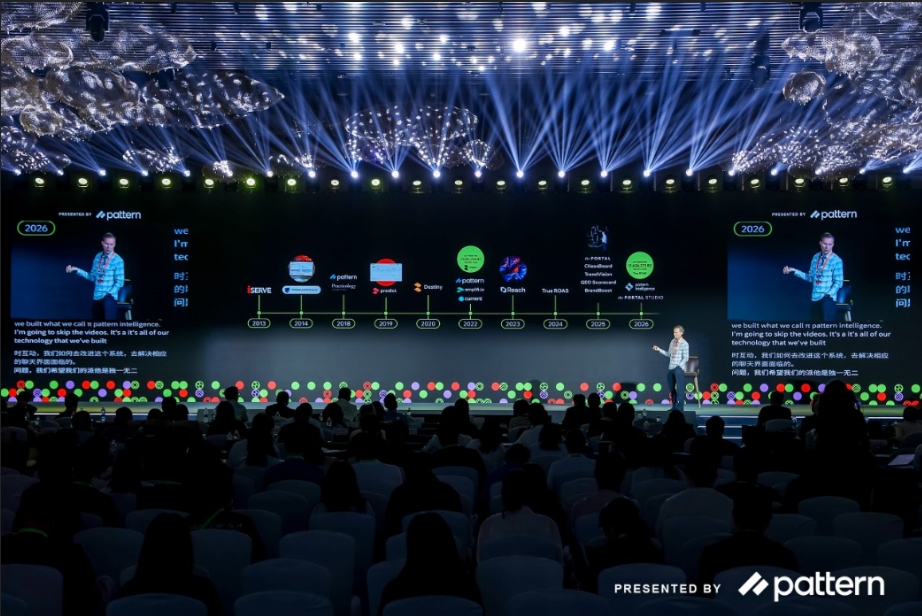
Dave Wright stated that the prerequisite for technology to empower business is high-quality products and appropriate marketing messaging. AI and large models are making product experiences more transparent, allowing consumers to understand and compare products in greater depth, which may further concentrate market share among high-quality products. Chinese brands have advantages in manufacturing, product supply and pricing, but they also need to build trust through clear content expression, so that consumers can accurately understand product value, before technology can amplify growth on that basis.
In his view, brands cannot simply pin growth on increasing ad spend; instead, they should combine organic and paid traffic, and assess operational outcomes driven jointly by traffic, conversion, content, pricing and fulfillment. If product information and conversion capabilities are not improved, increasing budgets will usually fail to deliver better results. The core value of technology is to translate massive volumes of consumer feedback, search and advertising data into actionable operational moves, continuously identify opportunities, validate results, and adjust strategies at machine speed.
According to the introduction, Pi (Pattern Intelligence) integrates Pattern's years of accumulated technical capabilities, connects to more than 70 global markets at the underlying level, is built on 91 trillion data points, and converts analysis into specific actions across advertising, content, pricing and fulfillment through an execution engine, helping brands improve the decision-making and execution efficiency of global operations.
Subsequently, Zheng Min, Chairman of Ebrun and Dean of Ebrun Think Tank, interpreted the "Insight Report on Accelerated Growth of Brand Globalization" jointly released by Pattern and Ebrun at the conference. The report forecasts that global retail e-commerce will maintain growth of around 7% over the next two to three years, with more market share concentrating among companies that can achieve sustainable, scaled growth. Meanwhile, the way consumers discover purchasing opportunities is further shifting toward "AI-driven discovery", and cross-platform shopping is also setting higher requirements for brands' global, omnichannel operational capabilities.
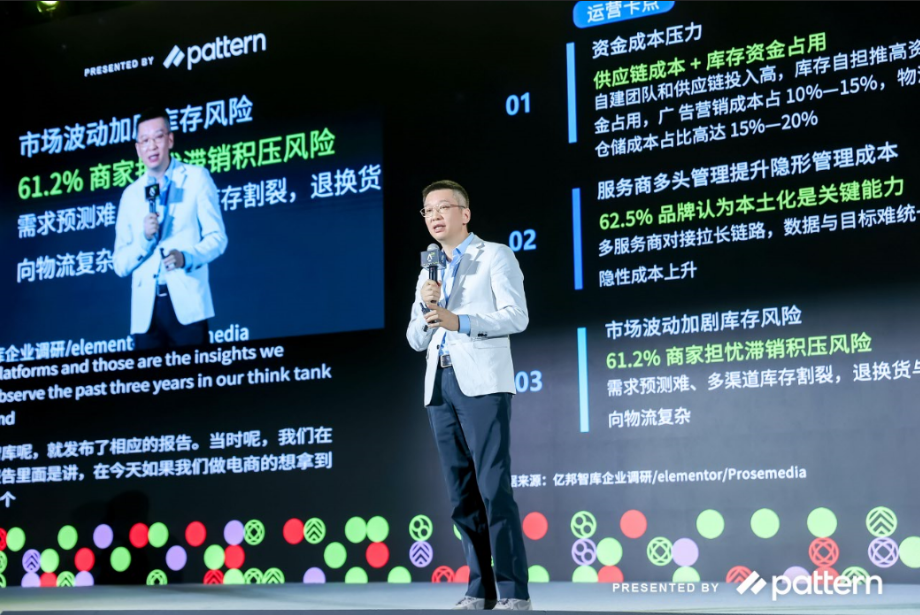
Zheng Min pointed out that the traditional growth formula of "traffic × conversion rate × average order value" needs to incorporate "supply" as a core factor. Taking Pattern as a sample, the report observed a "co-governed retailer-supplier relationship": distributors share operational and inventory pressure, and quickly feed market information and user demand back to brands, with both parties serving consumers through a sound division of labor, laying the foundation for sustainable brand growth.
02 From "Bounded" to "Boundless": How Can Brands Scale Up?
In the closing segment of the main forum, Liu Chen, Co-founder of Ebrun and CEO of Mati Club, served as moderator for a roundtable dialogue with Gao Haiyan, Co-founder of SmallRig, Shao Huaqiang, Vice President and General Manager of International Business at Rokid, and Huang Zhijin, General Manager of the Small Home Appliances Division at Bear Electric.
Liu Chen raised the core question: What is the starting point for companies going global? How can they develop a cross-border expansion model that fits their own characteristics, and how can they break through new capability boundaries? In his view, globalization is a process of constantly breaking boundaries and evolving continuously. Companies have different genes and starting points, so their expansion paths and rhythms also differ, and each player's experience needs to be understood in light of its own conditions.

Gao Haiyan noted that SmallRig's globalization has always been driven by user needs and co-creation. User communities are an infrastructure for communication and product innovation. Through demand management, flexible supply chains, creative revenue sharing and digital systems, co-creation can become a normalized, scalable and sustainable mechanism. As the needs of global users continue to expand, SmallRig has also moved from product manufacturing to scenario-based ecosystems, and further opened up resources including supply chains, markets and capital to co-create with the industry and more creators.
Shao Huaqiang believes that hard technology companies can have a global vision from their inception, but product launch and market expansion still require a clear rhythm. Rokid first validated its technology in industrial, cultural tourism and other scenarios in China before entering the consumer market; for new product categories with no existing precedents, it validates demand and pricing through crowdfunding to reduce trial-and-error costs. Science and technology innovation companies have low fault tolerance, so products launched to the market should match demand as closely as possible, and adopt a focused hit-product strategy.
Huang Zhijin shared how relatively mature small home appliance categories can build global brands. He stated that the manufacturing capabilities, user insights and operational experience accumulated domestically all need to be re-tested when entering overseas markets. Small home appliances are closely tied to local lifestyles and usage habits, so companies should target their most important target markets, maintain strategic resolve, accept longer operational cycles than in the domestic market, and fill gaps in overseas user insights, local operations and compliance capabilities through partnerships.
03 Insights: Advancing from 0 to 1 as a Global Brand
The first step to advancing as a global brand is often "how to be seen and how to be validated". At the first themed forum of the conference, guests outlined a reference growth path from 0 to 1, covering traffic entry points, channel models, brand creativity and product validation.
Steve He, Key New Account Manager at Google China, and Rex Yang, Vice President of China Business at Pattern, delivered a session titled "Seizing New Consumer Entry Points: Shifting from 'Being Searched' to 'Being Recommended'", providing advice for brands on generative engine optimization (GEO).
Steve He pointed out that while AI has improved information access efficiency, consumers still step out of AI environments to cross-verify information via search engines, video platforms, professional media and user communities, with authentic reviews and brand trust still influencing final purchase decisions. A brand's presence in AI recommendation results relies on authoritative facts and credible consensus formed across the entire internet. Therefore, GEO needs to integrate structured product data, authentic review and reputation accumulation, and catering to complex consumer intent, so that brands can be understood by AI and trusted by consumers. When measuring the value of GEO, brands should also focus on recommendation performance in scenario-based queries, users' subsequent verification behaviors, and omnichannel conversion increments.
Rex Yang added that consumers are moving further back in their journey to e-commerce platforms: after completing comparisons via AI in the early stages, they often have already formed clear brand preferences. Brands need to not only improve visibility and positive sentiment in AI results, but also ensure that content, pricing and inventory on e-commerce platforms and independent websites can meet the demand driven by recommendations, so that positive post-purchase reviews can feed back into AI recommendations.
Doug Jensen, Global Head of Sales and Sourcing at Pattern, broke down Pattern's global buyout-based exclusive distribution model. He noted that after purchasing brand inventory outright, Pattern uses data and technology to coordinate advertising, content, inventory and fulfillment, helping brands improve operational efficiency while expanding into new markets. Growth often comes from incremental improvements across every link – for example, more accurate keyword bidding, higher content conversion rates, faster inventory turnover, and more timely delivery. When these marginal advantages accumulate, they can lead to higher organic rankings, more traffic and sustained growth.
Subsequently, Ryan Barton, Director of International Business Growth at Pattern, served as moderator for a dialogue titled "How to Build a Cross-Market Adaptable Brand Creative System" with David Quaife, Managing Director of Pattern Middle East, and Dong Hongwei, Operations Director at AZDOME.
David Quaife pointed out that many conversion problems occur earlier at the brand perception stage: inconsistent visual expression, information overload or inaccurate localization can all erode consumer trust. A creative system should start from consumer data, answer "who the audience is, why they buy, and what they value most", translate product specifications into consumer-understandable value, and build trust through emotional expression and authentic evidence. Cross-market adaptation requires maintaining a unified brand positioning and visual system, while responding to local needs and aesthetic preferences, then validating effects through continuous testing, feedback and iteration.
Dong Hongwei noted that as channels and categories expand, relying on personal experience to adjust advertising, content and promotions is difficult to scale. Brands need to crystallize complex platform operations into systematic capabilities. After partnering with Pattern, AZDOME reorganized scenarios, selling points and trust evidence around consumer decision-making factors, driving its return on ad spend (ROAS) from 1.1 to 3.16 between February and August 2026. He believes such partnerships should serve long-term, systematic growth: both parties need to prepare products, open up data, and set aside time for validation, so that products, creativity, ad placement and operations enter a closed loop of continuous optimization.
Finally, Zhang Wenhan, Founder of Langhan Technology & INNO100, shared how AI hardware products can validate products and achieve a fast start through overseas crowdfunding. He pointed out that innovation needs to be validated by real paid demand: brands should assess consumer acceptance and product commercial feasibility before mass production and large-scale investment. Crowdfunding also acts as an amplifier for concentrated product launches, helping accumulate market validation, communication buzz, user communities and commercial endorsements, laying the foundation for subsequent entry into independent websites, Amazon and offline channels – provided that brands select competitive products and deliver on promises. Brands also need to connect product validation, user trust and channel expansion to turn a single new product launch into long-term growth.
04 Connection: Getting Channel Layout Right
In the process of accelerating overseas expansion, the essence of channel layout is solving the problems of how to sell products and how to collect revenue after sales. In North America, in addition to Amazon, platforms including Walmart Global eCommerce and TikTok Shop continue to release incremental growth, and are unavoidable channels for merchants to scale their business. At the second themed forum of the conference, guests shared insights on channel building, capital preparation and cross-border payment collection.
When discussing multi-channel layout, an unavoidable topic is TikTok Shop, the "interest e-commerce" platform that has risen rapidly in recent years. At the conference, Grace Yang, Vice President of Creator and Social Commerce at Pattern, served as moderator for an in-depth dialogue on "Winning at TikTok Shop US: Breakdown of Pattern's Best Practices for North American Growth" with Liu Mengyue, Head of User/Creator Marketing for TikTok Shop US, and top U.S. creator Brandon Michol.
Liu Mengyue pointed out that TikTok Shop integrates brand awareness, content seeding and purchase conversion, and brands should pay equal attention to its role in brand building, on-platform transactions, and sales driven to other channels such as Amazon and DTC sites. The three major opportunities in the U.S. market currently are live streaming, shoppable image-and-text content, and high-ticket products: live streaming already accounts for more than 25% of total GMV in the U.S. region, while high-ticket products can spark interest through short videos, then use live streaming to fully explain product value.
Brandon Michol noted that products with content potential need to be able to solve specific problems, and let consumers see functions and effects intuitively. Especially for high-ticket products, fully demonstrating product value and building trust is key to driving purchases. Authentic recommendations from creators, plus an understanding of target consumers' lives and needs, help build this trust.
Cal Han, Vice President of Asia Pacific at Thorne, shared how the company leverages Pattern to deploy across multiple markets and build a global growth engine. He pointed out that sales growth does not equate to healthy operations: Thorne once faced issues including low selling prices in some markets and a fragmented distribution network. High-end brands need to maintain control over their pricing system, channels and brand expression. In global cooperation, brands should be responsible for pricing, strategy formulation and demand creation, while partners take on demand fulfillment and operational execution, with both parties jointly sharing inventory and market risks. He sees Pattern as an extension of the brand team, with continuous communication and joint decision-making ensuring that multi-market operations serve unified brand goals.
In addition, Danni Zeng, Head of Market and Ecosystem at Tianyi Group, shared perspectives from the e-commerce financing dimension. She noted that expanding seller scale, rising customer acquisition costs during major promotion periods, and extended platform payment cycles are collectively squeezing the disposable cash space of companies. Sales growth and cash flow improvement are not synchronized: procurement, inventory preparation, logistics and advertising investment occur before payment collection, and multi-channel expansion requires even more capital support. Therefore, when measuring cross-border companies' growth capabilities, in addition to traffic, products and supply chain, stakeholders should also focus on capital efficiency, which is essentially operational efficiency.
Victor Yuan, General Manager of Marketing at Payoneer, explained the new full-stack financial paradigm for Chinese brands going overseas based on his company's business. He pointed out that new traffic sources, new markets and brand value are jointly driving Chinese companies to evolve from single-point operations and multi-point layout to global operations, and the capital link has also transformed from a single "line" of payment collection and withdrawal into a global capital "network" covering multiple entities, channels, currencies and various types of expenditures.
05 Leapfrog Growth: Sustained Improvement from Supply Chain and Marketing to Market Expansion
To achieve sustained growth when expanding overseas, brands cannot rely on a single capability – only those who can weave all complex links into a set of replicable comprehensive capabilities will win the long-term globalization battle. The third themed forum of the conference covered supply chain challenges, full-funnel advertising, affiliate marketing, and expansion into markets beyond North America, completing the puzzle of global operation systems for cross-border brands.
Rob Hahn, Chief Operating Officer of Pattern, pointed out that as platform fulfillment networks continue to regionalize, supply chains are directly affecting brands' sales performance. Sufficient inventory alone is not enough: brands need to place the right quantity of goods in the right warehouses, locating inventory closer to consumers, to improve delivery speed, conversion rates and advertising returns. Therefore, marketing, demand forecasting, warehouse inbounding, inventory distribution and replenishment need to be managed as an interconnected system.
Susan Lai, Director of Key Account Business Development for Amazon Ads China, explained the significance of "full-funnel advertising" for overseas-bound brands. She noted that brand marketing needs to shift from competing for existing search traffic to continuously creating new consumer demand. If budgets are overly concentrated on bottom-of-funnel search ads, it is like everyone crowding to "fetch water at the wellhead", with competition continuously driving up customer acquisition costs. Brands should allocate part of their budgets higher up the funnel, reaching and nurturing new users through streaming media, content marketing and information feeds, "injecting water at the source" to accumulate brand awareness and trust for subsequent conversions.
Suki Chen, Director of Key Account Sales for Levanta China, shared new traffic tactics from off-site seeding to AI recommendations in the GEO era. Suki Chen pointed out that while consumers still complete transactions on Amazon, brand selection decisions increasingly happen off-site: social content builds awareness, search, reviews and AI answers help consumers compare and verify, and Amazon captures already formed purchase intent. Specific usage scenarios, real experience data and direct comparisons with competing products not only help consumers build trust, but also form the evidence basis for AI to identify and recommend brands. As such, off-site content is becoming an important asset to influence brand selection and secure AI recommendations.
Finally, Jane Liu, Director of Cross-Border Seller and Self-Operated Business for Coupang China, Muhan Chen, Head of China Business at noon, and Libby He, South China Head of Channel and Ecosystem Management Team at Mercado Libre, participated in a roundtable dialogue, sharing how Chinese companies expanding overseas can find growth opportunities in three emerging markets: South Korea, the Middle East and Latin America.
Jane Liu pointed out that South Korea has moved past the stage of low-cost volume expansion, with consumers placing greater emphasis on product performance, visual experience and authentic reviews. Chinese brands can leverage Coupang's official logistics to reduce product testing costs, but long-term growth still requires solid product selection, localized operations, stable fulfillment and compliance capabilities.
Muhan Chen believes that the Middle East's strong consumer spending power and undersaturated brand supply provide growth space for differentiated products. Brands should dig into local life scenarios to identify segmented demand, develop independent product and marketing rhythms, and prioritize local inventory stocking, instant retail, and integrated online-offline promotions.
Libby He noted that consumption in Latin America continues to shift online, and supply from Chinese brands remains undersaturated, creating opportunities for brands with strong product capabilities and cost-performance advantages. Companies can start with lightweight product testing, then deepen local operations, while understanding Mercado Libre's rules around warehouse capacity, store weight and reputation, concentrating resources to build strong stores instead of copying playbooks from other platforms.
Ebrun will continue to track and report on this intelligence. For more information related to this article, please scan the QR code to follow the author's WeChat account.

This article was first published on the official website of Ebrun.
[Copyright Notice] Ebrun advocates respecting and protecting intellectual property rights. Without permission, no one is allowed to copy, reproduce, or use the content of this website in any other way. If any copyright issues are found in the articles on this website, please provide copyright questions, identification, proof of copyright, contact information, etc. and send an email to run@ebrun.com. We will communicate and handle it in a timely manner.
Translated by AI. Feedback: run@ebrun.com