
Ebrun's Zheng Min: New Global Brands Enter ‘Speciation Boom Era’ as Supply Chain, Engineering and Design Capabilities Form New Intersection
Ebrun Original – On September 17, at the Accelerate 2026 China Cross-Border Ecosystem Acceleration Conference, Zheng Min, Chairman of Ebrun and President of Ebrun Think Tank, interpreted the Insight Report on Accelerated Growth of Global Brands, jointly released by Pattern and Ebrun. Zheng projected that global retail e-commerce will maintain growth over the next two to three years, but market structure is shifting, with a larger share of the market concentrating among players capable of sustainable, scaled growth.
Meanwhile, the evolution of “consumer opportunity discovery” has progressed from information search and e-commerce platform search in earlier eras, to social discovery, and now further to “AI-powered discovery.” Consumers move fluidly across all channels and touchpoints, such that brands cannot predict at which exact touchpoint a user will stop and complete a purchase. Accordingly, brands expanding globally must build omnichannel operational capabilities tailored to global markets – they can develop these capabilities in-house, or partner with leading service providers to build them collaboratively.
Taking Pattern as a research case, Zheng noted that the company differs from traditional e-commerce operators and traditional distribution agents, having developed a “co-governed retailer-supplier relationship.” Under this model, brands and distributors jointly serve consumers, and form a healthier division of labor through data feedback, inventory turnover optimization, and global operations. Against the backdrop of the traditional growth formula of “traffic × conversion rate × average order value,” “supply” also needs to be incorporated into the equation.
Building on this, Zheng further proposed that Chinese new global brands have entered a “speciation boom era”: China’s supply chain, engineering capabilities and design expression are forming a new intersection, while the core of brand building evolves from trust, to reliance, to brand devotion.
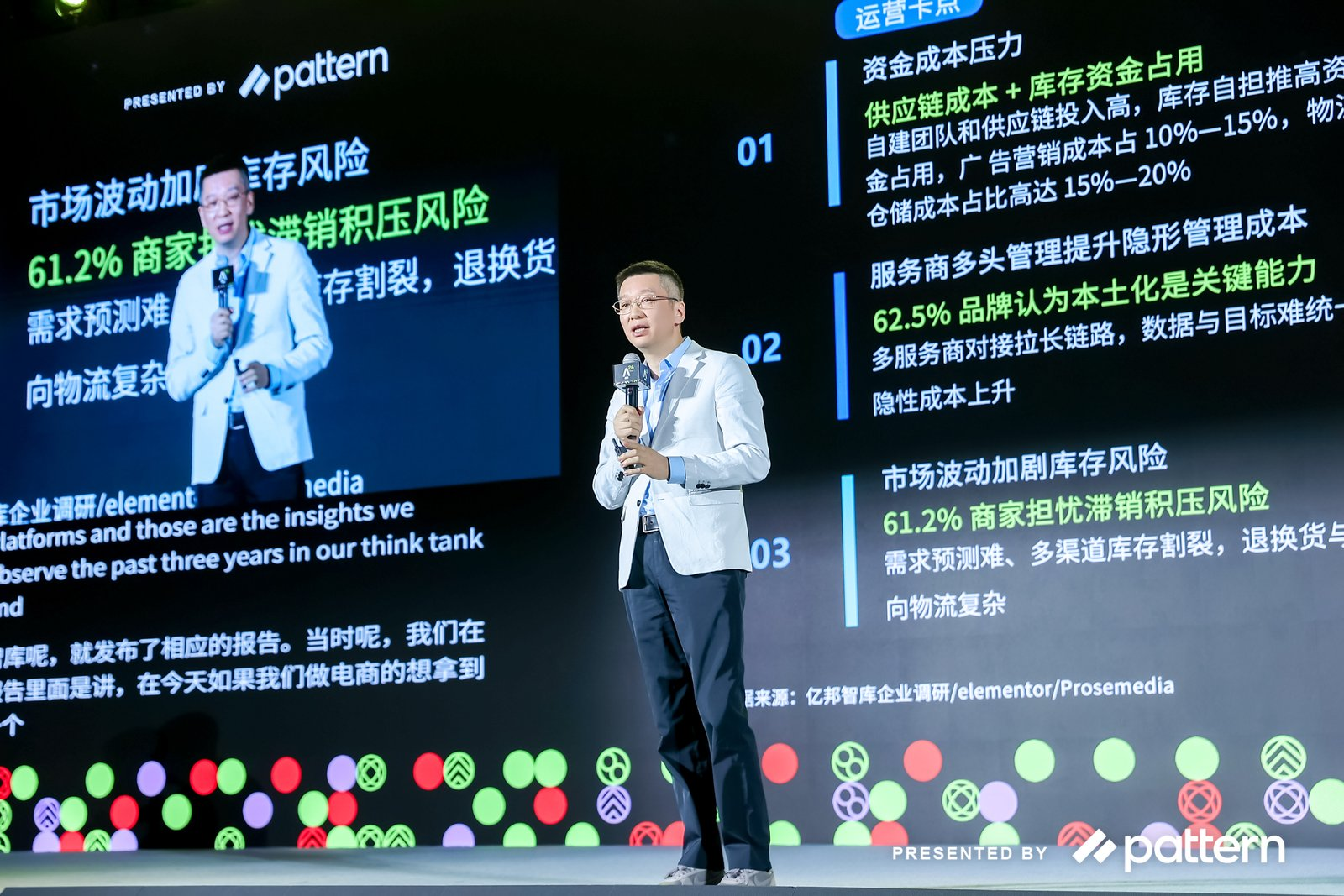
(This article is compiled from the speaker’s on-site remarks, with minor edits made without altering the original meaning.)
The following is the full transcript of Zheng Min’s speech:
01 Global e-commerce is still growing, but market share is concentrating at an accelerated pace
As many of you may have observed this morning, Pattern is a highly professional company. Earlier in his presentation, Dave made a remark that resonated deeply with me: the team is constantly focused on how to help the world’s best brands succeed. We are delighted to have co-published the Insight Report on Accelerated Growth of Global Brands with Pattern. Next, I will provide a brief interpretation of the report.
First, let’s look at the trends.
Since 2020, China’s e-commerce growth rate has fallen below the global average for retail e-commerce. But we have one core takeaway: over the next two to three years, global retail e-commerce shows no obvious signs of slowing, and will maintain growth of around 7%; what is changing, however, is the structure of that growth. This also explains why businesses need to pursue global expansion.
Let’s look at Amazon data. Between 2021 and 2025, the number of sellers with annual sales exceeding $1 million rose from roughly 60,000 to more than 100,000, representing a compound annual growth rate of over 13%. The number of sellers with annual sales exceeding $100 million grew from 50 in 2021 to 235 in 2025, representing a CAGR of 47%.
Compared to the 7% average growth rate of global retail e-commerce, the count of million-dollar sellers is growing faster than 13%, while the count of hundred-million-dollar sellers is growing at 47%. This indicates that going forward, the market will allocate more share to businesses capable of sustainable, scaled growth. That is our first insight.
Our second insight relates to AI.
Many industry players have already begun adopting AI. In the report, we pay special attention to the traffic conversion changes brought by AI: traffic driven by AI has a 42% higher conversion rate than traffic from traditional channels.
This morning during his presentation, John also outlined a critical evolution path for “consumer opportunity discovery”: it began with information search, represented by search engines, moved to e-commerce platform search, then to social discovery. Today, we are seeing “AI-powered discovery,” and we are hearing the concept of “intent-driven commerce” for the first time.
The third trend insight concerns the challenges brands face when expanding globally, and the capabilities they need to build.
Research shows that brands pursuing overseas expansion face two prominent “60%” pain points: 61.2% of merchants cite high concern over unsold inventory in overseas markets, and nearly 60% worry about how to coordinate and manage diverse local service providers in overseas markets.
Another survey shows that 73% of global online shoppers now make purchases across multiple platforms. Three years ago, Ebrun Think Tank noted in a report that winning a customer order in today’s e-commerce landscape is akin to playing roulette: consumers move fluidly across all channels and touchpoints, and brands cannot predict at which touchpoint a user will stop and make a purchase.
Therefore, brands expanding globally must build omnichannel operational capabilities for global markets. Businesses can build these capabilities in-house, or partner with excellent service providers to develop them together. That is our assessment of the capability requirements for global brand building.
02 Adding “supply” to the growth formula to build a co-governed retailer-supplier relationship
Based on the above insights, we studied Pattern’s business model, which has two highly unique traits.
First, unlike traditional e-commerce operators that provide services on a commission basis, Pattern operates on a buyout wholesale model. For brand owners, this means they do not have to bear excessive inventory risk alone – this is the fundamental difference between Pattern and traditional e-commerce operators. Second, Pattern also differs significantly from traditional distribution agency models.
As anyone with experience in traditional commerce knows, in traditional distribution systems, channel partners often guard closely information around how products are sold, at what price points, and are reluctant to share such data with brand owners. Pattern does not operate this way.
Operation service providers like Pattern go to great lengths to feed back to brand owners, as quickly as possible, information including what prices products sold at, which channels they sold through, as well as user intent and points of interest.
We have long reflected on this issue. Domestically, there is no shortage of criticism leveled at e-commerce. Why is that? Behind this lies an age-old issue: retailer-supplier conflict.
There has always been tension and negotiation between brand owners, suppliers and retail distributors. Today, we see that Pattern, by differentiating itself from both traditional e-commerce operators and traditional distribution agencies, has pioneered a third model: a co-governed retailer-supplier relationship.
Under this model, brands and distributors can form a more virtuous division of labor, jointly serve consumers, and develop better products for end users. Massive market information and user demands can be quickly transmitted back to brand owners, while distributors help brand owners share the pressure of operations and inventory turnover.
This is a positive change we observed while researching the report: the retailer-supplier relationship between brands and distributors is being restructured.
There is a well-known “universal growth formula” in e-commerce: traffic multiplied by conversion rate multiplied by average order value. But in Pattern’s e-commerce operation growth formula, “supply” is also added as a core variable.
The traditional growth formula has exposed flaws: for example, traffic costs are being bid up to unsustainable levels, while product prices are squeezed continuously lower. Only by incorporating supply and the retailer-supplier relationship into the growth formula can brands achieve branded, sustainable, healthy growth. That is the growth equation we observe at Pattern.
On the AI front, Pattern has built systematic Agent applications based on massive data volumes and its self-developed models. At the application level, this is an autonomous AI e-commerce execution engine, capable of identifying opportunities, detecting risks, and capturing user preferences.
Since brands expanding globally face the challenges and requirements of cross-border operations, they must leverage AI to improve efficiency. As it stands, Pattern not only helps Chinese brands expand globally, but also brings global brands into the Chinese market – at its core, it is a global e-commerce operation service provider.
We can illustrate this capability through several case studies.
Thorne, a nutritional supplement brand, leveraged Pattern’s support to establish Tmall Global as its core China channel, breaking into the category top 10 within six months. Its Tmall sales increased nearly 200% year-over-year, while maintaining strong brand premium.
Kelo-cote, a scar care product brand, also focused on Tmall Global as its core channel, achieving roughly 150% year-over-year sales growth and a brand premium of around 30%.
Spanx, a shapewear brand, used Pattern’s Destiny intelligent ad optimization engine to form a closed loop from ad optimization, to full-funnel advertising, to data-driven decision making. The number of its keywords ranking in the top four positions increased 138% year-over-year.
The fourth case is Bosch, the German engineering and consumer products brand well known to Chinese consumers. The case focuses on Bosch’s thermal technology products. Since countries around the world impose strict safety requirements on thermal products, this case better demonstrates Pattern’s capabilities in global operations and compliance. Over 18 months, Pattern helped the relevant products enter 13 global markets, with compliance serving as a core enabling capability.
These cases further explain why “supply” must be included in Pattern’s growth formula. Only by incorporating supply can brands truly build long-term equity.
03 New global brands enter the “speciation boom era”
Finally, I would like to share a judgment from Ebrun Think Tank this year: Chinese new global brands have entered a “speciation boom era.”
Why do we make this assessment? Because five trend lines we observed in the report all converge on one intersection: new brands and new categories built on the foundation of China’s capabilities in supply chain, engineering, and creative design are poised to win greater favor among global users.
At the same time, China’s cross-border e-commerce sector is evolving from a “seller” model to a “brand” model, with brand awareness awakening across the industry.
Ebrun Think Tank believes the core of a brand is “credibility,” which can be broken down into three layers: the first layer is trust, the second is reliance, and the third is brand devotion.
If a brand wins consumer trust, it can price its products 20% higher than comparable products without issue; if a product’s functionality delivers a strong user experience, the brand can build reliance among users; if a brand wins user recognition for its values and aesthetic, it can capture value from “brand devotion.”
Delivering strong quality earns trust; delivering strong functionality earns reliance; delivering resonant values and aesthetics leads to devotion.
After years of exchange with global cultural and aesthetic movements, Chinese brands have initially formed recognizable aesthetic schools, including minimalist tech, Oriental aesthetics, cute trendy toy culture, and laid-back casual style.
That concludes my brief sharing on the Insight Report on Accelerated Growth of Global Brands jointly published by Ebrun Think Tank and Pattern. I wish you all thriving business. Thank you!
This article was first published on the official website of Ebrun.
[Copyright Notice] Ebrun advocates respecting and protecting intellectual property rights. Without permission, no one is allowed to copy, reproduce, or use the content of this website in any other way. If any copyright issues are found in the articles on this website, please provide copyright questions, identification, proof of copyright, contact information, etc. and send an email to run@ebrun.com. We will communicate and handle it in a timely manner.
Translated by AI. Feedback: run@ebrun.com