
Where Does the Incremental Growth Lie for Cross-Border E-Commerce Service Providers in the AI Era?
【Ebrun Original】As the global e-commerce sector enters a new cycle of intelligent development, the service provider market is undergoing structural shifts. On one hand, the widespread adoption of AI tools on e-commerce platforms is driving increased standardization of basic operational services, eroding the value proposition of traditional service offerings. On the other hand, sellers' AI demands have evolved from streamlining operations to driving intelligent growth, creating a host of unmet new service needs. Changes on both the supply and demand sides are unlocking incremental growth opportunities in niche AI service segments.
On July 30, 2026, Ebrun Think Tank, in partnership with Amazon Service Provider Network (SPN), released the report *Winning in the New Cycle: AI Development Report for Cross-Border E-Commerce Service Providers* (hereinafter referred to as "the Report"). The Report breaks down the competitive landscape and growth opportunities for service providers in the new cycle across three core dimensions: e-commerce platform infrastructure, seller demands, and service provider supply.
01
E-Commerce Platforms: Standardization of Basic Services and Shifts in Consumer Behavior Force Service Upgrades
As e-commerce platforms continue to enhance their AI capabilities, some basic operational processes are shifting from manual delivery to support from intelligent tools. According to the Report, over the past year, Amazon third-party sellers alone used generative AI to create more than 12 million salable product listings, equivalent to an average of over 20 new product listings generated and launched with AI assistance every minute1.
This "one-click generation" capability has made basic operational services increasingly replaceable, with survey data showing that 57.3% of service providers have already felt significant operational pressure2. Going forward, service models that derive value from repetitive execution will face mounting challenges, requiring service providers to upgrade toward offerings with greater professional value and differentiated capabilities.
AI is not only reshaping operational workflows but also transforming how consumers discover products. Research from Similarweb shows that brands featured in ChatGPT recommendations are 2.5 times more likely to drive website traffic within seven days than brands that do not receive such recommendations. Sellers need to integrate product value, application scenarios, and user experience into product detail pages in a format that aligns with AI logic and comprehension3. This poses new requirements for service providers: they must not only help sellers optimize traditional operations, but also assist them in building a product content system that is "AI-understandable, AI-invocable, and AI-trustworthy."
02
Seller Side: Core AI Demands Shift From Streamlining Operations to Intelligent Growth
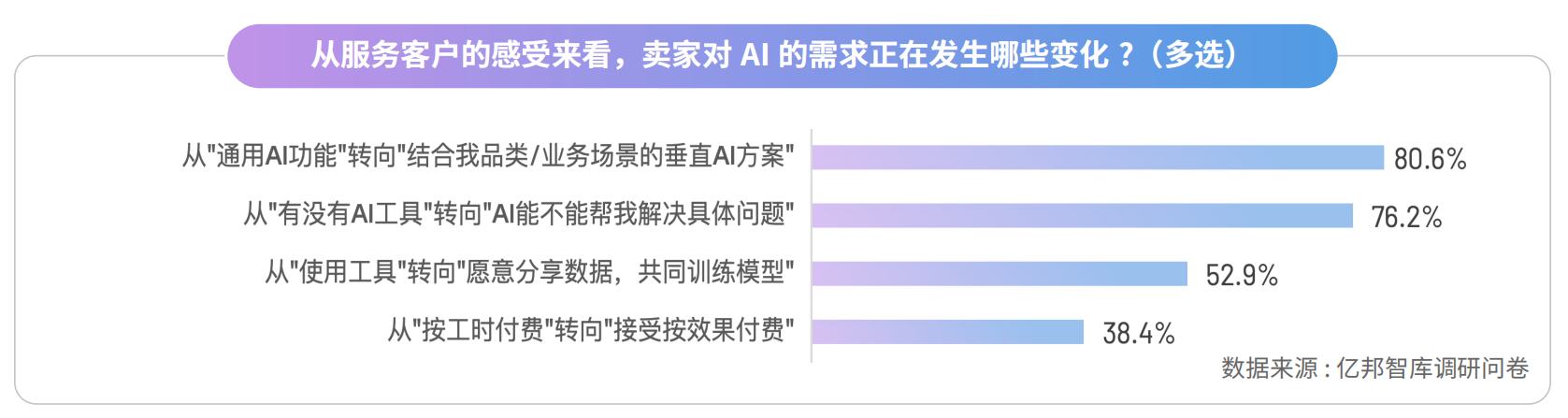
First, demands are evolving from "trial of new functions" to "deep cultivation of scenario-specific solutions". Sellers expect more vertical AI products to address their personalized pain points. Currently, sellers are grappling with severe product homogenization, persistently high operational costs, and weak product pricing power. As general-purpose AI tools gradually become standard offerings for sellers, their service demands have shifted toward AI products that better understand category characteristics and align with their own business scenarios to solve practical pain points. According to service provider feedback, 80.6% of sellers urgently require AI solutions to be deeply integrated with their specific product categories or business scenarios, while 76.2% of sellers have shifted their focus from "whether AI tools are available" to "whether they can solve concrete problems".
This requires service providers to nimbly identify changes in seller demands, refine AI products and services around category characteristics and business scenarios, and accurately respond to sellers' upgrade needs.
Second, collaboration models are shifting from one-off procurement to two-way alignment. Sellers seek deeper cooperation models to secure unique competitive advantages and long-term development. As AI applications currently on the market tend to be homogeneous and fail to deliver differentiation, sellers recognize that only through more open, in-depth collaboration can they obtain tailored AI capabilities built for their business, while safeguarding business independence and security to achieve sustainable growth. According to service provider feedback, 52.9% of sellers are willing to share business data to co-train models that better fit their scenarios; 38.4% of sellers prefer performance-based delivery models.
The relationship between service providers and sellers is shifting from traditional service procurement to in-depth cooperation. Going forward, service providers need to establish more transparent, secure, and quantifiable cooperation mechanisms to ensure high-quality delivery results and measurable outcomes, achieving two-way alignment and deep win-win outcomes through data sharing, co-creation of models, and performance-based revenue sharing.
03
Service Provider Side: Niche AI Service Segments Unlock New Incremental Growth
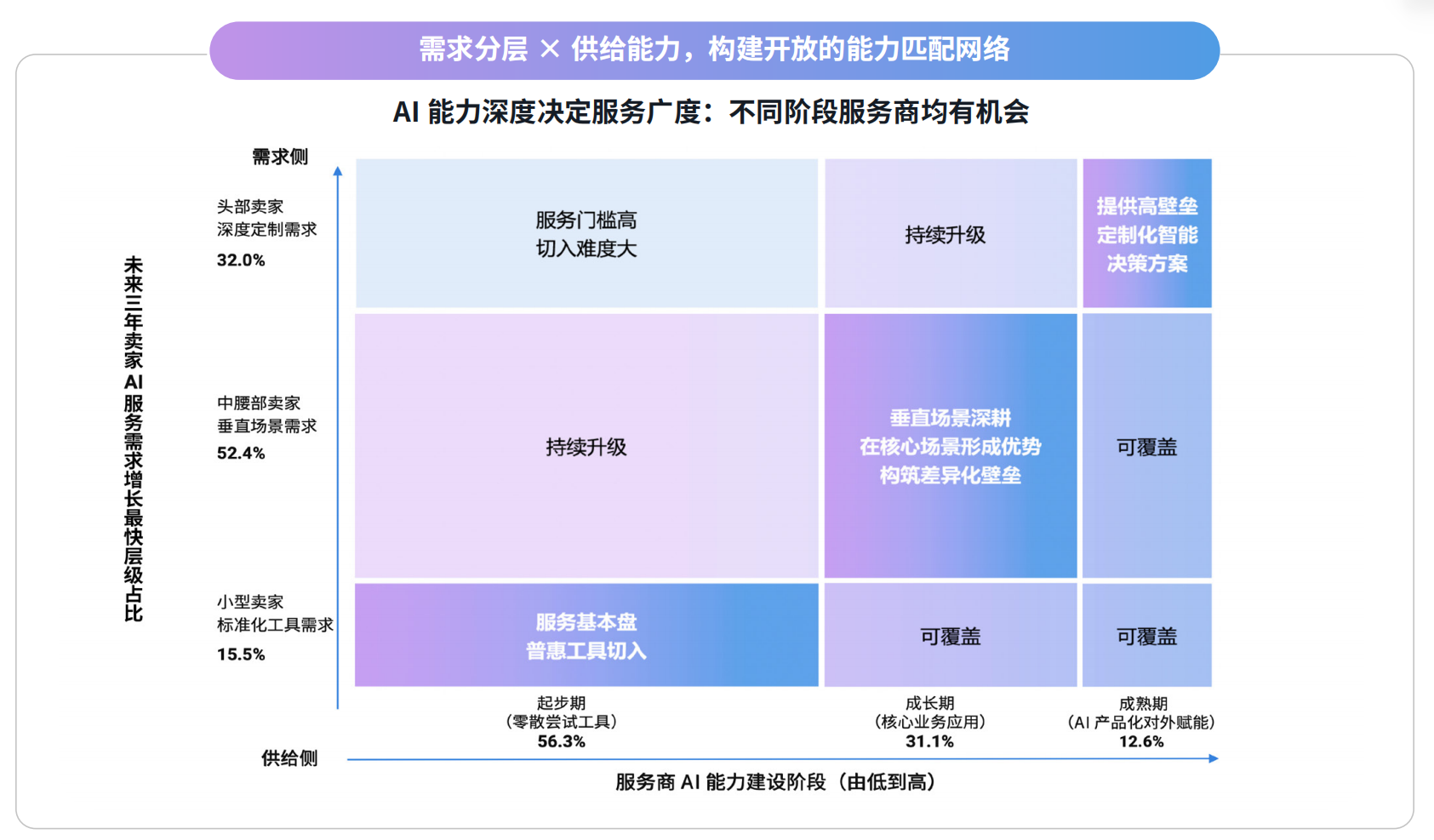
The AI capability building of service providers shows a pyramid-shaped divergence. Gaps in AI maturity across enterprises are becoming increasingly apparent: survey data shows that 56.3% of service providers are still in the initial stage of "sporadic tool experimentation"; 31.1% have entered the growth stage, starting to apply AI in core businesses to build differentiated capabilities; while only 12.6% have reached the mature stage, possessing productized AI capabilities that can empower external parties.
Analysis of service providers' AI capability development shows that players in the initial and growth stages account for nearly 90% of the total, and their growth pace will directly shape the future competitive landscape. According to the survey, 61.7% of service providers believe that "the gap between AI-savvy service providers and those without AI capabilities will widen"2, and those that first move toward "capability accumulation" will gain the upper hand in competition.
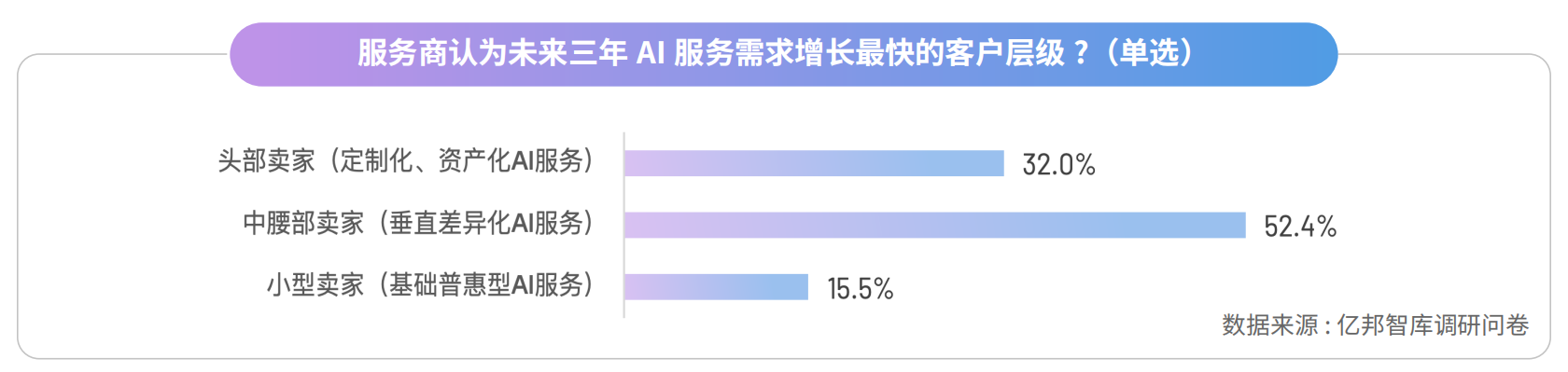
Demand tiers determine the differentiation of AI services. Sellers' demands for future AI services vary based on their scale and operational stage: when asked about "the customer tier with the fastest-growing AI demand in the next three years", 52.4% of surveyed service providers cited mid-tier sellers, while 32.0% and 15.5% cited top-tier sellers and small sellers, respectively.
- Small sellers: With limited resources and experience, they urgently need standardized, affordable AI tools that directly translate technology into effective operational actions to compensate for gaps in basic capabilities.
- Mid-tier sellers: As the core growth engine for AI services, they need to build targeted advantages in specific business scenarios, and their demand for "vertically differentiated AI services" naturally aligns with service providers' scenario-specific capabilities.
- Top-tier sellers: Although the service threshold for top-tier sellers is high, nearly one-third of service providers still regard them as the fastest-growing customer group. Such clients require deeply customized AI services, aiming to train proprietary models based on their own operational experience and private data to build high-barrier intelligent decision-making solutions.
The depth of AI capabilities determines the breadth of service reach. To address the demands of the three seller segments, service providers' capability radius will determine how much incremental space they can unlock, and those that first build "in-depth AI capabilities" will capture incremental opportunities.
- Initial-stage service providers can enter the small seller segment with basic standardized tools, then climb up to serve mid-tier sellers after accumulating experience; if they remain stuck in the "sporadic tool experimentation" stage, their future survival space will continue to shrink.
- Growth-stage service providers can either build differentiated barriers through deep cultivation of vertical scenarios to precisely target mid-tier sellers, or cover small sellers through standardized services.
- Mature-stage service providers possess full-stack service capabilities, able to provide in-depth customized solutions for upper-tier clients while also covering mid-tier and small sellers.
Only by clarifying their core focus and accumulating capabilities through continuous service delivery can service providers seize incremental opportunities in dynamic demand matching.
References:
[1] https://gs.amazon.cn/news/news-brand-260611
[2] 2026 Cross-Border E-Commerce Service Provider AI Capability Survey, valid sample size N=206
[3] https://www.searchenginejournal.com/ai-recommended-brands-saw-2-5x-more-site-visits-similarweb/580241/
This article was first published on the official website of Ebrun.
[Copyright Notice] Ebrun advocates respecting and protecting intellectual property rights. Without permission, no one is allowed to copy, reproduce, or use the content of this website in any other way. If any copyright issues are found in the articles on this website, please provide copyright questions, identification, proof of copyright, contact information, etc. and send an email to run@ebrun.com. We will communicate and handle it in a timely manner.
Translated by AI. Feedback: run@ebrun.com