
AI-Driven New Growth: Four Key Development Trends for Cross-Border E-Commerce in the New Industry Cycle
[Ebrun Original] Artificial intelligence is penetrating deeply into every link of business operations, accelerating the restructuring of the growth logic of global e-commerce. On the consumer side, user shopping behavior has upgraded across the board: shoppers now rely on AI shopping assistants to break down purchase needs, match suitable products, select optimal solutions, and complete orders. On the seller side, industry competition has evolved from point-by-point efficiency improvement to a contest of systematic, full-chain capabilities. Enterprises urgently need to break down business and data silos spanning product selection, marketing, ad placement, fulfillment, after-sales service, and risk control, to build an integrated, holistically connected intelligent operation system.
Against this backdrop, Ebrun Think Tank, in partnership with Amazon Service Provider Network (SPN), released the report *Winning in the New Cycle: AI Development Report for Cross-Border E-Commerce Service Providers*. The report provides an in-depth analysis of the transformation logic of the cross-border e-commerce sector in the AI era, and identifies four core trend insights: AI-powered efficiency and intelligent decision-making will become the new driver of sustained global e-commerce growth; multi-agent collaboration will support integrated operational decision-making for sellers; "natural interaction and intent recognition" will deliver notable e-commerce sales lifts; and a comprehensive policy framework will fully underpin the accelerated rollout of AI-powered e-commerce.
Insight 1: AI efficiency and intelligent decision-making take over as the engine of sustained global e-commerce growth
Global e-commerce is entering a phase of normalized, intensive operation marked by "expanding total volume and stabilizing growth rates". According to eMarketer forecasts, global retail e-commerce growth will stand at 7.2%, 7.2% and 6.9% in 2026, 2027 and 2028 respectively. Against this backdrop of single-digit growth, the lift from traditional traffic dividends is slowing, making AI a core variable driving industry growth1.
Take the U.S. market as an example: Adobe Analytics data shows that in the first quarter of 2026, online shopping traffic driven by generative AI surged 393% year over year, with referral conversion rates 42% higher than those of traditional channels2. eMarketer projects that between 2026 and 2029, AI-driven e-commerce sales in the U.S. will skyrocket from $20.6 billion to $144.5 billion, expanding roughly sevenfold in four years. The growth engine of e-commerce is accelerating its shift from scale-driven to intelligence-driven.

Insight 2: Multi-agent collaboration supports integrated decision-making for seller operations
As the industry enters the agent era, the operational logic and competitive landscape of cross-border e-commerce are shifting. Real-time feedback on market trends has shortened the cycle of hit product incubation from "weeks" to "days"; customer service response time has improved from "hours" to "minutes"; and intelligent allocation across overseas warehouse and distribution networks supports highly efficient fulfillment. Agents are gradually becoming the core of autonomous operational decision-making.
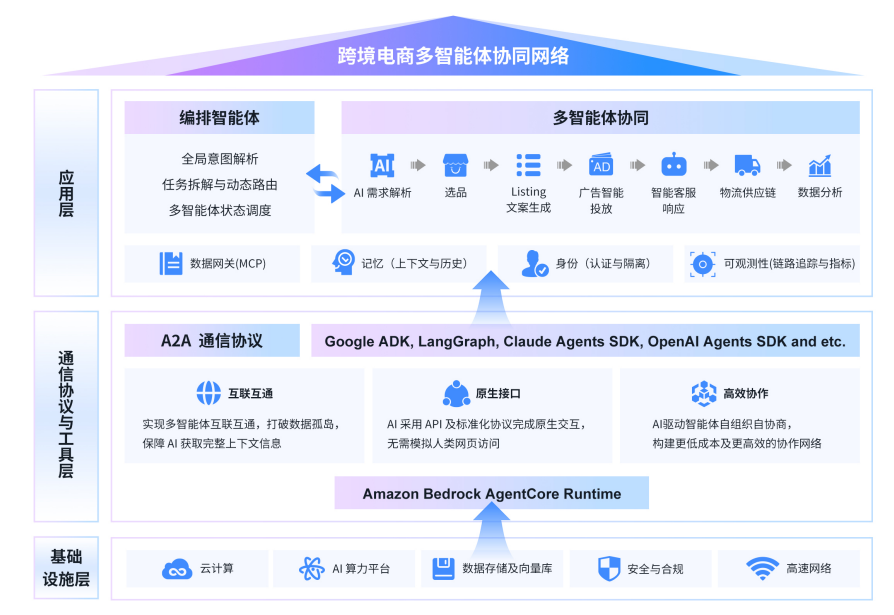
However, cross-border e-commerce features long operational chains with numerous links. A single agent for one specific link can solve local problems, but cannot cover the operational needs of the entire chain. Compounding this, agents for different links are often built separately by different vendors or teams, with incompatible data formats and decision-making standards, leading to disconnected front- and back-end decision-making and making it difficult to accumulate systematic, reusable business capabilities.
Against this backdrop, the focus of industry competition is shifting from point efficiency improvement to whether enterprises can integrate specialized agents for each link into an interconnected collaborative network to achieve organic combination and efficient cooperation. For example, some enterprises connected to multi-agent collaborative networks can quickly adjust operational strategies through data sharing and intelligent collaboration, accurately respond to market demand and deliver customized services. As e-commerce platforms fully transition to AI-driven models, enterprises that fail to access such collaborative networks will see their operation systems unable to seamlessly connect to and make real-time calls to the AI infrastructure of e-commerce platforms, leading to continuously eroding market competitiveness.
Gartner predicts that by 2027, one-third of agentic AI applications will combine agents with different skill sets to collaboratively handle complex tasks4. Leading e-commerce platforms have already taken the lead in building multi-agent collaborative infrastructure. Take Amazon as an example: it has introduced A2A (Agent-to-Agent, the inter-agent communication protocol) into its Amazon Bedrock AgentCore Runtime framework, enabling communication and cross-task collaboration between agents built on different frameworks, and providing a solid technical foundation for integrated autonomous decision-making5.
Insight 3: "Natural interaction and intent recognition" deliver notable lifts to e-commerce sales
Multimodal large models are driving a revolution in e-commerce interaction. Consumer shopping habits are shifting from manual search, filtering and comparison to describing scenario-based needs in natural language, with AI assistants directly outputting optimal solutions. The underlying technology supporting this experience upgrade is the multimodal large model’s ability to integrally understand and generate multiple types of information including text, images and voice.
Under this entirely new interaction model, whether a product can be accurately identified, verified and included in recommendation lists by AI systems has become a key threshold for gaining exposure. Meanwhile, industry traffic distribution rules are fully shifting from SEO keyword rankings to the "AI citeability" of product information. Product titles, attributes, scenario descriptions, images and reviews need to be restructured to meet standards of greater clarity, completeness, authenticity, credibility and alignment with AI reading logic. Otherwise, even if a product page is successfully listed, it will become "invisible" in AI recommendations and lose exposure opportunities. This is no longer a local issue of ad placement optimization, but an existential question of whether products can be seen by consumers.
Take Amazon’s AI shopping assistant as an example: whether seeking recommendations, checking specifications, getting shopping guidance or tracking order status, consumers only need to ask questions to receive conversational answers. In the past, to buy a pair of Bluetooth earphones, users would input keywords and compare various parameters on their own. Now, a growing number of users directly tell the AI: "I want a pair of Bluetooth earphones suitable for running, with good noise cancellation, under 500 yuan," and leave the rest of the work to the AI automatically. Consumption is shifting from active search to demand expression, significantly shortening the shopping decision-making chain6. As of 2025, more than 300 million consumers use Amazon’s AI shopping assistant to support their purchase decisions. Data shows that consumers using the AI shopping assistant are more likely to complete orders than non-users, with a 60% uplift in purchase conversion rate7. As AI recommendations begin to dominate the product discovery path, the organization of product information needs to proactively adapt to AI’s understanding and retrieval logic, so that products can be "understood, trusted, and recommended" in AI decision-making processes.
Insight 4: Intensive policy rollouts underpin the accelerated development of AI-powered e-commerce
The accelerated innovation of AI technology and business models cannot be separated from strong support from the policy environment. At present, a top-down policy matrix has basically taken shape, spanning central government policies to local implementation actions. This system not only creates a certain development environment for "AI + e-commerce", but also defines a clear roadmap for industry development in the new cycle through explicit top-level design, financial support and compliance guidance.
Overall, China’s AI policy system is gradually moving from single technology support to a new phase of coordinated advancement featuring "national strategic guidance, local application empowerment, industrial ecosystem cultivation, and security governance guarantees". On one hand, the central government continues to advance the "AI+" initiative and agent development, accelerating the deep integration of AI with real economy sectors including digital trade and cross-border e-commerce. On the other hand, local governments have developed differentiated support systems covering funding, computing power, data, scenarios and industrial ecosystems. Meanwhile, as regulatory frameworks for data security, algorithm governance, generative AI and intelligent agents continue to improve, the AI industry has entered a new phase of attaching equal importance to innovative development and security governance, providing a more clear, stable and predictable development environment for cross-border e-commerce service providers.
References:
[1] https://www.emarketer.com/chart/270813/worldwide-ecommerce-sales-growth-will-dip-slightly-2025-mostly-due-softness-china-trillionsretail-ecommerce-sales-worldwide-change-of-total-retail-sales-2022-2028
[2] https://business.adobe.com/blog/ai-traffic-surge-retail-sites-not-machine-readable
[3] https://www.emarketer.com/content/ai-commerce-2026
[4] https://enterprisetimes.in/latest-news/gartner-ai-agents-to-set-new-standards-for-teamwork-and-work-processes/#:~:text=%E2%80%9CAI agents are evolving rapidly, progressing from basic,said Anushree Verma, Sr Director Analyst at Gartner
[5] https://aws.amazon.com/cn/about-aws/whats-new/2025/10/amazon-bedrock-agentcore-available/
[6] https://www.ebrun.com/20260723/690072.shtml
[7] https://gs.amazon.cn/news/news-brand-260611
This article was first published on the official website of Ebrun.
[Copyright Notice] Ebrun advocates respecting and protecting intellectual property rights. Without permission, no one is allowed to copy, reproduce, or use the content of this website in any other way. If any copyright issues are found in the articles on this website, please provide copyright questions, identification, proof of copyright, contact information, etc. and send an email to run@ebrun.com. We will communicate and handle it in a timely manner.
Translated by AI. Feedback: run@ebrun.com