
Alibaba International’s Accio Surges Over 30x in Global User Base, Open-Sources First Real-World E-Commerce Agent Benchmark
CoCreate 2026, Alibaba International’s annual conference for overseas buyers, recently kicked off at the Los Angeles Convention Center in the U.S., drawing over 15,000 local small and medium-sized enterprises.
“The future of B2B is A2A — Agent-to-Agent commerce,” declared Zhang Kuo, President of Alibaba International, during his keynote address at the main forum, laying out his vision for the future of global trade.
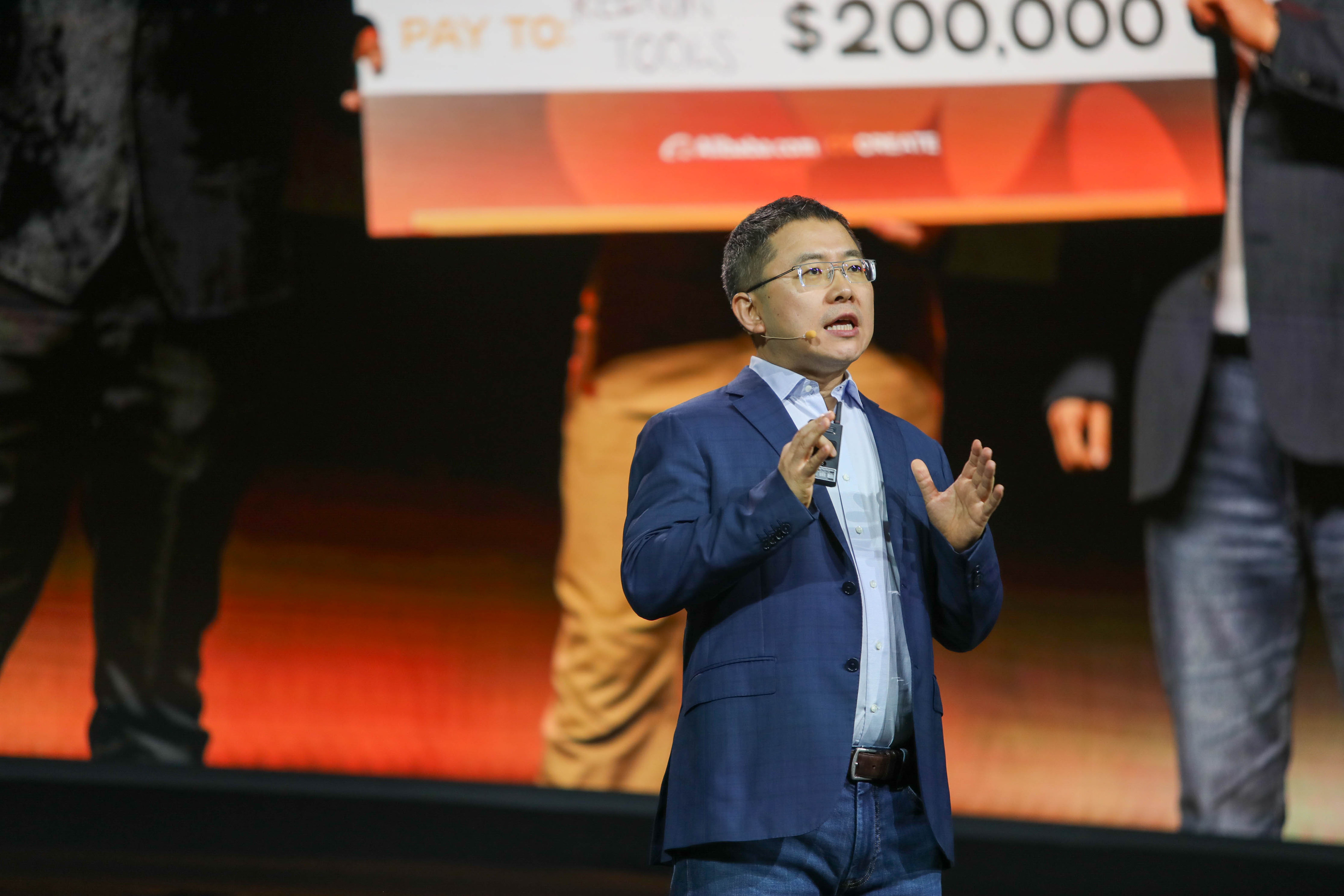
This prediction is not purely forward-looking. According to event disclosures, the behavior of overseas buyers on Alibaba International has already undergone a structural shift: instead of typing keywords into search bars, they now describe their needs directly in natural language, and let AI handle end-to-end workflows including trend spotting, product refinement, supplier vetting, term negotiation, and order management.
Data shows that traffic from overseas buyers using AI-powered multimodal search on Alibaba International has jumped more than 132%. On Accio, Alibaba International’s global AI workbench for e-commerce, AI token consumption grew sixfold in just four months.
Over the past year, Accio’s global user base has expanded by over 30 times, with 10 million SMEs now using the platform to run their business. Many of the 15,000 attendees at this year’s event are among the first cohort of cross-border buyers using agents like Accio for sourcing.
At the summit, Accio also announced the open-source launch of CommerceAgentBench on GitHub. an agent benchmark designed for real-world e-commerce scenarios. Its data foundation is drawn from 10 million active SME users on Accio, 1.6 million real user conversations, and 200,000 execution traces, distilled into 107 real end-to-end business tasks.As Zhang Kuo noted, CommerceAgentBench is built to test whether an AI can actually get business deals done end-to-end.
Addressing how to make agents truly usable, Zhang laid out a formula: Agent = model capability × execution harness × business context. This framework explains the rationale behind Accio’s decision to open-source its e-commerce benchmark: the move is designed to match the most suitable models for different tasks (i.e., route tasks to specialized models) and post-train its in-house models on real commercial workflows.
Based on this architecture, testing on core use cases shows Accio’s token costs are 50% lower than those of general-purpose agents.“For a small business, an AI tool too expensive to use every day might as well not exist,” Zhang said. “Our goal isn’t just to build more powerful AI — it’s to build business AI that’s truly practical and affordable.”
Also notable: after integrating with domestic Chinese e-commerce platforms including Taobao, Tmall, Pinduoduo, JD.com, Douyin Store, and 1688, Accio has now added integrations with overseas e-commerce platforms including Amazon, eBay, Shopify, Temu, and TikTok Shop, delivering on its vision of “multiple businesses, one AI workbench.”
This article was first published on the official website of Ebrun.
[Copyright Notice] Ebrun advocates respecting and protecting intellectual property rights. Without permission, no one is allowed to copy, reproduce, or use the content of this website in any other way. If any copyright issues are found in the articles on this website, please provide copyright questions, identification, proof of copyright, contact information, etc. and send an email to run@ebrun.com. We will communicate and handle it in a timely manner.
Translated by AI. Feedback: run@ebrun.com