
Are Adidas and Nike Losing Their Luster? Young Consumers Prefer Guochao Domestic Brands
By Liao Zilin | Edited by Yang Tan
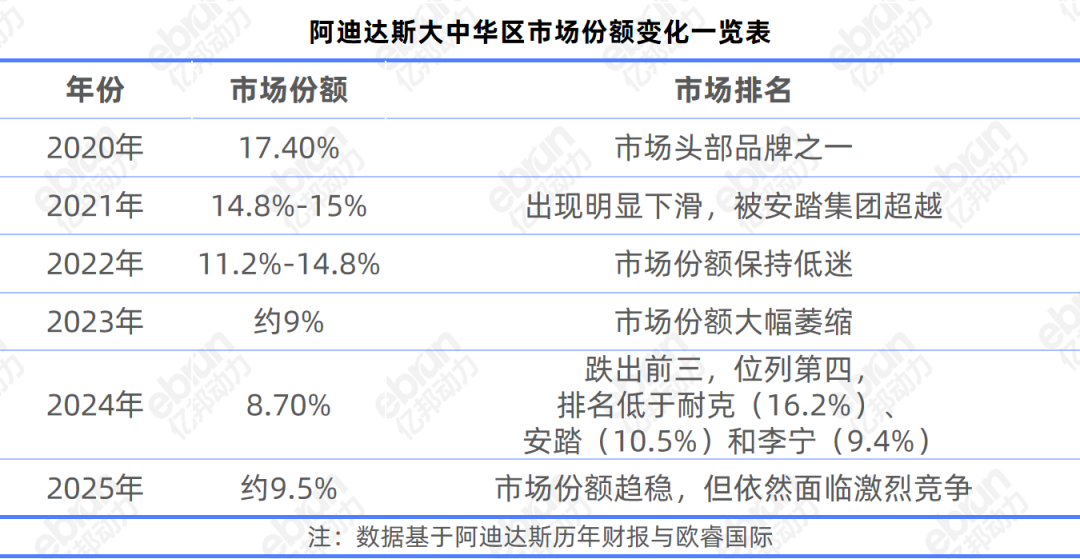
[Ebrun Original] After suffering a sharp downturn in its China business, Nike is set to be removed from the S&P 100 index. Adidas, meanwhile, has seen its market share in Greater China plummet from 15% in 2021 to roughly 9.5% in 2025. The once-dominant foreign sportswear giants are rapidly losing their shine.
In contrast, domestic sportswear brands are experiencing a concentrated boom. Anta posted 43.51 billion yuan in revenue in the first half of 2026, up 12.9% year-on-year; 361 Degrees reported an 8% year-on-year rise in net profit for the same period. Xtep's e-commerce performance was particularly strong, with sales on JD.com and Douyin growing 20%.
Emerging outdoor brands have posted even more impressive growth: Kailas, which focuses on the professional outdoor segment, is on track to hit 10 billion yuan in annual revenue; Pelliot has seen revenue surge more than 200% over three years, marking explosive growth; Mobi Garden and Scaler have capitalized on the boom in lightweight outdoor activities and camping consumption to quickly capture market share in niche segments.
The rise of domestic sportswear brands is not the result of short-term trend dividends, but the outcome of long-term capability accumulation, with global expansion set to become the core growth driver for these brands going forward.

Nike and Adidas Lose Ground, Foreign Brand Fades
It is worth noting that Nike's downturn in China is not a sudden market collapse, but a gradual decline.
Between 2017 and 2021, Nike was at its peak, with revenue growing at double-digit rates for 22 consecutive quarters, and its Greater China revenue hitting an all-time high of $8.29 billion in 2021.
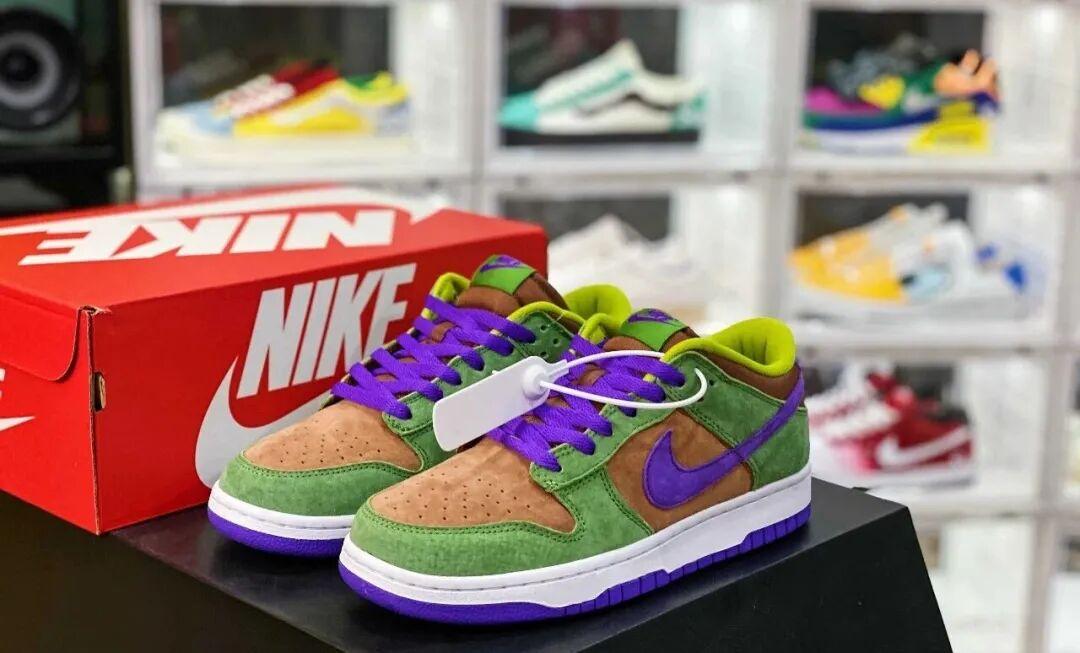
Back then, making money was easy for Nike: its headquarters only handled product development and wholesale, while distributors such as Topsports and Pou Sheng handled execution and on-the-ground operations, maximizing the dividends of its asset-light model. At the time, sneaker lines such as Air Jordan and Dunk were in extremely high demand, with consumers queuing overnight for limited releases, and prices doubling on the secondary market as a common occurrence. For many young people, owning a limited-edition pair of Nike sneakers was a symbol of trendy style.
The turning point came in 2021, when Nike doubled down on its global direct-to-consumer (DTC) strategy, which clashed with China's retailer ecosystem that relies heavily on distributors and features rapid iteration. This led to a number of deep-seated issues across product, channel, and operations.
After the post-pandemic recovery, Chinese consumers shifted their sports preferences to outdoor-oriented activities such as badminton, camping, running, and tennis, but Nike continued to allocate resources to traditional segments such as basketball and soccer, with sales heavily reliant on reissues of classic lines such as Air Jordan and Dunk, and relatively little localized new product development.
In addition, Nike has long used globally unified marketing materials and brand narratives, rarely participating in local outdoor community operations such as city running groups, and relying solely on advertising and celebrity endorsements to drive sales. However, China's Gen Z consumers no longer blindly buy into the narratives of foreign brands or the allure of traditional sports stars, and place greater value on IP that resonates with local culture.
Channel missteps also emerged that year, as Nike stopped treating its distributors, with whom it had worked for more than two decades, as long-term partners. It cut supply of popular products to distributors, with many limited-edition items prioritized for its own direct sales channels. Distributors were forced to seek alternative options, either acting as agents for domestic brands or shifting their support to other international brands.
On the online front, content e-commerce platforms such as Douyin and Xiaohongshu grew rapidly, completely changing the channel logic in the Chinese market. Nike's entire system was built for traditional wholesale, with private traffic operations, content e-commerce, and other "day-to-day" tasks previously handled by its distributors. By 2026, Nike had aggressively phased out all its online distributors in China, accelerating its loss of ground in the market.
While Adidas' performance in China appears much better than Nike's – with revenue reaching 2.09 billion euros in the first half of this year, up 15% year-on-year, marking 13 consecutive quarters of year-on-year growth – analysts attribute this to the low base from previous fiscal years.
In fact, Adidas' domestic market share has dropped significantly, from 17.4% in 2020 to roughly 9.5% in 2025.
The brand also has shortcomings in localized operations: roughly one-tenth of its approximately 7,500 stores in China are operated under agency by domestic brand HLA (Hailan Home). For example, under their FCC (Future City Concept) store partnership, Adidas is responsible for developing exclusive products for lower-tier markets, while HLA provides its franchise management system, frontline operation experience, and resources.
Currently, HLA operates 723 Adidas stores under agency, including 381 directly operated stores and 342 franchised locations. HLA's financial reports show that revenue from all other brands, including Adidas' FCC business, reached 1.94 billion yuan in the first half of the year, up 29.34% year-on-year.
Meanwhile, a growing number of international sportswear and outdoor brands are choosing to partner with domestic brands to expand in the Chinese market, rather than following the path of Nike and Adidas. Anta acquired a 29.06% stake in Puma for 1.5 billion euros, becoming its largest single shareholder. Biemlfdlkk has entered into a deep strategic partnership with Japanese high-end outdoor brand Snow Peak, taking full charge of its operations in the Chinese mainland.

Domestic Brands Rise Collectively, Overtaking Competitors Across Multiple Dimensions
In 2022, Anta's revenue surpassed that of Nike China for the first time, making it the top player in China's athletic footwear and apparel market, a development that caught many by surprise.
Prior to that, domestic brands represented by Anta, Li-Ning, and Xtep were generally stuck with two labels: either low-cost, mass-market products targeting lower-tier cities, or brands relying on guochao (national trend) marketing to attract attention. Nike and Adidas were the only high-end, professional sportswear brands recognized by consumers.
But in the years since Nike lost its footing, domestic brands have completed a remarkable turnaround. Anta's revenue nearly doubled from 49.3 billion yuan in 2021 to 80.2 billion yuan in 2025; Li-Ning posted steady annual revenue growth over the same five-year period, with full-year revenue reaching 29.5 billion yuan last year. Sanfo Outdoor, which transitioned from a retailer to a brand operator, turned from a net loss to a profit, with revenue approaching 1 billion yuan in 2025.
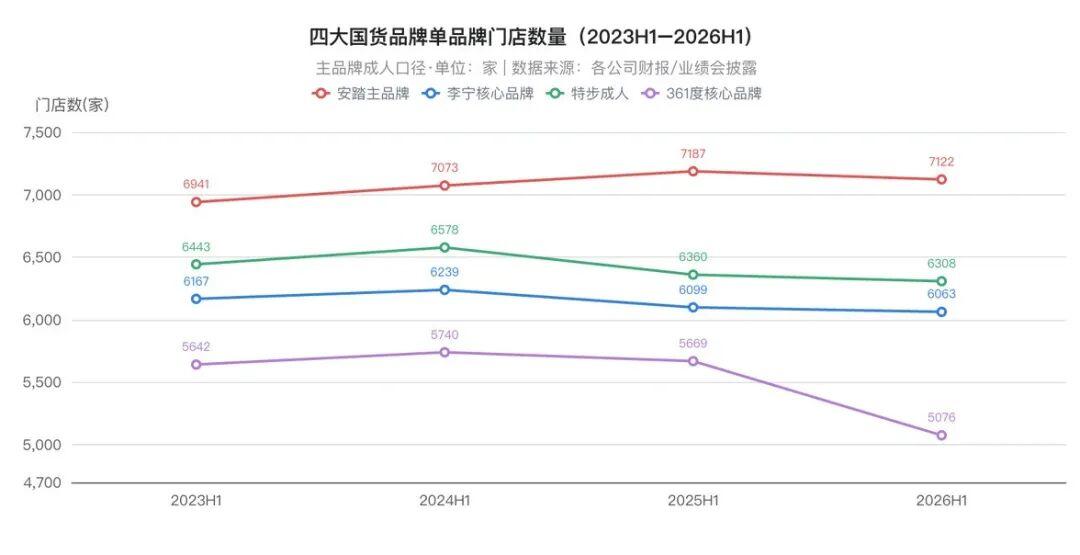
Looking back over the past few years, traditional domestic brands have gradually overhauled their legacy channels, proactively closing a large number of underperforming stores and shifting resources to larger format stores and experience centers.
For example, Anta has rolled out "Anta Market" concept stores that integrate experience spaces such as badminton courts, coffee and light food areas, and pet resting zones. Li-Ning has launched COUNTERFLOW, its standalone outdoor store concept, as well as Li-Ning Space, a special section featuring cultural and creative products in collaboration with the Palace Museum. 361 Degrees has opened more than 100 1,000-square-meter super flagship stores, creating one-stop, full-scenario sports consumption spaces. Since last year, they have also fully integrated with on-demand retail systems such as Meituan, JD.com, and Taobao Flash Purchase, offering "hourly delivery" services based on their store networks.
Domestic brands are also continuously filling gaps in product categories and high-end capabilities. Li-Ning has fully expanded into tennis, table tennis, badminton, and other categories; 361 Degrees has entered segments such as skateboarding and youth rope skipping. Anta has bet on a multi-brand portfolio, acquiring and integrating Fila, Descente, and Kolon Sport to cover fashion sports, high-end skiing, urban outdoor wear, and other segments respectively.
Emerging domestic outdoor brands represented by Kailas, Pelliot, and Mobi Garden have seized new growth opportunities in sports scenarios, emerging from the e-commerce ecosystem. Kailas has focused on the hardcore professional segment, avoiding pure traffic-driven marketing, and continuously sponsoring major domestic trail running events to serve the domestic mountaineering and trail running community, gradually breaking the long-held perception that "only foreign brands make professional outdoor gear".
Pelliot has capitalized on the mass lightweight outdoor trend, with its signature hardshell jackets balancing aesthetic design and basic waterproof and windproof performance to target female outdoor consumers, and carrying out extensive scenario-based marketing on Douyin and Xiaohongshu, leading to revenue doubling over three years.
Mobi Garden, which started as an OEM for tents, saw its own brand explode in popularity amid the camping boom, while also increasing R&D investment in hiking apparel and backpacks, completing its transformation from a "camping tent manufacturer" to a comprehensive outdoor brand.
It is worth noting that what underpins the rise of both traditional and emerging domestic brands is the increasingly mature supply chain for sports technology.
Continued R&D investment has allowed Li-Ning to develop its BENG midsole technology, which has helped domestic racing running shoes break multiple domestic marathon records. Anta's self-developed nitrogen foam midsole platform solved the mass production challenge of supercritical foaming, and its fluorine-free waterproof membrane broke the foreign monopoly on high-end outdoor fabrics. Kailas has iterated its self-developed Filtertec waterproof fabric, filling the gap in local technology for hardcore outdoor equipment.

Domestic Brands Set Sail for Global Markets
Going global is a shared goal for domestic sportswear brands.
On one hand, they are moving beyond simple logo placement partnerships with international sports stars, to deep collaboration on signature shoe development, global marketing, and other co-creation initiatives. For example, Li-Ning has entered a 10-year long-term partnership with Stephen Curry to co-build the Curry Brand, and has also signed Jimmy Butler, leveraging the stars' influence to break into global markets.
Anta has partnerships with Klay Thompson and Kyrie Irving, with their KT and KAI signature shoe lines posting strong domestic sales while also driving the brand's business growth in North America. 361 Degrees has signed Nikola Jokic and Aaron Gordon, Peak has signed Andrew Wiggins, Reebok has signed Austin Reaves, and each brand has launched exclusive signature sneakers. On-court exposure for these stars not only drives consumption enthusiasm among domestic fans, but also builds credibility for the brands in overseas markets, serving as an important breakthrough point for domestic brands' global expansion.
On the other hand, overseas performance relies on support from international distributors and cross-border e-commerce platforms.
In the first half of this year, Anta's overseas revenue grew 35% year-on-year. This performance was driven by: partnerships with leading retailers such as Foot Locker, DSG, and JD Sports to complete its layout in the mainstream retail system in the North American market; the rollout of its "Thousand Stores Plan" in Southeast Asia, with expansion into the Middle East and Africa, as well as entry into the Indian market through a partnership with Brandman Retail.
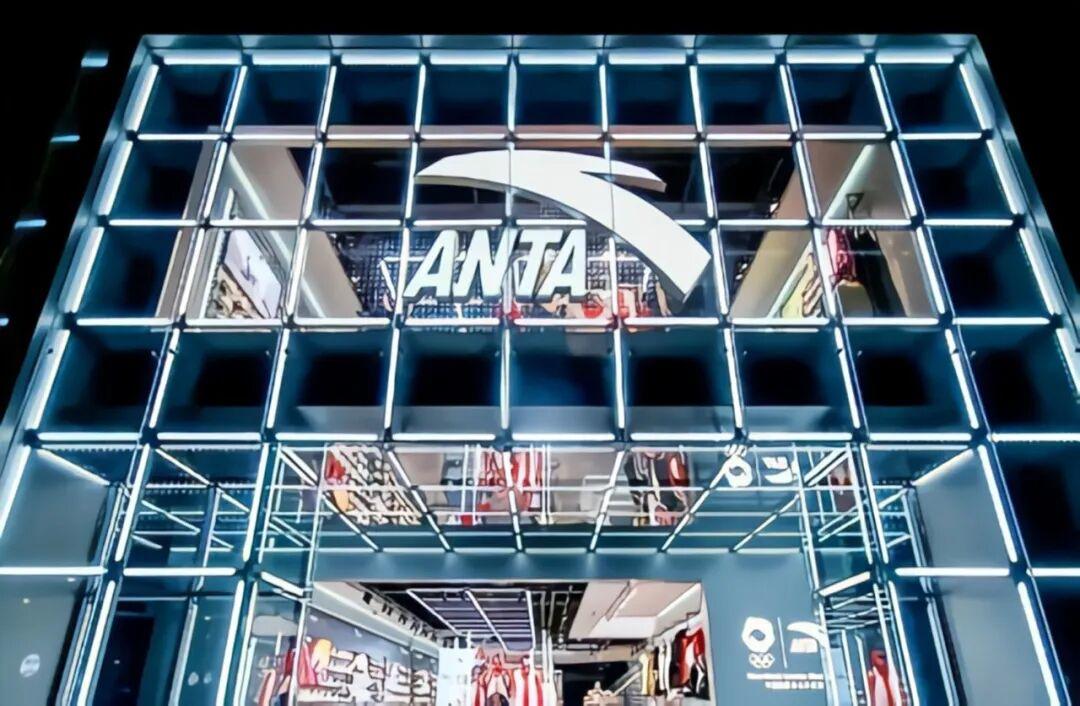
Xtep focused on Malaysia as its core market in the first half of the year, rolling out a large number of new brand image stores, while also ramping up efforts on local mainstream e-commerce platforms such as Shopee, TikTok, and Lazada, leading to overseas revenue doubling year-on-year. 361 Degrees saw overseas retail sales surge more than 80% year-on-year in the first half, with cross-border e-commerce sales soaring 140%.
Beyond product and brand expansion, a new globalization path is taking shape: using capital, operation, channel, and supply chain capabilities to integrate high-quality global brand resources in reverse. Through strategic partnerships and acquisitions of international brands, they take the domestic market as their base, grow and strengthen their position in the local market, and pursue a unique international development path.
Anta is a typical example: the group now owns eight international brands, while Xtep has acquired Saucony, Biemlfdlkk has taken over Snow Peak's China operations, and Sanfo Outdoor operates X-BIONIC in the Chinese market. In the first half of 2026, revenue from Anta-owned Amer Sports reached $3.578 billion, up 32% year-on-year, with net profit attributable to shareholders reaching $272 million, up 78% year-on-year. Revenue from the professional sports division housing Saucony and Merrell reached 875 million yuan, up 11.4% year-on-year, with a gross margin of 55.5%, significantly higher than that of Xtep's main brand.
Today, the decline of Adidas and Nike is not the result of short-term traffic fluctuations, but the inevitable outcome of rigid global brand strategies and failed localization efforts. The collective rise of domestic brands is a reflection of decades of supply chain accumulation and in-depth focus on local users. We remain optimistic and look forward to seeing whether Chinese brands can maintain their strong momentum in the future.
Ebrun will continue to track and report on this sector. If you would like to learn more information related to this article, please scan the QR code to follow the author on WeChat.

This article was first published on the official website of Ebrun.
[Copyright Notice] Ebrun advocates respecting and protecting intellectual property rights. Without permission, no one is allowed to copy, reproduce, or use the content of this website in any other way. If any copyright issues are found in the articles on this website, please provide copyright questions, identification, proof of copyright, contact information, etc. and send an email to run@ebrun.com. We will communicate and handle it in a timely manner.
Translated by AI. Feedback: run@ebrun.com