
Chinese Goods on European Shelves: A New Model for Global Expansion
Shi Lei
[Original report from Ebrun] Over the past two years attending IFA Berlin, I’ve started looking beyond the Chinese tech products on display in the exhibition halls.
Stepping outside the venue, I make a point of observing Berlin’s streets, shopping malls and retail channels to spot Chinese products that don’t appear on IFA booths. From Berlin to Paris to Rome, a huge volume of goods from Chinese supply chains are visible in street stores, supermarkets, sporting goods shops, home goods stores and all kinds of retail outlets.
They don’t always appear under a prominent Chinese brand name. Often, consumers only see a water bottle, a piece of sports equipment, a small household item, an item of clothing made from Chinese fabric, or even an everyday product few would associate with Chinese manufacturing. It is hard to tell where they come from just by looking at the brand logo. But trace back along the supply chain, and many of these products ultimately link back to China.
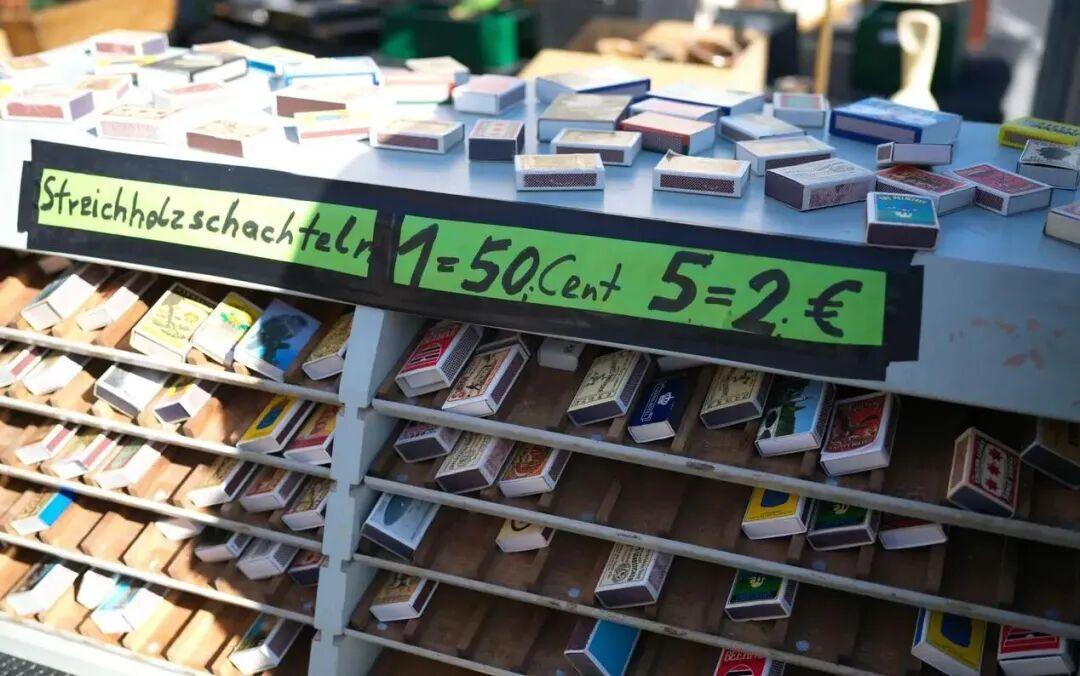
Street vendors in Munich, Germany sell matchboxes made in China.
Large manufacturing enterprises based in Ningbo, Shenzhen and other cities have become key representatives of Chinese consumer electronics expanding into overseas markets, bringing their brands, products and mature business models to Europe. At the same time, another even larger force has long been embedded in European consumers’ daily lives: goods from industrial clusters in Yiwu, Yongkang, Zhangzhou and other parts of Zhejiang Province.
They have far less brand visibility, but their reach may be even broader. What I have seen across Berlin, Paris and Rome is not the overseas expansion of a single Chinese brand, but a far more decentralized, invisible penetration of Chinese supply chains.
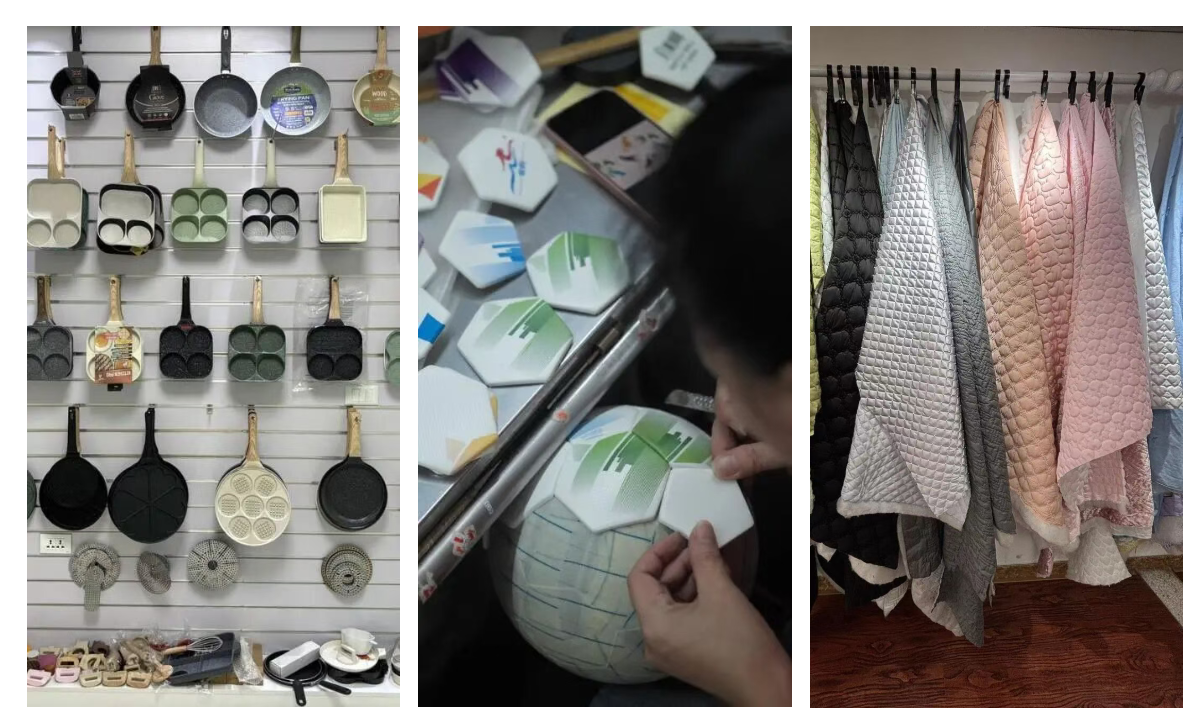
When I visited Zhangzhou’s football and basketball industrial cluster, Yiwu’s small commodities cluster, Yongkang’s water bottle cluster and Shaoxing Keqiao’s textile cluster this year, and compared the production sites of these factories with the goods I saw on the streets of European cities, a clearer picture emerged: Chinese supply chains are integrating into Europeans’ daily lives in very tangible ways.
This integration has been underway for many years. What is truly noteworthy is that the distance between Chinese factories and European consumers is shrinking. Market demand can reach factories faster, and factories can turn niche demand into concrete products more quickly.
The geographical distance between Yiwu and Berlin, Paris or Rome spans thousands of kilometers, but Chinese supply chains are constantly narrowing another kind of gap—the distance between the production end and the consumption end.

Chinese goods on European streets are backed by entire industrial clusters
One very interesting observation about Chinese goods in Europe is that: the more ordinary the product, the more revealing it is about the depth of the supply chain. A piece of sports equipment, a water bottle, a household item may seem far removed from technological innovation, but they often best demonstrate the fundamental strengths of Chinese manufacturing.
If IFA exhibition halls are where Chinese brands are most visible, stepping outside into the street retail channels of Berlin, Paris and Rome reveals the far broader reach of Chinese supply chains.
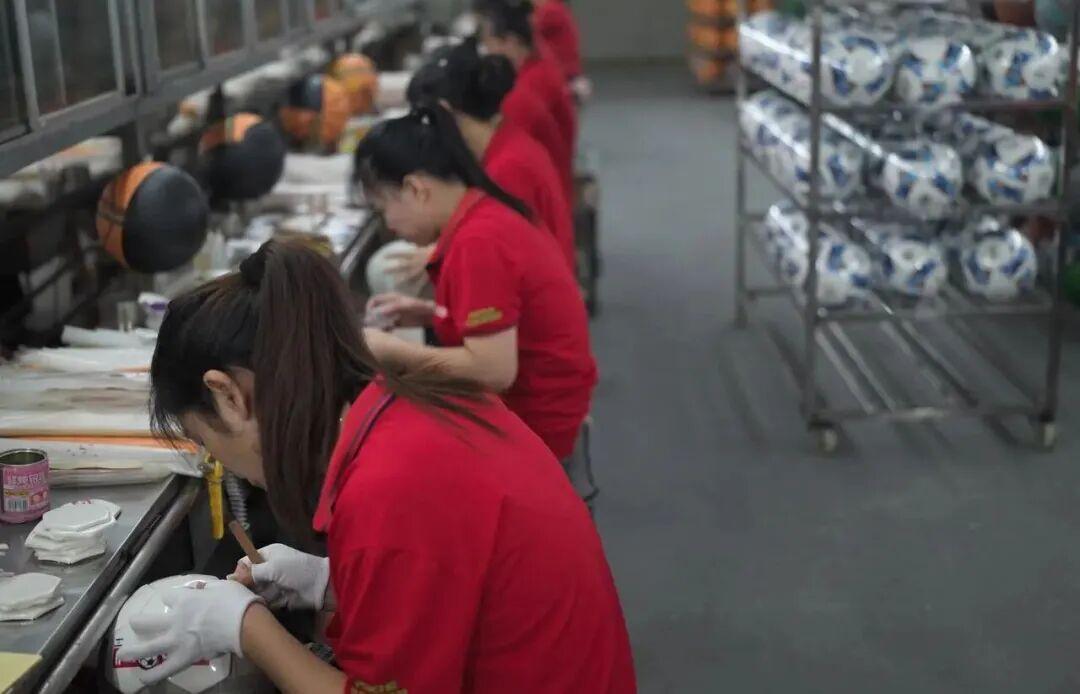
Zhangzhou’s football and basketball industry is a typical example. In a European sporting goods store, a football may just be one SKU on the shelf. But in a factory, it is the result of a complete production system: surface materials, printing, cutting, sewing, inner bladders, weight, elasticity, size, packaging—every step requires stable coordination.
More importantly, overseas market requirements for products are becoming increasingly detailed. Different countries, different channels, different events and different consumer groups may all have different specification requirements. Colors, patterns, sizes, materials and packaging methods can all be adjusted; this means factories are handling increasingly fragmented orders and more diverse products, but delivery speeds cannot slow down.
What the Zhangzhou industrial cluster demonstrates is Chinese manufacturing’s ability to accommodate these niche demands. This capability does not only serve Berlin. Whether in a Parisian sporting goods store or a street retail outlet in Rome, similar Chinese manufactured goods appear in different forms.
Look further on European streets, and there are many similar products. Yiwu’s goods are particularly prevalent in these scenarios. They may be a festive item, a small household object, a decoration, a piece of outdoor equipment, or a small commodity consumers rarely pay attention to the brand of.
The biggest characteristic of these products is their extremely rich SKU range. In cities like Paris and Rome, it can even be hard to accurately determine where an ordinary small commodity comes from, but when you walk into different types of retail stores, you will find similar products appearing repeatedly.
They may not carry a unified Chinese brand logo, but they share a common supply chain source. Yiwu’s value has long resided behind this richness. All kinds of fragmented demands from the global market can find corresponding producers here; after a new trend emerges, more product variants can be developed quickly; a demand that was originally small in scale can also be amplified through the global market.
Yiwu is therefore more like a huge global consumer goods supply pool. This year, Ebrun visited factories with Alibaba’s 1688 platform, and we can see that this supply-demand relationship is undergoing digital transformation.
In the past, factories obtained overseas demand mostly through traders, purchasers or regular clients. Now, industrial platforms like 1688 are becoming a connecting node: one end links a large number of industrial clusters and source factories, and the other end connects merchants searching for goods, supply chains and small-batch procurement capabilities.
This "connection" is becoming increasingly important. On August 28, at 1688’s 7th Super Factory Competition, 1688 Vice President Wang Qiang shared a very representative change: overseas procurement is gradually shifting from the past "people searching for goods" to "AI searching for goods". He mentioned that a medium-sized German purchaser has started using a procurement AI Agent to find suppliers. At 3 a.m., this Agent scanned 1,000 Chinese suppliers in just 27 seconds, screened out 11 of them, and sent inquiries to 3 of them.
What is truly noteworthy about this case is not just the improvement in procurement efficiency, but that the entry point for overseas demand to access Chinese supply chains is changing. In the past, European buyers needed to actively search, compare prices and send inquiries; in the future, a specific demand may be directly broken down and matched by AI, which then calls on Chinese goods and factories.
In my view, the significance of platforms is not to replace industrial clusters, but to make the originally scattered supply-demand relationships more visible and easier to match. When a niche demand from an overseas market can find a Chinese factory faster, the distance between industrial clusters and the global consumer market is further reduced.
At the same time, some factories have started using AI for market research, design, product testing and operational decision-making. This change does not alter the production capacity of factories, but it increases the speed at which demand reaches the factory.
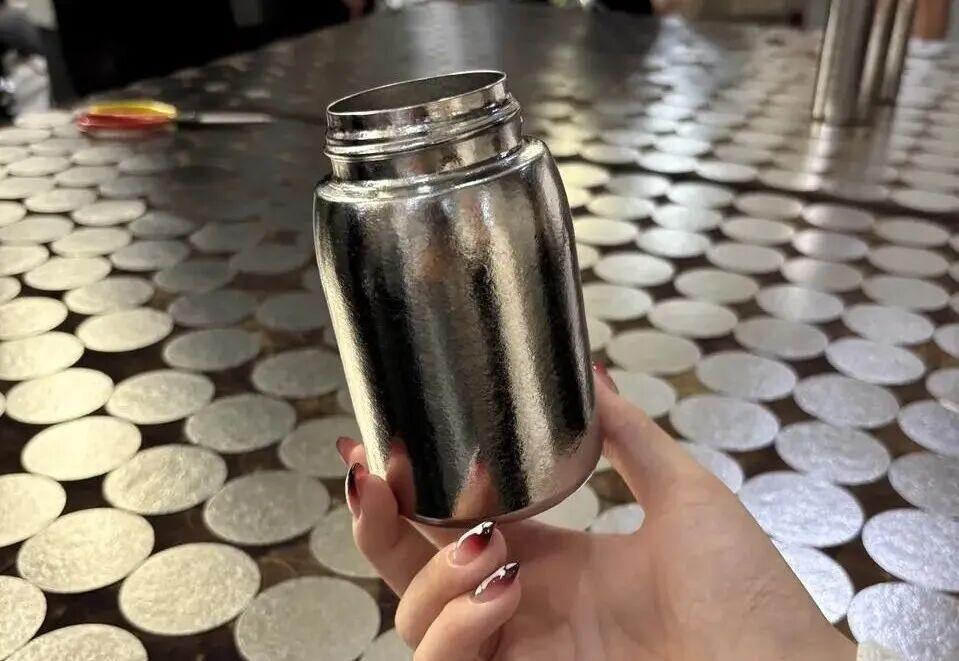
Yongkang’s water bottle industry provides another case study. In Berlin, Paris and Rome, water bottles are very ordinary consumer goods. They may appear in outdoor goods stores, home goods stores, department stores, or on a shelf where consumers never notice the place of origin.
Their real complexity lies in the production links consumers cannot see. Materials, molds, cup structure, sealing methods, thermal insulation performance, surface treatment, packaging—every link can affect the final product.
In the past, many factories mainly completed production according to designs and orders provided by clients. As supply chain capabilities improve, factories are increasingly participating in product development. From material selection to structural adjustment, from prototyping to cost optimization, the production end now has more room for product innovation.
The same applies to Zhejiang’s textile industrial clusters.
When my colleagues and I visited the Shaoxing Keqiao textile industrial cluster this year, we learned that for an item of clothing entering the European market, consumers see the style and fabric, but behind it are linked a large number of links including spinning, dyeing and printing, design, processing and logistics. The biggest advantage of industrial clusters like Keqiao is the high concentration of upstream and downstream industries. When new colors, new fabric demands or new design trends emerge in the market, the industrial chain can respond quickly.
The goods produced by these industrial clusters are completely different, but they all point to one fact: the way Chinese supply chains truly gain broad access to the European market often does not rely on a prominent Chinese brand.
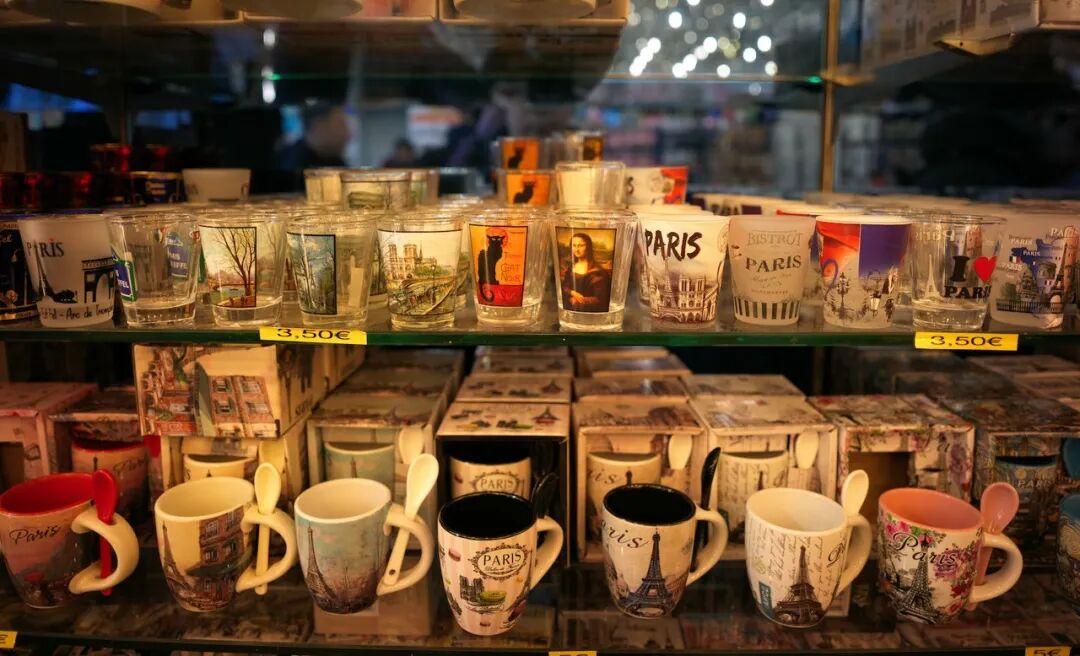
It may appear in Berlin, Paris or Rome; it may be in large supermarkets, or hidden in an inconspicuous small shop on the street. It may exist in European consumers’ lives in the form of a cup, a football, a piece of fabric, or a small commodity. This is a more invisible, yet more extensive form of globalization.

The advantage of Chinese supply chains is shifting from "cheap production" to "fast response"
When talking about Chinese manufacturing in the past, cost advantage was almost an unavoidable topic. But revisiting these industrial clusters and comparing them with consumption scenarios in different European cities, it becomes clear that cost is only one variable.
What truly supports these goods’ continued access to global markets is a supply chain system composed of industrial clusters, upstream and downstream coordination, engineering capabilities and flexible production. The most direct advantage is speed. A product goes through design, prototyping, modification, testing and production from the moment demand emerges to when it enters the market.
If upstream and downstream parties are far apart, every modification means higher communication and time costs. After years of development, many Chinese industrial clusters have formed highly dense upstream and downstream relationships. Material suppliers are nearby, mold factories are nearby, packaging factories are nearby, and production equipment and workers familiar with relevant processes are also concentrated here.
A product can be quickly adjusted by identifying the corresponding link when issues arise, which continuously accelerates product iteration speed. The second advantage comes from completeness. A product is never made independently by one factory; it may be linked to dozens or even more suppliers behind it. The value of industrial clusters is that these suppliers do not exist in isolation, but form a long-term collaborative network.
When orders increase, production capacity can be expanded quickly; when products are adjusted, upstream and downstream can be coordinated rapidly; when clients propose new process requirements, suppliers with corresponding capabilities can also be found relatively quickly. This capability is difficult to replicate in isolation. It comes from a long-term accumulated industrial ecosystem.
The third advantage, which is increasingly important, is flexible production capacity. The global consumer market is becoming more segmented. A product may only serve a small niche interest group; a color may only be popular in a certain market; a social media trend may create new consumer demand within a few weeks.
For factories, this means it is increasingly difficult to describe the market using the old model of large-volume, long-cycle orders. Small batches, multiple SKUs and rapid iteration have gradually become new production requirements; and a large number of Chinese industrial clusters happen to have the ability to accommodate these demands.
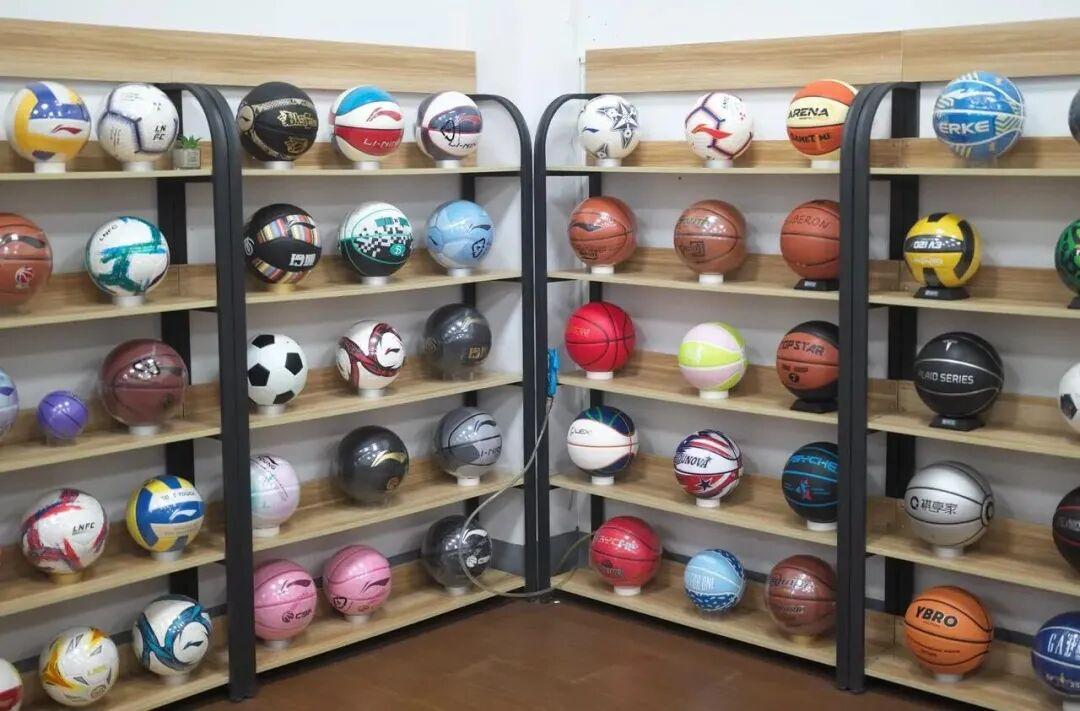
During our visits to factories in industrial clusters, we also learned that one change is particularly obvious: custom orders that previously required relatively large minimum order quantities (MOQs) are now being accepted by more and more factories through small-batch, fast-turnaround models.
Some factories have even lowered the MOQ to one unit, while promising to complete production on the same day or within a very short time. In this process, 1688 is also playing a very specific role. For a large number of small cross-border B2B merchants, they may not need to purchase thousands or even tens of thousands of units at once, but instead want to test a market, a SKU or a consumption scenario first.
Industrial platforms make it easier for these small-batch demands to find corresponding source factories, and also allow factories to obtain more small orders that were difficult to accept in the past. When small demands can also be accommodated by the supply chain, the global market is no longer just a game for big brands and large orders. This is also a change Wang Qiang repeatedly emphasized at the 1688 Super Factory Competition: today, Chinese manufacturing is no longer just facing the issue of how many orders it has, but whether it can be "found" by global demand more quickly. In his view, AI, cross-border business and supply chains are redefining the growth model of Chinese manufacturing in the coming years.
AI is becoming a very lightweight but increasingly prominent variable. Some factories have started using AI to judge overseas market trends, generate a large number of design solutions, which are then screened by humans; other factories apply AI to links such as quotation, customer service and content production.
In one case, a factory reduced the quotation process that previously took several hours to the minute level; in another case, AI can generate thousands of product images a day, providing basic materials for the development of a large number of SKUs. These changes do not mean that AI has replaced the manufacturing industry; its more practical role is to cut down the pre-production work that previously required a lot of manual labor.
What AI reduces is the time cost between demand being "an idea" and becoming "a product that can be produced". It is the combination of this with the original flexible production capabilities of Chinese industrial clusters that creates greater value. Demand is discovered faster, designs are generated faster, prototyping is faster, and small orders can also be produced, so goods can enter the market more quickly. In the past, production efficiency determined supply chain speed, but now, information efficiency also determines supply chain speed. This is why even a seemingly small demand from the European market may still find a suitable producer in China.
The truly noteworthy competitiveness of Chinese supply chains is gradually shifting from "what I can produce" to "how quickly I can produce your newly emerged demand".

Chinese factories are shifting from "taking orders" to "participating in defining products"
If the first two changes explain why Chinese supply chains can continue to serve the global market, the more noteworthy question is: what role will Chinese factories play in the global consumer goods industrial chain?
The answer may be changing. For a long time in the past, the global consumer goods industrial chain had relatively clear division of labor. Overseas brands were responsible for defining products, designing brands and operating markets, while Chinese factories were responsible for production.
Orders came to China from overseas, and finished products were sent back overseas. The core competitiveness of Chinese factories was to produce products stably, quickly and at low cost.
As manufacturing capabilities continue to improve, this division of labor is becoming more blurred. Factories are increasingly participating in product development. After a client proposes a general demand, the production end can participate in material selection, structural design, prototyping and testing, process optimization and cost control.
Some factories already have their own R&D personnel, design teams and product development capabilities. AI has further lowered the threshold for using these capabilities. Previously, a small factory wanting to research an overseas market may have had to rely on client feedback or long-term accumulation. Now, some enterprises have started using AI to organize market information, with humans then judging which trends are worth following. In the past, a design team could only complete a limited number of solutions a day; now, a large number of design sketches can be generated quickly, and human work shifts to screening, modification and judgment.
This means that the knowledge owned by factories has expanded from production experience to product experience. This change is particularly noteworthy for the European market.
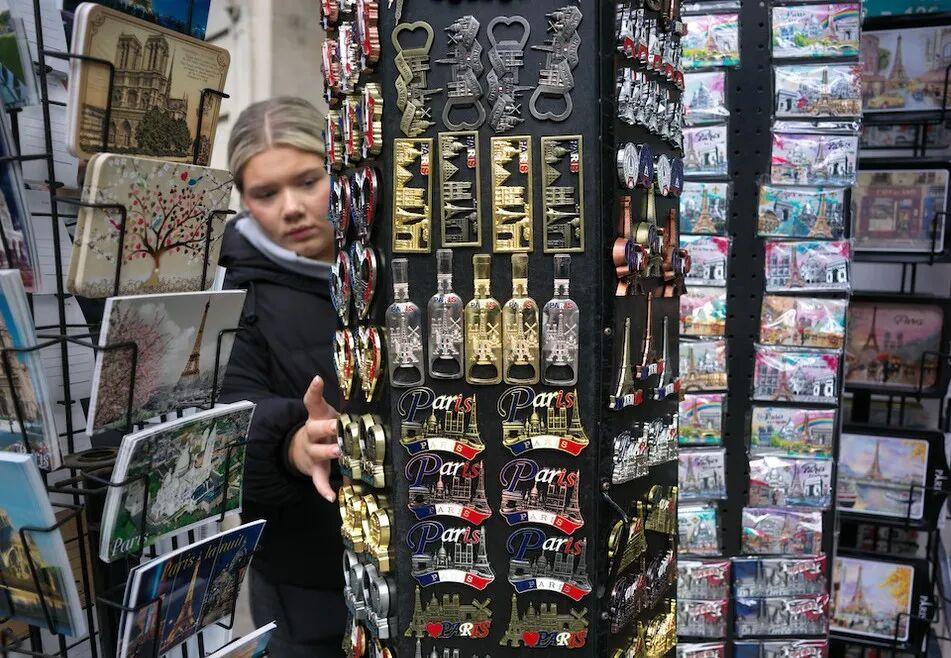
On the Champs-élysées in Paris, a little girl picks out refrigerator magnets from Yiwu, China.
Europe has a mature brand system and consumer market, as well as a large amount of niche demand. Chinese supply chains have rapid response and large-scale production capabilities.
The combination of the two will create new product innovation methods. When a demand emerges in the European market, brands or channels capture the trend, Chinese supply chains quickly complete prototyping and production, new consumer feedback is generated after the product enters the market, which then goes back to the production end for the next round of iteration.
The entire process is becoming faster and faster. In the past, product innovation mostly operated on annual cycles; now, the development cycle for some consumer goods is being compressed to much shorter timeframes. The relationship between Chinese supply chains and the global market is gradually shifting from production and sales to joint development.
For Chinese factories, this is a capability upgrade. For European consumers, it means that the Chinese goods entering their lives in the future may increasingly come from Chinese supply chains’ direct understanding of global demand. Looking back at the industrial clusters in Yiwu, Yongkang, Zhangzhou and Zhejiang from European streets, an interesting correlation emerges. Consumers in Berlin, Paris and Rome see the final products, while what happens in the industrial clusters is the complex production coordination behind these goods.
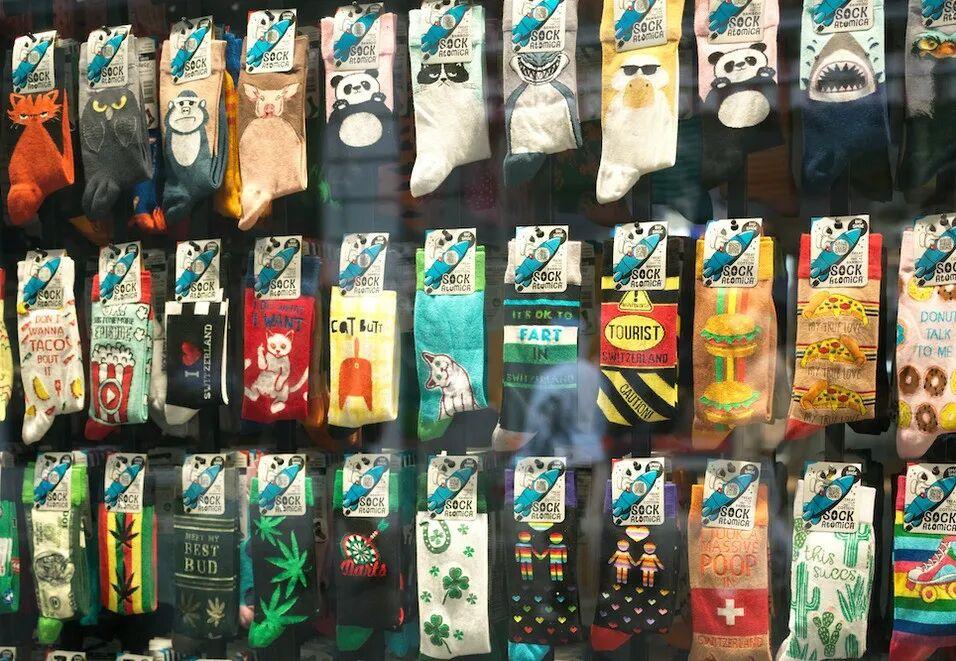
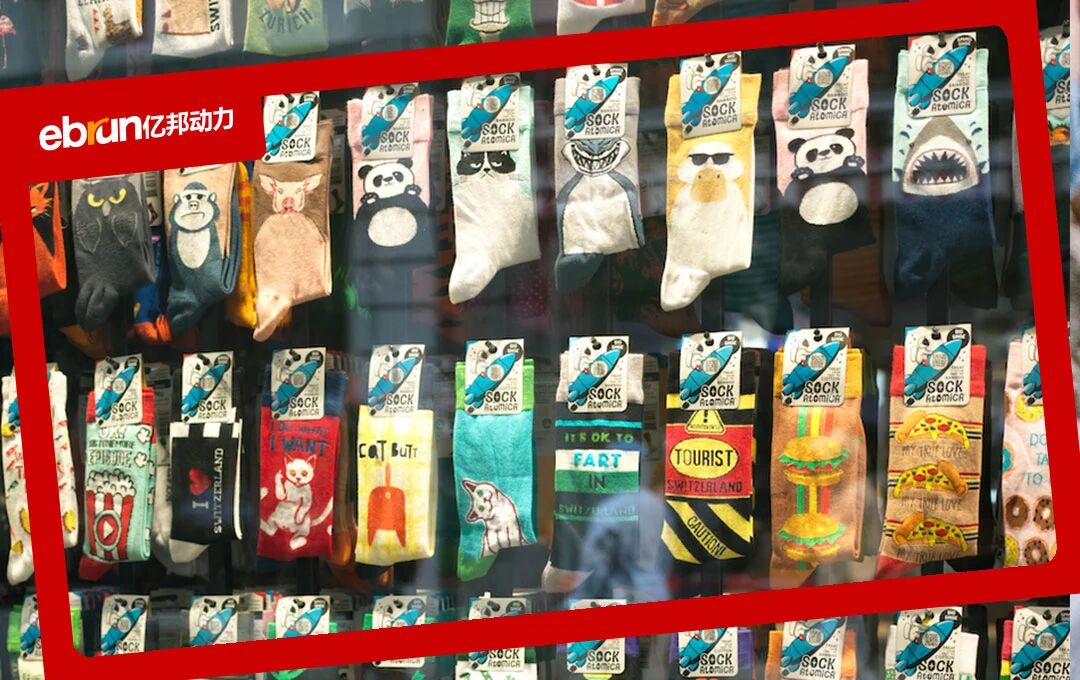
On the streets of Lucerne, Switzerland, socks printed with "Made in China" are sold.
Brands, trade, channels, logistics and other links connect the two ends, but the distance is constantly shrinking. This change also explains why discussions about Chinese manufacturing going global can no longer only focus on how many overseas stores Chinese brands have and how much market share they have captured.
There are a large number of Chinese factories whose brand names are not remembered by consumers, but are entering the global market through the industrial chain. They may not be standing in the center of IFA booths, but they are at the more everyday, broader supply end of the European consumer market.
What 1688 connects is precisely the end of this chain that is relatively easy to overlook: the connection between a large number of industrial cluster factories and a large number of small and medium-sized purchasers. A small cross-border merchant can find products with a MOQ of one unit here, and then bring them to Amazon, TikTok Shop or European offline channels; a factory can also reach overseas small B clients that were difficult to access in the past.
When the supply chain can serve smaller and smaller merchants, it means more and more ordinary people can use Chinese manufacturing to enter the global market. At the 1688 Super Factory Competition, Wang Qiang also mentioned that in the future, Chinese manufacturing will no longer only face traditional large clients, but more and more dispersed, fragmented, real-time changing global demands. AI is changing the procurement entry point, and industrial platforms make it easier for these demands to connect to source factories.
This may also be an important perspective for re-examining industrial clusters today: the value of industrial clusters is no longer just "producing more", but being able to accommodate small demands from the global market with lower thresholds and faster speeds.
In the past, Chinese factories excelled at turning global orders into goods. Now they are learning to understand global consumers and turn market demand into products more quickly. The role AI plays in this may not be as grand as imagined. It has not redefined manufacturing, but is gradually reducing the time between market research, design, quotation, communication and production. When this time is compressed, the original manufacturing capabilities of industrial clusters can be mobilized by the global market more quickly.
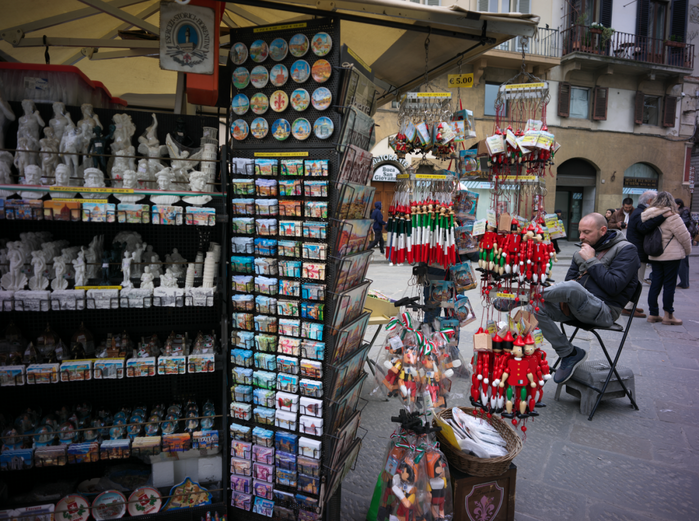
In Florence, Italy, vendors peddle small goods from Yiwu, China.
The geographical distance between Yiwu and Berlin, Paris and Rome spans thousands of kilometers; what is shortening is the industrial chain distance between Chinese manufacturing and global consumers. This may be the more noteworthy aspect of Chinese supply chains going global. Brands can be remembered, but they can also be replaced; but when a country’s industrial clusters can continuously, quickly and at low cost respond to increasingly fragmented consumer demands around the world, the competitiveness it forms is no longer just the competitiveness of a single brand.
It is more like a supply network distributed behind the global consumer market. Inside IFA exhibition halls, Chinese brands are competing for consumers’ attention; outside the venues, Chinese supply chains are already competing for the goods European consumers use every day.
Two models of going global are happening simultaneously. One takes place under the spotlight, the other between the shelves; and the latter may be closer to the truly broad foundation of the globalization of Chinese manufacturing.
Ebrun continues to track and report on this development. If you want to learn more information related to this article, please scan the QR code to follow the author’s WeChat.

This article was first published on the official Ebrun website.
[Copyright Notice] Ebrun advocates respecting and protecting intellectual property rights. Without permission, no one is allowed to copy, reproduce, or use the content of this website in any other way. If any copyright issues are found in the articles on this website, please provide copyright questions, identification, proof of copyright, contact information, etc. and send an email to run@ebrun.com. We will communicate and handle it in a timely manner.
Translated by AI. Feedback: run@ebrun.com