
He Zhiguan of Zhi Zhan Strategy: Winning the Global 'Cognitive War' — The Underlying Logic of a New Generation of Global Chinese Brands
[Ebrun Original] When consumers are asked "what bottled water do you buy when you're thirsty" or "what brand do you choose for a business phone", the answer often comes to mind even before they open an e-commerce platform.
This split-second decision is no easy feat for today's global expansion enterprises. Platforms are never short of products with similar functions, and supply chain efficiency, advertising tools and popular operating tactics are being replicated at a rapid pace. An enterprise may secure a click, an order, or even generate a wave of buzz at a certain point, but consumers may not remember it the next time they have a need.
On August 26, 2026, under the guidance of the China (Hangzhou) Cross-Border E-Commerce Comprehensive Pilot Zone and the Bureau of Commerce of Xiaoshan District, Hangzhou, the first session of the first phase of the "Foreign Trade Qinglan Plan · Brand Leap" course, hosted by the Global Cross-Border E-Commerce Knowledge Service Center and Ebrun Matishe, was held in Xiaoshan, Hangzhou. The invited expert for this session was He Zhiguan, founding partner of Zhi Zhan Strategy Consulting. As a new-generation strategic consulting firm in China, Zhi Zhan Strategy is also the first domestic institution to provide strategic positioning services for world-class high-tech AI enterprises.
During the course, He Zhiguan broke down this challenge into three consecutive links: demand, category and brand. Demand determines what problem consumers want to solve, categories provide the way to solve the problem, and brands answer the final question — why choose you in the end and give up another similar option.
In his view, this is exactly the hurdle many Chinese enterprises struggle to overcome when transitioning from selling goods to building brands: products are developed, channels are expanded, and content is continuously delivered, but these efforts fail to solidify into a clear, stable and repeatable reason for consumers to choose their products. Traffic passes through the enterprise, but no brand equity is retained.
 He Zhiguan, Partner of Zhi Zhan Strategy
I. As Information Asymmetry Diminishes, Competition Shifts to "Memory Capture"
For a long time in the past, cross-border business growth often stemmed from first-mover advantage. If an enterprise was the first to discover a category, a channel or a content strategy, it could secure a window of opportunity. But this window rarely stays open for long. Tools have lowered the threshold for information acquisition, platforms have shortened the distance between goods and consumers, and once an effective tactic is proven, peers can quickly see, understand and replicate it.
As a result, the core challenge has changed. In the past, enterprises were more concerned with "whether users can see our products"; now they also have to answer "what do users remember after seeing them". A single exposure only brings one contact; only when the brand name, category and differentiated value enter consumers' memory through repeated, consistent communication can that exposure turn into a priority choice for their next purchase.
He Zhiguan summarizes positioning as "the reason why consumers choose you instead of others". This statement may seem simple, but it implies a shift in business logic: good products no longer automatically translate to competitiveness, and sales growth does not automatically equal brand formation. If consumers only remember a certain function, a hot trend or an influencer, but do not know which company the product belongs to, the cost enterprises spend on promotion will rarely translate into their own assets.
That is why, in categories with severe homogenization, enterprises cannot just list advantages from an internal perspective. From a factory floor, a certain craft, component or function may seem outstanding enough; but when presented to consumers, it has to compete with existing options. Can users perceive this difference? Is the difference significant enough to change their original choice? Can competitors quickly replicate it? Without answering these questions, even a long list of selling points may be nothing more than a spec sheet.
At this level, global expansion brands are entering a new phase of competition: enterprises need to compete for both traffic positions on platforms and memory positions in consumers' minds. The former can be bought, while the latter requires the joint effort of products, communication and time to build.
II. Identify Your "Strategic Competitor" First, Then Define Who You Are
When many enterprises talk about positioning, their first reaction is to come up with a slogan. He Zhiguan believes that a slogan is just the external manifestation of strategy, and positioning is first and foremost a competitive choice. Enterprises must first understand the market landscape, identify the exact segment of demand they want to capture, and then decide against whom they will establish differentiation.
He divides competitors into two categories: one is "tactical competitors" that enterprises directly encounter in daily operations, and the other is "strategic competitors" that determine the brand's growth potential. The two are not necessarily the same. If enterprises only focus on the most similar products next to theirs on the shelf, they are likely to get trapped in localized competition over parameters, prices and advertising efficiency; the real opportunity to unlock growth sometimes comes from replacing outdated solutions outside the category.
He cited the Rokid brand strategy project he participated in as an example. According to his introduction at the event, the first question the team faced was to determine which comparison framework the product should enter, rather than adding more function labels to the AI glasses: competing with smart devices such as mobile phones and headphones, competing with similar AI glasses, or competing with traditional glasses.
If mobile phones were taken as the main competitor, the product capabilities at the current stage are not enough to replace mobile phones; if the enterprise only competes with similar products, even if it wins a local market share, it may still be limited to a nascent market. The project team eventually took traditional glasses as an important strategic reference, emphasizing the intelligent upgrade of the glasses form factor. This choice changed all subsequent decisions: the core user group was no longer just digital geeks, but also people who are already accustomed to wearing glasses and willing to try new experiences; channels could no longer rely solely on online parameter displays, but also needed to allow consumers to try on the products; product iteration, in-store display and promotional content all needed to be centered around the perception of "the next generation of glasses".
The value of this case lies in demonstrating how positioning is developed, rather than providing a standard answer for all smart hardware products. Positioning needs to be gradually refined based on market structure, the weaknesses of existing solutions and real user choices — picking a catchier slogan in a conference room is far from sufficient.
He Zhiguan emphasized that front-line research should restore real decision-making processes, and avoid forcing consumers to choose from preset answers: where they first learned about the product, what alternatives they compared at the same time, why they ultimately chose or abandoned the product, and which detail actually changed their judgment. In addition to interviewing consumers, distributors, platforms, sales associates and partners are also important sources of insight. Especially in cross-border scenarios, where enterprises are further away from end users, they need to bridge the cognitive gap through local partners, paid interviews, community recruitment and trade show exchanges.
A good positioning is more like a proven competitive hypothesis. It must both align with consumers' existing common sense and be grounded in the advantages that the enterprise can deliver; neither users' stated needs nor the enterprise's self-assessment can alone form the conclusion.
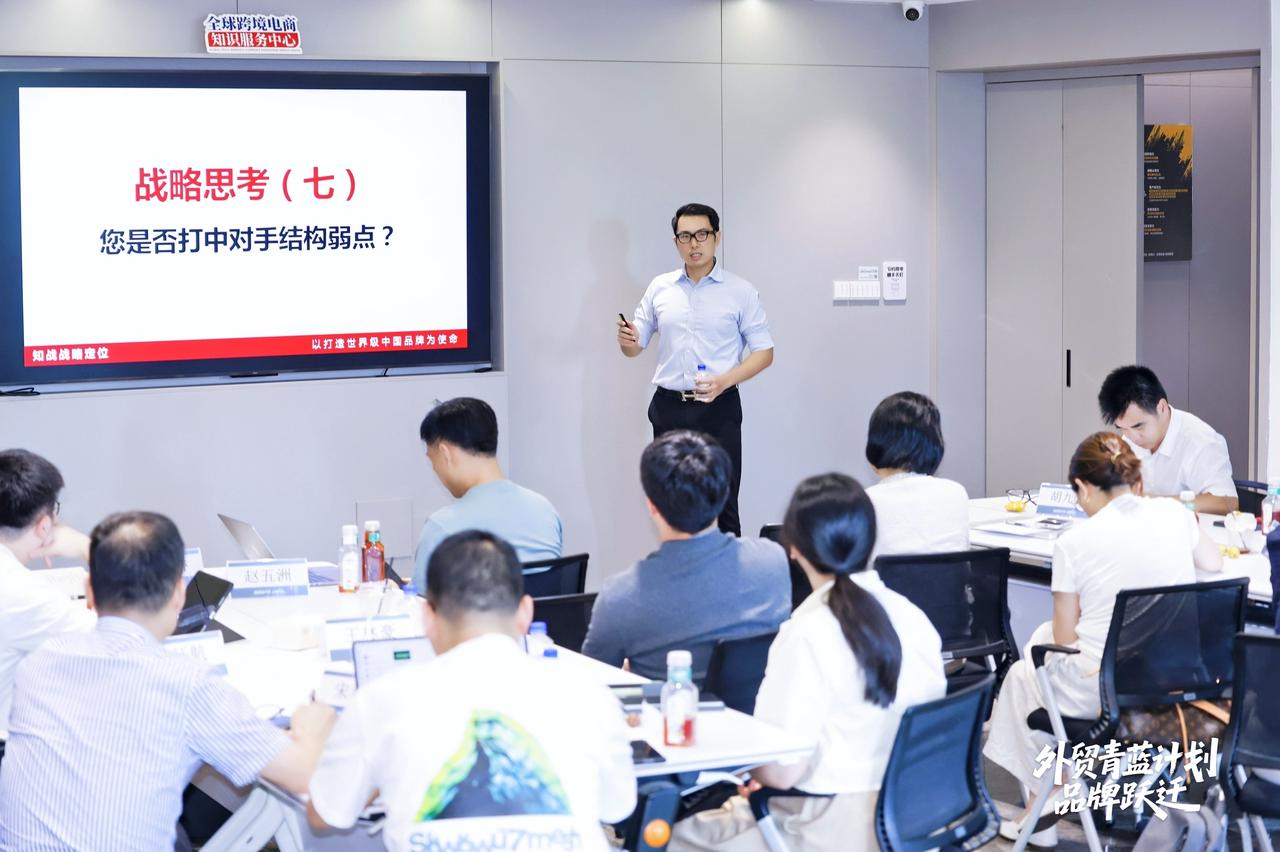 First session of the first phase of the "Foreign Trade Qinglan Plan · Brand Leap" course
III. From a Slogan to a Set of Interlocking Operational Alignments
Finding differentiation is only the beginning. The real difficulty lies in whether the enterprise can ensure that its products, pricing, channels, content, services and organization consistently communicate the same message over the long term.
He Zhiguan refers to this process as "operational alignment". If a brand wants to establish a premium perception, its pricing, channels and partners cannot consistently send low-price signals; if it emphasizes a specific niche scenario, product development and content marketing should prioritize serving that scenario; if target users need to experience the product to understand its value, channel investment cannot only focus on online traffic efficiency.
In the Rokid project, according to He Zhiguan, the team on the one hand re-emphasized the promotion of the Chinese brand name "Leqi", so that the attention generated by public events could be directed back to the brand; on the other hand, it coordinated content, offline experiences, niche community marketing and other initiatives around the same positioning. The number of initiatives is not the key; what matters is that every promotion can reinforce the brand name, category identity and core differentiation.
This also explains why "integrated brand and performance marketing" is rarely an unconditionally achievable goal in reality. Pure brand promotion may not directly convert to orders in the current period, while pursuing only immediate return on investment can easily sacrifice long-term perception. He Zhiguan prefers the term "brand-performance synergy": awareness, recognition and purchase are not the same action, but they need to reinforce each other under the same strategy.
For enterprises, this synergy requires at least three layers of validation.
First, whether the product can deliver on the positioning. Positioning sets the direction for product innovation. Enterprises need to concentrate resources on the products that best represent their strategy, and ensure that the value perceivable by users remains consistently ahead.
Second, whether channels match user decision-making processes. For products that require experience, enterprises need to solve the problems of trial use, service and trust; for products that rely on content for conversion, enterprises need to ensure that different influencers and different pages do not present the brand in inconsistent ways.
Third, whether promotion is building cumulative value. The same core message needs to appear stably and continuously, and cannot be changed constantly to follow trends. If an enterprise talks about technology one day, low prices the next, and lifestyle the day after, it may seem to have rich content, but in the end, nothing may be retained.
Brand building requires establishing a unified judgment standard for all existing actions of the enterprise: does this action reinforce the position we want to occupy? If not, resources need to be reallocated. Adding a marketing department alone cannot solve this problem.
IV. SMEs Don't Need to Copy Large Brands, But They Must Make Stricter Trade-offs
During the on-site Q&A, the most practical question came from small and medium-sized enterprises (SMEs) with limited budgets: without large-scale advertising budgets or the ability to hire celebrities, does positioning still work?
He Zhiguan's answer is that positioning is not equivalent to high-profile, large-scale marketing. The more limited resources are, the more necessary it is to spend money on the single most worthwhile point. Large enterprises can cover multiple channels at the same time, while SMEs should first find niche markets with relatively weak competition, clearer demand and where they can get fast feedback.
This means that focus does not equal immediately cutting all non-core products. Enterprises can retain existing business relationships, but new resources should no longer be allocated evenly. The product that is easier to differentiate, the market where there is a cognitive gap, and the scenario that can achieve higher conversion efficiency should become the phased strategic high ground. In He Zhiguan's words, it is "winning where it is easy to win": first establish a clear position in an area where you are most likely to succeed, then gradually expand your results.
With limited budgets, enterprises still have options beyond low prices: they can build differentiation through consistent content, focusing on niche user groups, strengthening sales scripts, optimizing page presentation and concentrating limited channel resources. Budget waste often stems from spending money to say the exact same thing as all competitors.
More importantly, positioning should not be treated as a one-time conclusion. He Zhiguan does not agree with the claim that "positioning is always correct". In his view, whether positioning is ultimately valid depends on whether the enterprise can implement it, and whether users are actually influenced. FMCG products can get feedback relatively quickly, while durable goods and categories with long decision-making cycles require longer observation periods; when the competitive environment changes, positioning also needs to be reviewed and adjusted.
Therefore, enterprises need to set up a validation mechanism for their strategy: within a clear cycle, observe whether the target user group, conversion efficiency, repurchase rate or channel feedback are changing in the expected direction; if the direction is correct, concentrate resources to continue amplifying efforts; if the market does not respond, distinguish whether the strategic hypothesis is wrong, or whether the product, content and channels have not achieved alignment. Continuously obtaining effective feedback determines whether persistence is still meaningful.

Transitioning from selling goods to building a brand is by no means just adding a layer of packaging to existing operations. It requires enterprises to shift from "what can we produce" to "why do consumers choose us", and then embed that answer into products, pricing, channels and every promotion. For Chinese enterprises expanding globally, crossing national borders is only the starting point of globalization. The real longer journey is to become part of the daily choices of an unfamiliar market, and to be accurately remembered amid repeated comparisons between similar products.
This article was first published on the official Ebrun website.
[Copyright Notice] Ebrun advocates respecting and protecting intellectual property rights. Without permission, no one is allowed to copy, reproduce, or use the content of this website in any other way. If any copyright issues are found in the articles on this website, please provide copyright questions, identification, proof of copyright, contact information, etc. and send an email to run@ebrun.com. We will communicate and handle it in a timely manner.
Translated by AI. Feedback: run@ebrun.com