
SHEIN Officially Goes Public: Market Cap Exceeds HK$180 Billion, Securing Third Place in Global Fashion Industry After 14 Years of Development
【Ebrun Original】On September 1, Shein International Holdings Limited (hereafter referred to as "SHEIN") officially listed on the Hong Kong Stock Exchange. The offering price was HK$48.56 per share, with an offering market capitalization of approximately HK$206.2 billion. Its current market capitalization stands at HK$189.6 billion, with total fundraising exceeding HK$13.5 billion.
Founded in 2008, SHEIN has evolved over 14 years from a cross-border seller focusing on wedding dresses to the world's third-largest fashion retailer by market share. Touted as the "world's largest online fashion destination," SHEIN served approximately 273 million active customers across around 160 markets as of 2025. The company offers over 2 million apparel styles, adding around 4,700 new apparel SKUs on average daily.
According to its prospectus, from 2023 to 2025, SHEIN's net revenue reached $32.103 billion, $38.748 billion and $41.847 billion respectively, representing year-over-year growth rates of 41.1%, 20.7% and 8.0%. Net profit for the three years stood at $2.789 billion, $3.365 billion and $2.064 billion, corresponding to net profit margins of 8.7%, 8.7% and 4.9%.
In the first quarter of 2026, SHEIN posted net revenue of $8.952 billion, a 1.1% increase from $9 billion in the same period of 2025. It recorded a net loss of $99 million during the quarter, compared to a net profit of $395 million in Q1 2025, mainly due to changes in the fair value of convertible redeemable preferred shares. Total orders rose to 1.09 billion from 970 million in the year-ago quarter.
01 Supply Chain Moat: 100-Unit Minimum Order Quantity, 36-Day Inventory Turnover, SHEIN Redefines Fast Fashion with Small-Batch, Rapid Replenishment Model
SHEIN has long been renowned for its in-house operated "Large-Scale Automated Test and Replenish" (LATR) model, which forms its most robust supply chain moat. According to the company, this model is the ultimate solution to the industry's long-standing trilemma, enabling it to strike an optimal balance between product assortment diversity, new design launch speed and inventory management efficiency. This is the core pillar that allows SHEIN to redefine efficiency standards for the fast fashion sector.
The LATR model is built on two foundational infrastructure pillars: an end-to-end intelligent supply chain and an agile global fulfillment network.
The end-to-end intelligent supply chain digitally integrates the entire value chain from trend identification, design and development, order allocation, production optimization to customer feedback. Its automated order allocation system intelligently matches orders to suppliers based on factors including their specialized capabilities, pricing and production capacity. Meanwhile, SHEIN provides cloud-based software solutions to suppliers free of charge, helping them manage order taking, production, quality assurance and shipping processes.
On the global fulfillment network front, SHEIN has optimized inventory turnover, delivery speed and costs through strategic inventory placement and intelligent freight route planning. As of June 30, 2026, SHEIN operated approximately 6 million square meters of warehouse space globally, covering Asia, North America, Europe, the Middle East and South America. In terms of delivery, over 90% of orders were delivered within 10 working days of shipment in 2025 and the first quarter of 2026. Additionally, per-order fulfillment costs have declined, dropping from $18.9 in 2023 to $17.7 in 2025, a decrease of approximately 6.3% over two years.
Under the LATR model, each new SKU has an initial production run of only 100 to 200 units for market testing. Replenishment orders are initiated within 5 days after sales performance is validated, significantly reducing inventory risk and shortening response cycles. In 2025, SHEIN's inventory turnover days were just 36, with unsold inventory remaining at a low single-digit percentage of total stock.
As of March 31, 2026, SHEIN's product assortment included over 2 million apparel styles. Through its first-party model, customers were introduced to approximately 4,700 new apparel styles per day on average in the first quarter of this year. Beyond apparel, SHEIN has expanded its product portfolio to include a diverse range of categories such as footwear, accessories, beauty, home goods and lifestyle products.
According to the prospectus, SHEIN's supply chain network covered more than 7,500 contract manufacturers as well as a large number of merchants, independent designers and other suppliers in 2025, most of which are small and medium-sized enterprises (SMEs). As of June 30, 2026, the company employed over 370 in-house designers.
For supply chain management, SHEIN has established a strict supplier code of conduct and conducts on-site SRS audits. Suppliers and subcontractors are assigned ratings of A, B, C, D or E based on SRS audit results. SHEIN provides additional incentives to A and B-rated suppliers, while D or E-rated suppliers are subject to closer monitoring. Between 2023 and 2025, SHEIN completed approximately 4,200, 4,550 and 5,150 SRS on-site audits respectively, covering around 95% of contract manufacturers for its private label products by procurement value.
02 Platformization Xcelerator Program: Making "Flexible Supply Chain" Globally Replicable
SHEIN started out with a fully self-operated model, but has gradually expanded into a third-party platform model in recent years. It launched the brand incubation program "SHEIN Xcelerator" to support designers and brands, while building a diverse brand portfolio through in-house incubation and acquisitions.
In terms of brand support, SHEIN officially launched the "SHEIN Xcelerator" in October 2025, targeting emerging and established brands globally, including Chinese designers and brands. The program provides brand incubation and global expansion support, enabling participants to leverage SHEIN's "flexible supply chain" foundation. The initiative is upgraded from the previous "SHEIN X" program, and has empowered nearly 20 brands worldwide to date.
According to official disclosures from SHEIN, the Xcelerator program has delivered remarkable results. For example, one brand saw its sales increase approximately 15-fold in the second year after joining the program, its operating margin improve by over 30 percentage points, and its inventory turnover days reduced by roughly two-thirds. The operating margin of the brand empowerment service is approximately twice that of the group's overall operating margin.
However, the Xcelerator program currently makes a limited contribution to SHEIN's overall revenue. The prospectus shows that in 2025 and the first quarter of 2026, Xcelerator contributed no more than 1% of the group's net revenue.
In addition, SHEIN has built a rich brand matrix over the years through in-house incubation and acquisitions, expanding its business to cover more price points, unique styles and broader product categories. According to the prospectus, its brand portfolio currently includes 10 major brands.
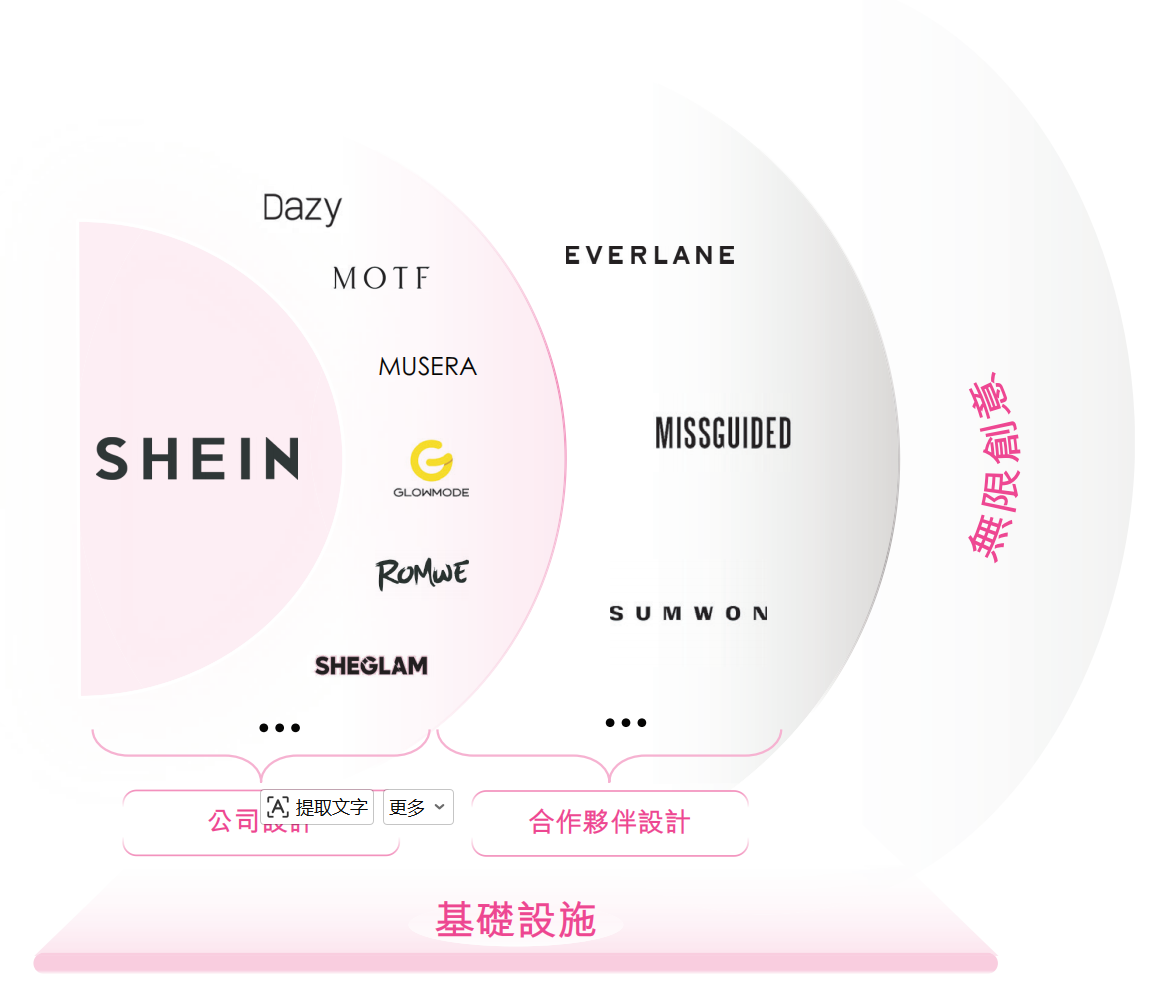
In-house incubated brands include mid-to-premium brand MOTF, activewear brand Glowmode, beauty brand SHEGLAM and Korean-style apparel brand Dazy, among others. Acquired brands include U.S. fashion brand EVERLANE, UK fast fashion brand MISSGUIDED, and Dubai-based fashion brand SUMWON.
While expanding its own brand portfolio, SHEIN is also transitioning from a purely self-operated model to a hybrid model combining self-operated business and an open platform. In March 2022, SHEIN first piloted its open platform model in Brazil, allowing third-party merchants to set up and operate their own stores. It subsequently rolled out the platform model to markets including Mexico and the U.S. In 2023, SHEIN officially announced its transformation into an e-commerce platform and launched the "Seller Gravity" million-seller program, completing its strategic shift from a branded retailer to a platform enterprise.
Currently, SHEIN's open platform business includes three models: platform-managed operations (i.e., full-service managed model), semi-managed operations, and merchant self-operation. The platform-managed model, launched first by SHEIN, requires sellers to only focus on supplying goods, while the platform handles almost all operational links, covering over 150 countries and regions worldwide. The semi-managed model falls between the full-service managed model and self-operation, giving merchants more autonomy while the platform provides support including logistics and marketing. This model is currently available in markets including the U.S., UK, EU, Mexico, Australia and Japan. The merchant self-operation model allows merchants to join the platform and run their own stores independently, with full store operation permissions and independent pricing rights. It is currently open in markets including the U.S., Mexico, UK and EU.
Prospectus data shows that SHEIN's platform expansion has accelerated in recent years: the share of service revenue in SHEIN's total revenue rose from 2.7% in 2023 to 11.3% in 2025, reaching 14.3% in the first quarter of 2026.
03 Securing Third Place in Global Fashion Market After 14 Years, New Journey Ahead
Following its listing, SHEIN's current market capitalization exceeds HK$189 billion, pushing the net worth of founder Chris Xu, who holds a 33% stake, to over HK$60 billion ($8 billion).
Back in 2008 when SHEIN was founded, Chris Xu started as a cross-border seller in Nanjing, running a small business focused primarily on wedding dresses. Few could have predicted that this small company would grow into a fashion giant covering over 160 markets worldwide and serving more than 280 million active users 14 years later. According to a CIC industry consulting report, SHEIN holds approximately 1.9% of the global fashion market, ranking third, behind Nike (3.0%) and Inditex (2.5%).
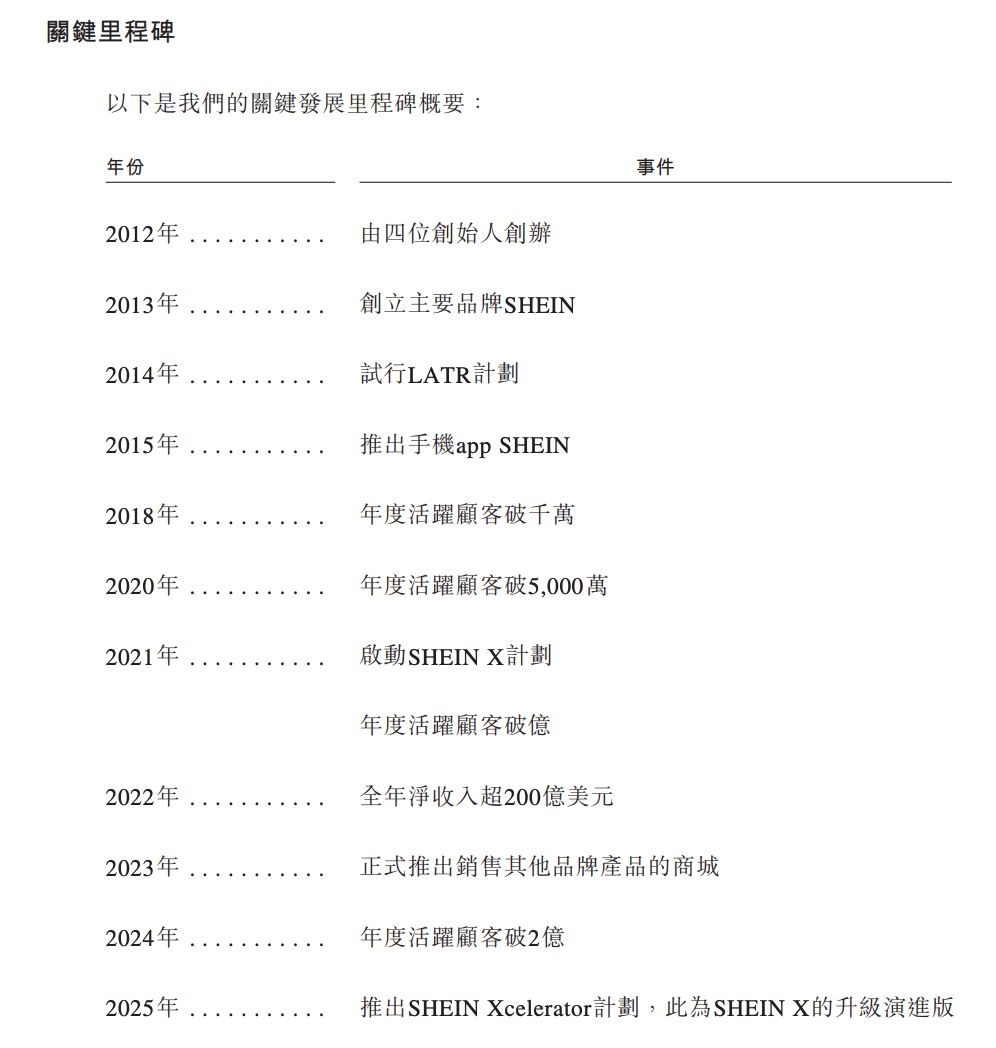
In 2012, the company acquired the Sheinside.com domain name, established its flagship brand SHEIN, and fully shifted to the fast fashion women's wear category. It later moved its headquarters from Nanjing to Panyu, Guangzhou, immersing itself in the Pearl River Delta's apparel industry cluster.
In 2014, SHEIN began building its supply chain system and piloted the LATR model. With a keen grasp of traffic dividends on overseas social media platforms, early SHEIN quickly broke into North American and European markets through KOL marketing on platforms including Facebook and Instagram, building a reputation among young consumers for its combination of extreme affordability and fast new product launches.
In 2015, SHEIN's mobile app officially launched, marking the company's formal transition from an independent site merchant to an omnichannel fashion retailer.
Over the next decade, SHEIN's active user base soared. Its annual active customers exceeded 10 million in 2018, 50 million in 2020, 200 million in 2024, 273 million in 2025, and reached 281 million in the first quarter of 2026.
Meanwhile, SHEIN's global footprint has continued to expand. From North America to Europe, the Middle East to Southeast Asia, and Latin America to Oceania, SHEIN had entered approximately 160 countries and regions as of 2025.
In terms of logistics fulfillment, SHEIN has built a massive warehousing and logistics network worldwide to continuously improve fulfillment efficiency. However, according to the prospectus, over 90% of its net revenue still comes from products stored in its central warehouses in China.
As of June 30, 2026, SHEIN leased and managed approximately 6 million square meters of regional distribution warehouses, with 37 warehouses in China, 6 in the U.S., 18 in Europe and 11 in other regions. In terms of leased warehouse area, China has the largest storage space at 4.08 million square meters, followed by Europe with 1.01 million square meters, the U.S. with 408,000 square meters, and other regions with 527,000 square meters.
On the offline front, SHEIN opened its first pop-up store in New York as early as 2018. In November 2022, it launched its first "try-only, no-sales" offline experience store in Tokyo. In November 2025, SHEIN opened its first permanent global physical store with an area of over 1,000 square meters at the BHV department store in Paris, marking its evolution from a purely online retailer to an omnichannel "global fashion retailer".
The successful listing is undoubtedly a milestone moment for SHEIN, but it is not the end point, but a new starting point. The fashion giant now faces the challenge of maintaining growth at its current large scale and opening a new chapter in globalization.
Of course, a series of new challenges are also inevitable. In its prospectus, SHEIN clearly outlines risk factors for future development:
First, the impact of changes in tariff policies. Since May 2025, the U.S. elimination of de minimis tariff exemptions has adversely affected SHEIN's U.S. sales and overall net revenue growth. In response, SHEIN has implemented measures including raising prices in the U.S. market to pass on costs, adopting formal customs declaration procedures, and adjusting local inventory and fulfillment strategies.
Starting July 1 this year, the EU officially eliminated tariff exemptions for low-value parcels under 150 euros, which will further increase the overall cost of direct mail parcels. Approximately one-third of SHEIN's net revenue came from Europe in 2025 and the first quarter of 2026. As SHEIN has raised prices to offset part of the increased costs, its sales volume in Europe may face short-term negative impacts, according to the prospectus, which added that "it is still too early to fully assess the long-term impact".
Second, compliance and regulatory pressures, concentrated in four areas: data privacy, consumer protection and ESG, intellectual property, and labor practices. The prospectus also notes that an increasing number of jurisdictions are imposing extended producer responsibility (EPR) fees, leading to rising compliance costs.
In addition, from the external environment perspective, SHEIN is facing rapidly evolving market competition. For example, Temu has disrupted the full-category market with its "extreme value for money" proposition, TikTok Shop has emerged as a new player with its content e-commerce model, while platforms including Amazon and AliExpress are ramping up efforts in different segments. While none of these players share SHEIN's exact positioning as a fashion retailer, there is potential overlap in certain local markets.
SHEIN has built its current global footprint over 14 years, creating numerous "miracles", but its journey continues.
Ebrun will continue to track and report on related developments. For more information related to this article, please scan the QR code to follow the author's WeChat account.

This article was first published on the official Ebrun website.
[Copyright Notice] Ebrun advocates respecting and protecting intellectual property rights. Without permission, no one is allowed to copy, reproduce, or use the content of this website in any other way. If any copyright issues are found in the articles on this website, please provide copyright questions, identification, proof of copyright, contact information, etc. and send an email to run@ebrun.com. We will communicate and handle it in a timely manner.
Translated by AI. Feedback: run@ebrun.com