
Tang Minglei: Agents Are Shifting from 'Selling Tools' to 'Selling Outcomes', E-Commerce Will Enter the A2A Era
[Ebrun Original] On August 28, at the "2026 Brand Supply Chain Innovation Private Board Meeting and 'ZTO Cloud Warehouse Night' Appreciation Dinner", Tang Minglei, Co-Founder and Chief Strategy Officer of Panfeng Intelligence and former Investment General Manager of Alibaba DingTalk, delivered a speech titled "The Next Decade: Seven Revolutions in the A2A Native Era and Observations on A2A E-Commerce".
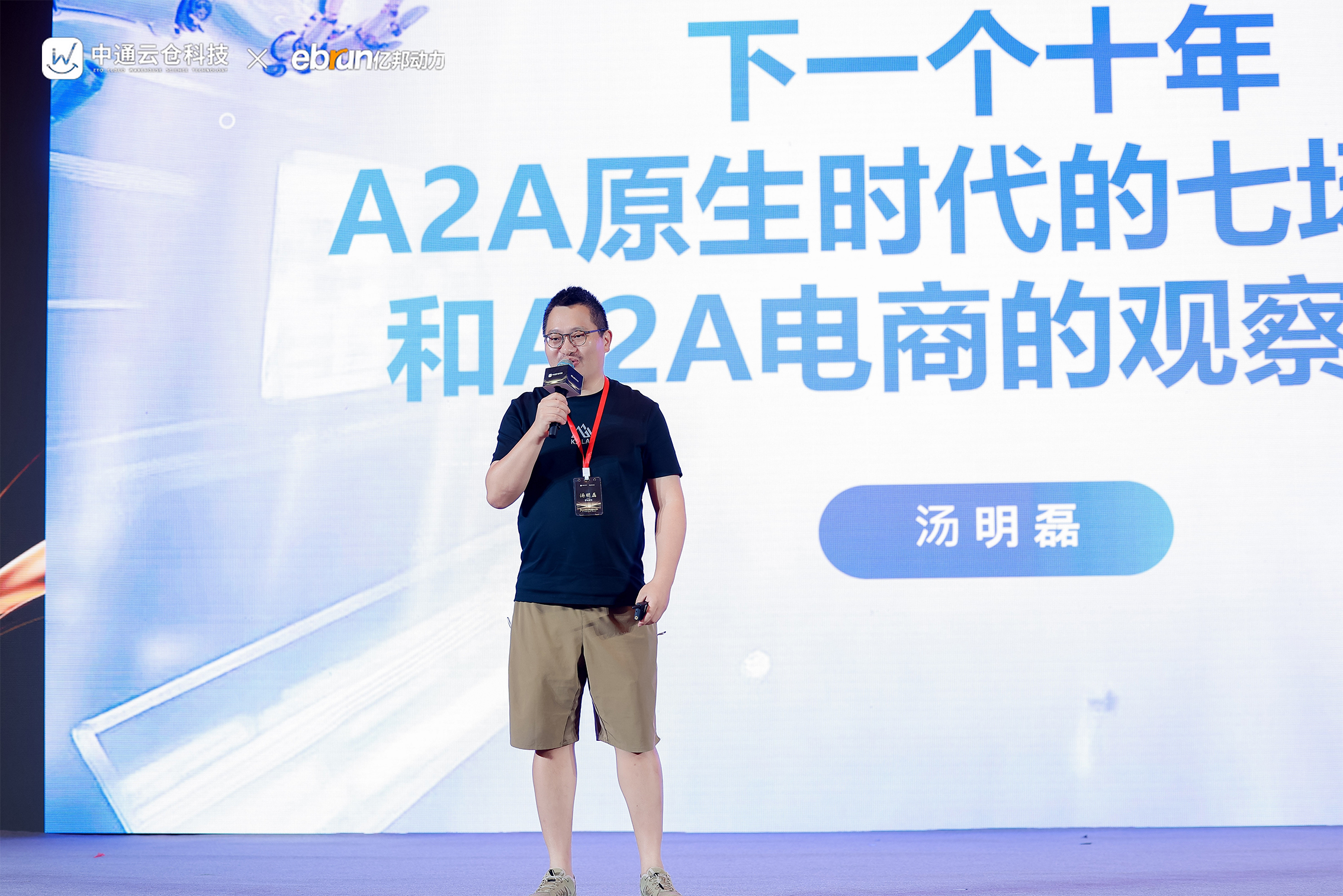
Tang Minglei believes that AI is evolving from a capability-providing tool to a production unit that can directly execute tasks and deliver outcomes. The resulting changes extend beyond enterprise efficiency to include human-AI collaboration models, platform evaluation metrics, system formats, business models, competitive moats, organizational mechanisms, and e-commerce formats.
In the e-commerce sector, as Personal Agents gradually participate in consumption decisions, processes such as searching, browsing, filtering, comparing, and placing orders may be further delegated to AI. The core of competition among e-commerce platforms may also shift from human attention and traffic distribution rights to the understanding, execution, and trusteeship of user intentions.
However, Tang Minglei also emphasized that not all shopping scenarios will be fully handed over to AI. Standardized, repetitive efficiency-focused shopping is more suitable for A2A, exploratory shopping requires human-AI collaboration through the A2A2A model led by Panfeng, while casual browsing-oriented shopping aimed at killing time and obtaining emotional value will still retain human participation.
This article is compiled based on the guest's on-site speech, with deletions and modifications made without affecting the original meaning.
The following is the full speech transcript:
It is a great pleasure to be here to communicate with everyone.
I have spent 10 years in industrial internet investment, and now I am an industrial AI entrepreneur with 10 months of experience. After starting my business, I have moved more to the frontline, experiencing the development of AI and the profound changes it brings.
Panfeng Intelligence currently provides e-commerce Agent OS for overseas influencers, who can fully automate the entire long workflow from product selection insight, content creation, video publishing to data analysis through Moras. Since its establishment, the company has completed three consecutive rounds of financing within half a year.
Today, I would like to share some observations on the AI era and A2A native e-commerce from the dual perspectives of investment and entrepreneurship.
01
AI Shifts from "Providing Capabilities" to "Delivering Outcomes"
In 2024, 2025, and 2026, everyone is talking about AI, but AI at different stages has completely different "characteristics".
I summarize 2025 as the "Year of C".
Here, C stands for Capability, namely abilities and tools. Chat, Coding, and Creator have become the keywords of this stage. People are concerned about whether AI can chat, program, generate content, and how to use AI to improve personal efficiency.
By 2026, AI is moving from the "Year of C" to the "Year of R".
R stands for Result, namely outcomes. Remember, Run, and Return have become the new keywords. People are starting to focus on longer context memory, more reliable data returns, and whether AI can directly run tasks and deliver outcomes.
AI no longer just provides a capability to humans, but begins to directly undertake work.
People with an AI Enable mindset view AI as "my capabilities plus AI equal a stronger version of myself"; while people with an AI Native mindset think about how to distill their experience and rules into AI, so that AI can develop stronger work capabilities.
The AI Enable approach is that humans first learn a task, then use AI to improve efficiency; the AI Native approach is that AI first learns, then humans call upon and manage the AI.
An AI Enable organization may hope that "10 people plus AI become 10 more efficient people"; while an AI Native organization starts to explore whether "1 person plus AI can achieve the work capacity of a 10-person team".
This change is also reconstructing the collaboration model between humans and AI.
From 2024 to 2025, what we mainly saw was humans using AI tools to improve efficiency. Next, more and more enterprises will enter the stage of "humans hiring AI", handing over a relatively complete work segment to agents for automatic execution.
My further judgment is that the scenario of "AI hiring humans" may emerge in the future. Humans will take on roles such as annotation, feedback, training, or being distilled in some work, while AI will be responsible for organizing and assigning tasks.
Further down the line, a main Agent may call multiple Sub-Agents to jointly complete end-to-end workflows through a Multi-Agent architecture. The collaboration relationship will further enter the stage of "AI hiring AI".
This is not a fully realized fact, but my deduction of future collaboration models.
Along with changes in collaboration models, platform evaluation metrics may also change.
In the mobile internet era, an important metric for evaluating a platform's scale and viability is DAU, or Daily Active Users. But in the AI era, users may not need to open a platform frequently.
Users only need to issue a complex task once, and AI can run continuously for a long period, consume a large number of Tokens, and finally deliver the outcome. The task value generated by one active session may exceed multiple simple accesses in the past.
Therefore, a new observation metric has emerged: TPD, which can be understood as Token Play, referring to how many Tokens the platform actually drives and how many tasks it completes every day.
In the past, platforms hoped users would open, browse, and interact repeatedly every day; in the future, users may only need to express their intention once, and AI will complete a large amount of work in the background.
For AI companies, what is truly important is not only how many users and employees they have, but also how much computing power a single person can call, how high the Agent density is within the organization, and how many effective tasks these agents have completed.
The expression method of systems will also change.
In the past, software and information systems were mainly designed for humans. Graphical user interfaces, buttons, tables, and menus were all designed to make it easier for humans to understand and operate information.
Systems in the AI era need to further shift to being For Agent. Information expression may increasingly evolve from LUI to GUI, from PPT to HTML, from Word to Markdown, and from traditional spreadsheets to structured data that is easier for machines to read.
This does not mean that original file formats will disappear immediately, but systems need to simultaneously consider whether these information can be read, understood, called, and executed by Agents.
In the future, users may no longer need to open different apps for each service separately. Users only need to express their needs to a Personal Agent, and the agent can call different Skills and service interfaces to generate the work interface required to complete the task.
The entry point in the mobile internet era is entering a platform or starting a usage process; the entry point in the AI era will become executing a task, or even proactively understanding and capturing a user's intention in advance.
Centralized entry points may decrease, while distributed interfaces will increase; the role of platforms in aggregating and distributing traffic may weaken, while the ability to understand and execute intentions will become more important.
02
AI Is Reconstructing Business Models, Competitive Moats, and Organizational Mechanisms
The business model of the first batch of AI tools is still largely similar to SaaS.
Enterprises pay based on seats or Token usage. AI applications combine and encapsulate large model capabilities, then sell them in the form of software or tools.
This model can be understood as "Token wholesale": enterprises earn the price difference after repackaging model capabilities, but usually do not take direct responsibility for the final business outcomes.
Another possible business model is "Token investment".
We can use the electricity era as an analogy. After the emergence of electricity, one type of enterprise was responsible for selling electricity, while another type of enterprise used electricity as a production material to build factories and produce goods.
The same applies to the AI era.
Enterprises can either sell Tokens and AI tools, or invest Tokens into specific industry scenarios, combine model capabilities with industry know-how, directly complete tasks and deliver outcomes.
The former model is more like selling co-pilots and tools, while the latter model is more like autonomous driving, where enterprises need to take responsibility for outcomes.
When Tokens are treated as investments, enterprises no longer only focus on the price difference between Token procurement and sales, but on how much business return these Tokens ultimately generate.
Therefore, AI business models may evolve from charging per person, per seat, and per call volume to charging based on outcomes and return on investment.
Competitive moats will also change accordingly.
An important moat of mobile internet platforms is the scale effect. More supply brings more demand, and more demand in turn attracts more supply. The two ends of supply and demand promote each other, eventually forming network effects and platform moats.
However, the user switching cost of AI platforms may not be as high as imagined.
Developers and users will quickly migrate between multiple tools based on the capabilities of different models. Simply having user habits does not necessarily mean being able to retain users in the long term. What can truly retain users is intelligence level and task outcomes.
Therefore, I believe that competitive moats in the AI era will further evolve from "scale effects" to "black hole effects".
More data helps models develop higher intelligence, and higher intelligence in turn attracts more tasks and data. Data and intelligence reinforce each other, forming a new closed loop.
The mobile internet era competed for the scale of supply and demand, while the AI era competes for Context, that is, more complete, continuous, and authentic context.
Whoever can more accurately understand users, accumulate task feedback, and continuously improve outcome quality will be more likely to form new competitive moats.
AI will also change enterprise organizations.
Taking Panfeng Intelligence as an example, we are a company where all employees use AI Coding. Including myself, team members need to be proficient in using AI programming tools.
After starting the business, we did not directly purchase a large number of traditional SaaS. CRM, customer management systems, BI dashboards, and some financial tools are all developed by team members according to their own business needs with the help of AI Coding.
In the past, enterprises mostly adopted tree-like, hierarchical organizational structures; in the AI era, organizations may become flatter.
Management objects will also extend from human resources to computing power. Enterprises not only need to consider how to divide work among employees, but also how to configure models, Agents, and computing resources.
The definition of talent will also change. In the past, enterprises valued specialists with deep capabilities in a single field, but in the future, they may need more generalists who can understand complex problems, clearly express intentions, and proficiently call AI.
Collaboration methods will shift from bureaucratic control to flexible collaboration. Past processes were mostly designed to deal with certainty, while future organizations need to adapt to random changes.
This is why one-person companies, flexible teams, and micro-organizational structures will continue to emerge. One person can call multiple agents, then connect with external ecosystem partners, to achieve work capabilities that previously required larger organizations.
03
E-Commerce Will Shift from Attention Economy to Trusteeship Economy
In the past, e-commerce systems were all designed for humans.
Category trees, search boxes, filter bars, sorting rules, product detail pages, and comment sections serve human input, browsing, comparison, and decision-making respectively.
Search boxes are for humans to type in, detail pages are for humans to browse, and comment sections are for humans to read through. The common purpose of these designs is to save humans' time and help them make choices faster.
But if Personal Agents help users complete shopping in the future, what changes will happen to e-commerce interfaces?
Except for expressing intentions and confirming payment, the intermediate processes of searching, browsing, filtering, comparing, evaluating, communicating, and selecting may all be further delegated to AI.
An important change in AI-native e-commerce is the ability to expand the length of demand expression.
In the past, users could only enter short keywords such as "black shirt", "men's sneakers", or "father's birthday gift" in the search box, and a large amount of background information would be lost during the search process.
In the AI era, users can say: "I'm going to Disney next weekend, I want clothes that look good in photos, are comfortable to walk in, and it may rain in the afternoon, please help me put together an outfit."
They can also say: "Next week is my father's 70th birthday, and also the 50th anniversary of his career. He likes calligraphy and traditional Chinese painting, I want a not-too-expensive but customized gift."
AI can carry more complete Context, and complete matching based on scenarios, identities, preferences, and constraints.
This will drive e-commerce to shift from attention economy to trusteeship economy, from traffic distribution to precise matching, and from data hoarding to data circulation.
However, different shopping demands are suitable for different A2A models.
The first type is efficiency-focused shopping.
For example, buying cat food, milk powder, batteries, daily necessities, or restocking the refrigerator. These demands are clear and highly standardized, and AI can directly complete decision-making and order placement based on historical consumption and inventory status. There is no need for users to spend time repeatedly searching and comparing.
This is the scenario where A2A is easiest to be implemented first.
The second type is exploratory shopping.
For example, trying new brands, choosing gifts, buying furniture, matching outfits, or looking for new lifestyles. Users have general demands, but no clear answers yet.
In these scenarios, AI can complete information collection, candidate solution filtering, and recommendation reason generation, while humans complete aesthetic and value judgments. Influencer content and professional recommendations can also participate in the decision-making as an intermediate link, forming the A2A2A model.
The third type is casual browsing shopping.
Users have no clear demands, and shopping itself is a process of killing time, seeking inspiration, or obtaining emotional value. In these scenarios, if AI pursues efficiency excessively, it may instead damage the experience.
Therefore, traditional content e-commerce and mobile internet e-commerce will not disappear immediately, but will continue to meet shopping demands that require browsing, discovery, and emotional experience.
AI-native e-commerce does not mean letting AI take over all consumption, but redividing the tasks between humans and AI in different scenarios.
Efficiency-focused shopping may be mainly completed by AI, exploratory shopping is completed through human-AI collaboration, and casual browsing shopping will continue to retain active human participation.
Finally, I would like to share some calm reflections.
AI's capabilities are getting stronger, and teams will perform better and better after calling AI. But sometimes, what is truly getting stronger may be the large model, not necessarily humans themselves.
Twenty years ago, being able to be online anytime was a status symbol. Today, having the right to be disconnected is instead a form of freedom.
Currently, being able to access AI systems and use AI proficiently is an advanced capability; in the future, when AI covers more life and work scenarios, being able to retain one's own time, judgment, and experience outside of AI may also become a scarce choice.
Technology will reconstruct platforms and reshape business. But beyond pursuing efficiency and outcomes, we still need to think about what belongs to human happiness, dignity, creativity, and well-being.
In the A2A era, all platforms may be redefined, and all businesses may be reshaped.
I hope to continue discussing the changes and cooperation opportunities in the AI era with everyone in the future.
Thank you all.
This article was first published on the official website of Ebrun.
[Copyright Notice] Ebrun advocates respecting and protecting intellectual property rights. Without permission, no one is allowed to copy, reproduce, or use the content of this website in any other way. If any copyright issues are found in the articles on this website, please provide copyright questions, identification, proof of copyright, contact information, etc. and send an email to run@ebrun.com. We will communicate and handle it in a timely manner.
Translated by AI. Feedback: run@ebrun.com