
Creality Makes Earnings Debut: Revenue Grows, Net Profit Turns to Loss, and It Will Launch a Line of 3D Printers Designed for Children
【Ebrun Original】Shenzhen Creality 3D Technology Co., Ltd. recently released its financial results for the first half of 2026. In the first six months of the year, the company posted operating revenue of 1.626 billion yuan, up 12.9% year-on-year, with gross profit reaching 500 million yuan, a slight 0.9% increase. During the reporting period, the company recorded a net loss of 59.1 million yuan, and an adjusted net loss of 15.7 million yuan, compared to a net profit of 1.075 billion yuan in the same period last year. Its gross margin stood at 30.8%, down 3.6 percentage points year-on-year. While Creality saw revenue growth in the first half, costs and expenses rose at a faster pace, compounded by foreign exchange losses, leading to the shift from net profit to net loss. On the day the earnings report was released, the company's closing share price stood at HK$24.90, down 5.40%.
Founded in 2014, Creality is a global provider of consumer-grade 3D printing products and services. It listed on the main board of the Hong Kong Stock Exchange in May 2026 under the ticker symbol 3388.HK. Its products and services cover 3D printers and consumables, 3D scanners, laser engravers and related accessories, and it offers a range of content services via its Creality Cloud platform. In addition, the company launched Nexbie, an overseas e-commerce platform for 3D creative products, in August 2025.
From a product line perspective, Creality's revenue comes mainly from four categories: 3D printers, scanners and engravers, 3D printing consumables, and accessories.
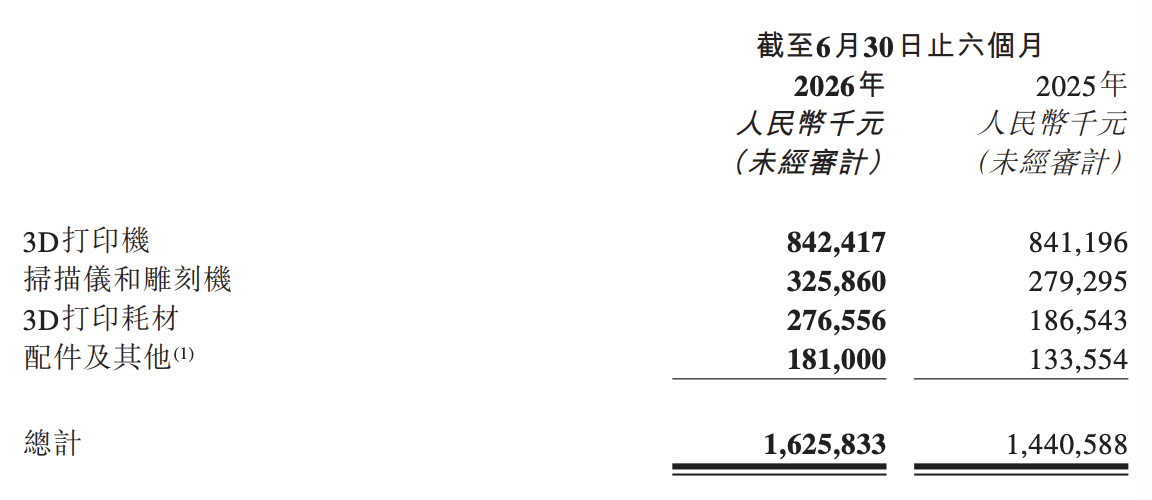
Among them, 3D printers, the largest revenue contributor, brought in 842 million yuan in the first half of this year, up 0.1% year-on-year.
Revenue from 3D printing consumables reached 276 million yuan, surging 48.3% year-on-year, a standout performance. According to the earnings report, this growth was mainly driven by the continued expansion of multi-color printing application scenarios, which boosted total consumable consumption, as well as significant improvements to the printing experience enabled by Radio Frequency Identification (RFID) technology. (Consumables with RFID tags have built-in information including material type, color, brand, and recommended printing temperature. After the printer reads this information, it can automatically load the correct printing configuration file, eliminating the need for users to manually set up RFID consumables, which greatly lowers the operational threshold of the printer and reduces print failure rates.)
Revenue from scanners and engravers reached 326 million yuan, up 16.7% year-on-year. This growth was primarily due to the company's continuous launch of new products including the Sermoon series of 3D scanners, Falcon T1 and A1C laser engravers, covering both the high-end flagship market and entry-level market; new intelligent 3D scanning technologies that have improved the ease of use and user experience of 3D scanners; and continued expansion of sales channels and optimization of end-user services.
According to data from CIC, the global consumer-grade 3D scanner market is highly concentrated. In 2025, the top three market players accounted for approximately 90.0% of total GMV, with Creality ranking first in the global consumer-grade 3D scanner market with a 45.3% market share by GMV.
In addition, revenue from accessories and other categories reached 181 million yuan during the reporting period, up approximately 35.5% year-on-year.
From a regional market perspective, during the reporting period, the Americas contributed 662 million yuan in revenue, up approximately 25.1% year-on-year; Europe contributed 404 million yuan, up approximately 8.4% year-on-year; China (including Hong Kong, Macau and Taiwan) contributed 392 million yuan, up approximately 3.8% year-on-year; and other regions contributed 168 million yuan, up approximately 4.1% year-on-year.
Regarding the decline in gross margin from 34.4% in the same period last year to 30.8%, the earnings report attributed the drop to the company's strategic decision in the second half of 2025 to set slightly lower pricing margins for newly launched products to offer consumers more cost-effective options, as well as promotions and active product iteration to clear out older series and optimize the product portfolio.
In terms of costs and expenses, Creality saw increases in cost of sales, R&D expenditure, sales and marketing expenses, and general and administrative expenses during the reporting period.
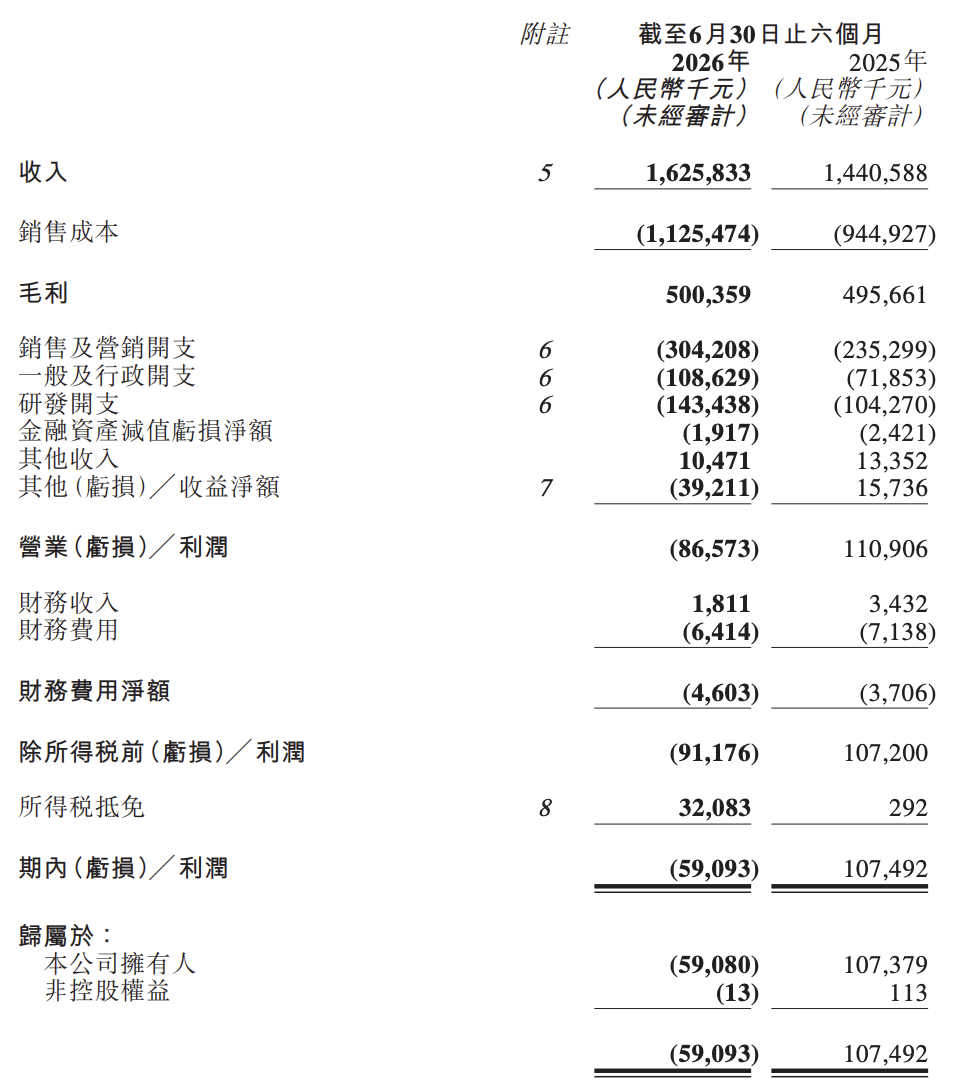
Cost of sales reached 1.125 billion yuan, up 19.1% year-on-year, mainly due to higher sales volume and rising prices of key raw materials such as printed circuit board assemblies, memory and chips.
R&D expenditure reached 143 million yuan, up 37.6% year-on-year, accounting for 8.8% of total revenue. R&D-related employee costs rose from 82.8 million yuan to 110 million yuan. The company's R&D team consists of 890 professionals, with technical expertise spanning multiple foundational areas including mechanical design, electrical and electronic systems, motion control algorithms, slicing software and firmware.
Sales and marketing expenses reached 304 million yuan, up 29.3% year-on-year. Among them, marketing and advertising expenses increased from 107 million yuan to 128 million yuan, mainly due to the company stepping up promotion on e-commerce platforms, social media and other channels, as well as deepening cooperation with channel partners through co-branding initiatives. Employee costs increased from approximately 55.5 million yuan to approximately 71.8 million yuan, primarily due to the expansion of the marketing and sales team to support ongoing brand promotion, overseas business expansion and e-commerce platform operations. Commissions paid to e-commerce platforms rose from approximately 37.6 million yuan to approximately 56.6 million yuan, mainly driven by business growth on platforms including Amazon and TikTok.
General and administrative expenses reached 108 million yuan, up 51.2% year-on-year, mainly due to increases in listing-related expenses and share-based compensation expenses.
In addition, the Creality Cloud community platform delivered strong operational performance during the reporting period: new registered users grew 77.1% year-on-year, average monthly active users rose 68.3% year-on-year, the number of new public models increased 137.6% year-on-year, and platform membership revenue grew 60.1% year-on-year, indicating continued vitality in its user ecosystem.
In the first half of this year, Creality launched new products including the entry-level i7 series 3D printers, desktop consumable production systems, Sermoon series scanners, and the Falcon T1 laser engraver. Among them, the desktop consumable production system (Creality Filament Maker M1 and Filament Shredder R1), launched to address consumable waste, raised approximately $7 million in total funding on crowdfunding platform Indiegogo, attracting more than 5,000 backers globally and ranking first among all 3D printing category crowdfunding projects worldwide in terms of funding amount in the first half of 2026.
In terms of AI applications, Creality has also launched a series of tools including CubeMe, MagicRelief, SnapForm, SignForge and FanForge, which simplify users' 3D creation workflow from traditional professional modeling to the process of "upload images or enter ideas - automatically generate 3D models - cloud slicing - one-click printing", effectively lowering the barrier to creation. As of June 30, 2026, usage of these related AI applications continued to grow, with usage in June up 85.6% compared to January. The earnings report stated that the company plans to continue improving its AI talent pipeline and increase R&D investment in generative AI and its scenario-based applications.
According to the earnings report, Creality plans to launch new product lines in the second half of this year, including: The K3 multi-color 3D printer as a core product. The K3 features a four-nozzle design equipped with intelligent multi-nozzle collaboration technology, enabling faster printing, reduced material waste and high cost-effectiveness; An upgraded i8 four-color printer, which delivers faster printing speed with zero waste; A new series of 3D printers designed exclusively for children, focusing on 3D printing convenience and stability for children aged 4 to 15, and addressing several key pain points suitable for this age group; The PIKA 3D scanner, which offers multi-light source, wireless and high-efficiency scanning in a compact and portable form factor; The A1C engraver, which integrates a lifting platform, compact form factor and auto-focus function into an affordable product.
In addition, Creality plans to deploy more than 2,000 offline display outlets overseas and open approximately 30 physical stores in mainland China by the end of this year.
Ebrun will continue to track and report on related developments. For more information related to this article, please scan the QR code to follow the author on WeChat.

This article was first published on the official website of Ebrun.
[Copyright Notice] Ebrun advocates respecting and protecting intellectual property rights. Without permission, no one is allowed to copy, reproduce, or use the content of this website in any other way. If any copyright issues are found in the articles on this website, please provide copyright questions, identification, proof of copyright, contact information, etc. and send an email to run@ebrun.com. We will communicate and handle it in a timely manner.
Translated by AI. Feedback: run@ebrun.com