
Charles of Ozon China: Russian E-Commerce Market Is Still Far From Reaching Its Growth Ceiling
[Ebrun Original] On August 28, at the "2026 Brand Supply Chain Innovation Private Directors' Meeting & 'ZTO Cloud Warehouse Night' Brand Salon", Charles from Ozon China delivered a speech titled Embark on a New Journey for Russian Markets, Unlock New Cross-Border Growth.
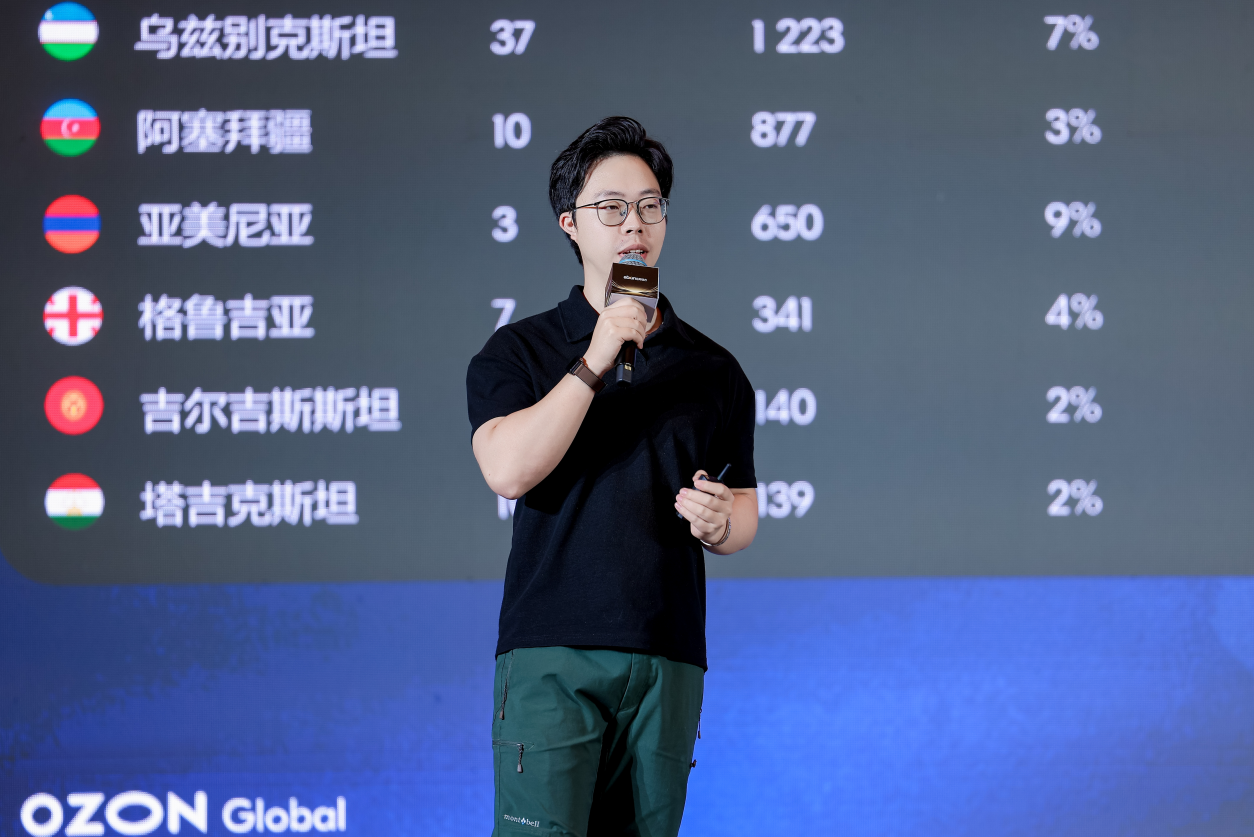
Charles noted that Russia and the Commonwealth of Independent States (CIS) market has long been overlooked by Chinese companies expanding overseas, yet the region has a population of approximately 250 million and maintains large-scale bilateral trade with China. As the core market in the region, Russia's e-commerce scale is still growing rapidly, with its market penetration rate and consumers' online shopping frequency continuing to rise.
Russia has a vast territory, and there are obvious disparities across different regions in terms of population density, purchasing power, and logistics infrastructure. For Chinese companies, these disparities mean that brand enterprises, industrial cluster merchants, and industry-and-trade integrated enterprises can all find suitable consumer groups and business opportunities.
To support Chinese merchants entering the Russian market, Ozon is leveraging capabilities including cross-border self-fulfillment, semi-fulfilled by platform services, local logistics facilities, platform traffic tools, and brand support to lower the threshold for companies to test the market and conduct local operations.
This article is compiled based on the guest's on-site speech, with minor edits made without altering the original intent.
The following is the full speech transcript:
Hello everyone, I am Charles from Ozon China.
Today, I would like to share with you insights covering the opportunities in the Russian and CIS markets, Ozon's platform development, how Chinese cross-border merchants can participate, as well as category and brand strategies for 2026.
01
Russia and the CIS Are Overlooked Incremental Markets
When studying overseas markets from a China-centric perspective, people usually think of Japan and South Korea when looking northeast; Southeast Asia when looking south; and further afield, Europe, the United States, the Middle East, and Africa.
However, there is another region adjacent to China that is often overlooked by global brands and cross-border merchants: the Russian and CIS markets.
The CIS consists of multiple former Soviet republics. The entire region has a population of approximately 250 million, and the bilateral trade volume with China exceeds $300 billion. Russia dominates this market.
Today, I will mainly focus on Russia to introduce the development of its e-commerce market, Ozon's role in the local market, and how Chinese cross-border merchants can participate in this business.
Russia is the largest country in the world by land area, with a population of about 146 million and Russian as its official language. In terms of purchasing power parity, Russia has a considerable economic size.
To understand the Russian market, one first needs to understand its geographical differences.
The Ural Mountains divide Russia into eastern and western parts. Western Russia has a more concentrated population, as well as denser urban distribution and logistics transportation networks. Major cities such as Moscow, St. Petersburg, and Kazan are mostly located in the western region.
Consumers in these areas have relatively strong purchasing power and are more familiar with e-commerce. They may have higher acceptance of products with distinctive design, brand premium, or innovative functions.
Moving east into central and far eastern Russia, administrative regions become larger, population density drops, and road and logistics networks are more scattered.
In these areas, the variety of offline goods is relatively limited, and end prices may be higher. As a result, consumers here show characteristics similar to those in China's e-commerce "lower-tier markets": they demand a richer supply of goods, and pay more attention to product prices and logistics accessibility.
When looking at the entire Russian market as a whole, you will find that multiple types of consumer demand coexist.
Brands that have already entered mature overseas markets can find consumers in western Russian cities who have higher requirements for product quality, design, and branding; industrial cluster and industry-and-trade integrated enterprises with supply chain and price advantages can also find corresponding demand in wider regions.
It is precisely the disparities between different regions in Russia that allow both brand enterprises and industrial cluster merchants to find their own market space.
02
E-Commerce Grows at a High Speed, Logistics Infrastructure Determines Market Coverage
From 2021 to 2025, the Russian e-commerce market maintained rapid growth, with an average annual growth rate of nearly 40% in the first four years. Even on a global scale, this is a relatively outstanding growth rate.
Currently, Russia's e-commerce penetration rate is about 25%, and it is expected to continue rising through 2027. Considering Russia's 146 million population, the market is still far from reaching its growth ceiling.
We conduct market visits to Russia every year. The ongoing formation of online shopping habits among Russian consumers is in some ways similar to the stage before the full popularization of mobile e-commerce in China.
More and more consumers are beginning to find that online shopping not only offers more competitive prices, but also a wider range of product choices. Meanwhile, the logistics fulfillment capabilities of local Russian e-commerce platforms continue to improve, further driving consumers to shift from offline to online shopping.
Founded in 1998, Ozon is one of Russia's leading full-category e-commerce platforms, with businesses covering e-commerce, digital banking, supply chain finance, logistics networks, instant retail, and advertising services.
In 2025, Ozon had 65.1 million active users, with annual GMV reaching 41.6 trillion rubles, approximately $54 billion.
The purchase frequency of active consumers is also rising. The average annual order volume per platform user increased from about 26 orders in 2024 to more than 38 orders in 2025.
The rapid growth of the platform scale requires, on one hand, a richer supply of goods, and on the other hand, continuous growth in consumer traffic, as well as the establishment of a logistics fulfillment network that can cover different regions of Russia.
If we use a Chinese e-commerce platform as a reference, I think Ozon is more similar to JD.com in some aspects. Russia has a vast territory, and operating e-commerce in such a market imposes very high requirements for warehousing and logistics fulfillment capabilities.
To this end, Ozon has continued to increase investment in logistics infrastructure.
From 2018 to 2025, Ozon's logistics-related facility area increased from about 100,000 square meters to about 4 million square meters, the number of logistics fulfillment centers increased from 7 to 200, and the number of pickup points increased from about 300 to more than 83,000.
The pickup point network helps the platform connect with more scattered consumers, and is an important foundation for Ozon to improve the shopping experience across Russia.
For Chinese merchants, the Russian market requires not only competitive products, but also the selection of appropriate fulfillment methods based on order density, consumption levels, and logistics conditions in different regions.
03
From Self-Fulfillment to Semi-Fulfillment, Merchants Can Test the Market in Phases
In 2026, Ozon further adjusted its entry and operation policies for Chinese cross-border merchants.
Currently, merchants do not need to pay security deposits, entry fees, monthly fees, or annual fees to settle on the platform. A single corporate entity can register up to 6 stores, and new stores can also receive corresponding advertising support to help products complete the cold start phase.
It should be noted that the platform still charges corresponding sales commissions based on product categories.
Ozon currently provides two main shipping models for Chinese merchants: the self-fulfillment model rFBS and the semi-fulfillment model FBP.
Self-fulfillment is currently the more widely used and flexible model among merchants.
Merchants can first prepare product materials, set prices, and complete product listing. After an order is generated, they ship the goods via cross-border logistics. This model has a relatively low entry threshold, which is suitable for merchants to conduct new product testing and market validation, and can also reduce early inventory pressure.
As order volume increases, merchants can choose to stock goods based on sales performance, and improve delivery efficiency and consumer experience through methods such as semi-fulfillment.
The FBP model requires merchants to store physical goods in corresponding warehouses in advance, and the platform will complete subsequent fulfillment after actual inventory is recorded. For new merchants in some electronic product categories, the platform is also testing a warehouse-first sales model to reduce the impact of malicious copycat listings and counterfeit goods on the market.
Different models are not simply better or worse than each other, but are suitable for different business stages.
When first entering the Russian market, merchants can test product selection, pricing, and consumer demand through self-fulfillment; when certain products achieve stable sales volume, they can then improve delivery timeliness through stock preparation and local fulfillment.
In terms of payment collection, the platform settles accounts based on the exchange rate on the day the order is completed, and pays RMB to the merchant's designated account to reduce the exchange rate fluctuation risk faced by merchants.
Ozon is also strengthening collaboration with domestic supply chain partners including ZTO Cloud Warehouse Technology to continuously optimize cross-border logistics products for Chinese merchants. By improving transportation efficiency, shortening delivery time, and reducing comprehensive logistics costs, we help products gain better market competitiveness.
04
Platform Operation Requires a Simultaneous Understanding of Products, Traffic, and Fulfillment
After brand merchants and high-quality stores enter Ozon, they need to understand the basic composition of platform traffic.
Ozon's platform traffic can be roughly divided into three categories: organic traffic, paid traffic, and promotional event traffic.
Organic traffic is related to the operational quality of the product itself, including factors such as whether product information is complete, whether translations are accurate, whether prices are competitive, logistics timeliness, consumer reviews, and store ratings.
The platform's search algorithm also comprehensively considers the relevance of product listings to user search terms, product browsing and conversion performance, sales volume, price, delivery speed, and consumer personalized preferences.
This means that merchants cannot just complete product listing, but also need to continuously optimize product content, pricing, reviews, and fulfillment experience.
Paid traffic mainly comes from in-site advertising and corresponding promotion tools. For brands that already have a certain level of offline recognition in Russia, paid tools can help brands extend their existing awareness further to the online space.
Promotional event traffic mainly comes from platform-level promotion activities such as Black Friday and Double 11. The platform will provide corresponding traffic and marketing resource support around key events.
Products, content, advertising, and fulfillment are not independent links. Delivery speed affects product search rankings, consumer reviews affect organic traffic, and price and historical sales performance further affect conversion rates.
Therefore, after entering the platform, merchants need to take product selection, product content, pricing strategies, advertising placement, and cross-border fulfillment into overall consideration under the same operational logic.
05
Both Brands and Industrial Cluster Merchants Can Find Growth Opportunities in the Russian-speaking Region
In 2026, Ozon's China business will focus on four major categories: electronics, fashion and beauty, household goods, as well as maternal and infant toys.
Specific product categories include smartphones, computers and accessories, small home appliances, robot vacuums, clothing, shoes and hats, beauty and skincare products, auto and motorcycle parts, outdoor products, children's products, and toys.
In terms of merchant types, the platform not only hopes to connect with industrial cluster and industry-and-trade integrated enterprises, but also cooperate with Chinese original brands willing to expand overseas, as well as authorized Chinese distributors of international brands.
For industrial cluster merchants, the Russian market can provide broader product demand and price space; for brand enterprises, Russian consumers' acceptance of Chinese cars, mobile phones, and other technology products is increasing, and more and more Chinese brands are also entering the local online and offline markets.
Ozon's China business will continue to drive growth around product richness and value competitiveness, and explore self-fulfillment, semi-fulfillment, and other cross-border models to provide corresponding market entry paths for different types of enterprises.
For brands entering the Russian market, they need to provide more competitive products, shorter logistics delivery times, and also carry out continuous brand marketing and promotion.
Russia is not a completely homogeneous market. There are obvious differences between different regions, different population groups, and different consumption scenarios. Only by understanding these differences and choosing appropriate products, pricing, channels, and fulfillment methods can enterprises truly find growth opportunities.
The Russian e-commerce market is still developing rapidly. Whether it is brands that already have global operation experience, or industrial cluster enterprises with product and supply chain advantages, they can all find their own position in this market.
This article was first published on the official website of Ebrun.
[Copyright Notice] Ebrun advocates respecting and protecting intellectual property rights. Without permission, no one is allowed to copy, reproduce, or use the content of this website in any other way. If any copyright issues are found in the articles on this website, please provide copyright questions, identification, proof of copyright, contact information, etc. and send an email to run@ebrun.com. We will communicate and handle it in a timely manner.
Translated by AI. Feedback: run@ebrun.com