
AI Agents Gain a Physical Form: A New Era of Hardware Global Expansion Begins

By Yang Peiyu | Edited by He Yang
[Ebrun Original] 2025 is widely regarded as the first year of large-scale commercialization for AI Agent products, marking their official transition from conceptual research to real-world application. Even as software-based Agent use cases continue to expand, AI Agent-enabled hardware has already emerged on the scene. Where users were previously limited to interacting with Agents on computer screens, the industry is now moving beyond software-only deployments to explore how Agents can be embedded into physical devices that integrate fully into daily life.
This trend was further underscored at the July World Artificial Intelligence Conference (WAIC). As AI expands from the digital world to the physical realm, hardware has become a new focal point for technological advancement, with integrated software-hardware Agent systems emerging as an irreversible industry trend. Everyday consumer products such as glasses and earbuds are now being equipped with Agent-enabled capabilities, delivering innovative functions spanning health management, work productivity, and companionship.
A diverse range of market players are ramping up new product launches and securing capital inflows, creating a booming sector almost immediately after entering public consciousness. Some leading Agent hardware products have already made inroads into global markets: RingConn’s smart ring now ranks second in the global smart ring category; XREAL generates over 70% of its revenue from overseas markets; and Plaud’s AI-powered voice recording products have shipped 2 million units to approximately 170 countries.
While Chinese hardware has gone through multiple waves of global expansion, this latest Agent-enabled wave represents a completely new starting point. The sector is still in its early stages of development and global expansion, and even current market leaders have gone through years of behind-the-scenes development before achieving their current results. By examining their growth paths, we can gain insight into how the Agent hardware global expansion trend will evolve and where it may lead.

Who is Leading the Global Expansion of Agent Hardware?
While large language model-powered consumer hardware already possesses audio and visual perception capabilities, Agent hardware goes a step further by gaining actionable execution capabilities and autonomy. As end-cloud collaboration gains increasing focus, Chinese enterprises across various segments are entering the market as AI hardware evolves from passive response to active execution, creating a vibrant and diverse competitive landscape.
1. Smart Wearable Hardware: AI Glasses Lead the Pack, Accessory Form Factors Drive Differentiated Positioning
Agent hardware must first perceive and understand the physical world before making decisions and executing actions. As a result, frequently used accessories that naturally integrate into user scenarios, such as glasses, earbuds, rings, and pendants, have been widely adopted as smart hardware carriers, with considerable market potential. According to data from market research firm Precedence Research, the global smart wearable device market is projected to grow at a compound annual growth rate (CAGR) of 19.59%, exceeding $430 billion by 2034.
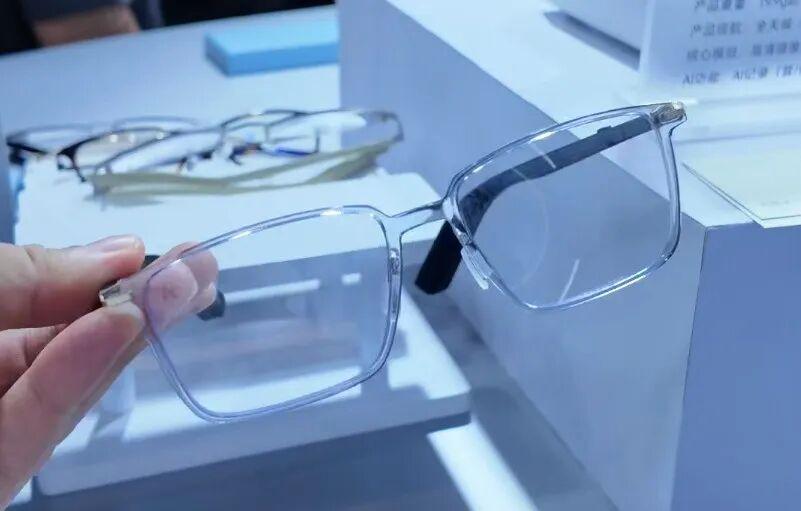
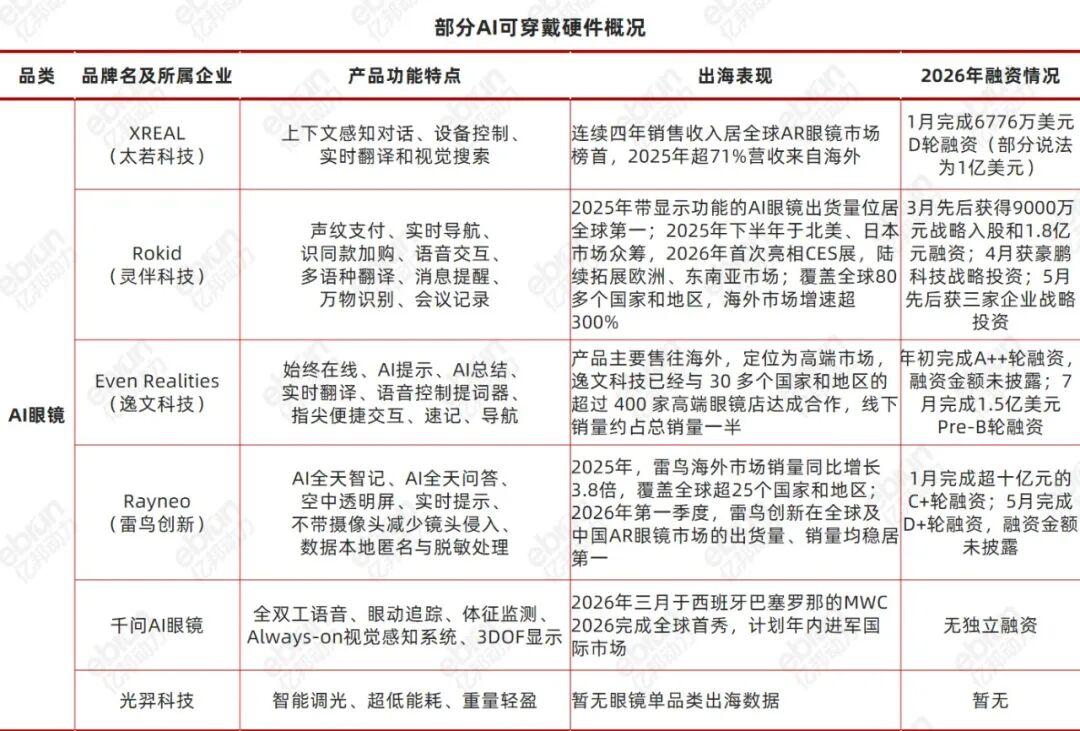
AI glasses have become a fiercely contested hotspot for tech companies and internet giants. This year, smart glass manufacturers including Rayneo, Even Realities, Rokid, XREAL, and Viture have launched a flurry of new products, competing on wearing comfort, battery life, and functionality. Rokid’s launch of the world’s first native operating system for smart glasses marks a shift beyond simply adding more features to products.
In addition to dedicated smart glass manufacturers, cross-sector players are also entering the market. iFLYTEK launched its first native Agent glasses, equipped with the Agent Glassclaw, which can break down tasks and call on services to complete work. Alibaba’s Tongyi Qianwen upgraded its already released AI glasses to Agent-enabled smart glasses, enhancing perception and interaction capabilities through eye-tracking and biometric monitoring technologies, and allowing on-demand access to third-party skills and Agents. XGIMI’s smart glasses raised millions of dollars in crowdfunding, as the company seeks to identify a second growth curve.
IDC data shows that the global smart glasses market grew 130.1% year-on-year in the first quarter of this year, and forecasts that Chinese smart glass shipments will account for 45% of the global market share in 2025. Players in this fast-growing track believe it is never too late to enter the market, with even latecomers aiming to capture a share of the growing market.
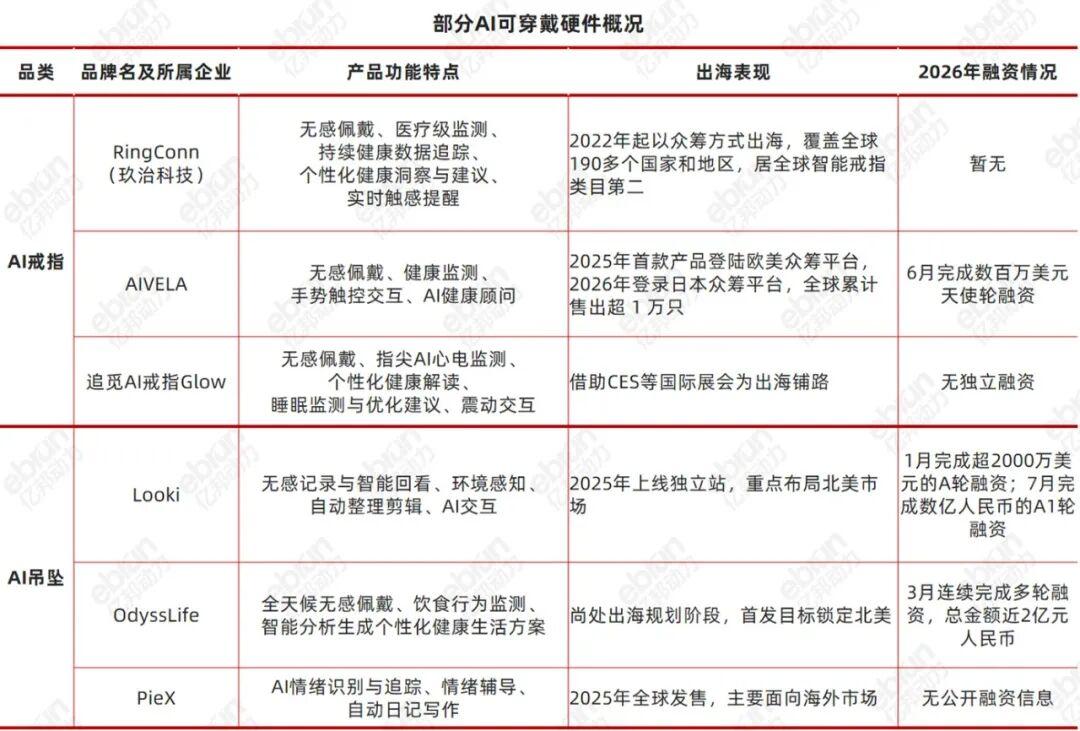
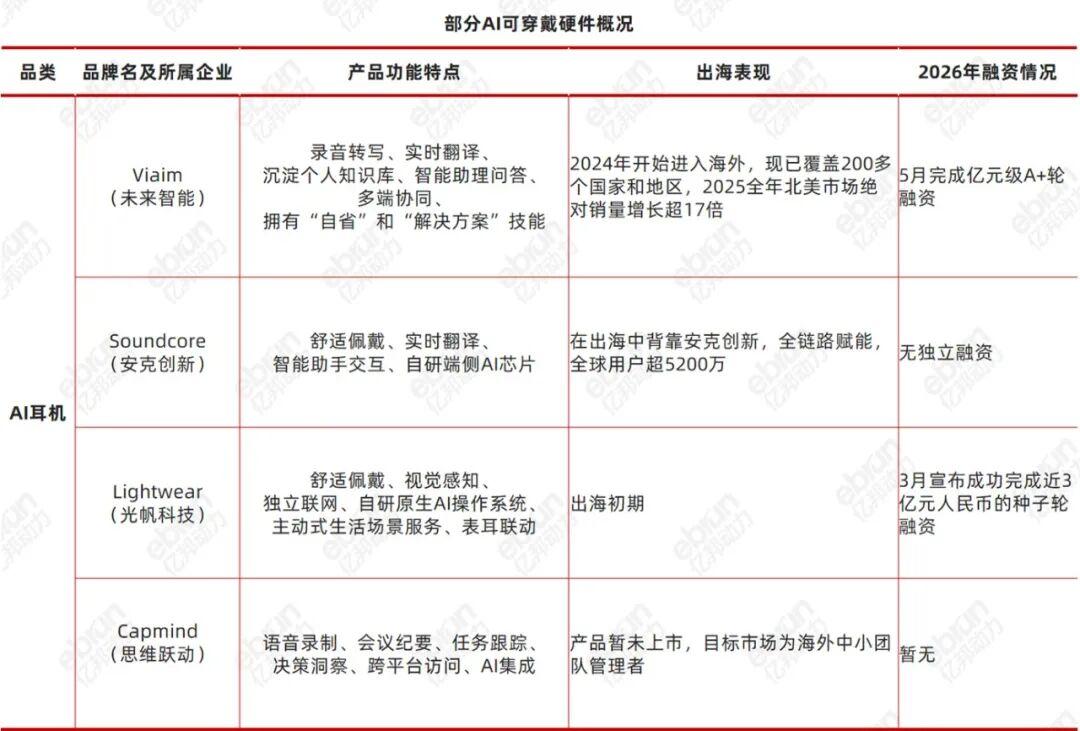
Turning to AI rings and AI earbuds, these devices have far more limited functional scope compared to glasses. Manufacturers must make trade-offs to deliver lightweight designs while maintaining battery life and intelligent capabilities. Nevertheless, brands such as RingConn, AIVELA, and Dreame’s Glow have managed to keep device weights within the 2-4 gram range, enabling unobtrusive all-day wear.
Among the Agent-enabled rings and earbuds already on the market, some brands have already established a foothold overseas, while a new cohort of players is just beginning their global expansion journeys. AIVELA’s ring can parse conversational context and comes with two built-in AI health advisors with distinct personalities. Lightwear’s earbuds feature an integrated camera, operating as independent hardware rather than a smartphone accessory without relying on a mobile ecosystem.
The AI pendant category is still in its early stages of development, but has attracted significant investor interest, with Looki and OdyssLife both raising funding rounds of over RMB 100 million. Unlike the aforementioned smart wearables, AI pendant brands have adopted highly differentiated functionalities to carve out market niches, with use cases including life video recording, diet and health management, and emotional wellness, suggesting opportunities for products focused on vertical scenarios. In industry conversations, Ebrun has also learned that wearables and health rehabilitation devices are widely regarded as the most promising application scenarios among current Agent-focused hardware categories.
2. Smart Companion Hardware: A Critical Year for Commercial Validation, Chinese Brands Catch Up
While humanoid robots are not yet ready for mainstream household adoption, compact, agile AI companion robots are already entering the market. The 2025 CES exhibition brought widespread attention to AI companion hardware, and this year is considered a critical year for the category to transition from concept demonstrations to commercial validation. Business Research Insights data shows that the global AI companion robot market is expected to reach $22.98 billion by 2026, growing at a CAGR of 25.68%. Japanese and American companies were the earliest pioneers in this market, but their high costs and price points have created opportunities for Chinese brands to gain market share. For example, KEYi TECH’s products have been sold to more than 150 countries and regions; Fudz Technology generates 70% of its revenue from overseas markets; and Luobo Intelligent made its overseas debut via a Japanese crowdfunding campaign in May, immediately topping the daily sales rankings.
Companion hardware comes in a wide variety of form factors, including hanging ornaments, plush toys, wheeled mobile devices, and desktop products. These devices emphasize not just functionality, but also emotional warmth, targeting diverse user groups including children, young people living alone, and even pets.
These products are continuously being upgraded. For example, following the success of its Loona pet robot, KEYi TECH launched the Loona Deskmate, which combines three functional roles: desktop charging, emotional companionship, and office assistant. It supports wake-word-free interaction, local data processing, and contextual perception, featuring AI Agent capabilities that give it a leading edge among peer brands.
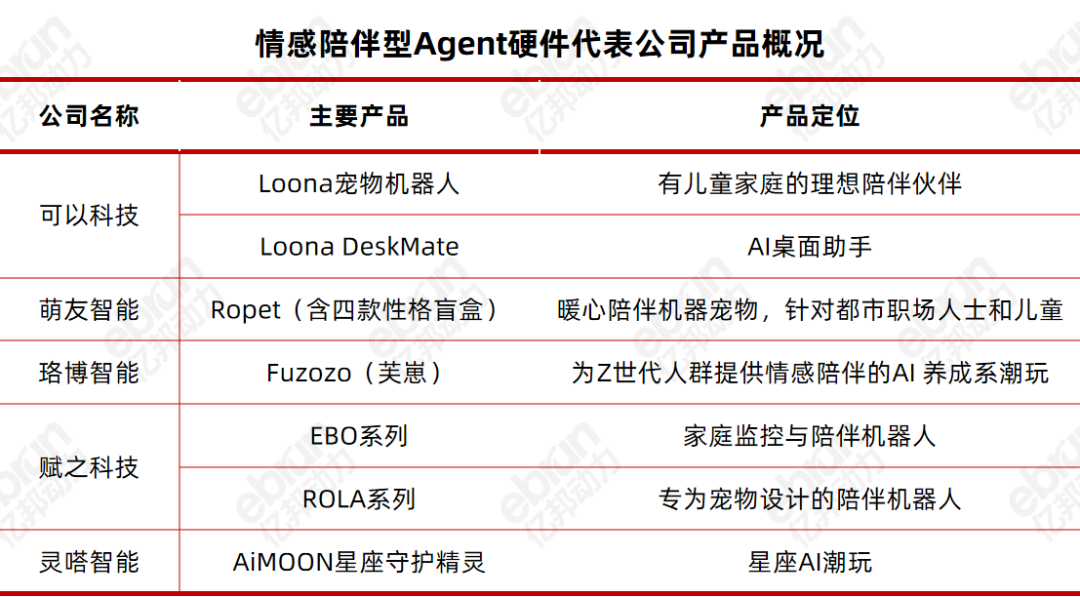
Click to view high-resolution image
3. Smart Office Hardware: Recording Products Lead Market Entry, Agent Computers Represent Long-Term Potential
While companion hardware delivers emotional value, office-focused hardware is designed to address efficiency challenges. Most AI glasses and earbuds include office functions, but are not tailored specifically for work scenarios. Another group of enterprises is developing products focused on work scenarios, starting with recording transcription, desktop control, and on-device computing capabilities, including both standalone devices and Agent frontends for computers.
AI recording hardware is currently the most mature category. Plaud has capitalized on its first-mover advantage with thin, lightweight, magnetically attachable recording devices integrated with large language models, achieving explosive growth in overseas markets in 2025. Following this success, major players have entered the market: DingTalk launched its first AI recording card last year, and Anker partnered with ByteDance to launch an AI recording device this year. The key competitive differentiator for these brands lies in the ability to understand and act on recorded content to create automated workflows.
To make products more attuned to user needs, tech companies are also creating dedicated environments for Agents that do not rely on traditional computers. These products, known as "Agent Computers," can operate continuously, run local large language models, and ensure local data security. Some companies have already made significant progress: Daiqu Technology’s AI desktop assistant, equipped with OpenClaw, processes various tasks directly on the user’s device, raising over RMB 1.5 million in overseas crowdfunding. However, market reception remains to be seen, as some products have passed early validation but have not yet been officially delivered. As such, Agent Computers are not expected to be the main driver of global expansion in the short term, but represent significant long-term potential. The category is attracting close attention from investors, with most players in early financing stages and participation from mainstream venture capital firms, industrial capital, government-backed funds, and internet company investors.
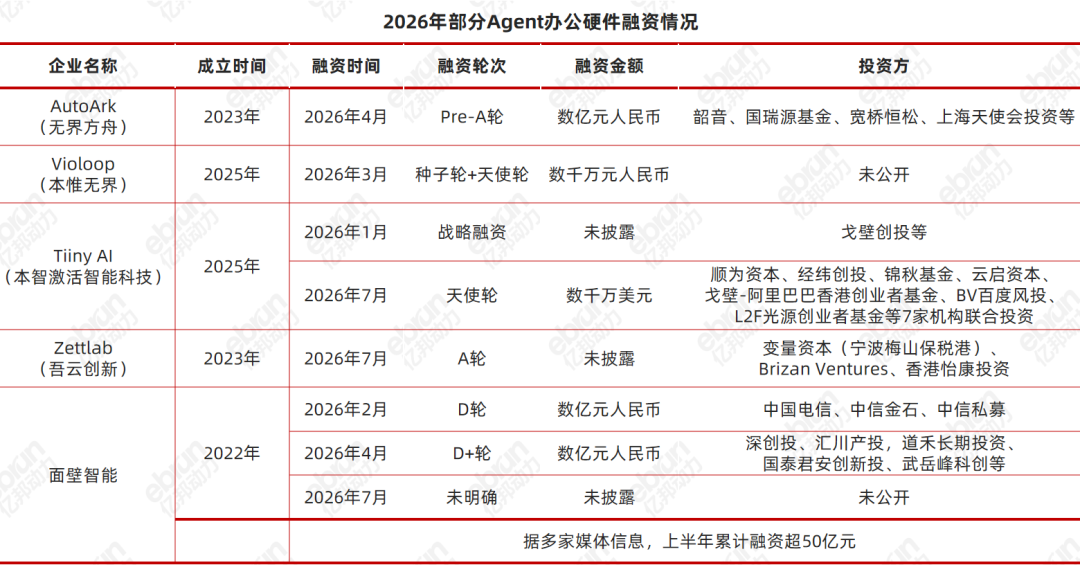
Click to view high-resolution image

What’s Driving the Emergence of Agent Hardware: Capabilities Meet Timing
The evolution from simple AI feature integration to the current pursuit of Agent or Agent-like capabilities across hardware markets, and the concentrated emergence of a new generation of hardware, is both an inevitable trend in product development and the result of maturing artificial intelligence technologies combined with China’s local industrial ecosystem advantages.
1. Smart Hardware Enters the "AI-Native" Stage
The development of smart hardware has moved past the standalone device era, where products operated independently with limited functionality, and is transitioning beyond the connected scenario era focused on limited environments such as smart homes—where connectivity relied on pre-set fixed commands without the ability to autonomously adjust based on perceived environmental changes. The industry is now moving toward AI-native intelligence, where on-device AI capabilities and end-cloud collaboration will be the core competitive differentiators.
There is a broad industry consensus around the need to imbue hardware with Agent attributes. Yang Jianbo, founder of KEYi TECH, shared his assessment of this trend: "AI should not be confined to screens. The traditional chatbot interaction method is not the most suitable form of AI interaction for ordinary people. We need AI to be more proactive and persistent."

On the consumer side, after experiencing Agent-powered software systems, users now expect hardware to be able to handle tasks stably and autonomously. Qin Ziang, founder of AI earbud brand Capmind, noted that people are not always in front of their computers when handling tasks, but want to interact with AI at all times and have AI understand them as fully as possible, making integrated software-hardware Agent systems particularly relevant today.
2. Technological Breakthroughs and Cost Reduction Create New Opportunities
The product design and commercialization phase has coincided with technological inflection points including the maturation of large language models, breakthroughs in on-device AI chips, and the adoption of the Model Context Protocol (MCP), facilitating software deployment on edge devices and enabling terminals to process tasks locally with fast response times. Falling computing costs have addressed the previous challenge of unaffordable AI implementation, while mass production of high-precision sensors that give hardware perception capabilities has further driven down costs. China holds a dominant position in hardware manufacturing, with accessible technology and reduced pricing creating opportunities for startups while keeping products within the budget range of average consumers. For example, in the highly competitive AI glasses market, overseas prices range from $200 to $800, with tiered pricing providing more choices for consumers.
3. Complete Industrial Ecosystem Boosts Innovation Efficiency
While supply chain cost advantages are no longer a standalone competitive edge for Chinese smart hardware expanding globally, the rapid response capabilities of the complete industrial chain help Chinese brands seize first-mover advantages. China not only has integrated software and hardware engineering capabilities, but different cities are also developing differentiated tracks based on their respective resources. Most of the aforementioned smart hardware brands are concentrated in the Yangtze River Delta, Pearl River Delta, and Beijing-Tianjin-Hebei regions, leveraging local artificial intelligence ecosystems, consumer electronics industries, talent, and scientific research resources.
According to the 2026 China Smart Hardware Industry Development Research Report published by 36Kr Research Institute, the industry has a clear division of labor: upstream players control core technologies, midstream players handle product design and manufacturing, and downstream players deliver value in application scenarios, creating full-chain efficiency advantages. In Shenzhen, the "one-kilometer" industrial chain can turn a design concept into a prototype in just one week, supporting the booming global expansion of AI hardware from Huaqiangbei.
4. Long-Term Accumulation Lays the Groundwork for Explosive Growth
As one of China’s "three new pillars" of foreign trade (alongside new energy vehicles and photovoltaic products), smart hardware exports showcase Chinese brands’ original technological capabilities and represent the innovation level of the country’s high-end manufacturing sector. The implementation of national strategies supporting artificial intelligence development has also created a favorable policy environment for this new wave of smart hardware global expansion. Long-accumulated industrial strength and a supportive policy environment explain the concentrated emergence of AI hardware products this year. "When you see results externally, there is a considerable long process that preceded it," observed Duan Yu, smart hardware investor and executive director of Guangyi Technology, noting the time lag between product development initiatives and market results. From another perspective, the current wave of industry activity may translate into more polished, mature Agent hardware products in two to three years, leading to a completely different global expansion landscape.
However, manufacturing advantages alone are not enough. Being able to build a product does not mean there is actual user demand. Smart hardware companies cannot focus purely on technical showmanship to create artificial demand, as consumers will reject such products. Even if gimmicks attract some users in the short term, they will be quickly abandoned, making sustained global revenue growth impossible. The failures of AI Pin and Rabbit R1 serve as a warning to smart hardware companies: products should not try to be all things to all people, and no matter how advanced the AI technology is, product design requires prioritization. R&D teams should identify existing needs rather than inventing new ones, so they can develop products that integrate naturally into specific scenarios for target consumer groups.
As a serial entrepreneur, Qin Ziang identified the challenges company managers face in tracking project execution progress from his own experience, leading him to target small and medium-sized team managers as the core users for his earbud product, which tracks meeting action items to improve decision-making efficiency for small teams. "Products need to integrate into users’ entire work process without changing their existing habits," Qin explained regarding his choice of the earbud form factor, which can capture audio, enable voice response interactions, and cover both online and offline meeting scenarios. He has avoided unilateral assumptions in product design, using target consumer research to inform adjustments and refinements.
Developing products that respect users’ existing habits is essential to driving high-frequency usage after purchase, building brand equity, and avoiding rapid obsolescence in the global expansion wave. For example, Agent wearable hardware is all based on product forms familiar to consumers, with a strong focus on wearing comfort. The same applies to Agent office hardware: Tiiny AI’s pocket supercomputing box is designed specifically for AI inference, with no pre-installed traditional operating system, and features simple one-click download and operation of mainstream open-source models and applications.

New Challenges for Agent Hardware After Global Expansion
For Chinese brands with numerous competitive advantages, participating in global competition is a natural next step, but brands from different backgrounds are adopting different strategies for entering overseas markets.
Highly innovative hardware startups with highly vertical products often launch first on U.S. or Japanese crowdfunding platforms, allowing them to test market demand and build a user base with limited resources, paving the way for subsequent sales through channels such as independent websites or Amazon.
Explaining the choice of the U.S., EU, and Japan as key global markets, Qin noted that U.S. consumers are already open to trying new products and willing to pay for innovation, while Japanese consumers’ preference for detail-oriented products aligns well with scenario-specific Agent hardware. Yang added that these markets have higher consumer price tolerance and benefit from the distribution leverage of the English-language content ecosystem.
Brands affiliated with tech or internet company ecosystems, by contrast, have access to existing channel resources and mature operational management capabilities, making it easier for them to enter overseas markets. For example, iFLYTEK’s AI glasses are entering overseas markets through partnerships with Chinese automakers expanding globally. However, these ecosystem-affiliated brands usually start in the domestic market first, while many startups are built for global markets from inception, with many choosing to launch and validate products globally first.
After entering international markets, brands must address the critical question of business models to ensure long-term survival. Some existing Agent hardware products, such as RingConn, Viaim, and AIVELA, market one-time hardware purchases as a selling point, while others, including Plaud and OdyssLife, offer AI subscription services. While there is no industry consensus on the optimal business model, one-time sales of AI accessories are a viable strategy, but for products positioned as Agent hardware, a combined model of hardware sales plus subscription services appears more favorable for extending product monetization cycles. Currently, however, hardware sales account for the majority of revenue.
Yang told Ebrun frankly about the current industry business model landscape: "There are no mature precedents for integrated software-hardware subscription models in the consumer robot category." However, he noted that subscription services have certain advantages. "Only a healthy commercial closed loop can better serve users," Qin shared. "This allows us to continuously develop new services to solve problems." Users also benefit from subscription models, as the hardware’s core value is fixed, and the viability of subscriptions depends on whether they deliver real value to users, "creating a positive growth flywheel between users and brands."
"Token usage has costs, and small companies cannot afford to offer services completely free," but larger companies can absorb these costs—for example, Google’s Fitbit Air uses a one-time hardware purchase model. Given this dynamic, Duan believes that voluntary subscriptions, mandatory subscriptions, and hardware-only sales models will continue to coexist.
In this wave of Agent hardware global expansion, different product categories face different competitive landscapes. Categories such as AI glasses and AI companion products, which entered the market earlier, already face significant homogenization competition. Overall, however, most Agent hardware categories are still in the early stages of development, with significant untapped opportunities. As a strategic high ground for future hardware development, both domestic and international players are still exploring the market.
In terms of competition between Chinese and foreign brands, "in some areas, European and American players need to learn from China," but over the long term, all current leading positions are temporary. As Qin noted, for Chinese brands to maintain competitive advantages, they need to continuously "engage directly with frontline users," "focus more and more narrowly on core use cases," and "continue to attract talent."
User insight is a frequently mentioned area for improvement. "North American and European teams generally do a better job of user insight than most domestic teams," Duan pointed out, a gap that Chinese brands need to work to close in the future.
KEYi TECH has concluded from its global expansion experience that new categories need to first build trust capital before pursuing scale. Yang told Ebrun that brands face numerous challenges when expanding globally, including category education and user recognition, as users may not clearly understand competitive concepts such as screen context awareness, and the gap between initial user "wow" and long-term trust takes time to bridge. "Hardware global expansion is not just about selling products—it’s about the ability to consistently deliver on promises," he said. Building official user communities, providing frequent over-the-air (OTA) updates, and delivering high-quality after-sales service are effective ways to retain users.
In industry conversations, data compliance and geopolitical risks are also consistently highlighted as key challenges for global expansion. This month, the EU’s AI Act entered into force, with multiple provisions governing general-purpose AI models and transparency requirements taking effect. For Agent hardware to achieve long-term success globally, companies must not only deliver strong products but also strictly comply with local regulations.
Ebrun will continue to track and report on these developments. For more information related to this article, please scan the QR code to follow the author’s WeChat.

This article was first published on the official Ebrun website.
[Copyright Notice] Ebrun advocates respecting and protecting intellectual property rights. Without permission, no one is allowed to copy, reproduce, or use the content of this website in any other way. If any copyright issues are found in the articles on this website, please provide copyright questions, identification, proof of copyright, contact information, etc. and send an email to run@ebrun.com. We will communicate and handle it in a timely manner.
Translated by AI. Feedback: run@ebrun.com