
From Global Sales to Omnichannel Operations: Anker Innovations’ Wu Zhuohui to Address the 2026 Brand Supply Chain Innovation Private Board Meeting
For Chinese brands expanding into global markets, successfully launching products in a single country or on a single platform is merely the first step of globalization.
As brands expand their footprint across more markets, running online marketplaces, official brand websites, and offline retail operations simultaneously, operational complexity rises in tandem: consumer demand, channel regulations, and delivery requirements vary across regions, yet inventory must remain mobile across a broader scope; while the front end needs to respond rapidly to market shifts, the back-end warehousing, fulfillment, and supply chain systems must also provide sufficiently stable support.
How to advance from "selling products globally" to "sustaining long-term operations worldwide" has emerged as a new challenge for Chinese brands going global.
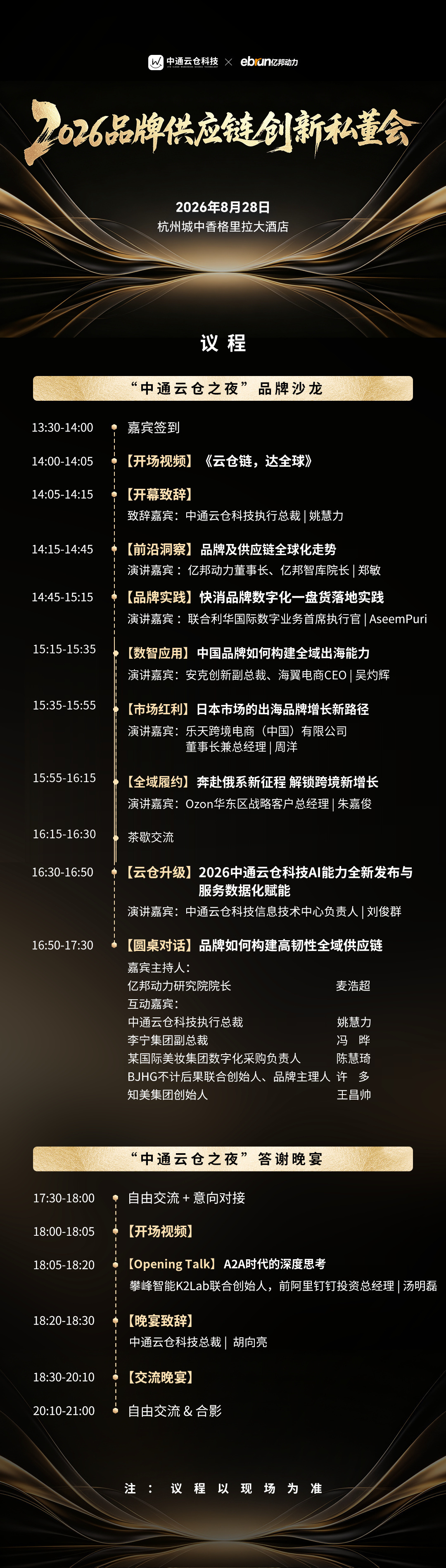
On August 28, the "2026 Brand Supply Chain Innovation Private Board Meeting & 'ZTO Cloud Warehouse Night' Appreciation Gala", co-hosted by Ebrun and ZTO Cloud Warehouse Technology, will take place at the Midtown Shangri-La Hotel in Hangzhou. Wu Zhuohui, Vice President of Anker Innovations and CEO of HAIYI E-Commerce, has confirmed his attendance and will deliver a keynote speech titled How Chinese Brands Can Build Omnichannel Global Expansion Capabilities at the event.
01
Behind Growth, Omnichannel Operations Are Becoming the Foundation of Brands’ Global Management
According to Anker Innovations’ recently released Q1 2026 financial report, the company posted operating revenue of RMB 7.608 billion for the period, representing a 26.93% year-on-year increase. Of this total, overseas revenue reached RMB 7.25 billion, accounting for 95.30% of total revenue.
A closer look at the revenue structure reveals an increasingly distinct diversification trend in Anker Innovations’ channel layout. During the reporting period, the company’s online channels generated RMB 5.142 billion in revenue, up 25.17% year-on-year; offline channels contributed RMB 2.465 billion, rising 30.79% year-on-year; and the company’s official website brought in RMB 814 million, growing 46.73% year-on-year.
These figures reflect not only expanding sales scale, but also shifts in brands’ global operation models.
From third-party e-commerce platforms to official brand websites, and from online sales to offline retail, the scenarios where brands connect with consumers are constantly expanding. The richer the channels, the more consumers enterprises can reach, but the relationships between products, inventory, orders, and fulfillment across different channels also become more complex.
As such, omnichannel layout is not simply a matter of adding more sales entry points. It requires brands to reorganize their products, marketing, inventory, and supply chains: they must preserve the operational characteristics of each channel while avoiding silos between different channels; they must stay close to local markets while maintaining consistency in brand, product, and service experiences across the globe.
Anker Innovations’ practices offer a valuable case study for Chinese brands looking to move from channel expansion to omnichannel operations.
02
From Market Entry to Market Operation: What Capabilities Are Required for Omnichannel Global Expansion?
In the past, discussions around brand global expansion often focused on product selection, traffic, and platform operations. But as business scales grow, the challenges brands face gradually shift from "how to enter a market" to "how to operate in a market over the long term."
On one hand, differences in consumption habits, channel structures, and market rhythms exist across countries and regions, requiring brands to build product and operational capabilities that are more aligned with local users. On the other hand, the parallel development of online marketplaces, independent websites, and offline channels also places higher demands on inventory allocation, order management, and fulfillment efficiency.
This means omnichannel global expansion cannot rely solely on breakthroughs in a single channel, nor can it simply replicate business models already proven in one market. Brands need to build a continuously adjustable business system that balances global perspective with local operations, and channel growth with operational efficiency.
In his upcoming speech, Wu Zhuohui will draw on Anker Innovations’ global operational practices to explain how the company views omnichannel and full-channel layout, and share insights on the core capabilities Chinese brands need to build as they move from product exports to brand globalization.
For brands currently expanding into overseas markets, the value of this sharing lies not only in learning about the operational results achieved by a global enterprise, but more importantly in understanding how products, channels, and operational systems support each other to deliver those results.
03
Global Brand Expansion Requires More Open Ecosystem Collaboration
It is extremely difficult for a single enterprise to achieve global brand operations independently.
As channels multiply and markets continue to expand, brands need to tackle more complex challenges around warehousing layout, inventory deployment, cross-regional fulfillment, and service coordination. Whether front-end market opportunities can be translated into stable growth depends largely on whether the back-end supply chain can respond in a timely manner.
This also means the relationship between brands and supply chain service providers needs to evolve. Supply chain service providers should not only complete warehousing and distribution after orders are generated, but also understand brands’ channel structures and operational rhythms to provide more flexible inventory and fulfillment support for different markets and channels.
Wu Zhuohui will also express Anker Innovations’ willingness to cooperate with more ecosystem partners at the event, and discuss the types of collaborative relationships that can be established between brand enterprises and supply chain partners such as ZTO Cloud Warehouse, based on the actual needs of brands’ omnichannel global expansion.
This collaboration is not just about connecting resources, but also about complementing capabilities: brands are closer to products, users, and the market, while supply chain service providers support business implementation through their warehouse networks, systems, and fulfillment services. Only when front-end operations and back-end supply chains form effective synergy can brands expand into more markets and channels while maintaining stable delivery capabilities and consumer experiences.
From the growth performance reflected in its financial reports, to the synchronized expansion of online and offline channels, to open cooperation with supply chain ecosystem partners, Anker Innovations’ omnichannel layout presents a clear path: brand globalization requires not only bringing products to more markets, but also building the channel, organizational, and supply chain systems that can support long-term operations.
On August 28, Wu Zhuohui, Vice President of Anker Innovations and CEO of HAIYI E-Commerce, will further share practices and insights on how Chinese brands can build omnichannel global expansion capabilities at the 2026 Brand Supply Chain Innovation Private Board Meeting.
This article was first published on the official Ebrun website.
[Copyright Notice] Ebrun advocates respecting and protecting intellectual property rights. Without permission, no one is allowed to copy, reproduce, or use the content of this website in any other way. If any copyright issues are found in the articles on this website, please provide copyright questions, identification, proof of copyright, contact information, etc. and send an email to run@ebrun.com. We will communicate and handle it in a timely manner.
Translated by AI. Feedback: run@ebrun.com