
Deep Dive into Lazada’s End-to-End Cross-Border Ecosystem: A Growth Playbook for Brands Entering Southeast Asia at Different Stages
【Ebrun Original】Over the past few years, a growing number of consumer brands have expanded into Southeast Asia.
According to the 2026 Southeast Asia E-Commerce Report released by Momentum Works, the region’s e-commerce transaction volume reached $157.6 billion in 2025, marking a 22.8% year-on-year increase and nearly a 3x rise from 2020 levels. The share of branded goods in this total has also been climbing.
As the market expands, the threshold for brand operations has risen accordingly.
After entering the market, brands quickly find their operational priorities expanding from store setup and order fulfillment to product selection, pricing, inventory management, marketing, and local consumer operations. There are also stark differences across Southeast Asia’s six major e-commerce markets. Varying customer bases, demand patterns, and fulfillment conditions across countries mean brands need to make separate upfront investments and regional adjustments.
As a result, Chinese brands entering Southeast Asia today have moved past the questions of “should we go?” and “can we sell there?” to considering how to enter, at what cost, and how deep to run operations.
This also means that brands at different stages face distinct challenges when expanding into Southeast Asia. For new entrants, the priority is to quickly identify which countries and products are worth investing in to gain an initial market foothold. For brands that have already completed a certain level of localized setup, the goals shift to expanding consumer reach, and improving the efficiency of product operations and brand localization.
Against this backdrop, Ebrun’s latest Super Brand Insight feature analyzes two brand cases – Mobi Garden and Chow Tai Fook – which are at different stages of their overseas expansion, to break down Southeast Asia growth strategies for Chinese brands ranging from low-risk market testing to deep local operations, providing a reference for brands at different stages to find a cross-border path suited to their own situation.
01
Mobi Garden: Low-Cost Entry to First Validate Market Viability
For Mobi Garden, the Southeast Asian market presents clear opportunities but has long been difficult to enter.
The 23-year-old outdoor brand has matured product lines for tents, hiking, and camping in China, as well as relatively complete brand and product assets. After entering Southeast Asia, Mobi Garden found that local consumers are generally younger, and hiking and camping are among the fast-growing outdoor segments, closely aligning with the core consumer group the brand aims to target.
Yet despite the obvious opportunities, getting started was far from simple.
Wu Han, head of Mobi Garden’s overseas channels, admitted that the real challenge of the Southeast Asian market is that almost everything has to be rebuilt from scratch. Every new market entry requires building a new local team, and it is hard to predict which products will fit the local market in advance. Differences in climate, usage scenarios, and price bands can turn initial product selection and stocking into crippling inventory pressure.
Through Lazada’s “One-Click Easy Cross-Border” program integrated with Tmall, Mobi Garden entered five markets at once: Singapore, Malaysia, Thailand, the Philippines, and Vietnam. Products, sales data, and reviews already validated on Tmall in China can be directly mirrored to local stores, with AI handling multi-language translation of product details. In addition, Lazada’s team operates the five country-specific stores, while Mobi Garden only needs to ship goods to a domestic warehouse in China. The platform takes over all subsequent cross-border logistics, customs clearance, delivery, and after-sales services.
“Lazada’s One-Click Easy Cross-Border allows us to bring our entire Tmall product portfolio to test, enter, and break into the Southeast Asian market at lower cost and higher efficiency,” Wu said.
The “testing” he mentioned became the most critical action in Mobi Garden’s current round of overseas expansion.
After launching in five markets simultaneously, the next step was to identify markets worth prioritizing for investment. The Lazada operations team first identified opportunities from data across the six Southeast Asian markets, then filtered them based on Mobi Garden’s product characteristics.
The Vietnamese market quickly caught Mobi Garden’s attention. In 2024, Vietnam’s outdoor equipment market was valued at around $5 billion, with over 80% of outdoor products relying on imports. Ho Chi Minh City and Hanoi are home to a large number of young consumers, and outdoor activities such as camping and hiking are attracting more and more new users. Mobi Garden’s product lines, ranging from tents and outdoor furniture to cooking gear, perfectly cover the core needs of these consumers.

In December 2025, Mobi Garden launched 372 SKUs on its Vietnam site. In its first month of operation, Vietnam became the largest of the five markets by sales volume. The brand then expanded its product lineup to include tailgate tents, four-season dome tents, inflatable mattresses and other items tailored to local demand. In May this year, Mobi Garden expanded its operations beyond Lazada’s ecosystem to TikTok, Facebook, and local communities, building product awareness in advance through local creators to further expand brand influence and product sales.
Lazada also began helping the brand access more local traffic and influencer resources at this stage. The platform screened Vietnamese KOLs and KOCs matching the outdoor and camping audience through its Affiliate Alliance, with commissions settled based on actual transaction volume, and directly linked influencer livestreams and short videos to products in Mobi Garden’s official Lazada store. During the D6 promotion period, GMV driven by off-site KOLs accounted for approximately 71% of Mobi Garden’s total GMV on the Vietnam site. In the 30 days ending June 8, 2026, search and recommendation contributed around 63% of the Vietnam site’s GMV.
Vietnam thus evolved from a test market to the first Southeast Asian market where Mobi Garden achieved product-market fit. Its monthly GMV once accounted for 60% of the brand’s total Lazada sales, and in the sixth month after entry, average daily GMV grew roughly 3.9 times from the month before the promotion. After the promotion ended, the store’s daily baseline sales increased by 69% compared to previous levels.
Mobi Garden has since begun replicating its Vietnam experience to Malaysia and Singapore. For the brand, which previously lacked local operational foundations in Southeast Asia, the value of the “One-Click Easy Cross-Border” program has gradually become clear throughout this process:
brands can first bring domestically validated products to multiple markets for testing, use real order data to judge which countries and products are worth further investment, and then gradually increase investment in local product testing, content marketing, and inventory once the direction is clear.
02
Chow Tai Fook: Deep Localization to Boost Operational Efficiency
As a globally renowned Chinese luxury group, Chow Tai Fook is in a vigorous phase of international expansion, further enhancing its global brand influence.
Southeast Asia, in particular, has a strong existing foundation for gold consumption. Gary Bau, General Manager of E-Commerce at Chow Tai Fook Jewellery Group, noted that many local consumers have a persistent habit of buying gold and trading in old jewelry for new, which is a key reason Chow Tai Fook has long been bullish on Southeast Asia.
Chow Tai Fook first began expanding into the Southeast Asian market 10 years ago. As of the end of June 2026, the brand operates more than 20 retail points in markets including Singapore, Malaysia, Thailand, and the Philippines. After entering local markets, Chow Tai Fook has always strived to inherit its nearly century-old brand heritage and exquisite craftsmanship, while resonating with overseas customers through designs aligned with contemporary aesthetics. For example, the brand has transformed traditional Chinese cultural elements such as the Baoxiang flower and Fulug drum into minimalist, modern design patterns to convey Chinese culture to overseas customers. In different markets, Chow Tai Fook also integrates more local elements into product design and store displays based on local cultural characteristics and consumer preferences.
To get closer to young consumers, Chow Tai Fook continues to explore youth-oriented, digital brand communication methods. This year, the brand partnered with the popular Southeast Asian mobile game Mobile Legends: Bang Bang (MLBB) to reimagine in-game characters and props as gold jewelry products, connecting gaming culture and jewelry culture through innovative design. The first round of promotion generated over 3.5 billion impressions, demonstrating the brand’s ability to continuously refresh its image and expand cultural resonance through cross-border collaborations.
While physical stores address the issue of brand localization, reaching a broader consumer base requires coordinated multi-channel development. Bau noted that around 88% of jewelry transactions still take place offline, but only about 12% of these offline purchases have no online touchpoints at all. Consumers may first see a product on social media, search and compare options online, then visit a physical store to complete the purchase. For Chow Tai Fook, online channels have become an important entry point for local consumers to learn about the brand and access its products.
“Online operations are extremely important if a brand wants to achieve rapid growth in a market,” Bau said. Even if stores are concentrated in capital cities or major urban centers, online channels can extend the brand’s reach to the entire country. In his view, online channels serve both sales and brand promotion functions, complementing offline stores.
At this stage, the platform capabilities Chow Tai Fook needs are different from those required by brands just entering Southeast Asia. It already has local entities, stores, and merchandise, so its next priorities are identifying which products are worth promoting, how to reach more consumers, and how to make its existing local operations more efficient.
One of the segments Bau values most is product selection. “Consumer demand and spending habits vary greatly across markets.” For jewelry in particular, the cost of recalling and reallocating goods after they enter overseas markets is high, so it is critical to improve the accuracy of demand forecasting before stocking.

In its partnership with Lazada, platform data is primarily used to identify core product portfolios, high-potential price bands and categories, as well as to inform new product decisions. Bau noted that Lazada’s data analysis also helps Chow Tai Fook “develop new products and decide how to launch our offerings. Once goods are shipped, adjustments are not easy, so data accuracy is extremely important.”
In addition, Chow Tai Fook combines on-site exposure, Coins channel placements, Affiliate influencer alliance resources, and CPS campaigns for different products and promotions, paired with off-site social media promotion. During new product launches or platform events, the two parties also co-invest through channel subsidies, coupons and other initiatives, integrating the platform’s data, traffic and marketing resources into the brand’s existing local operating system.
As of August 13, 2026, Chow Tai Fook has delivered strong performance in the Southeast Asian market, with significant growth in sales, brand exposure and consumer search interest. In Malaysia, Chow Tai Fook ranked first in the jewelry category during Lazada’s platform events in both July and August. Comparing the August and June platform events, sales doubled from June levels, demonstrating strong market influence and consumer recognition.
For Chow Tai Fook, which already has a foundation of stores, local entities and supply chains, further growth requires extending operations to every touchpoint where consumers interact with the brand in their daily lives. Questions including which products are more suitable for the local market, which price bands offer greater opportunities, how new products can find their first batch of consumers, and how limited store networks can cover a larger market, all require more granular local data and online reach capabilities. Lazada’s role has thus evolved from helping brands enter the market to supporting product operations, consumer reach and brand localization, helping brands operate their existing resources more efficiently in local markets.
03
From Market Entry to Deep Market Penetration
The cases of Mobi Garden and Chow Tai Fook actually correspond to two typical states of Chinese brands entering Southeast Asia.
For new entrant Mobi Garden, the first step was to minimize upfront investment and first identify which countries are viable and which products sell well. For Chow Tai Fook, which already has local entities, stores and supply chain foundations, the operational priority has shifted to product selection, expanding consumer reach, and deepening the brand’s local presence.
Data released by Cube Asia shows that the share of sales from brand-authorized online stores in Southeast Asia’s e-commerce market has risen from 12% in 2020 to 30% in 2025, and is expected to reach 55% by 2030. The continued growth of branded consumption means Chinese brands have access to more market opportunities, while understanding of local consumers and operational efficiency will become even more important.
This also makes merchant investments more targeted than in the past. Before product-market fit is achieved, brands can reduce heavy investment in teams and inventory, use real order data to identify direction, and increase investment in local teams, stocking, marketing and brand building once the business stabilizes.
The three operating models currently offered by Lazada largely correspond to these different stages. “One-Click Easy Cross-Border” is more suitable for early-stage market testing and validation, and Mobi Garden is a representative merchant for this model. Chow Tai Fook represents local stores on Lazada, which already have local entities, qualifications and inventory, but need Lazada’s localized capabilities and insights to help them further establish roots. Lazada also supports a cross-border store model, suitable for merchants registered in China that want to directly reach Southeast Asian consumers. For example, multiple merchants in the new energy category, which has seen surging sales in Southeast Asia recently, entered Lazada through cross-border stores. Since the end of last year, sales for merchants in this category have grown more than 6 times.
Lazada Group President and Singapore CEO Jing Qian summed up the value of this system as “providing the most suitable growth path for brands at different stages”. In her view, there are differences in consumer preferences and operating environments across Southeast Asian countries, and the deeper a brand goes into local operations, the higher the corresponding management complexity. The platform’s role is to handle more of this complex work in the backend, allowing brands to retain operational flexibility.
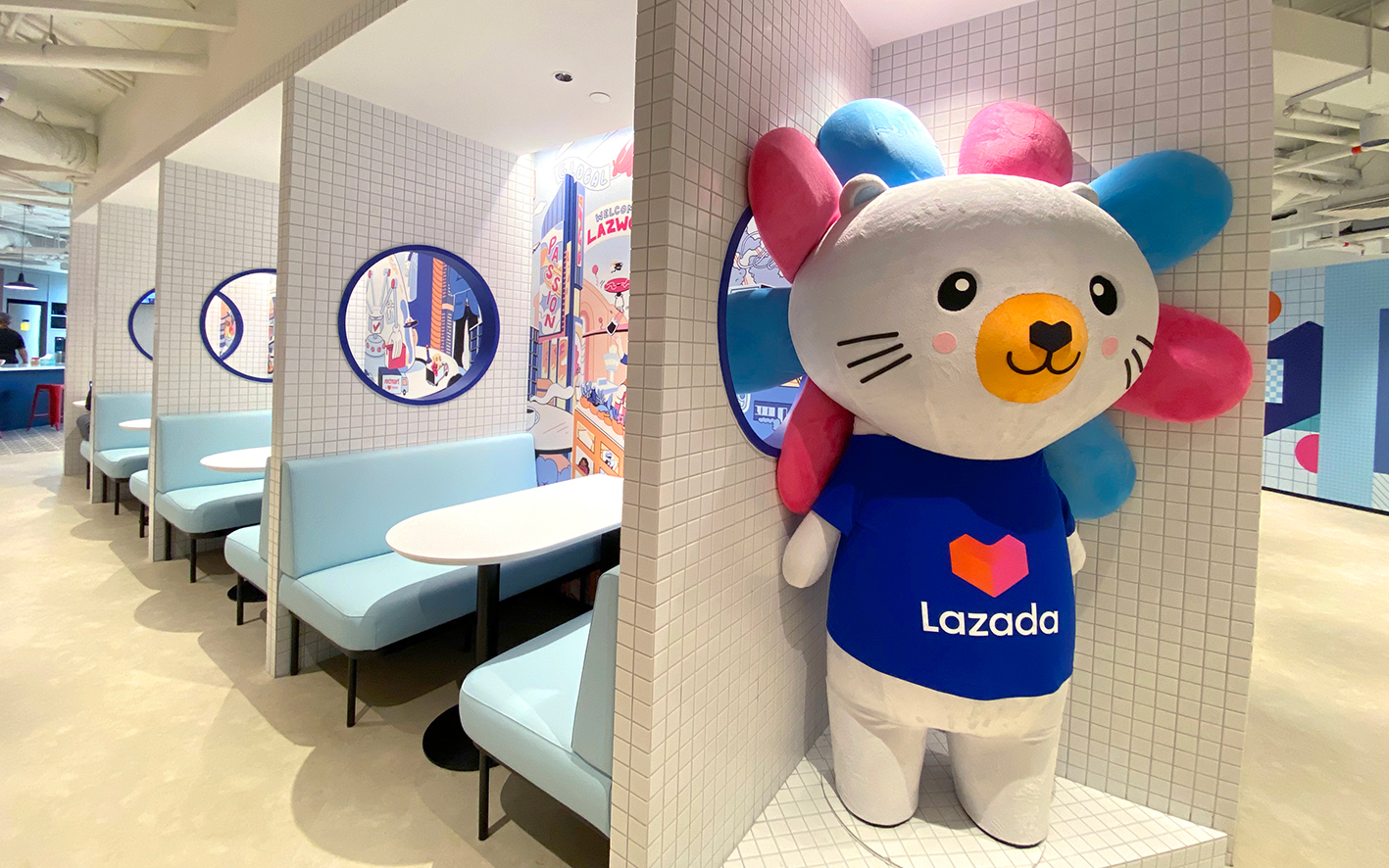 Lazada Singapore Office
This does not mean brands must follow a sequential progression of “One-Click Easy Cross-Border → Cross-Border Store → Local Store”. Qian noted that while the three models have a progressive relationship, leaps between them are also possible. Brands with mature operational capabilities and familiarity with digital tools can directly enter deeper operating stages, while brands just starting to test overseas markets can first use lighter models to identify suitable products and audiences before deciding on subsequent investments.
She revealed that AI and big data will be further integrated into links including product selection, pricing, marketing and customer service in the future. According to the platform’s vision, some overseas operations may even be completed in the future by a small number of the brand’s domestic operators working in tandem with the platform’s local teams, with a large volume of standardized work in between handled by AI.
These capabilities are also tied to Lazada’s brand-focused direction in recent years. Qian noted that the platform is more focused on penetration rate, repurchase rate and consumer experience among brands’ core users, and aims to serve quality consumers and brand merchants. As branded consumption continues to grow in Southeast Asia, cooperation between the platform and brands will also gradually expand from facilitating individual transactions to user operations and long-term brand growth.
Ebrun will continue to track and report on this sector. If you would like to learn more information related to this article, please scan the QR code to follow the author’s WeChat account.

[Copyright Notice] Ebrun advocates respecting and protecting intellectual property rights. Without permission, no one is allowed to copy, reproduce, or use the content of this website in any other way. If any copyright issues are found in the articles on this website, please provide copyright questions, identification, proof of copyright, contact information, etc. and send an email to run@ebrun.com. We will communicate and handle it in a timely manner.
Translated by AI. Feedback: run@ebrun.com