
A New Generation of Chinese Domestic Brands Are Redefining Their Global Positioning

By Li Mengqi | Edited by He Yang
[Ebrun Original] A cohort of young consumer brands that grew out of China’s domestic social media and content platforms are expanding overseas at an accelerating pace.
Last fall, Songmont brought its "Far Mountain Resonance" exhibition to Paris. In a two-story venue in central Paris, a rock installation inspired by Song Dynasty painter Fan Kuan’s *Travelers Among Mountains and Streams* spanned both floors, accompanied by the chiming of traditional Chinese bells. The space integrated ancient Central Chinese architecture, landscape painting, and traditional handicrafts, alongside the brand’s latest bag collections. The fashion brand, which opened its first domestic store only in 2021, has gradually built global recognition since. This year, leading fashion industry publication *Business of Fashion* listed it as one of the Chinese fashion brands with rising international visibility and popularity.
Around the same time last year, fragrance brand To Summer opened its first store outside the Chinese mainland in Hong Kong’s Causeway Bay. In March this year, footwear brand PANE, founded in 2022, announced its official entry into the Japanese market, selling through physical stores and online channels under Japanese retail group UNITED ARROWS.
These new consumer brands, or internet-native brands, have typically excelled at connecting with consumers via content in their home market. Take Songmont for example: its founder Fu Song first shared daily stories and insights about bag design on Xiaohongshu (Little Red Book) in the brand’s early days, before buyer-influencers led by actress Dong Jie introduced the brand to a wider audience. Rejecting traditional marketing playbooks, they adopted a DTC (direct-to-consumer) model, defining their aesthetic identity and target audience early on through product design, visual identity, storytelling, and lifestyle curation, while continuously refining their products and brand messaging based on consumer feedback.
Now, as they expand their horizons to overseas markets, they are offering a new set of case studies for Chinese brands going global.
There is no one-size-fits-all playbook for this exploration yet. Brands at different stages vary in terms of resource allocation, target market selection, and core hypotheses they aim to validate. The most obvious commonality lies in their timing. "Going global," or globalization, is built into their strategy from the early stages of development. Unlike traditional legacy brands that only seek overseas growth after their domestic market matures or hits a ceiling, these new players often launch their first overseas forays even before their domestic operations are fully scaled.
Content-driven distribution makes it easier for them to be discovered by overseas consumers across borders, while their agile, young brand structure means they face fewer constraints from legacy channel and operational systems. Having operated in a highly mature, even hyper-competitive domestic market from inception, they also hold a distinct understanding of the value proposition of overseas markets.
However, there is still a long gap between "being discovered by overseas consumers" and successfully building and operating a sustainable brand abroad. Channel structures, pricing systems, category logics, and cultural contexts all differ, meaning proven domestic strategies cannot simply be replicated wholesale. Recognizing overseas opportunities earlier also means confronting these challenges sooner.

Going Global, "Forced" to Advance Timeline
The last generation of Chinese consumer brands typically took a far slower approach to international expansion. Take Li-Ning, for example: founded in 1990, it built a nationwide retail network by 1997, and opened its first overseas flagship store in Spain in 2001 – 11 years after the brand’s launch. The standard model was to first scale domestically, refine supply chains and channel systems, then expand internationally.
Today’s young consumer brands are moving at a very different pace. The most notable shift is that overseas consumers often find the brand long before the company formally plans its international expansion.
Domestic designer homeware brand OKENSHO is a prime example. Founded just three to four years ago, it has had clear content-native traits from its domestic launch. In 2023, OKENSHO accumulated its first batch of users and completed its cold start via a Xiaohongshu livestream, relying on renderings of its debut hit product, the Camellia Sofa.
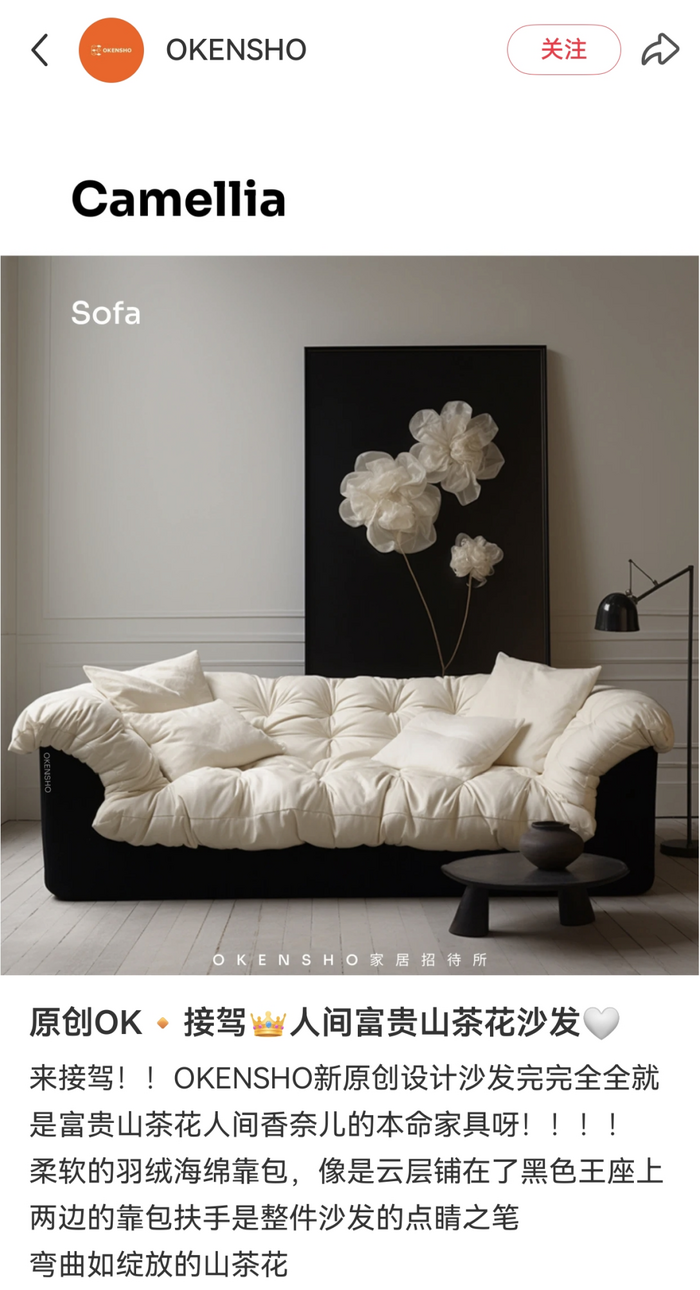
Image source: OKENSHO Camellia Sofa
This content-driven approach to finding consumers unexpectedly introduced the brand to far-flung markets. Founder Lance told Ebrun that even in the brand’s earliest days, a group of overseas consumers learned about them via social media, placed orders on domestic e-commerce platforms including Xiaohongshu and Tmall, and covered international shipping and forwarding costs themselves to have the products delivered abroad. At that point, OKENSHO had not even considered entering overseas markets – content had already crossed borders ahead of formal channel expansion.
Sporadic but consistent overseas orders forced the brand to confront questions: Where are these consumers coming from? Why are they willing to pay extra costs to purchase our products? How can we better serve their needs? As a result, accelerating overseas expansion moved up the company’s priority list, rather than being an option reserved for after domestic scale was achieved.
Over the past few years, overseas content discovery and social commerce infrastructure has rapidly closed the gap with China’s. For example, Instagram’s influencer collaboration and brand content ecosystem is already highly mature, while platforms including YouTube, Pinterest, and TikTok have all closed the loop from content to transaction. Domestic content communities led by Xiaohongshu are also expanding their global reach.
For new consumer brands accustomed to finding users via content, this means they can easily leverage familiar operating models similar to their domestic experience when entering overseas markets: first build awareness through brand content, and reach target consumers early.
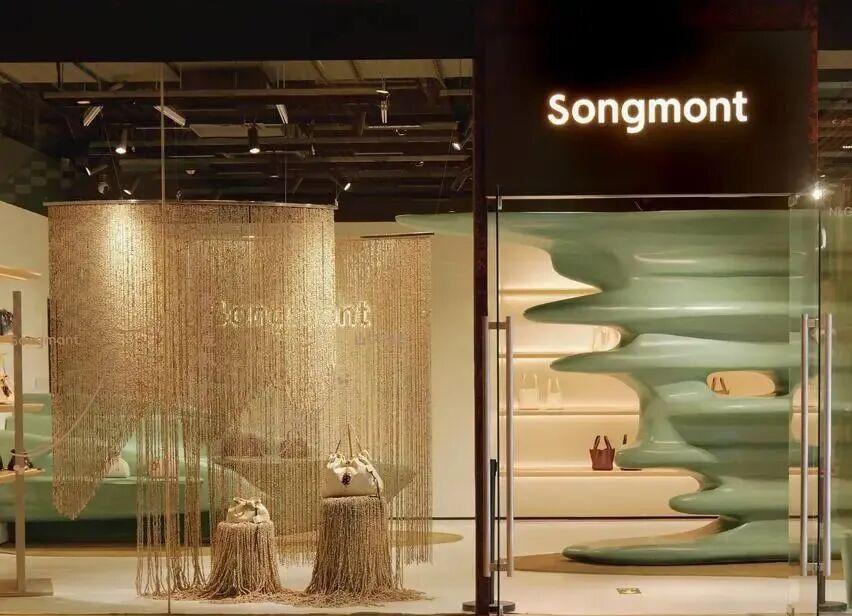
For example, while Songmont still has limited overseas sales channel coverage, its main Instagram account has already amassed over 600,000 followers. Before PANE formally launched its overseas business, it already had a fan base in Japan, Thailand, and the U.S., with some overseas consumers even making special trips to China’s physical stores to purchase its products after seeing them on social media.
Another shift comes from the brands’ own internal calculus. "Domestic consumers are increasingly sophisticated when evaluating products, prices, and brands," Lance noted. To achieve growth, brands need to make more precise choices around pricing, target audience, and product mix. For content-native brands, he said, the target consumer group and price tier are usually defined in the early stages, and become increasingly difficult to adjust as the market matures.
Lance pointed out that China is far from a saturated market, but the designer homeware segment OKENSHO operates in already has a relatively fixed pricing system. Staying within that price band leaves the brand with very limited premium and profit margins. It is difficult to solve this problem by focusing solely on the domestic market, so the pace of overseas expansion must be accelerated.
One of OKENSHO’s core goals for entering overseas markets is to rediscover the value proposition of its products. "Overseas markets offer not just new customers, but a value coordinate system different from China’s existing pricing structure, allowing brands to re-evaluate how their design, materials, and product differentiation are priced and recognized," Lance explained.
For the previous generation of Chinese companies that expanded globally based on manufacturing advantages, price and efficiency were the easiest strengths to build quickly. However, today’s content-native brands have already built capabilities in product definition, original design, content operation, and user management in their home market. When they go overseas, they do not necessarily need to follow the traditional route of large-scale distribution, channel expansion, and cost competition. This means they do not have to scale up first and cut costs to win market share, but instead have the opportunity to target consumers directly through product differentiation and brand value.
"The timing of going global is not only determined by domestic business scale, but more importantly by whether the company has developed replicable capabilities," said Wu Huaiqin, founder of home care brand Yuanben Life.
Founded at the end of 2020, Yuanben Life began exploring overseas markets in 2025, at a time when its domestic business was still in a rapid growth phase, with consecutive revenue growth, profitability, and offline presence in nearly 20,000 stores. For Wu, there is no need for the brand to wait until domestic operations are fully mature to launch globalization efforts. Once product, supply chain, brand, and organizational capabilities take shape, the company can test overseas markets with small-scale investments first.
At the same time, the path for domestic brands to validate overseas markets is shortening. Beyond content, tools including crowdfunding, pre-sales, and independent stores allow brands to put a small number of products in front of real consumers before building a complete overseas channel and operational system.
Take audio brand MORROR ART as an example. Four years after its founding, when it completed Series B funding, its domestic product portfolio was still expanding, and it began testing overseas markets in 2025. While its overseas operational system was still being built, it used Kickstarter as a key market testing ground, raising over $1 million in 30 days on the platform. Founder Zhang Jian said this kind of feedback allowed the team to directly validate whether Chinese original design could resonate with overseas consumers, even without an existing channel or user base.

Same Goal, Different Paths
OKENSHO chose the U.S. as its first overseas market, a decision that did not require complex market screening. Lance and core members of his team previously lived in the U.S., so they are relatively familiar with local consumers and the market environment. He revealed that OKENSHO is currently building its independent DTC site, aiming to launch in time for the year-end holiday season. On the product side, the team does not plan to launch its full furniture line overseas at once, but will first enter with small and medium-sized SKUs such as side tables and dining chairs, then gradually expand its product offering based on feedback.
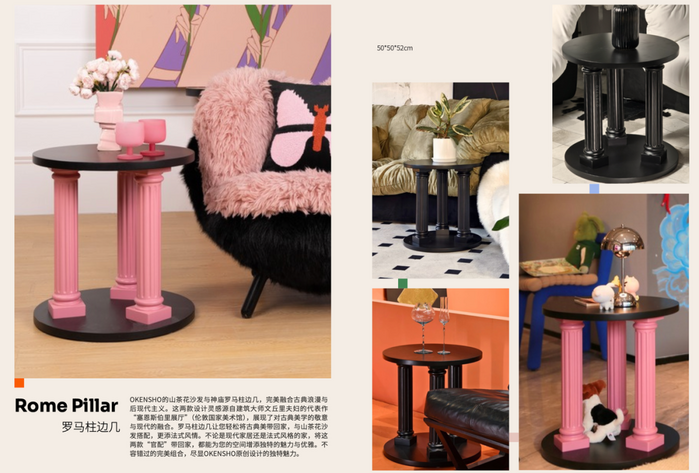
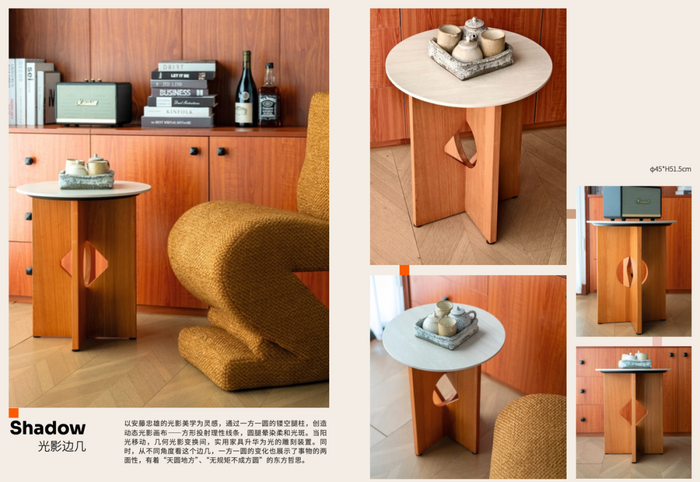
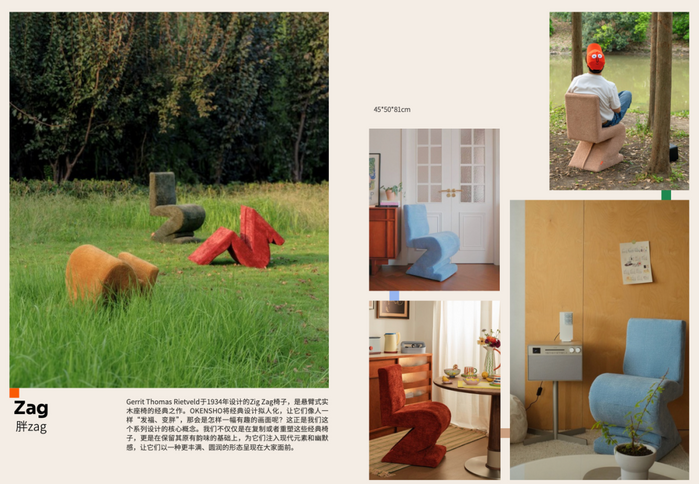
Image source: OKENSHO small furniture products
There are practical considerations behind this strategy. Compared to its core sofa category, dining chairs and side tables have more manageable shipping and after-sales processes, making it easier to quickly gauge consumer response. Lance added that U.S. consumers prefer larger sizes for these products, and have higher acceptance of items with stronger material textures and more distinct characteristics.
Beyond product adaptation, the team also needs to build a new set of channel capabilities. "An independent site is just a touchpoint," Lance said. OKENSHO will continue to expand its reach through brand content and influencer collaborations on social media, but the team is currently prioritizing local channel construction, aiming to enter established local channel networks through partnerships and wholesale supply.
In his view, this channel strategy is very different from the domestic playbook. China’s e-commerce platforms have relatively concentrated consumer journeys, where discovery, demand evaluation, and transaction conversion can all be completed within mature platform ecosystems. In the U.S., this journey is fragmented across different channels: independent sites can handle transactions, but struggle to drive customer acquisition and consumer education.
Meanwhile, furniture is a relatively unique category: size, material, and spatial fit all influence consumer decisions, and the bulkiness of products drives high logistics and after-sales costs. As a result, offline channels take higher priority for OKENSHO. Lance said the brand plans to allocate part of its inventory to local galleries, buy-in stores, and distributors in the U.S., allowing consumers to see and experience products in person through their existing offline networks.
Fellow designer homeware brand Grado has gone even further down this path. The company’s overseas business has long entered local markets via distributors, design channels, and commercial projects. Local partners not only handle sales, but also help the brand integrate into familiar home retail and interior design scenarios for local consumers.
On the online front, OKENSHO has chosen to first build an independent site rather than leverage traffic from local e-commerce platforms. Lance explained that OKENSHO’s products are relatively non-standard, while mature shelf e-commerce platforms are designed for standardized product presentation and comparison, where consumers tend to make decisions based primarily on price and functionality. "It’s very difficult for designer furniture to build sufficient premium in that environment." Since OKENSHO’s core goal for entering overseas markets is to rediscover the value space for design products, entering a transaction system dominated by standardized comparison would defeat that purpose.
OKENSHO’s strategy is also shaped by category characteristics: furniture is experience-heavy, logistics-heavy, and has low repurchase rates. For more standardized consumer goods that are easier to sell online, the overseas expansion path looks completely different.
Yuanben Life began systematically exploring overseas markets in mid-2025. Prior to that, the brand had already received scattered overseas orders and had relatively stable brand agency clients in South America, with actual sales already established in Chile and Uruguay, and its full product line available in the market with Spanish-language packaging.

Image source: Yuanben Life’s overseas market products
Wu Huaiqin said that after working with South American clients, the company found that while consumers in different countries have different cultural backgrounds, purchase channels, and consumption habits, their basic demand for home care products is not as different as expected. This led the company to consider whether its domestic product, supply chain, and even content capabilities could be directly replicated overseas.
Social media platforms led by TikTok have therefore become potential entry points for the brand. Wu noted that content showing cleaning efficacy, stain removal, and before-and-after use comparisons are inherently easy for all consumers to understand, and the short-video production capabilities the brand has accumulated domestically can be quickly adapted for overseas markets.
Interestingly, Yuanben Life does not frame its overseas business as purely DTC for its own brand.
Trade shows, industry platforms, and local partners are also part of its overseas strategy. Through these channels, the brand can find distributors and retail clients, as well as take on ODM and OEM orders.
Per Wu’s current plan, B2B business can help the company enter local markets faster and build cash flow, while ODM business leverages its existing product R&D and supply chain capabilities. On this basis, the proprietary brand will gradually build consumer awareness and long-term brand equity using its content capabilities. Yuanben Life aims to build an overseas structure where multiple business lines support each other, rather than relying solely on a consumer brand to break into the market from scratch.

Beyond Product Exports: What Do Brands Lack?
As international expansion is integrated into brand growth at an earlier stage, questions that used to be considered only after a brand matures are now being addressed much earlier.
Bathcare brand Bathfeel, founded 11 years ago, has not yet formally launched its overseas business, but for the company, globalization is not an issue that only needs to be considered when it actually goes abroad. According to a brand representative, an important characteristic of a "brand" in the current era is that it should be positioned for the global market from inception. "It shouldn’t be a Shanghai brand or a Changsha brand – it should be designed for the global market from the start, with a language system, product system, and cultural system aligned with a global perspective," the representative said.
This view has directly shaped Bathfeel’s brand value positioning. The brand has long used "The body is the self, the body is freedom" as its core brand concept. The representative noted that while this idea can be traced back to the Chinese cultural concept of "unity of body and mind," the concepts of body, self, and "body and mind" have a low cultural understanding threshold globally. "Brand value must be universal and understandable across markets worldwide."
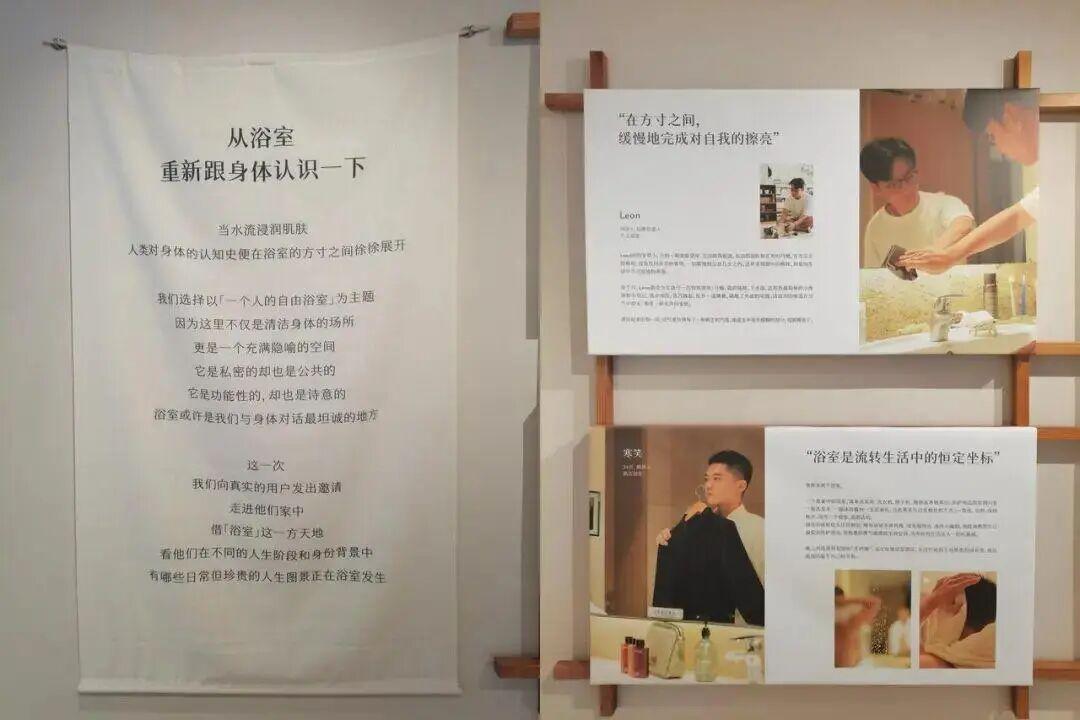
For Bathfeel, this means cultural globalization does not require transplanting specific Chinese cultural symbols directly to overseas markets. More importantly, brands should extract values from their own culture that can be understood by different markets, then re-express them in language familiar to local consumers.
But the reality of entering overseas markets is far more complex. "Consumer sentiment is not as naturally universal as topics like the body and self. Sentiment is a product of specific social environments, with regional and temporal differences," the representative pointed out. When entering a new market, brands need to re-understand the local consumers’ living conditions, their purchase motivations, and the emotional value they seek beyond product functionality.
This is a key pain point for many brands in the process of going global: how to retain the brand’s existing identity and DNA while finding messaging that resonates with the local context.
Yuanben Life’s preliminary answer to this question is: "The underlying value cannot change, but the expression can be adapted." According to Wu Huaiqin, the brand’s reason for existing, its product advantages, and its core value should not be rewritten for different markets. On the other hand, packaging, language, content, visual identity, and communication methods can be adjusted to suit local consumers. "The brand core remains consistent, but the messaging that consumers directly receive needs to be localized," he said.
For OKENSHO, design is the core capability the brand aims to retain and amplify in overseas markets. Lance believes that whether a product meets current consumer needs ultimately determines whether content and products gain traction. Design differentiation requires brands to re-evaluate for their target market which elements align with local consumers’ aesthetic preferences.
These considerations are driving a subtle shift in the definition of "brand globalization" among merchants. In the view of Bathfeel’s representative, Chinese companies have already proven their supply chain and manufacturing capabilities, but for the new generation of brands, simply selling a high-quality product globally is not enough to build long-term brand value. A brand needs to create three layers of value simultaneously: functional value, which explains why the product is worth buying; emotional value, which builds a deeper relationship between consumers and the brand; and cultural value, which defines the aesthetic and lifestyle the brand ultimately represents.
"If you only sell a product, it can be easily replicated," the representative added. What brands really need to answer is what new value they can create for global consumers beyond the product itself.
For this cohort of young brands that are considering overseas markets earlier in their lifecycle, this is clearly a longer-term goal. "Judging by the real standard of brand globalization, Yuanben Life is currently in the transition phase from ‘product export’ to ‘brand entry into overseas markets,’" Wu Huaiqin said.
Bathfeel’s representative also acknowledged that Chinese brands still have a large gap compared to mature international brands. "The core gap is organizational capability," she said. A truly international brand does not just send a separate overseas team to operate abroad, but requires internal teams including product, brand, supply chain, and marketing to gradually build the capacity to serve different markets.
Another gap that cannot be bridged quickly is time. Brand awareness, reputation, and trust all require long-term accumulation. These assets cannot be built quickly with one or two years of overseas investment.
This understanding creates an interesting contrast with the current reality: global markets can be integrated into a brand’s development plan earlier, but becoming a truly global brand still seems to be a process that requires time to build.
Ebrun will continue to track and report on this trend. For more information related to this article, scan the QR code to follow the author’s WeChat account.

This article was first published on the official Ebrun website.
[Copyright Notice] Ebrun advocates respecting and protecting intellectual property rights. Without permission, no one is allowed to copy, reproduce, or use the content of this website in any other way. If any copyright issues are found in the articles on this website, please provide copyright questions, identification, proof of copyright, contact information, etc. and send an email to run@ebrun.com. We will communicate and handle it in a timely manner.
Translated by AI. Feedback: run@ebrun.com