
Alibaba Posts RMB 268.9 Billion Revenue in Q1 of Fiscal 2027, Instant Retail Grows 45% YoY | Earnings Analysis
Ebrun Original | August 21 report: Yesterday, Alibaba Group (NYSE: BABA, HKEX: 9988) released its financial results for the first quarter of fiscal 2027, covering the period from April 1, 2026 to June 30, 2026, i.e., the quarter ended June 30, 2026.
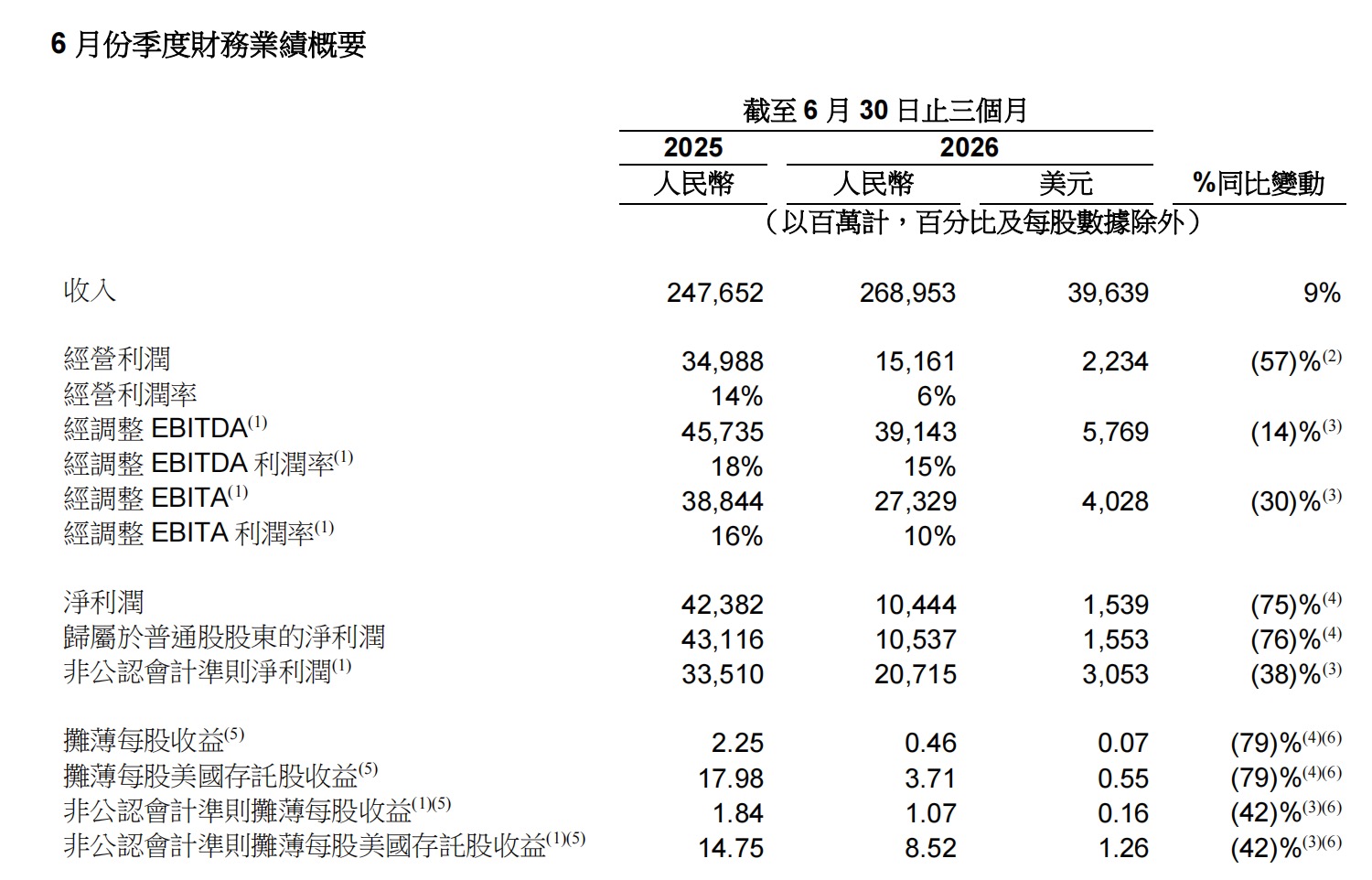
In the second quarter of this calendar year, Alibaba’s total revenue reached RMB 268.953 billion (all figures below are denominated in RMB), representing a 9% year-on-year increase. Net profit stood at RMB 10.444 billion, down 75% year-on-year, primarily due to lower operating profit, reduced net gains from investment disposals, and lower net gains from mark-to-market changes in Alibaba’s equity investment holdings.
Eddie Yongming Wu, Chief Executive Officer of Alibaba Group, stated: “We delivered strong results this quarter, with our full-stack AI capabilities driving continuous improvement in commercial returns. External commercial revenue of Alibaba Cloud accelerated to 45% growth, with AI-related product revenue posting triple-digit year-on-year growth for the 12th consecutive quarter. Our recently launched cutting-edge models for language, programming, video, audio, image and music all rank among the first tier in performance. We have launched Tongyi Work, an AI productivity platform designed to boost operational efficiency and capabilities for enterprises. Benefiting from our full-stack AI strategy, Alibaba is well positioned to capture the enormous growth opportunities in the artificial intelligence and AI computing power markets.”
1. Q2 Revenue Hits RMB 268.953 Billion, Product Development Expenses Rise 50.18% YoY
In the second quarter, Alibaba’s revenue reached RMB 268.953 billion, up 9% year-on-year. Non-GAAP net profit was RMB 207.15 million, down 38% year-on-year.
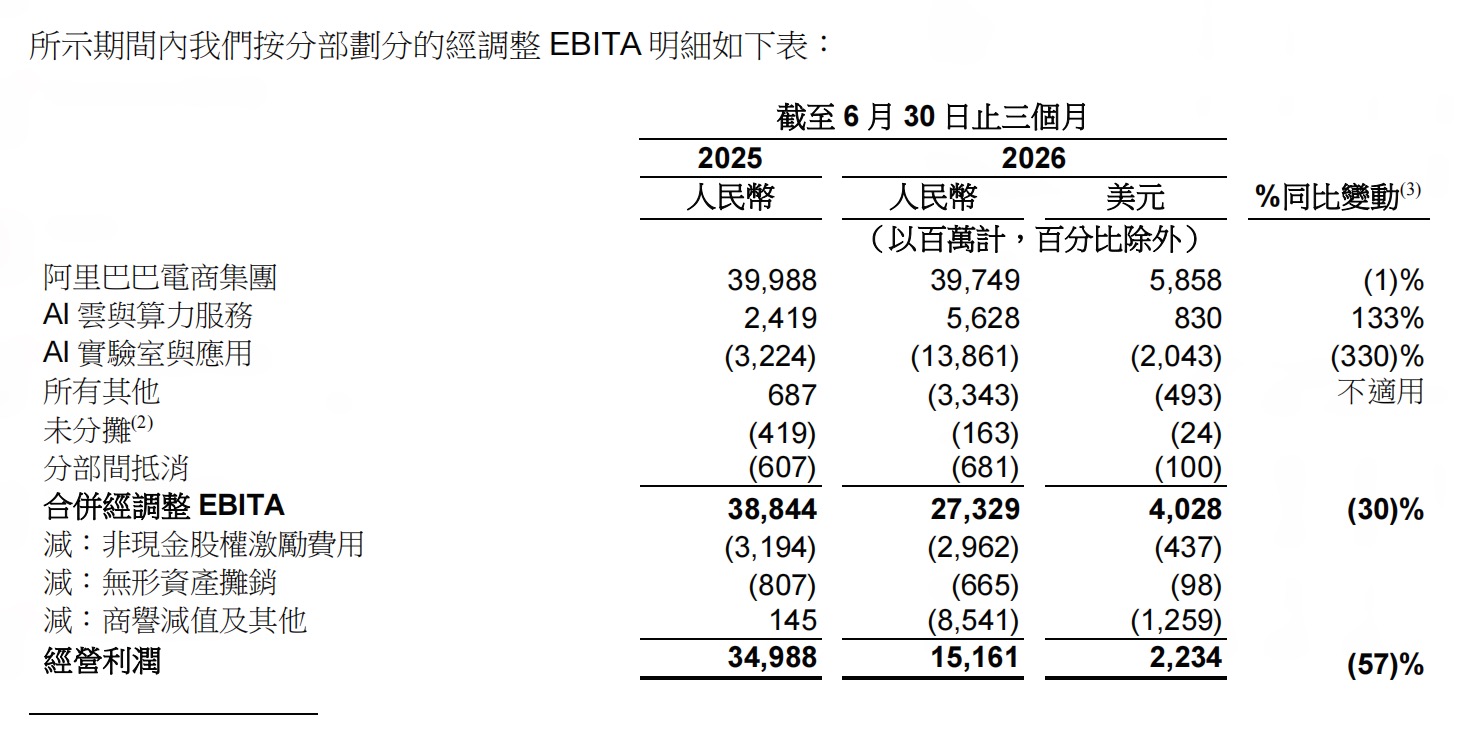
During the reporting period, Alibaba’s operating profit was RMB 15.161 billion, a 57% year-on-year decrease; operating margin stood at 6%, compared to 14% in the same period last year, mainly due to lower adjusted EBITA, goodwill impairment charges recorded this year, and a provision related to a ?550 million fine imposed by the European Union under the Digital Services Act. Adjusted EBITA, a non-GAAP financial metric, was RMB 27.329 billion, down 30% year-on-year. The year-on-year decline in this metric is primarily attributable to increased investment in technology, partially offset by improved operating performance of the cloud business and higher operational efficiency across multiple businesses.
On the cost side, Alibaba’s operating costs in the second quarter were RMB 166.096 billion, up 21.75% year-on-year, accounting for 61.8% of revenue, compared to 55.1% in the same period last year. The increase in operating costs as a percentage of revenue is driven by the higher proportion of cloud and technology businesses in Alibaba’s revenue mix, as well as the impact of deemed revenue deductions arising from new marketing development initiatives.
During the reporting period, sales and marketing expenses were RMB 47.625 billion, accounting for 17.7% of revenue, compared to RMB 53.178 billion, or 21.5% of revenue, in the same period last year. The earnings report noted that the decline in this expense as a share of revenue is mainly due to the impact of Alibaba’s new marketing development plan, under which relevant subsidies previously recorded as sales and marketing expenses are now treated as revenue deductions, as well as more efficient investment in Taobao Flash Sales. General and administrative expenses were RMB 12.708 billion, up 71.78% year-on-year, accounting for 4.7% of revenue, compared to 3.0% in the same period last year.
In addition, driven by Alibaba’s investment in technology infrastructure costs and R&D personnel, product development expenses in the second quarter reached RMB 22.529 billion, up 50.18% year-on-year, accounting for 8.4% of revenue, compared to 6.1% in the same period last year.
For the quarter ended June 30, 2026, net cash flow generated from operating activities was RMB 22.945 billion, up 11% year-on-year. Free cash flow, a non-GAAP financial liquidity metric, was an outflow of RMB 44.670 billion, compared to an outflow of RMB 18.815 billion in the same period of fiscal 2025. The earnings report stated that the decrease in free cash flow is primarily attributable to increased cloud infrastructure spending by Alibaba.
2. China Instant Retail Revenue Grows 45% YoY
Notably, the segment reporting format in Alibaba’s earnings release has changed this quarter.
The report noted that for the quarter ended June 30, 2026, Alibaba carried out strategic integration of certain businesses to achieve synergies across its e-commerce platforms and strengthen its full-stack AI capabilities. Alibaba China Digital Commerce Group, Alibaba International Digital Commerce Group, and Freshippo have been integrated to form Alibaba E-Commerce Group. Cloud Intelligence Group and T-Head have been integrated to form “AI Cloud and Computing Services”, to consolidate the infrastructure and computing power layer of its full-stack AI capabilities. In addition, the AI Model Lab, Tongyi 2C Business Unit and Tongyi Work, previously classified under the “All Others” segment, have been integrated to form “AI Labs and Applications”, to connect the entire value chain from AI model innovation to consumer applications and enterprise productivity solutions.
Following the above strategic adjustments, starting from this quarter, earnings results are presented under four segments: Alibaba E-Commerce Group, AI Cloud and Computing Services, AI Labs and Applications, and All Others.
In the second quarter of this year, Alibaba E-Commerce Group posted revenue of RMB 205.862 billion, up 4% year-on-year. AI Cloud and Computing Services revenue was RMB 48.437 billion, up 45% year-on-year, mainly driven by growth in public cloud business revenue, including increased adoption of AI-related products. AI Labs and Applications revenue was RMB 3.338 billion, up 16% year-on-year. The All Others segment, which mainly includes AliHealth, Orca Entertainment Group, Amap, Lingxi Interactive Entertainment and other technology businesses, recorded revenue of RMB 28.803 billion, up 1% year-on-year.
The earnings report specified that Alibaba E-Commerce Group is a unified entity formed by the combination of Alibaba China Digital Commerce Group, Alibaba International Digital Commerce Group, together with Freshippo and certain commercial businesses under Cainiao. The new Alibaba E-Commerce Group reflects Alibaba’s strategic focus on unlocking significant synergies between domestic and cross-border e-commerce operations. Starting from this quarter’s earnings report, revenue of Alibaba E-Commerce Group is composed of four parts: China E-Commerce, China Instant Retail, International E-Commerce, and Global Wholesale.
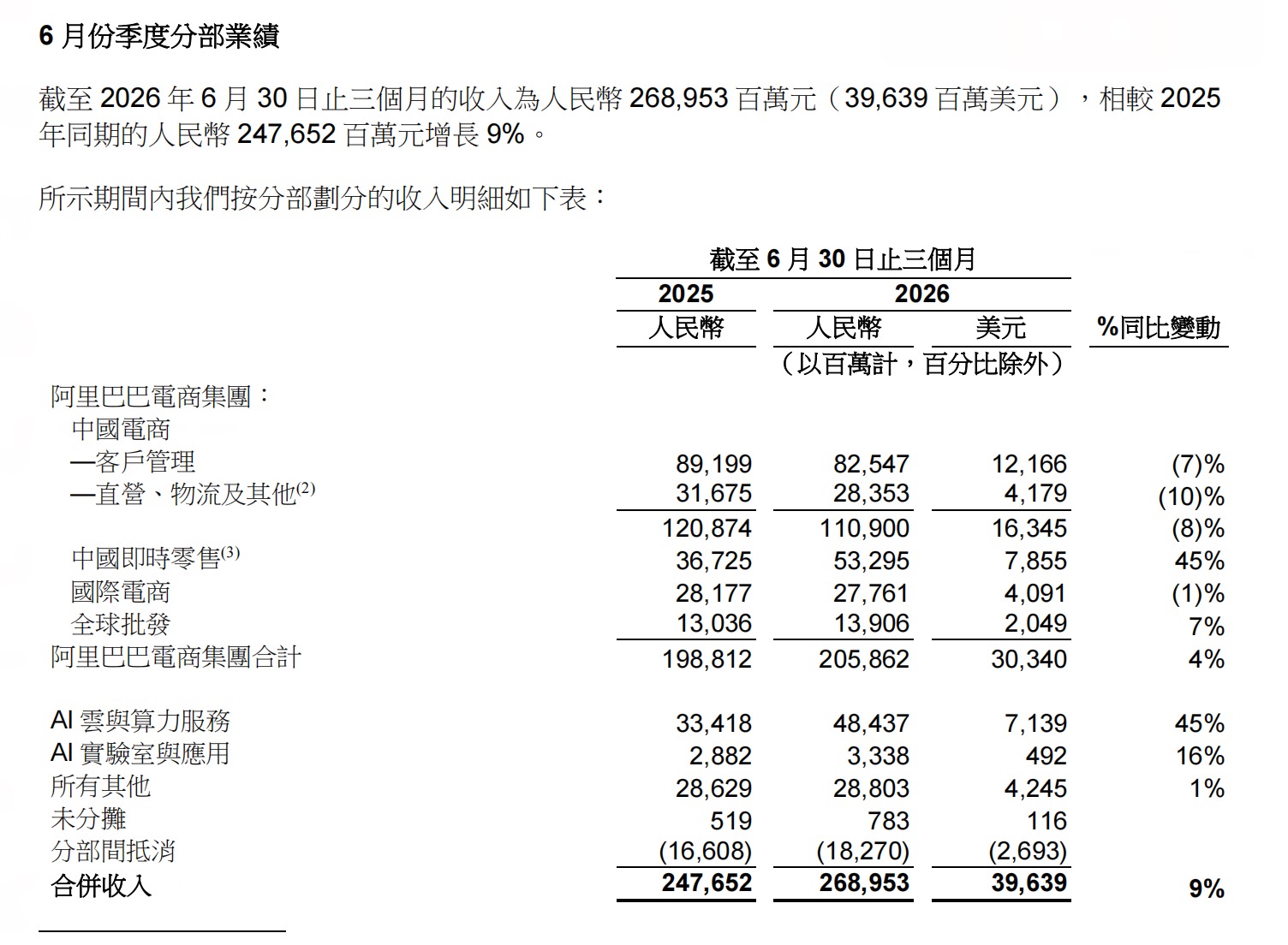
During the reporting period, China E-Commerce business revenue was RMB 110.900 billion, down 8% year-on-year. Customer management revenue decreased 7% year-on-year. Excluding the impact of deemed revenue deductions arising from the new marketing development plan, customer management revenue on a like-for-like basis would have grown 1% year-on-year. The earnings report noted that the slower revenue growth is mainly due to decelerating gross merchandise volume (GMV). Customer management revenue growth was supported by the increase in monthly active consumers of the Taobao App driven by growth in the instant retail business.
Direct sales, logistics and other revenue of the China E-Commerce business mainly comes from the direct sales operations of Tmall Supermarket (excluding real-time delivery business), Tmall Global and other businesses (for which revenue and inventory costs are recognized on a gross basis), as well as revenue generated from logistics services and other value-added services. This quarter, direct sales, logistics and other revenue was RMB 28.353 billion, down 10% year-on-year, reflecting Alibaba’s planned reduction of certain direct sales operations.
Fan Jiang, CEO of Alibaba E-Commerce Business Group, noted during yesterday’s earnings call that the short-term macro environment for domestic e-commerce remains challenging. In the long run, Alibaba is focusing on core supply, while looking to enhance e-commerce experience and overall operational efficiency through AI.
On the supply side, since last year, Taobao and Tmall have supported original merchants including brand merchants, while tapping into the potential of high-quality white-label supply from industrial clusters. According to the company, Alibaba will continue to strengthen partnerships with leading brand owners to help brand customers achieve stable and sustainable business growth; at the same time, it will deepen its presence in industrial clusters to support more manufacturing factories to open stores directly on the platform. Jiang also mentioned the performance of this year’s 618 Shopping Festival: “In the just-concluded 618 promotion, despite certain macroeconomic challenges, the results met our expectations, especially the operating results of core merchants, which delivered solid performance.”
In terms of integrating AI capabilities with e-commerce platforms, on the user side, Alibaba will continue to roll out more AI-powered new experiences and scenarios, such as multimodal search and AI fitting rooms. Meanwhile, the platform will leverage AI technology to improve experience and efficiency in existing shopping scenarios. On the merchant side, Alibaba is experimenting with AI to empower merchants across all operational links, especially in data analysis, advertising and marketing, and customer service. “Going forward, we will also cooperate with Tongyi Work to launch AI agents more tailored to e-commerce scenarios,” Jiang added.
In the second quarter, China Instant Retail revenue, which includes revenue generated from Taobao Flash Sales, Freshippo and the real-time delivery business of Tmall Supermarket, reached RMB 53.295 billion, up 45% year-on-year. The growth of this business was mainly driven by Freshippo and Taobao Flash Sales.
In terms of international e-commerce business, revenue was RMB 27.761 billion, down 1% year-on-year. The share of AliExpress sales contributed by local merchandise supply continued to increase significantly year-on-year.
Global Wholesale business, which includes the 1688 platform and Alibaba.com, posted revenue of RMB 13.906 billion, up 7% year-on-year, mainly due to growth in value-added service revenue related to cross-border business.
Fan Jiang, CEO of Alibaba E-Commerce Business Group, stated during the call: “AI technology will bring very significant changes to B2B trading platforms, and may even fundamentally transform the existing business model. In particular, the agent model will play an increasingly important role in B2B transactions. AI is comprehensively changing the way B2B merchants, especially cross-border merchants, operate. We believe that based on our accumulation in this field over the past 20 years, we have the opportunity to create entirely new business models and commercial opportunities in the B2B and cross-border trade sectors in the AI era.” It is reported that “Accio Work”, the AI agent platform Alibaba launched for cross-border e-commerce merchants, has been used by 50,000 paying merchants since its launch.
In the second quarter, adjusted EBITA of Alibaba E-Commerce Group was RMB 39.749 billion, down 1% year-on-year, mainly due to Alibaba’s increased investment in user experience and technology, partially offset by improved operating performance across multiple businesses.
In terms of membership performance, as of June 30, 2026, the number of Alibaba’s 88VIP members was approximately 64 million, maintaining double-digit year-on-year growth.
3. Instant Retail Expected to Contribute 30% of Total Platform GMV in the Future
“After more than a year of development and investment in the instant retail business, the scale and market share of Taobao Flash Sales have undergone substantive changes, with huge improvements in user mindshare, supply diversity, logistics experience and order volume. Last quarter, while maintaining growth in user and order scale, we achieved significant optimization of our unit economics (UE), with the loss scale narrowing considerably,” Jiang summarized.
The earnings report noted that while maintaining market share, Taobao Flash Sales has continued to see sequential improvement in unit economic benefits, mainly driven by higher average order value and fulfillment efficiency. In addition, both order volume and revenue of Freshippo maintained year-on-year growth, benefiting from business expansion into emerging cities and counties, as well as deeper cooperation with Taobao Flash Sales to offer differentiated daily necessities and fresh produce.
Jiang revealed that Alibaba will accelerate the integration of Freshippo, Tmall Supermarket and other relevant segments going forward. Meanwhile, it will develop instant retail for non-catering categories, especially accelerating the expansion of front warehouses. “Freshippo accelerated the deployment of front warehouses over the past year, driving accelerated year-on-year growth in overall GMV,” he said. In addition, the instant retail business will continue to expand category coverage and drive innovation in key categories to enhance consumer experience. The platform believes that the GMV scale of non-catering instant retail will exceed that of catering categories in the next fiscal year, driving growth in more physical goods categories across the broader e-commerce market.
Notably, Jiang pointed out during the call that the instant retail segment is expected to achieve overall profitability in fiscal 2029. In the long run, Alibaba believes the instant retail business is expected to contribute 30% of the platform’s total GMV, becoming the second growth curve for its e-commerce segment.
Ebrun will continue to track and report on relevant developments. For more information related to this article, please scan the QR code to follow the author on WeChat.

This article was first published on the official website of Ebrun.
[Copyright Notice] Ebrun advocates respecting and protecting intellectual property rights. Without permission, no one is allowed to copy, reproduce, or use the content of this website in any other way. If any copyright issues are found in the articles on this website, please provide copyright questions, identification, proof of copyright, contact information, etc. and send an email to run@ebrun.com. We will communicate and handle it in a timely manner.
Translated by AI. Feedback: run@ebrun.com