
Bambu Lab Makes Its Move: 'Maker Tool Trio' Brands Launch Cross-Category Market Expansion
[Ebrun Original] The wave of cross-category market expansion has finally reached the maker tools sector.
On August 13, leading 3D printing firm Bambu Lab officially announced that it will launch its new subtractive manufacturing product R1 in September, a move widely seen as its formal entry into the laser engraver market, where it will go head-to-head with laser engraving leader xTool.
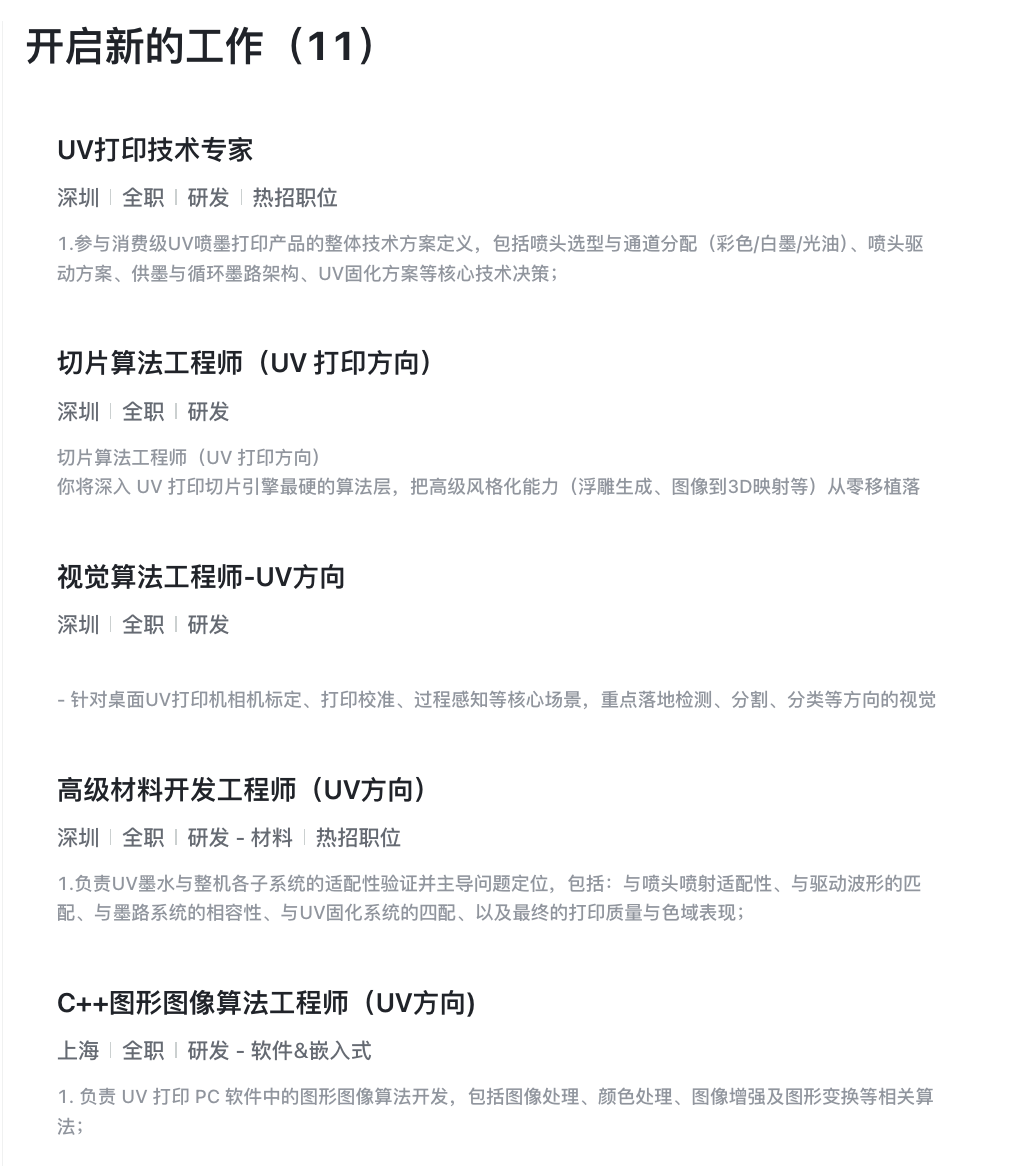
Shortly after, news broke that Bambu Lab has initiated a consumer UV printer (ultraviolet curable inkjet printer) project, which is currently in the talent recruitment phase. Its job board lists openings including UV Printing Technology Specialist, Slicing Algorithm Engineer (UV Printing Track), Computer Vision Algorithm Engineer (UV Track), Senior Material Development Engineer (UV Track), and C++ Graphics and Image Algorithm Engineer (UV Track).
Founded in 2020, Bambu Lab entered the market later than established 3D printing players such as Creality, Intamsys, and Anycubic, but has recorded explosive growth in recent years. It became the first company in the industry to exceed 10 billion yuan in annual revenue in 2025, and cumulative domestic sales had surpassed 1 million units as of June 2026. On the product front, Bambu Lab has built a complete product matrix ranging from the entry-level A series, mid-range core P series, high-end X series, to flagship H series.
The decision to expand its product categories is easily understandable: it is a common strategy for companies to seek new growth drivers once they reach a certain market share threshold in their original core track. Moreover, 3D printing, laser engraving, and UV printing are collectively known as the "maker tool trio", belonging to adjacent product categories. B-side users including studios, farm operators, and advertising agencies usually purchase all three as a set, with some also adding CNC machine tools to their setups.
In fact, this is not Bambu Lab's first foray into laser engraving. Its H2D model launched in March 2025 already includes laser engraving capabilities, but it is not a dedicated laser engraver. Instead, it is a 4-in-1 device that also supports dual-nozzle FDM 3D printing, laser engraving and cutting, CNC knife cutting, and drawing functions. One studio owner described it as "the option with the highest fault tolerance", suitable for use as a backup machine.
Bambu Lab has also been laying out investments in the upstream and downstream of the laser engraving industry. It is reported that the company has invested in domestic laser firm Yineng Zhiguang, the only external independent company Bambu Lab has taken an equity stake in via investment since its founding.
While Bambu Lab is entering the laser engraving and UV printing tracks, xTool, which built its business in laser engraving, is also expanding into more product categories. The "maker tool trio" are quietly penetrating each other's core markets.
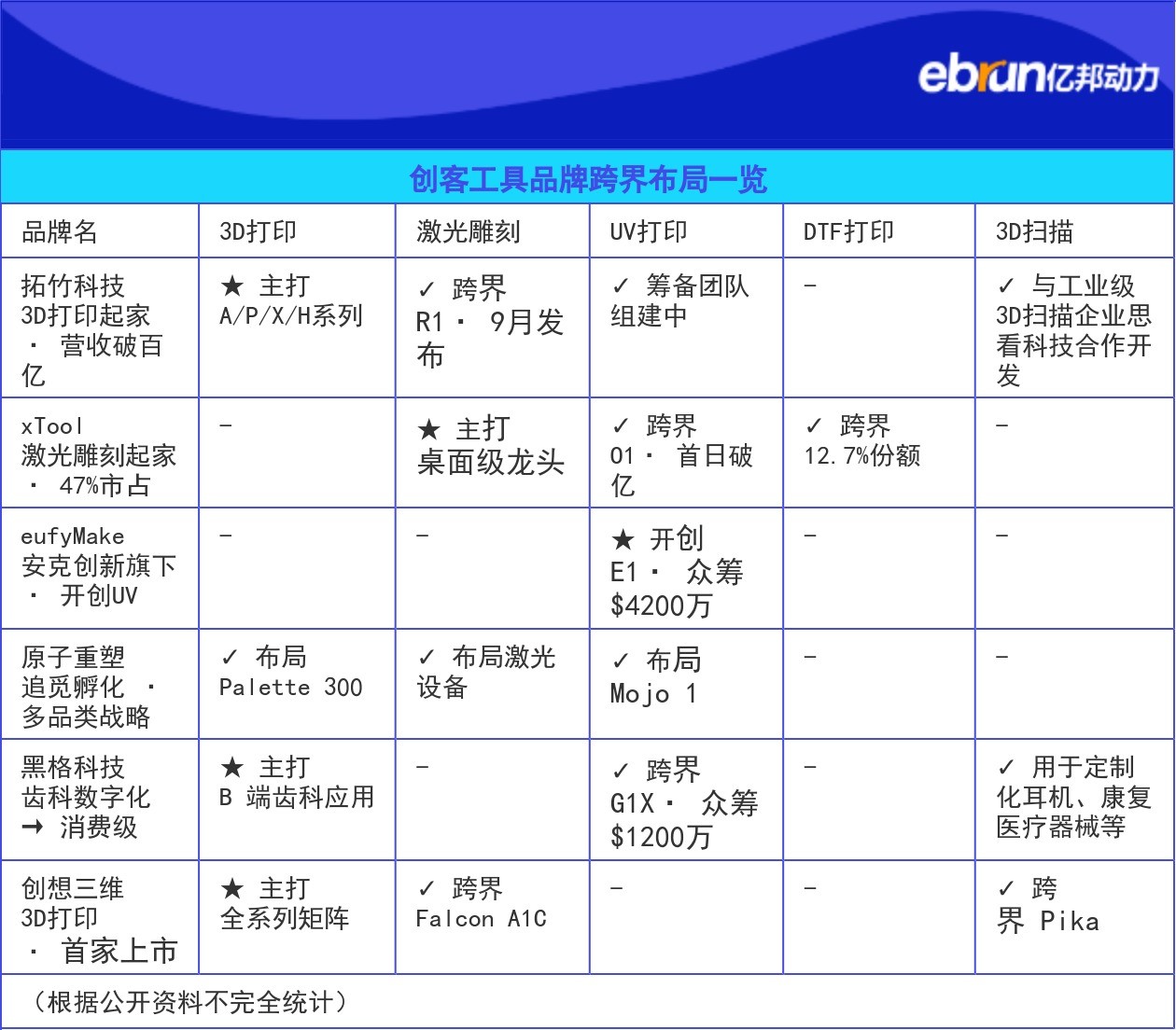
| Overview of Cross-Category Layouts of Maker Tool Brands | |||||
| Brand Name | 3D Printing | Laser Engraving | UV Printing | DTF Printing | 3D Scanning |
Bambu Lab Founded in 3D printing · Revenue exceeds 10 billion yuan |
★ Core A/P/X/H series | ? Cross-category R1 · Launching in September |
? Team in formation | - | ? Co-developing with industrial 3D scanning firm Scantech |
xTool Founded in laser engraving · 47% market share |
- | ★ Core offerings Leading desktop market position |
? Cross-category O1 · First-day sales exceed 100 million yuan |
? Cross-category 12.7% market share |
- |
eufyMake Under Anker Innovations · Pioneered UV printing |
- | - | ★ Pioneering E1 · Raised $42 million in crowdfunding |
- | - |
Atom Rebuild Incubated by Dreame · Multi-category strategy |
? Launched Palette 300 | ? Developing laser devices | ? Launched Mojo 1 |
- | - |
HeyGears Digital dentistry → consumer market |
★ Core offerings B-side dental applications |
- | ? Cross-category G1X · Raised $12 million in crowdfunding |
- | ? Applied to customized earphones, rehabilitation medical devices, etc. |
Creality 3D printing · First listed company in the sector |
★ Core offerings Full product matrix |
? Cross-category Falcon A1C |
- | - | ? Cross-category Pika |
| (Incomplete statistics based on public information) | |||||
In June 2025, xTool launched its first apparel DTF (Direct-to-Film) printer, officially expanding from laser engraving into the printing sector. Within months, the product captured 12.7% of the global DTF niche market, claiming the top market share position. In July this year, xTool officially launched its first UV printer, the xTool O1. Sold via its overseas DTC model, the O1 recorded over 100 million yuan in sales on its launch day, marking the fastest 100-million-yuan sales record for a new product in xTool's history and breaking the industry record for first-day sales of a new product, marking a massive success.
Explaining the rationale behind expanding into UV printing, Liu Qiang, head of products and technology for xTool China, previously told Ebrun: "We hold around 47% of the desktop laser market, which is effectively the industry ceiling, so we are actively seeking our second growth curve."
UV printing is a process that combines digital inkjet technology with instant UV curing. In practical use, UV printers and laser engravers are typically used for surface decoration, while 3D printers and CNC equipment are responsible for producing product bases. As such, UV printing and laser engraving have a complementary relationship: UV printing adds the coloring capability that laser technology lacks, which is one of the reasons xTool chose to enter UV printing first rather than 3D printing or other categories.
Among the "maker tool trio", while 3D printing and laser engraving already have a wide range of consumer products, UV printing has only recently moved into the consumer segment. The world's first consumer UV printer was launched by eufyMake, a brand under Anker Innovations. Different from additive manufacturing 3D printing and subtractive manufacturing laser engraving, the eufyMake E1 is officially described as a "3D texture UV printer". It can output full-color patterns just like a regular printer, but uses UV curable ink that can print on over 300 materials including metal, wood, glass, leather, ceramic, and acrylic, and can stack 3D textures up to 5 millimeters high.
The eufyMake E1 raised over $42 million in crowdfunding on the global crowdfunding platform Kickstarter, setting a record for the highest crowdfunding amount across all categories on the platform at the time. The massive success of the eufyMake E1 validated market demand for UV printing, created a new category for the maker tools track, and laid the foundation for later entrants.
Now, a growing number of personal creative tool brands are entering the UV printing track, and multi-category or even full-category layouts have become a consensus among players.
Atom Rebuild, incubated by Dreame Technology last year, has completed three rounds of financing just one year after its founding. It early on established a strategy to build a product matrix covering multiple processes, and has laid out product lines including FDM 3D printers, UV printers, and laser engraving equipment, while also developing its own consumable system. It has already launched the Palette 300, a desktop 3D printer with 12 smart nozzles, and the Mojo 1 UV printer.
HeyGears, which started in the digital dentistry market, has also set its sights on the consumer UV 3D printing market. Its desktop full-color 3D UV printer G1X recently launched on Kickstarter, raising nearly 50 million yuan (approximately $7.22 million) on its first day of crowdfunding, with total crowdfunding now exceeding $13 million. Unlike mainstream FDM multi-color printing, the G1X adopts inkjet UV curing technology that can achieve photo-like continuous color and gradients instead of color block stitching.
Meanwhile, Creality, the first listed consumer 3D printing company, has also been making continuous moves in the laser sector. It began developing laser engraving products in 2021, initially launching laser modules as accessories for 3D printers. In 2022, it officially launched its first standalone laser engraver, the CR-Laser Falcon, followed by the Falcon 2 in 2023 with further improved engraving speed and power. Creality now has a tiered product matrix covering professional, commercial, advanced consumer, and entry-level segments, including the Sermoon, Raptor, Otter, and Ferret series.
A few days ago, Creality launched the portable AI 3D scanner Pika and the desktop laser engraver Falcon A1C, marking the continuous improvement of its multi-category product matrix.
From cross-category expansion moves by industry leaders to full-range layouts by emerging startups, the boundaries between the "maker tool trio" are being broken down, and product forms are evolving from single-function to multi-purpose. In the upcoming "full-category race", the real determining factor for success will be whether brands can integrate hardware technologies and coordinate software ecosystems to turn the capabilities of the three tools into a seamless creative experience, making desktop manufacturing truly unrestricted.
Ebrun will continue to track and report on this sector. If you want to learn more information related to this article, please scan the QR code to follow the author's WeChat.

This article was first published on the official Ebrun website.
[Copyright Notice] Ebrun advocates respecting and protecting intellectual property rights. Without permission, no one is allowed to copy, reproduce, or use the content of this website in any other way. If any copyright issues are found in the articles on this website, please provide copyright questions, identification, proof of copyright, contact information, etc. and send an email to run@ebrun.com. We will communicate and handle it in a timely manner.
Translated by AI. Feedback: run@ebrun.com