
Skip Physical Stores, Launch on Tmall First: Over 100 Overseas Brands Rewrite Their China Entry Playbook
[Ebrun Original] In just one minute after launching, transaction volume surged past the RMB 10 million mark, and its official flagship store gained more than 140,000 followers within 24 hours. That is the opening performance of premium U.S. lifestyle brand ALO when it launched its first China store on Tmall.
This explosive online debut showcases the entirely new approach overseas brands are taking to explore the Chinese market.
ALO’s strong start is far from an isolated case.
Ebrun has learned that since 2026, more than 100 overseas brands have adopted a similar strategy to enter China, choosing Tmall as their first stop for market entry. These brands span multiple categories including sports and outdoors, designer fashion, luxury goods, and sleep tech, with examples ranging from Silicon Valley AI sleep tech brand Eight Sleep, French white sneaker label VEJA, to South Korean streetwear brand Mardi Mercredi.
This "e-commerce first" business phenomenon is emerging as the new standard playbook for overseas brands entering the Chinese market.
The calculus of expansion and retrenchment in the business world is often embedded in the path choices when exploring new markets. A growing number of overseas brands are now choosing e-commerce platforms as their first foothold.
This goes far beyond a minor adjustment to sales channels, and essentially points to a profound game of China entry strategy reshaping and operational sovereignty reclamation.
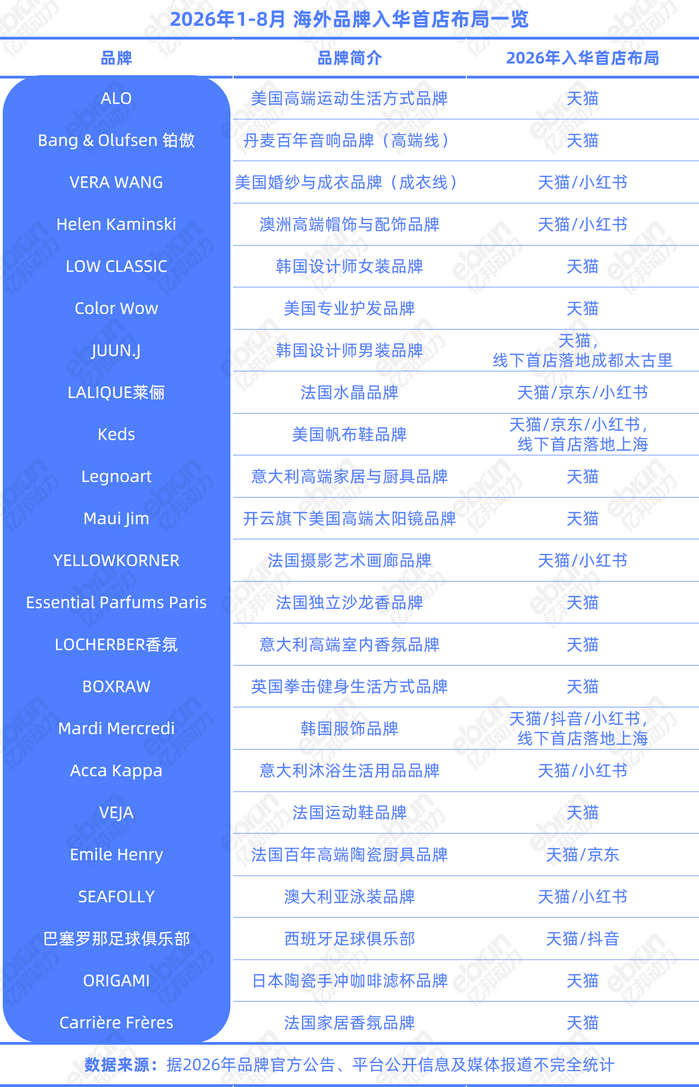
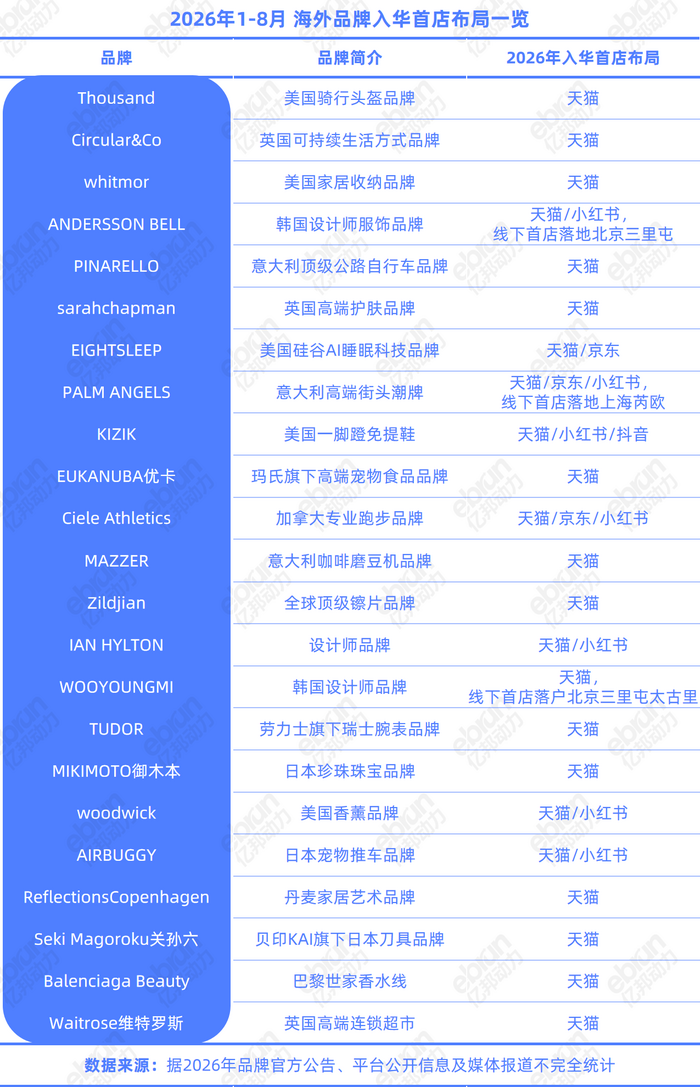
Click to view high-resolution image
01
Why is "e-commerce first" becoming the new path?
For multinational brands expanding globally, the core challenge has always been how to accurately gauge the pulse of the market in an entirely new consumer ecosystem.
The rise of "e-commerce first" precisely provides overseas brands with an agile and deterministic mechanism for exploring the Chinese market.
Take emerging activewear brand Vuori as an example: it first launched on Tmall at the end of 2022 to build its user base, and gained deep consumer insights through efficient online operations.
ALO also demonstrated the commercial efficiency of this low-capital path. By quickly validating its commercial closed loop through its Tmall debut store, the brand was able to rapidly build operational awareness of the local market.
This trend is particularly critical for small and medium-sized agile brands, as well as brands that have already built a certain level of buzz on social media but have not yet established an official presence.
For small and medium-sized brands, initial resources are often relatively limited. Entering the market via an e-commerce flagship store allows them to leverage local digital infrastructure with more focused investment, and quickly test consumers’ actual preferences for product pricing, styles, and categories.
As Maggie Xie, Associate Director at S&P Global Ratings, analyzed, launching an online store first allows brands to capitalize on social media hype with very low capital investment, and accurately test the actual demands of local consumers.
Similar shifts are also taking place in high-end tech and niche vertical sectors. Eight Sleep, the Silicon Valley AI sleep system favored by Elon Musk and Mark Zuckerberg, explicitly stated when announcing its China entry in April that it valued the platform’s borderless reach across all tiered cities nationwide, as well as its inherent advantages in digital operations and consumer insights.
The efficiency of this commercial testing ground has been widely validated across multiple categories. From Canadian professional running brand Ciele Athletics, 100-year-old French premium ceramic cookware brand Emile Henry, to British boxing fitness brand BOXRAW and Japanese pour-over filter brand ORIGAMI, these vertical sector brands all achieved zero-to-one national consumer market reach immediately upon launch.
In fact, e-commerce has outgrown its positioning as a downstream sales touchpoint for traffic conversion, and has evolved into the "first step" for brands to set their own pace in the Chinese market and conduct low-threshold, agile market research.
02
What are brands fundamentally changing behind the "e-commerce first" trend?
Behind the "e-commerce first" phenomenon, brands’ absolute control over operational sovereignty and official brand narrative is the core driver of this collective shift.
When entering new markets, many overseas brands are increasingly prioritizing consistency in brand expression, stability in pricing systems, and long-term accumulation of user assets.
The trajectory of popular South Korean apparel brand Mardi Mercredi is a typical example. After closing stores previously operated by local agents in 2025, the brand recently announced its return to China via a direct-to-consumer model. Prior to the opening of its first direct flagship store in Shanghai, the brand had already launched official flagship stores on e-commerce platforms including Tmall. "We hope to reconnect with Chinese consumers in a more mature and stable way," the brand stated in its return announcement.
When century-old U.S. canvas shoe brand Keds returned to the Chinese market in March 2026, it also chose Tmall as its main direct-to-consumer foothold for rebuilding its brand image, regaining full control over brand operations.
French "white sneaker" brand VEJA has expanded to more than 100 countries globally via multi-brand buyer stores, but when entering China, Tmall became its only official e-commerce channel.
Artaud Frenoy, Head of VEJA Asia Pacific, emphasized that direct operation is the core strategy for entering China, as it allows better control of brand image and a full presentation of its product line and brand ethos.
Even independent designer brands and haute couture players are actively embracing this direct-to-consumer model. Top South Korean designer womenswear label LOW CLASSIC, menswear brand JUUN.J, and the new ready-to-wear line of renowned wedding dress brand VERA WANG all chose to launch official direct flagship stores this year to establish authoritative brand presence.
Building direct-operated e-commerce channels is essentially an inevitable choice for brands to establish official direct-to-consumer (D2C) access.
Brands are no longer satisfied with just "finding a channel to sell goods", but are eager to build long-term, sustainable user relationships. The essence of this "operational rights frontloading" is that overseas brands are seeking to regain control over brand narrative, pricing power, user data, and consumer relationships.
03
Digital infrastructure reconstruction: From "sales channel" to "brand entry point"
The reason why the "e-commerce first" trend has exploded at this particular juncture ultimately boils down to the maturity of underlying consumer mindset and digital infrastructure.
First is the shift in how consumers discover and perceive brands. For many overseas brands that already have a reputation but have not yet officially entered the market, consumers often already know them through social media, cross-border shopping reviews, and celebrity outfit posts.
As brand buzz crosses borders ahead of official launch, consumers’ core demand for new brands quickly evolves into searching for an officially endorsed, authoritative purchasing entry point.
Against this backdrop, the core value of e-commerce flagship stores has been redefined.
First, flagship stores act as a trust anchor for "official endorsement" and "authentic brand website", instantly eliminating the trust barrier that overseas brands face when first entering the market. Second, flagship stores offer extremely high coverage efficiency, unconstrained by geographic limits, helping brands reach potential audiences across all tiered cities nationwide with minimal friction.
For multinational brands, Tmall flagship stores now serve as the cognitive anchor for their official identity.
Whether it is Danish luxury audio brand Bang & Olufsen launching its first China store for its Luxury line on Tmall Luxury, or Moroccan luxury coffee brand Bacha Coffee shaping its "Hermès of coffee" brand image via its e-commerce debut store, e-commerce platforms are playing the role of narrative carrier.
Nick Wakeman, founder of British clothing brand Studio Nicholson, once stated that fully presenting the brand’s core identity through Tmall Luxury is critical, as it allows for a tailored e-commerce experience for the Chinese market.
The functions Tmall carries have long gone beyond mere GMV figures. It is now fully replicating the entire lifecycle required for a brand to enter a new market: establishing official recognition, covering the national market, validating consumer preferences, and ultimately accumulating reusable user assets.
Even top cymbal brand Zildjian, which historically relied heavily on specialized channels, and Italian professional coffee grinder brand MAZZER, have chosen to open their first China stores on Tmall.
In addition, this trend has attracted overseas brands from even more categories. For example, global top cymbal brand Zildjian, Italian coffee grinder brand MAZZER, Italian premium road bicycle brand PINARELLO, U.S. home fragrance brand WoodWick, Danish home art brand Reflections Copenhagen, Japanese cutlery brand Seki Magoroku, and Balenciaga Beauty, the fragrance line of Balenciaga, have all chosen to launch their first China stores via e-commerce platforms, further confirming the broad applicability of the "e-commerce first" strategy.
This also shows that the reach and professional accumulation of digital platforms are now capable of supporting the brand narratives of extremely vertical, ultra-niche segments.
Conclusion
As an entirely new business phenomenon, "e-commerce first" is redefining the pace and format of overseas brands’ entry into China.
This model has demonstrated striking commercial efficiency, providing a smooth, agile, and deterministic expansion channel for overseas brands of all sizes.
As more pioneers like ALO, Eight Sleep, and VEJA validate this path, the China story of multinational retail is being completely rewritten.
However, taking "e-commerce first" as the first step of China entry does not mean brands can rest on their laurels. The instantaneous explosion and highlight moments brought by an online debut store are merely a fulcrum to leverage the vast Chinese consumer ecosystem.
When the first wave of buzz fades, overseas brands still face a deeper localized test: how to convert short-term online transaction momentum into a long-term brand moat? How to feed consumer data accumulated through digital channels back into product R&D and long-term brand building?
Today, as global brands increasingly embrace China’s digital infrastructure, while the threshold for entering China has lowered, competition in refined operations has just begun.
Only brands that know how to use digital infrastructure for precise positioning, while also maintaining the agility to achieve seamless omni-channel integration, will be able to truly stay and take root in this new cycle of multinational retail.
Ebrun will continue to track and report on this trend. If you want to learn more information related to this article, please scan the QR code to follow the author on WeChat.

[Copyright Notice] Ebrun advocates respecting and protecting intellectual property rights. Without permission, no one is allowed to copy, reproduce, or use the content of this website in any other way. If any copyright issues are found in the articles on this website, please provide copyright questions, identification, proof of copyright, contact information, etc. and send an email to run@ebrun.com. We will communicate and handle it in a timely manner.
Translated by AI. Feedback: run@ebrun.com