
EU Tariff Overhaul Sends Shockwaves Through Cross-Border E-Commerce, Splitting the Industry in Two?

By Wang Yu | Edited by He Yang
[Ebrun Original] "Right now, I might as well be a liability for the company," one cross-border e-commerce practitioner remarked. Since the start of July, his trading company has seen European orders on the "four major" platforms plummet, nearly halving in just over a month. As a junior supervisor overseeing the European managed services business line, his team has been drastically downsized, and he has only received his base salary for two consecutive months.
The slump in orders stems from the impact of the EU's new round of customs policies coming into force. From July 1, the EU officially abolished the previous tariff exemption for imported goods valued under ?150, and introduced a fixed ?3 tariff per HS code for parcels of goods originating from outside the bloc.
Note: HS codes are internationally standardized commodity classifications used to determine applicable tariff rates.
This means Chinese cross-border sellers who long relied on small direct mail parcels and low-cost, high-volume sales lost their core cost moat overnight.
"We did consider adjusting our strategy," the aforementioned practitioner said. The company internally discussed securing full compliance qualifications for the European market and increasing stock in overseas warehouses, but ultimately put those plans on hold due to inventory and capital occupation risks. For now, the more realistic option for the company remains cutting headcount, clearing inventory, and waiting for orders to rebound.
Zooming out to the broader picture, what changes has the industry actually seen since the EU's new tariff policy took effect? What are sellers expanding into Europe experiencing?
Ebrun surveyed multiple frontline sellers, including small and medium-sized sellers that rely on the fully managed model to move large volumes of general merchandise, factory-based sellers upstream in the supply chain, and mature brands with long-standing operations in the European market. Sellers have had vastly different experiences, and hold drastically different outlooks for the future of their European businesses: some are facing pressure on orders and profits and are scaling back European operations; some are accelerating their overseas warehouse and compliance layouts to seek new room for growth; others are choosing to wait temporarily for the market to rebalance...
The tariff reform has finally come to fruition, potentially permanently altering some of the European market's "landscape" and causing castles built on sand to collapse. But after the reshuffle, the game continues.

"The 'Gray Rhino' Arrives as Expected, Leaving Small Sellers in Disarray?"
"The gray rhino has arrived right on schedule," one seller said. "The drop in performance was expected, we were mentally prepared for it."
The EU has been deliberating the new tariff policy for years: in May 2023, the European Commission formally proposed a customs reform package; thereafter, discussions on abolishing the tariff exemption for imported goods under ?150 moved forward; in November 2025, EU member states reached an agreement on setting a temporary ?3 tariff; after multiple rounds of advancement, the ?3 tariff officially came into force this July.
The market's risk-averse reaction first emerged as early as six months ago. Data from TTG (Luxembourg-based consulting firm Trade and Transport Group) shows that China's low-value e-commerce exports to Europe began a structural decline starting from early 2026 — after four consecutive years of high growth, the curve turned downward, with the annual growth rate quickly falling into negative territory.
The sharp volatility in cargo flows is directly linked on one hand to "policy tightening" by countries including France and Italy ahead of the EU's small parcel tariff implementation; on the other hand, it reflects that a group of sellers had already prepared in advance, adjusting their export models and rearranging their market presence to pave the way for a soft landing.
Note: France implemented a "small parcel tax" in advance starting from March, levying ?2 per category for goods from outside the EU valued under ?150 according to product type; Italy announced a ?2 per parcel "small parcel administrative fee" at the start of the year, which has been delayed multiple times.
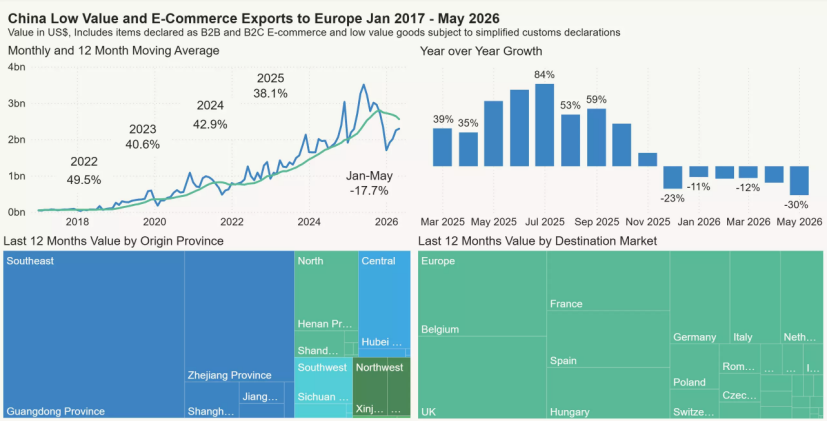
Figure: Aggregate Data on China's Low-Value E-Commerce Exports to Europe, January 2017 – May 2026 (Data source: TTG)
Looking at the operating performance of small and medium-sized sellers, European businesses on cross-border e-commerce platforms including Temu, SHEIN, and AliExpress had already entered "crisis mode" ahead of July — dried-up traffic, plummeting order volumes, and front-end price hikes, three sharp blows hitting right at the core.
"After closing the books, June was the lowest point in my two years selling on SHEIN, and Temu also hit a new low since the US market collapse last year," seller Gu Sheng said. "No violations, no bad reviews, no drop in listing weight — I did nothing wrong, but the number of visitors was visibly falling, and orders dropped off a cliff."
According to his description, previously after 4 p.m. daily, orders would rise rapidly as platform advertising scaled up; but starting from mid-June, this favorable pulse gradually weakened until it disappeared entirely.
Correspondingly, front-end prices have risen. "A 70% price increase, is that reasonable?" one fully managed seller questioned. "Our supply prices to the platform have been falling, but half of our listings have seen front-end price hikes! The promotional price is ?60, but the front page shows ?103. Thinner profits have only brought lower sales volumes!"
Temu seller Leo told Ebrun that over the past month, it has been normal for fully managed business order volumes of sellers around him to halve — a 30% drop is already considered strong operational performance; worse off are some store group players, who once had 1,000 orders per day and now only get around 100.
In addition, according to survey results from Ebrun communities, nearly half of sellers said they have experienced volatility due to the EU's new tariff policy, over 30% "feel the impact is significant and are struggling to stay afloat," while nearly 20% reported "moderate volatility." A considerable proportion of sellers who had been observing the market and preparing to enter the European region have abandoned their plans entirely.
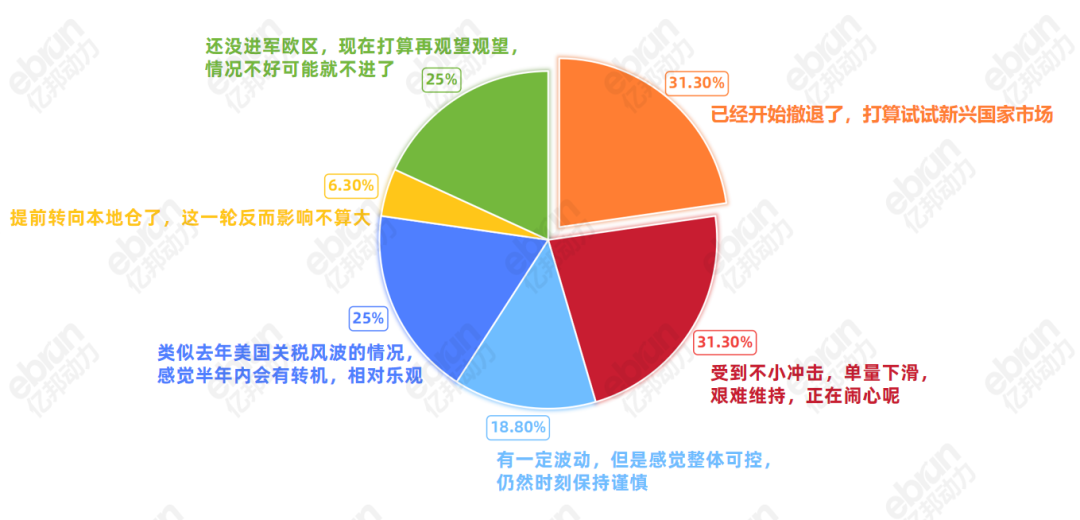

"'Short-Term Pain' Is More Widespread"
For the most direct targets of the new tariff policy — small and medium-sized sellers focused on fully managed, low-price general merchandise — the actual monetary losses should not be overestimated. The anxiety brought by declining expectations, slower turnover, and strategic misalignment is real, but it is only anxiety.
"For solo operators like me, there's no performance target hanging over us. If it's hard to make money in the short term, we just lie low for now, as long as we don't lose money. At worst we dip into our savings, ride out this period, and the situation will eventually become clear," Gu Sheng said frankly. "Besides, fully managed sellers already have light burdens, no need to hold inventory. We'll just stop once we sell off the remaining stock in the consolidation warehouse."
The unexpected losses that actually hit wallets were concentrated in the short, intense "transition period" between late June and early July. "Most of it is short-term pain," one seller said.
Sellers who long relied on tax-free small parcels in the past often have a limited understanding of customs affairs, seeing it as nothing more than "filling out forms and paying fees." But now, the hassles have become trivial and concrete — along with the extra ?3 fee per order comes stricter declaration reviews and HS codes that must be precisely aligned.
"It was supposed to be charged per code, but it ended up being ?3 per order," some sellers reported. Starting from mid-June, their partnered logistics providers suddenly required accurate HS codes for all SKUs — previously, account managers would handle this work as a matter of course — otherwise, they could not consolidate parcels per code for billing. The reason is not complicated: service providers are unwilling to file declarations themselves, as any errors leading to customs seizures would leave them liable to customer claims, so they now list each declaration line separately and charge individually.
"We operate a wide range of categories, have an enormous number of SKUs, and insufficient staff, so we simply cannot conduct accurate self-audits and provide all codes in the short term," the seller said helplessly. "The first week we had to bite the bullet and pay a lot more in taxes, worked overtime to organize the codes, and even paid compliance specialists to verify and optimize them."
On the other side, some brands selling products like large home appliances and residential energy storage have also been caught off guard. These products usually have high average order values, large weight and volume, and are not shipped via small direct mail parcels. Instead, they are bulk shipped to overseas warehouses via sea freight, with deliveries completed from local warehouses after consumers place orders, so the normal sales process is not directly affected by the ?3 tariff.
But in actual operations, brands still have some "small parcel" needs, such as sending new product samples, replacement samples, spare parts, and after-sales replacements. A marketing staff member at an outdoor energy storage brand told Ebrun that product updates for some offline industry exhibitions and store showrooms happened to coincide with the rollout of the new policy. A single product set often includes multiple components such as the main unit, base, replacement parts, appearance components, and free gifts — declaring them broadly as "accessory sets" versus strictly declaring each item individually according to EU HS codes can lead to drastically different final tariff outcomes.
"One product can cost an extra ?10 or more in tariffs. Sending a batch of samples can lead to a difference of nearly ?1,000 in customs clearance costs. The finance department keeps asking us why there is such a big difference from previous expenses, if someone is tampering with the numbers," one person in charge said quite helplessly. "To make the exhibition schedule, we can't easily switch carriers at the last minute."
Another "loss point" occurs in the advertising spend process. An Amazon Europe seller told Ebrun that after the tariff increase, multiple low-priced products in his store were forced to raise prices. Once selling prices rose, conversion rates plummeted — there were plenty of ad clicks, but no orders, so advertising budgets were burned through rapidly.
"Initially, we were too conservative in estimating the negative impact on conversion rates, and adjusted our advertising settings a step too late. As a result, ACOS skyrocketed to over 200%, with a severely inverted return on ad spend," he said. "It was only after the fact that we started redeveloping marketing plans for our low-price product lines."

"How Much Have Costs Actually Risen?"
The ?3 surcharge per HS code sparked "cost panic" in seller circles as soon as the new policy took effect. Many overseas warehouse service providers and recruitment personnel for emerging market platforms have fanned the flames on social media, vigorously publicizing the "disastrous consequences" of rising small parcel direct shipping costs, as if the European market has suddenly become unprofitable and the entire cost structure has collapsed.
But the real market picture is not just a doomsday narrative. Feedback from the front lines shows that low-priced product listings have indeed been hit on a large scale; but on the other hand, the new tax costs are being jointly absorbed by upstream and downstream players in the industry. Sellers in different price brackets, different categories, with different operating strategies and different fulfillment routes give vastly different answers to the question of whether the EU's new tariffs are fatal.
For sellers with slightly higher price points, their profit models still work. The most "brutal" battlefield is concentrated on products shipped via standard individual direct parcels, with fully compliant customs clearance and declared at actual value. One seller did the math: before the new policy, he sold small, low-weight products under ?10 on Amazon, with a ?2 procurement cost, ?3 logistics fee, ?1 in VAT and other taxes, ?1 in platform commissions and other fees. Factoring in returns, he could still maintain a 20-25% profit margin. Now, in addition to the mandatory ?3 tariff, each parcel incurs new costs — customs clearance service fees, payment handling fees, HS code optimization fees, etc. All these add up to eat into the already slim profits. If prices are not raised, it is even difficult to cover return risks, leading some SKUs to "lose more money the more you sell."
However, as long as sellers are willing to "get creative" and take on risk, they can still find more cost-effective logistics channels. "Honestly, very few European sellers I know are honestly paying the full ?3 tariff, everyone uses low-cost 'dual customs clearance and tax-included' services," said Xiao Wu, a seller on Temu's Y2 model. "My freight forwarder only raised shipping costs by less than 10 RMB per order after July, and operation fees rose by 2 RMB, so total costs only increased by 12 RMB."
This is not an exaggeration. Searching for "European small parcels" on social media platforms like Xiaohongshu, a large number of service providers promote tax-included direct shipping products that "don't require paying tariffs," actively soliciting customers in the comment sections. "The overall price list has definitely gone up, but you don't have to pay tax separately, so it's a good deal no matter how you calculate it," Xiao Wu said. Using top-tier compliant freight forwarders adds at least 20 RMB per order; but using small and medium-sized forwarders, the price increase for small, low-weight general merchandise has been pressed down to as low as 8 RMB, with some service providers even promising that they are "working on solutions" for German routes, which will only add 6 RMB per order once rolled out next month.
According to Ebrun's research, currently, tax-included direct shipping products for general merchandise under 2kg are generally priced at 55-65 RMB per kilogram, with all-in operation fees ranging between 24-36 RMB per parcel.
"Just like when the US abolished the T86 exemption last year, there are always countermeasures to policies. The actual cost increase passed on to sellers is not that high. In the end, it's not the sellers who are competing fiercely, but the freight forwarders — the forwarders figure out ways to absorb the costs themselves, and sellers only recognize dual customs clearance and tax-included services," Xiao Wu said.
Where does this huge cost compression space come from? Looking at the overall market, the most direct factor is that European route freight rates have fallen for multiple consecutive weeks. Data from Zongteng Group shows that from late May to early August, market quotes for European small parcel freight rates have dropped from the previous high of 35-40 RMB per kilogram to 20-25 RMB, a drop of nearly 40%. The nearly halved shipping rates give freight forwarders room to maneuver.
July and August are traditionally the off-season for cross-border e-commerce. On the other hand, after the new tariff policy came into force, overall European B2C small parcel cargo volumes have dropped by 15-25%. On the capacity side, Aevean data from July 27 shows that average daily all-cargo aircraft capacity from Asia Pacific, the Middle East and South Asia to Europe shrank by 14% in July compared to June, equivalent to a reduction of about 18 wide-body all-cargo aircraft per day. Demand has fallen too fast, cargo space is available on demand, shipping rates cannot rise, and the short-term supply-demand relationship is unlikely to reverse.
Many service providers have shifted from shipping individual parcels directly point-to-point to consolidated shipments: combining goods with the same HS code and similar destinations into a single large parcel for shipment to Europe to reduce duplicate tax payments. The trade-off is that logistics timelines may be delayed by several days.
In addition, in the highly competitive cross-border logistics track, there are still many freight forwarders willing to take risks and operate in gray areas. Various so-called "avoidance solutions" and under-declaration of values that walk the line are common methods to lower logistics costs. "Of course, if you enjoy the low prices, don't expect the freight forwarder to take responsibility for you if something goes wrong," one freight forwarder practitioner said bluntly.

"Direct Mail Parcels Stall, Brand Sellers Barely Notice a Difference?"
Compared to the panic and anxiety of small and medium-sized sellers, most brand sellers have a noticeably calmer attitude.
"In Europe, around 40% of our shipments go through overseas warehouses, and only the rest are direct shipped," a top-selling apparel brand told Ebrun. "The tax increase has had some impact on profit margins, but overall we can still maintain stable profitability."
"Our average product price is in the $30-60 range. In theory, each product would see a ?3 cost increase, but we actually only raised prices by ?1-1.5 per item," the person in charge said. "Consumers and us are each bearing part of the cost increase."
When asked about the impact of price increases on sales, he said frankly that there are significant differences between regions and channels. For example, the German market has had a relatively muted reaction to price increases, while the French market is much more sensitive. Platform channels focus on blockbuster core products and seasonal bestsellers, with deeper inventory levels, most shipped from overseas warehouses, so the tariff impact is not obvious; independent sites, which have more long-tail products, rely more on small parcel direct shipping, so the impact is more prominent.
"Some small and medium-sized independent sites that rely on low inventory turnover models basically can't operate anymore," he said frankly. "In the future, we will also shift more towards the overseas warehouse model."
If fashion apparel brands, with their large number of SKUs and fast iteration cycles, rely more on small parcel direct shipping and have had a relatively strong reaction to tariff changes, brands in other categories are even more unfazed by the tariff increase.
Most brand sellers surveyed by Ebrun now primarily use local warehouse fulfillment in Europe, with many medium and large-sized products even assembled locally. Small parcel tariffs are not a core concern for them.
"The impact of the new tariff policy on us is probably less than the sales fluctuations caused by algorithm adjustments on Facebook and TikTok ads," the founder of an e-bike brand said bluntly.
Even top-selling brands known for having a large number of small and medium-sized SKUs do not seem to be too troubled. SmallRig, a leading brand in the camera accessory segment, told Ebrun that currently the company only uses direct shipping for a small number of new product categories, with all Amazon channel goods fulfilled by Amazon warehouses; while independent site channels are generally considered more suitable for long-tail product sales, except for shipments to non-EU countries and after-sales replacement parts, direct shipping is rarely used.

As a "hardware innovation powerhouse" with product lines spanning dozens of niche segments and a peak SKU count of over 1,000, SmallRig said it is primarily optimizing and absorbing the new tax costs internally through supply chain coordination, without significant increases to end consumer prices. As a result, end sales have been minimally impacted, overall shipments to Europe remain stable with no significant fluctuations, and sell-through across all platforms is performing well.
Creative hardware brand Divoom provided a more detailed breakdown. As a company focused on creative desktop products with pixel art features, Divoom currently relies primarily on overseas warehouse/FBA stock in the European market, with domestic direct shipping only used as a supplement. Core sales SKUs in particular never rely on direct shipping long-term.
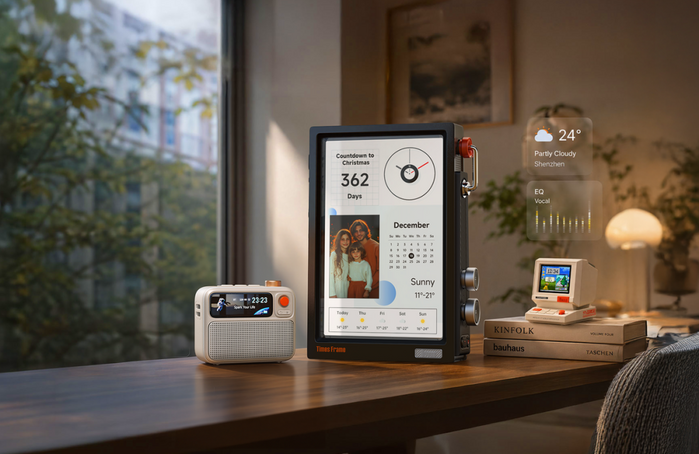
Currently, Divoom only retains direct shipping for three types of products: first, SKUs in the new product testing phase; second, non-core, low-turnover models; third, small, low-weight products with average order values high enough to cover logistics costs.
"For all core products that have achieved stable sales, we prefer to stock them in local warehouses in advance. For 3C products, the importance of fulfillment speed, return and exchange experience, and platform conversion rates is far higher than saving on inventory costs," Divoom said frankly.
On the issue of price increases, considerations for each brand are complex and diverse. In the decision of whether to raise prices or not, the "?3" has become a relatively insignificant variable.
"Our European pricing is tied to our US pricing, so we can't disrupt our pricing system, so we haven't made many adjustments for now; besides, the average order value of our complete bikes is already quite high, so the ?3 tariff really doesn't make much difference whether we adjust prices or not," the aforementioned e-bike brand person in charge said bluntly.
"The new costs will not be passed on to consumers all at once, we prefer small adjustments, so there have been no severe sales fluctuations so far," Divoom pointed out. "We don't make pure low-priced products anyway, if we change prices frequently over a few euros, it would easily disrupt our pricing system and consumer perception."
One coffee machine brand revealed that it follows a small, high-end route in the European market, relying primarily on local distributor sales, with the new tax costs fully borne by distributors and ultimately passed on to consumers, so this round of price increases has had a minimal impact on its sales.
Returning to the new tariff policy itself, what brand sellers are really concerned about is not the trivial changes to their accounts, but the long-term shaping of the European cross-border trade ecosystem.
"What really matters is the rise in overall landed costs and per-shipment fulfillment costs, not just the tariff itself," Divoom drew a clear comparison between the EU's new tariff policy and the transmission logic of the US-China tariff war: US-China tariffs primarily affect supply chains and bulk import costs; while this round of EU policies targeting low-value cross-border e-commerce focuses on changing the cost model of small parcel direct shipping.
"From the perspective of individual product operation, for low-sales, low-margin long-tail SKUs with high fulfillment costs, it will make less and less sense to keep them in the European market in the future. There is now a clearer 'viability threshold' for whether a SKU is worth keeping in the European market long-term," Divoom said. "From a brand seller's perspective, we acknowledge that short-term costs have indeed increased, but in the long run, this is pushing cross-border sellers to move towards local inventory, local fulfillment, and branded operations."

"Looking at the longer term, sales volume may be secondary, profits are the main theme," the aforementioned apparel brand person in charge also pointed out. "The new policy will force enterprises to pursue higher margin routes, that is, brand routes and high value-added routes, otherwise it will be difficult to break through the return on investment bottleneck."
"For future development, we will continue to optimize our fulfillment model and SKU structure, concentrating resources on deepening and penetrating core high-potential products," a SmallRig person in charge also said, noting that the new policy will reshape its operational approach in Europe.

"After a Month of Self-Rescue, Glimmers of Hope Emerge?"
"In late June, all models were seeing declines, just with different degrees of drop," said Lin Yan, a top seller on Temu's European Y2 model. "It's not just fully managed and Y2 listing sales, which are directly affected by direct shipping costs, that plummeted; even Y1 listings have seen slight drops in sell-through according to peers."
Note: Y1 refers to Temu's semi-managed overseas warehouse stocking model, where sellers stock goods in overseas warehouses in advance and ship locally after orders are placed; Y2 is the domestic direct shipping model, where goods are shipped from China after orders are placed.
In addition to the impact of platforms cutting advertising spend in Europe, the way taxes are displayed also scared off many orders at first. For Temu, for example, the initial price hike mechanism almost directly added the ?3 tariff to the product listing price, which inevitably deterred consumers.
But after entering July, platforms gradually adjusted to display the additional fees separately on the checkout page. At the same time, after the first two weeks of short adjustment, European consumers have recovered from their initial shock at the sudden ?10+ in additional fees per parcel, gradually understanding the general logic of price increases by category for direct shipped products, and now only willing to pay for goods shipped from local warehouses.
Note: Some cross-border e-commerce platforms have minimum order thresholds, so consumers often need to buy multiple items at once to reach the threshold; since different products correspond to multiple different HS codes, the ?3 tariff is charged multiple times, making the actual additional cost for a single purchase far higher than ?3.
"On Temu, I only dare to buy products with the 'Local warehouse' green label, otherwise, after I work hard to reach the minimum order threshold in my cart, I find the tax is almost as much as the cost of the goods," one Chinese student in Europe complained. "On other platforms, checking if there's a local shipping label has become the first step in my shopping process."
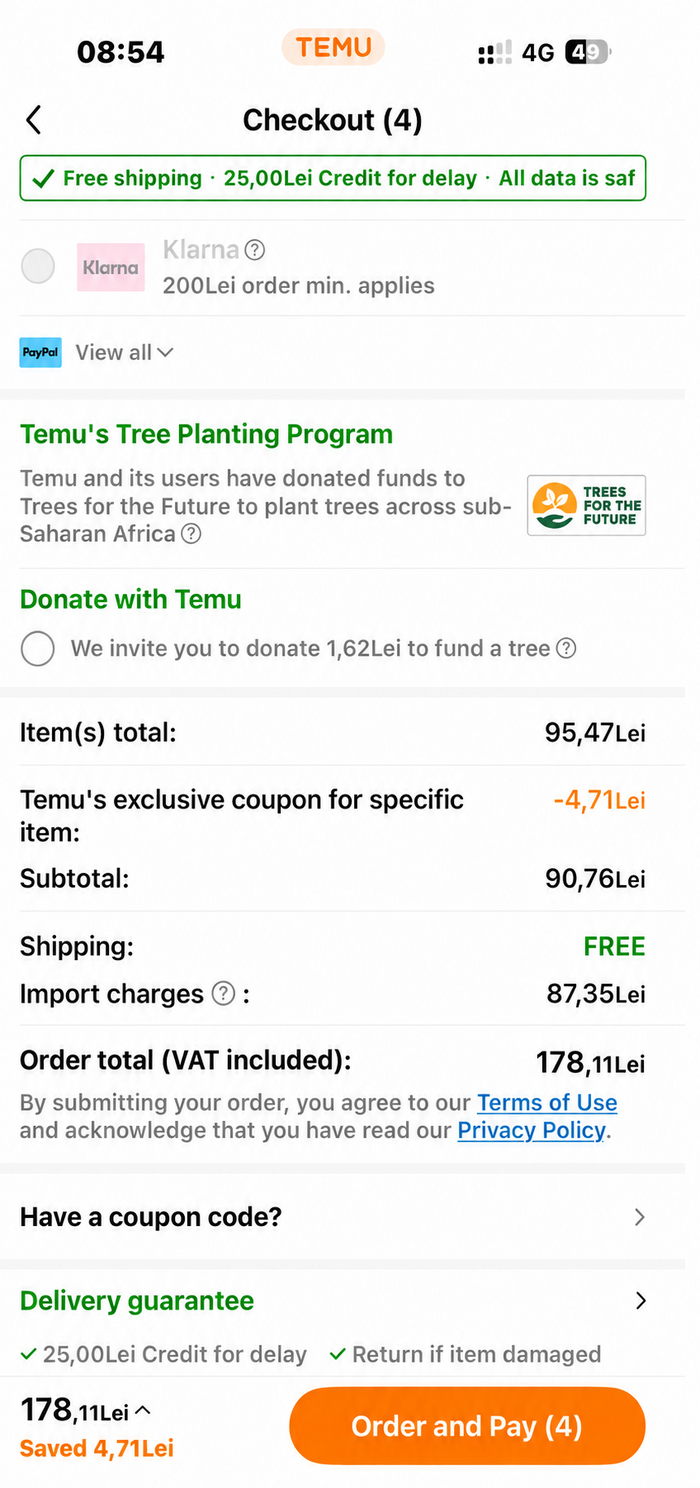
A checkout screenshot shared by an Eastern European consumer on social media
Driven by European consumers' growing awareness, overseas warehouse sellers represented by Temu's Y1 model became the first group to recover growth and even see order surges amid the new policy's impact.
"I heard Y1 traffic in Europe is growing very fast recently. Many sellers who prepared their VAT and local inventory in advance had their stock sell out in early July, even couldn't restock fast enough, with sales doubling and making easy profits," Lin Yan reported.
In contrast, sellers relying primarily on the direct shipping model are pulling out all the stops to offset declining sales — some are making cuts, others are expanding.
The path of making cuts is straightforward. One AliExpress managed seller (a cooperation model where sellers stock goods in Cainiao's preferred warehouses, and the platform is responsible for cross-border logistics fulfillment) said frankly that he delisted 40% of his listings in June, all low-margin general merchandise under ?15, keeping only listings over ?25 — the top priority is to protect profit margins. In his view, this is a forced shift to develop higher-priced product selections — the low-margin, high-volume strategy for trade-focused sellers in Europe is over.
He added that even for the few value-for-money products remaining, they are now sold in multi-item sets, paired with discount coupons to encourage customers to buy multiple SKUs of the same category at once, paying only one tariff to spread the cost pressure. In the future, they may also try the POD (Print on Demand) model, where the final production or customization process is completed locally in Europe after consumers place orders.
At the same time, there have been positive signals from the platform side. SHEIN, Temu, and AliExpress are all increasing support for sellers to stock goods overseas. For example, Temu has launched a fully managed pre-stocking option for European overseas warehouses. There were previously fully managed pre-warehouses in North America, but they were invitation-only, tested internally for only a small number of top sellers; this time, a pop-up window directly appears in the back-end stock order interface, and many ordinary small and medium-sized sellers have seen this option for their best-selling standard products. Although limited by sea freight speed, the listing cycle will be extended — requiring at least 35-40 days of lead time for stocking — goods are sent directly to overseas warehouses, enabling faster local fulfillment, avoiding small parcel tariffs, and potentially lowering front-end prices.
Some sellers revealed that buyers have made commitments to guarantee a 30-day turnover cycle, and even if front-end prices are discounted, the platform will ensure that sellers sell out their stock. More importantly, after this batch of goods is sent overseas, the platform also bears the sunk cost — Temu will lose money if the goods don't sell out, so the probability of traffic restrictions is lower, and sellers have more negotiation room for price adjustments in the back end.
With efforts from all parties, by mid-August, the situation finally seemed to show signs of improvement. Many sellers reported that traffic for newly listed products has rebounded significantly recently, and sell-through is acceptable.
"One new product got over 10,000 impressions in a week, but compared to the hot traffic, order volume is still average — it looks like traffic recovery is outpacing conversion rate recovery right now," one Temu seller speculated, noting that platforms have begun gradually testing the resumption of advertising spend in Europe.
Overall, the market is indeed recovering, but it is a structural recovery, with benefits not evenly distributed: sellers with different models, different categories, and different store sizes have vastly different experiences.
"If order volumes dropped to 10-20% of May levels after mid-June, by August they have gradually recovered to 40-50% of that level. It's hard to say how much more they will recover — it will likely be difficult to return to the peak period, but it's a positive sign nonetheless," he said.
Despite the subtle market recovery, many sellers have made up their minds to leave their original comfort zones and explore more new channels. Temu Y2 model seller Xiao Wu said frankly that for small and medium-sized sellers like him who are not backed by factories, the low-threshold "comfort zone" of the past in Europe is completely gone — the managed product distribution strategy simply doesn't work after adding the tariffs. Fortunately, the compliance qualifications they previously secured to operate on mainstream platforms have become reusable assets, laying the foundation for expanding to other European platforms.
"There are many small, high-quality local platforms in Europe that we will actively consider entering in the future," he said. "We follow where the opportunities are, and small boats can turn around quickly."
Ebrun will continue to follow and report on this development. If you want to learn more information related to this article, please scan the QR code to follow the author's WeChat.

[Copyright Notice] Ebrun advocates respecting and protecting intellectual property rights. Without permission, no one is allowed to copy, reproduce, or use the content of this website in any other way. If any copyright issues are found in the articles on this website, please provide copyright questions, identification, proof of copyright, contact information, etc. and send an email to run@ebrun.com. We will communicate and handle it in a timely manner.
Translated by AI. Feedback: run@ebrun.com