
As Amazon’s AI Shopping Assistant Takes Over Traffic Entrances, Which Products Are “Disappearing” from Recommendations?

By Yang Peiyu | Edited by He Yang
[Ebrun Original] Amazon’s product recommendation logic is undergoing a major shift. For sellers, the traditional marketing playbook of driving more traffic by securing top Amazon search rankings no longer works every time.
When consumers turn to Amazon’s AI shopping assistant Alexa for Shopping for purchase advice, some products that previously appeared at the top of search results pages are vanishing entirely from the AI assistant’s recommendations.
A study of Alexa for Shopping conducted by AI optimization service provider Autopilotbrand (note: 12,810 recommendation entries corresponding to 1,963 non-branded search queries were crawled between May and June this year) shows that 63.9% of AI-recommended products do not rank in the top 10 of organic search results for their respective keywords, while 40.9% do not appear on regular search results pages at all. Only 14.3% of paid-ranking products made it into AI recommendations.
Organic search rankings and paid advertising are the two conventional product exposure channels on Amazon. The former is gradually built up through sales growth, while the latter involves purchasing ranking positions via bidding. According to the aforementioned study, neither currently has a significant impact on the AI shopping assistant’s recommendation results — meaning a product’s prior ranking on Amazon’s search pages does not determine whether it will be selected by the AI assistant.
Alexa for Shopping officially launched in May this year, formed by the merger of Amazon’s previous shopping expert assistant Rufus and its personalized AI assistant Alexa. Following the integration, consumers can ask questions directly in Amazon’s search bar. The AI shopping assistant can generate personalized shopping guides, provide category and product insights, create dynamic product comparisons, view full-year price trends, and automatically complete tasks such as finding discounts, adding items to carts, and handling routine repurchases based on personalized insights.
During the Q2 earnings call on July 30 this year, Amazon CEO Andy Jassy noted that the Amazon AI shopping assistant has accumulated more than 350 million users over the past 12 months, with active users doubling year-over-year in the second quarter. Additionally, users of Alexa for Shopping spend an average of 40% more than those who do not use the tool.
In other words, as Amazon’s AI shopping assistant rapidly expands its user base and penetration, its product recommendation logic has largely broken away from the existing search ranking system. While its commercialization rules have not yet been clarified, a clear signal has emerged: the old mechanism where merchants “rank for” or “buy” their way in front of consumers may no longer work with the AI shopping assistant. Many products that previously occupied top recommendation positions now have no more advantage than long-tail products that most buyers never scrolled far enough to see in the past.
The semantic upgrade of how people and products are matched has turned the AI shopping assistant into an intermediary. Merchants that have long focused on persuading consumers now also need to figure out how to win the trust of AI.

AI as the traffic gatekeeper: The old order is losing effectiveness
Before the arrival of Alexa for Shopping, Amazon’s recommendation algorithm underwent several adjustments. From A9 to COSMO to Rufus, there was already a shift from keyword matching to semantic search, but since AI was not embedded as a default option in the search entry, the difference between AI recommendation results and search page rankings was not intuitively felt.
Liao Jun, head of China at intelligent ad management platform Pacvue, told Ebrun: “During the Rufus era, as a service provider we did not get too involved. It was Alexa for Shopping that caught our attention.”
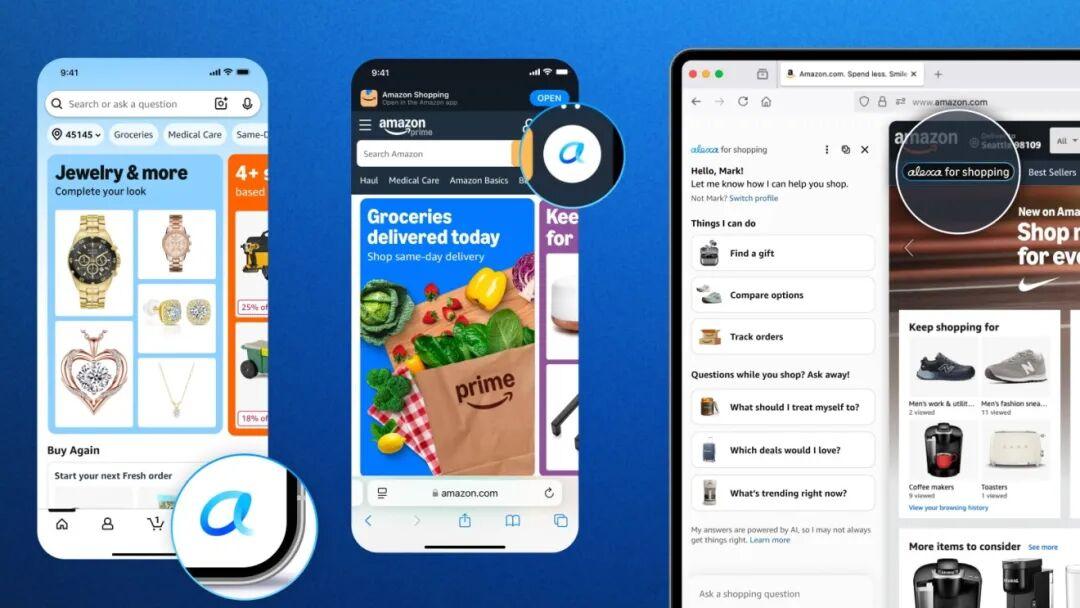
Image source: Amazon
Alexa for Shopping is a next-generation shopping assistant that incorporates consumer preferences, shopping history, and conversation history. It has adjusted the search mechanism at the technical level, delivering highly personalized product search results that vary from user to user. This is disrupting the two traditional product exposure channels — organic rankings and paid ad slots — and the traditional strategies aligned with those channels will inevitably be impacted.
Even identical search queries return different recommended products under the old and new logic sets. Sellers sensitive to changes in Amazon’s search results are already consulting marketing service providers about their Share of Voice (SOV) in AI recommendations.
The challenge facing sellers and marketing service providers has shifted to how to improve ad conversion rates from a holistic operational perspective. Ads will not disappear with the emergence of AI shopping assistants, but the way ads are consumed is likely to change, affecting which products can be discovered by AI.
Matt Yu, head of AI products at omnichannel intelligent ad optimization platform SparkX, explained: “Right now ads are targeted at consumers. In the future, many ads may be targeted at agents. But ads are still essentially an attention economy — the only difference is whose attention we are competing for.”
During product operations, merchants now need to persuade both consumers and AI. On this point, Liao Jun also noted: “If your product information can persuade people but is not optimized for AI extraction, you will lose a huge portion of traffic, because the visible space under AI recommendations is shrinking.”
Previously, products on the first five pages of Amazon’s search results were essentially visible to consumers, so sellers only needed to strive to rank among the top 50 or top 100 results, leaving a large margin for error. But Alexa for Shopping has narrowed that range: the AI only recommends a single-digit number of products. If a product does not make it into those recommendations, “for consumers, that product may as well not exist.”
AI stands between sellers and consumers as a traffic gatekeeper — products must pass AI’s vetting before reaching the consumer interface. Some sellers have observed that AI prefers answer-oriented information, so “stuffing keywords no longer works.”
Matt also pointed out that old product descriptions often used crude keyword stuffing to be easily indexed, which was not user-friendly for consumers and lacked sufficient semantic context for algorithms to capture for recommendations. This means keyword strategies that have been in use for more than a decade are losing effectiveness, and sellers need to shift from competing on price and keywords to selling scenarios and solutions to consumer needs.
But the reality is that many sellers are still choosing to wait and see, with most of those actively adapting currently being top brand sellers. “Sellers don’t know yet whether this change is good or bad, so they hope someone will be the first to ‘eat the crab’ and only make changes themselves after seeing positive results,” Liao added. Some sellers “know this is happening but don’t know what to do about it.”
Additionally, the emergence of Alexa for Shopping is testing the data monitoring and analysis capabilities of marketing service providers. Amazon has not yet disclosed the proportion of traffic driven by its AI shopping assistant, so helping sellers monitor traffic sources and measure ad effectiveness is a key priority for marketing service providers.
According to Liao, ad attribution has become more difficult because consumer conversations with AI shopping assistants are non-linear, making it hard to assess which specific factor influenced a purchase decision, leading to challenges in tracking ad performance. This, in turn, affects the effectiveness of services provided to sellers.

From “keyword stuffing” to “answering questions”: AI does not prioritize ads
The shift from keywords and rankings to semantics translates operationally to a change in mindset from “how to get my product discovered” to “how to make my product trusted.” AI will only recommend products to consumers after it understands and trusts them.
So how do you get AI to understand your product? According to consistent feedback from multiple service providers and merchants, the key lies in the comprehensive presentation of product information.
From A9 to Alexa for Shopping, no matter how Amazon’s recommendation logic changes, product listings remain a critical and unavoidable source of information for product retrieval. When similar products compete for limited AI recommendation slots, a listing is the equivalent of a “resume” that determines whether a product qualifies for the “interview” stage in front of consumers.
Marketing fluff does not add information value when read by AI, which prioritizes facts over vague adjectives. Clear factual descriptions such as precise data, structured parameters, applicable scenarios, and target audiences help AI accurately match products to consumers.

But this does not mean more content is always better; ensuring content consistency is far more important. Matt used ergonomic chairs as an example: “If you label it a gaming chair and then also call it an office chair, trying to fit every scenario, you may end up fitting none. The listing content should reflect the exact customer group the product is intended for.” Liao also emphasized the importance of consistency between images and text: “If the images and text descriptions do not match, AI will suspect there is a problem with your product.”
Ebrun has also learned through industry exchanges that consumer reviews, which naturally carry scenario context and are relatively neutral, are becoming increasingly important under the AI recommendation logic. Review endorsements are an advantage for merchants, but quality matters more than quantity. Reviews are not fully controllable: discrepancies between review content and seller-presented content, or low consumer ratings, can all impact AI recommendations.
Under the old operational logic, ad placement and content operated as separate systems, with the former responsible for boosting click-through rates and the latter for increasing conversion rates. But with the advent of AI recommendations, the two need to be operated in an integrated manner. Liao explained this judgment: “Right now, ads and content are a single entity. If your content is poorly written, you won’t even get click-through rates.”
While requirements are getting higher, the rules are quite fair for now: sellers cannot yet pay to have their products appear in Alexa for Shopping’s recommendation results. Liao pointed out that the tool functions as Amazon’s official shopping guide, selecting products from the shelf for consumers, and sellers cannot directly influence its recommendation results through ad placement. Whether a product is recommended therefore still depends on comprehensive factors including listings and reviews.
However, knowing how to adjust operations is not enough; sellers also care about whether those optimization efforts will actually deliver results. In this regard, Matt offered actionable advice: implement robust data monitoring and conduct stress tests. Sellers can use the Search Query Performance (SQP) reports provided in Amazon’s backend to identify which queries deliver higher conversion rates, then ask the AI shopping assistant the same queries as a consumer to see if their own products are recommended. They can also compare their products against recommended competitors to identify and fill gaps in product information.

Short-term parallel of old and new recommendation logic: Will sellers face a reshuffle?
The rewriting of Amazon’s traffic distribution rules will inevitably be accompanied by a restructuring of the interest landscape. Who can capture the AI recommendation dividend, who will be forced out by the AI wave, and how fast do sellers need to move to keep up with the development of AI recommendations?

Multiple service providers and merchants surveyed by Ebrun for this report noted that the clear beneficiaries of the AI shopping assistant can generally be categorized as premium, niche sellers and long-tail product sellers. Their common trait is clear product positioning, which naturally aligns with the AI shopping assistant’s recommendation logic focused on “who is this for, what scenarios is it for, and what problem does it solve.” As long as products are described clearly, the matching efficiency between people and products is far higher than with traditional search engines, giving previously hard-to-find products a chance to be seen.
Notably, small sellers are not necessarily at a disadvantage in this shift. Some small sellers have fewer products, allowing them to carry out refined management, and their flexible operational models can quickly adapt to the AI recommendation logic.
Conversely, many groups of sellers will be impacted. Sellers that previously succeeded by accumulating sales, stuffing high-volume keywords, and using bidding strategies may exit first, with dropshipping sellers and white-label sellers as typical examples. Additionally, commodity sellers facing severe homogenization and competing primarily on price wars may also be affected relatively early.
All of these judgments, however, are premised on whether consumer habits of using AI shopping assistants can be successfully cultivated. It is unrealistic for all consumers to rapidly adopt AI shopping assistants in a short period. Liao believes it remains to be seen whether the current hype around Alexa for Shopping reflects a temporary novelty for consumers or a permanent shift in consumption behavior patterns.
“In the short term, traditional search is still the base. Sellers need to first defend their existing search traffic stock before competing for the incremental traffic from AI recommendations,” Liao said. This means bidding and ranking strategies still have room to function. But “the iceberg below sea level has enormous volume.” In the long run, AI as a shopping traffic entrance is an irreversible trend, and centralized traditional search will eventually decline.
According to Matt’s analysis, Amazon’s replacement of Rufus with Alexa for Shopping shows “Amazon is playing a very long game.” Going back to the beginning of the story, Alexa was originally just a voice assistant built into Amazon’s Echo speakers, but after more than a decade of development, it has significantly higher market recognition than Rufus. The launch of Alexa for Shopping has sparked speculation that Amazon is leveraging Alexa’s brand awareness to boost consumer acceptance of its AI shopping assistant.
“Whether it’s the Amazon website or devices like Echo, they are all entrances for Alexa for Shopping from Amazon’s perspective,” Matt said. He judges that it is not just a simple shopping assistant, but is building an entire ecosystem. It will eventually compete with similar rivals such as ChatGPT Shopping, but consumer search mindshare is likely to remain with Amazon.
This judgment on the competitive outcome is tied to Amazon’s focus on consumer experience. Liao believes Amazon’s extremely extensive product selection and neutral image are advantages for its AI shopping assistant. The evolution of its search logic from start to finish is essentially centered on better understanding and matching consumer needs. AI recommendations have no obvious commercial bias, which reassures consumers and drives retention.
These assessments of Amazon’s shopping assistant development trends have also given sellers a degree of reassurance. As Matt put it: “There’s no need to panic too much, but you need to be prepared. When massive changes actually happen, you’ll be ready.”
Alexa for Shopping is rewriting Amazon’s traffic distribution logic. Sellers that once curried favor with search algorithms now also need to cater to AI. But beyond the changes, a core principle is being reaffirmed for sellers: rankings can be a nice bonus, but rankings disconnected from product quality and consumer needs are meaningless. To be chosen, a product’s inherent problem-solving ability is the universal rule.
Ebrun is continuing to track and report on this development. To learn more information related to this article, please scan the QR code to follow the author’s WeChat account.

[Copyright Notice] Ebrun advocates respecting and protecting intellectual property rights. Without permission, no one is allowed to copy, reproduce, or use the content of this website in any other way. If any copyright issues are found in the articles on this website, please provide copyright questions, identification, proof of copyright, contact information, etc. and send an email to run@ebrun.com. We will communicate and handle it in a timely manner.
Translated by AI. Feedback: run@ebrun.com