
Listed at RMB 200,000 per Account and Marred by Frequent Scandals: Why Are Cross-Border Sellers Still Snapping Up 'Local Accounts'?

By Li Mengqi | Edited by He Yang
【Ebrun Original】News that a batch of Chinese sellers' local stores on a cross-border e-commerce platform were suddenly shut down disrupted the calm of August.
The incident involved a Shenzhen-based service provider specializing in Latin American local accounts, where over 1,000 of the Brazilian local store entities it provided gradually encountered abnormalities. Sub-accounts of the stores were suspended, master accounts triggered facial recognition or KYC verification, and some sellers even faced frozen payments, resulting in massive losses for affected sellers.
Such incidents are far from unprecedented. In February this year, for example, a service provider offering local store registration, operation outsourcing, and foreign exchange settlement services collapsed, affecting hundreds of sellers and sparking widespread concern across the industry.
These successive local account controversies have pushed a business that long operated in the hidden corners of the cross-border industry into the spotlight.
So-called local accounts generally refer to e-commerce platform store accounts registered under overseas local corporate entities. Compared to cross-border stores registered under Chinese entities, local accounts can meet certain platforms' requirements for entity identity, product categories, or operation rules. For Chinese sellers, they may be a prerequisite for entering specific markets and categories, and are also perceived to offer operational advantages in terms of traffic, profit margins, and growth potential.
However, setting up a local store requires resolving issues such as overseas entity registration, local identity verification, and follow-up platform checks, which present a high barrier for small and medium-sized sellers without overseas teams and local resources. As a result, a large number of sellers opt to purchase ready-made accounts directly, spawning an entire industrial chain centered on local account trading. Service providers organize local corporate entities and resources overseas, then package and sell e-commerce platform store accounts with local identities to sellers.

This practice has become commonplace in the industry, with "local accounts" for various platforms and major markets widely circulated in the market. Nevertheless, successive scandals have exposed loopholes and risks in this trading model: a problem in any single link can disrupt the entire operation. Moreover, against the backdrop of increasingly stringent compliance policies, this practice itself more or less crosses regulatory red lines. Are merchants paying high prices for accounts to acquire genuine operational advantages, or to pay for an unproven expectation? What problems does the business built around local accounts solve, and what risks does it amplify?

'Local Accounts' on Cross-Border E-Commerce Platforms Become Hot Commodities
According to one cross-border seller, local accounts for some popular platforms are now quoted at nearly RMB 200,000 this year, and ready-made accounts are often out of stock, requiring sellers to join a waiting list.
The price reflects both the cost of registering and maintaining overseas entities, and indirectly confirms the strong demand for local accounts among merchants.
Initially, local accounts solved market access issues for some merchants.
An industry veteran with long experience serving cross-border sellers told Ebrun that demand for overseas entity registration, local store opening, and account transfer emerged as early as 2017-2018. The reason is that different platforms set different access rules, open categories, and operational requirements for cross-border and local entities, with some platforms only accepting registrations from local companies, and some highly regulated categories prioritizing access for local merchants.
For Chinese sellers looking to enter these markets and categories, a local entity is first and foremost an entry ticket. At the same time, some merchants discovered in their operations that local stores may also enjoy preferential resources from platforms. As a result, some sellers who could have continued operating cross-border stores began actively seeking local accounts.
"Local stores are the platform's 'biological children,'" one seller joked. According to his observation, cross-border stores registered with Chinese business licenses are more prone to risk control issues on some platforms, while local stores have advantages in traffic, conversion rates, category access, and account stability. "The platform allocates traffic, so conversion rates surge. We can also operate high-margin categories."
Traffic support is one of the most frequently cited advantages when sellers discuss local accounts. While no one has yet provided conclusive evidence that platforms have explicit, universal traffic preference policies for local stores, some merchants remain convinced that products from local stores have the opportunity to gain more exposure.
"The platform's search algorithm counts local entities and local shipping as core weighting factors, so for identical products, local stores are more likely to rank in the first few pages of search results," a local account service provider said, adding that this gap in organic traffic becomes even more pronounced during major promotion events.
The improved consumer experience brought by localized fulfillment also seems to further boost the traffic performance of products and stores under local accounts. Some merchants believe that most overseas consumers prefer to buy from local stores that ship locally, and have inherent distrust in the fulfillment of products from cross-border stores.
A merchant operating in the Russian market cited an example: cross-border stores on a local platform have a logistics lead time of 10-30 days, while local stores using overseas warehouses can shorten this to 3-7 days. Local stores not only reduce consumers' concerns about after-sales service, but also significantly cut freight and return/exchange costs through faster local fulfillment. "After switching from a cross-border account to a local account, our negative review rate dropped by 90%, and our repurchase rate also increased," the merchant said.
In fact, traffic performance is affected by many factors, and localized fulfillment is not exclusive to local stores — cross-border store merchants can also stock goods in overseas warehouses to achieve local shipping. However, some industry insiders believe that local accounts can indeed help sellers gain direct advantages in terms of the competitive environment.
"On a platform or in a category with fewer Chinese merchants, business is usually easier," the aforementioned industry insider pointed out. When operating cross-border stores, Chinese sellers often have to compete with a large number of Chinese merchants with homogeneous supply chains and operational methods. After entering platforms or categories mainly operated by local merchants, the competitive landscape changes, and Chinese merchants' supply chain efficiency, product selection capabilities, and operational experience may form relatively obvious advantages.
Beyond the allure of higher sales and profits, the capital circulation efficiency of local accounts is also one of the factors merchants care most about.
Some sellers believe that overseas companies and their corresponding corporate collection accounts are more in line with local business needs in terms of fund receipt, capital turnover, and long-term operation, and can also reduce costs incurred by cross-currency conversion. One seller noted, for example, that some platforms usually do not charge transaction fees for USD transfers to US bank accounts, but cross-currency transfers to accounts in other countries incur certain conversion costs. If using a personal account to receive funds, there will be additional collection fee costs, as well as the risk of account freezing. For sellers with expanding business scales, matching store entities, collection systems, and local operations is also seen as a way to improve operational stability.
From a rigid requirement for accessing specific platforms and categories to expectations for better traffic, fulfillment, competitive environment, and capital efficiency, owning a local account has gradually evolved from an access issue that a small number of merchants had to solve into an operational resource that more and more people actively seek.
The cost for sellers to register an overseas company on their own is not necessarily high. According to a service provider, the basic cost of registering a company in the US may only be a few thousand RMB, while in some European countries it may range from tens of thousands to over a hundred thousand RMB. But the real barrier is that merchants also need to handle bank account opening, company address maintenance, bookkeeping and tax declaration, which involve different institutions and local resources and require long-term maintenance by professionals. An even greater difficulty is that some platforms require directors or legal representatives to have local identity.
For enterprises with overseas teams and corporate systems, these capabilities can be built in a short time and pose no problem. But the broader group of small and medium-sized sellers lack the corresponding professional capabilities and local resources, so purchasing ready-made local accounts has become a relatively convenient path.

Local Accounts Are Far More Than Just an Account
According to Ebrun's understanding, the "supply" side of local account transactions in the current cross-border e-commerce industry mainly comes from three types of service providers.
The first type originally engaged in overseas corporate services, handling overseas company registration, bank account opening and other businesses for Chinese enterprises, and later extended local e-commerce platform account registration into a new service item.
The second type comes from the cross-border e-commerce comprehensive service industry. They combine local accounts with services such as overseas warehousing, logistics, and fund repatriation to provide multiple services to sellers simultaneously.
The third type is closer to what the industry calls "account traders" or resource brokers. They usually organize local companies, legal representatives, and already applied platform accounts directly, then resell these resources to sellers. Further upstream, there are providers of local companies, legal representatives, addresses and other resources.
The aforementioned cross-border service provider said that the resources held by "account traders" are not necessarily fully owned by them; they obtain the right to use entities from these upstream resource providers through purchase, lease or cooperation, and then use them to apply for platform stores. "Most service providers usually do not hoard a large number of ready-made accounts for a long time. Popular resources are mostly handled through pre-order and temporary matching, and a single set of accounts may also circulate between different service providers," he said.
This also means that the supply of local accounts held by such "account traders" is difficult to standardize. "Most of these account traders are self-employed, and many do not even have a formal company name," the service provider revealed. Although local account transactions cover many platforms, countries and regions, they are difficult to scale up due to supply constraints.
Currently, local account transactions in the market cover multiple mainstream e-commerce platforms, including Amazon, TikTok Shop, Mercado Libre, Ozon, etc., involving markets such as the US, Europe, Latin America, Russia and Southeast Asia.
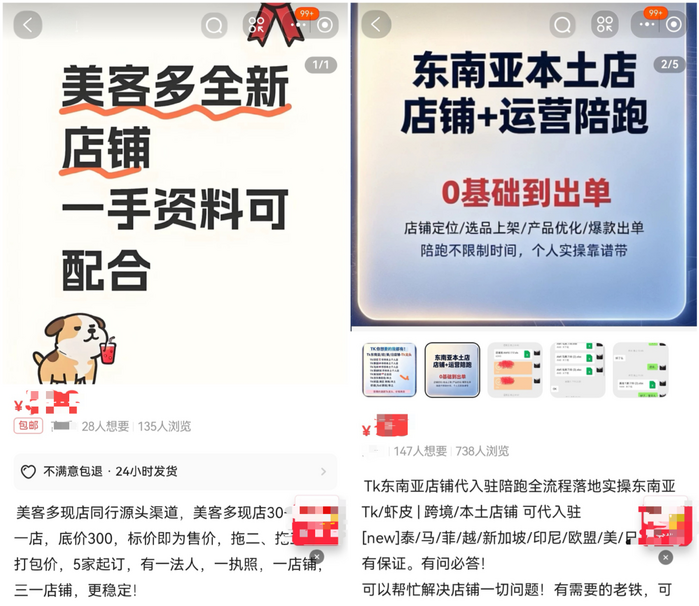
Image source: Xianyu
Account forms also vary across platforms, including both stores registered under overseas corporate entities and personal local stores. For example, TikTok Shop in Southeast Asia, Latin America and the US itself allows sellers to register with local personal identities. On second-hand trading platforms such as Xianyu, a large number of transfer information for TikTok Shop personal local accounts can also be found.
Among them, the price of ordinary personal accounts and basic store resources is generally below RMB 1,000, and some personal accounts can be purchased for less than RMB 200. Accounts bound to corporate entities, local legal representatives and follow-up verification services are priced roughly below RMB 10,000, with some reaching tens of thousands of RMB. Accounts for popular platforms or scarce resources can be priced close to RMB 200,000. "The profit margin of the platform and the available supply in the market basically determine the price range of local accounts," the aforementioned service provider explained.
Higher-priced local accounts do not mean lower risks, more comprehensive services, or better stability. Since the supply of these accounts depends on different entities and resource providers, even after a local account transaction is completed, the company, legal representative and certification materials behind some accounts are not fully controlled by the merchant, so subsequent operations still require continuous cooperation from the service provider or even upstream resource providers. For example, platforms may re-verify the entity identity during subsequent operations, requiring the submission of company materials, address proof, or arranging for the legal representative to participate in video verification. Merchants may trigger risk control at any time and face stricter secondary reviews.
It is reported that the more than 1,000 Brazilian local accounts involved in the August scandal mentioned at the beginning of this article were suspended because the service provider shared registered addresses and email domain names among multiple corporate entities to reduce the registration and maintenance costs of local entities, triggering platform audits and causing direct operational losses to merchants.
Similar risks are not uncommon in local account operations. The aforementioned service provider mentioned, "Sometimes when an employee leaves, you may lose contact with the relevant person entirely." Especially when there is no direct connection between the overseas legal representative and the Chinese merchant, problems have to be relayed through multiple layers of service providers, making processing time and outcomes highly unpredictable.
Beyond account qualifications, merchants still need to build corresponding local fulfillment capabilities. "Every link must be implemented in accordance with the standards of local companies," the service provider said. For example, some European platforms require sellers to provide customer support in local languages, EU-based warehousing, and European return addresses, and some platforms also require sellers to set up a complete return process. Therefore, even if a merchant successfully purchases a local account, warehousing, logistics, customer service and after-sales still require continuous investment from the enterprise. Few local account service providers will continue to participate in this process.
These risks and requirements together constitute the real threshold for local accounts. "Some merchants think that spending some money to buy an account is enough, but there are many more investments to bear in actual operation. And if any link goes wrong, the previous investment may become worthless," the service provider said bluntly.

You Can Buy a Local Account, But You Can't Buy Genuine Growth
Successive scandals involving local account service providers further warn merchants that while the reliability of the chosen service provider is an issue, the real risk comes from the transaction method itself.
For merchants who really need a local entity to enter a certain platform or category, a more prudent approach is to first establish an operating entity in accordance with the public rules of the target platform, ensuring that the actual operator, company information and information submitted to the platform form a long-term, authentic correspondence, and that key account permissions and verification materials are controlled by the enterprise itself as much as possible. An industry insider told Ebrun that when third parties are needed to handle company registration, local administrative processes or daily services, service providers should be kept in the role of "service providers" as much as possible. He pointed out that if the platform explicitly prohibits the transfer of seller accounts, then directly purchasing an existing account itself requires re-evaluation.
Resolving the above issues only means that the merchant has a relatively sustainable operating identity. A local account is not necessarily a ticket to more resource preference or business growth. In the view of the aforementioned industry insider, a deeper misconception in this narrative is that some merchants equate "local accounts" with "localization."
In response, a seller operating European marketplaces told Ebrun that local accounts may have a certain positive impact on conversion rates, but it is difficult to form an overwhelming advantage. Moreover, when the product itself is not competitive and is highly homogeneous, the entity identity cannot support higher pricing.
Factors that truly influence consumer decisions include whether the product meets local demand, whether brand messaging is understandable, whether the price matches the market, whether logistics and after-sales services are stable, and the enterprise's understanding of local culture and consumption habits. These capabilities together form a broader sense of localization — which occurs across a series of operational links including products, marketing, channels, fulfillment and organization. A local account is just one type of entity and channel tool that sellers can choose when entering certain markets.

"You can't overstate its role, nor can you use it to cover up deficiencies in operational capabilities. If you are convinced that a local account is the key factor to solve your business growth problems, then do it properly and in compliance," the seller said. "Sometimes, the shortcut is actually the longest path."
Specifically, on the product side, enterprises need to understand the needs of local consumers and adjust corresponding designs and pricing. On the marketing side, content expression, channel selection and brand positioning should also conform to the characteristics and needs of the local market and target audience. He further stated that as the enterprise's operating scale gradually expands, investments in local warehousing, employees and corporate entities will be gradually deployed. "Localization is an ongoing effort, and enterprises need to adjust repeatedly during operations."
The aforementioned senior service provider pointed out that for merchants facing clear access restrictions and who already have local fulfillment and operational capabilities, local accounts can indeed help them fill in key conditions. But for novice sellers who are still in the stage of verifying products and business models, or even just testing the waters, a local account is difficult to deliver value even if it brings stable traffic, if they have not yet found matching demand and target audiences.
"It can help enterprises enter more markets and amplify the advantages brought by supply chain and operational efficiency. But when enterprises lack basic capabilities, local accounts may also amplify costs and risks, becoming a 'negative leverage,'" he concluded.
Ebrun is continuously tracking and reporting on this development. To learn more information related to this article, please scan the QR code to follow the author's WeChat.

[Copyright Notice] Ebrun advocates respecting and protecting intellectual property rights. Without permission, no one is allowed to copy, reproduce, or use the content of this website in any other way. If any copyright issues are found in the articles on this website, please provide copyright questions, identification, proof of copyright, contact information, etc. and send an email to run@ebrun.com. We will communicate and handle it in a timely manner.
Translated by AI. Feedback: run@ebrun.com