
GMV Surges 44% to $21.9B, Cross-Border Business Jumps 60% YoY! Mercado Libre Posts Strong Q2 Results
[Ebrun Original] August 11 -- Latin American e-commerce and fintech giant Mercado Libre recently released its financial results for the second quarter of 2026, logging accelerated expansion across its two core business segments: e-commerce and advertising.
According to the earnings report, the company's net revenue plus financial income reached $10.2 billion in the quarter, up 50% year-on-year in U.S. dollar terms. This marks the 30th consecutive quarter of over 30% growth, the fastest pace in nearly four years, and the first time the company has exceeded $10 billion in quarterly revenue. Operating profit came in at $683 million, with an operating margin of 6.7%, largely flat quarter-on-quarter.
Meanwhile, the company's e-commerce business gained comprehensive momentum across key Latin American markets, with gross merchandise value (GMV) and units sold hitting new all-time highs.
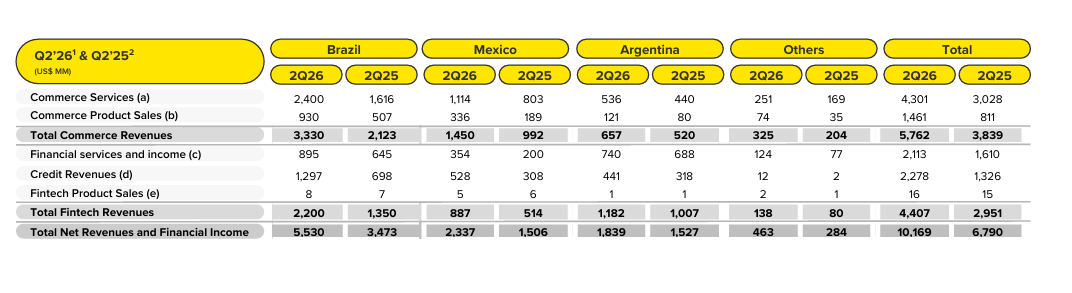
During the reporting period, Mercado Libre's quarterly GMV reached $21.9 billion, up 44% year-on-year; total units sold on the platform hit 795.4 million, rising 45% year-on-year.
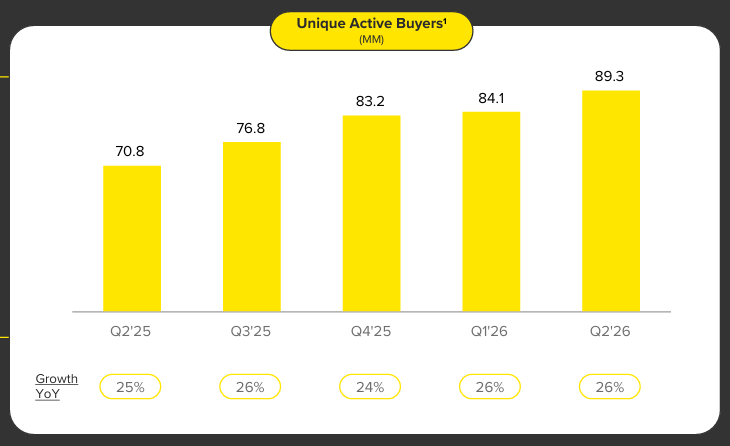
Unique buyers exceeded 89.3 million, up 26% year-on-year, while average purchases per user reached 8.9 units, climbing 14% year-on-year, indicating sustained improvements in user activity and purchase frequency on the platform.
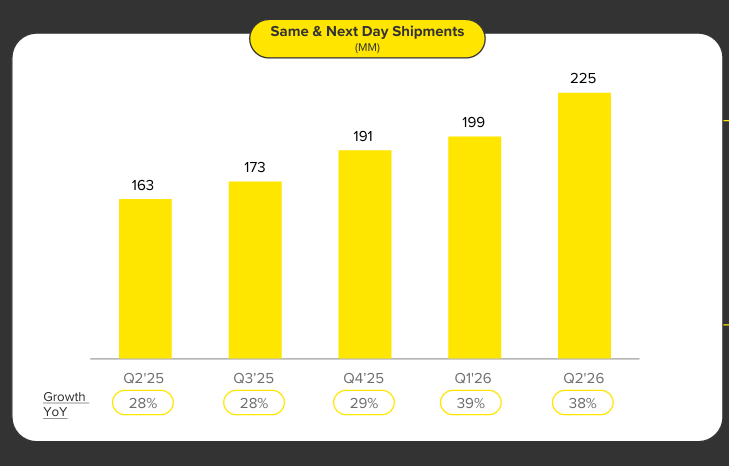
In terms of logistics fulfillment, same-day and next-day delivery orders reached 225 million, up 38% year-on-year. As the company continues to expand its logistics infrastructure, its delivery efficiency in the Latin American market has further improved.
By region, the Brazilian market remained a key growth engine for Mercado Libre, delivering the most standout performance.
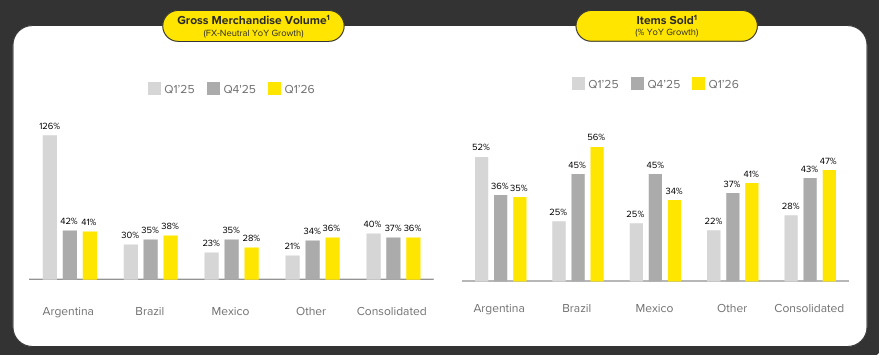
In the second quarter of 2026, units sold in Brazil rose 56% year-on-year, active buyers increased 29% year-on-year, and average purchases per buyer grew 19% year-on-year.
The earnings call noted that the platform's depth of engagement with consumers in Brazil is improving significantly:
the ratio of daily active users to monthly active users has hit its first inflection point, with DAU growth accelerating each quarter since the platform lowered its free shipping threshold. New buyers that joined after the policy adjustment purchased more product categories across a wider assortment one year on, and boasted higher retention rates than groups that joined earlier; The share of users purchasing from three or more categories rose nearly 6 percentage points year-on-year to an all-time high.
At the same time, the unit economics of free shipping fulfillment services in the Brazilian market has continued to improve.
Driven by technology, economies of scale, and efficient utilization of previously underutilized "idle capacity", delivery costs in the Brazilian market have continued to fall. The slower free shipping option is now economically viable for nearly half of the product price brackets tracked by Mercado Libre, which range from 19 reais to 79 reais.
Building on this progress, Mercado Libre launched PIX discounts for buyers in April, and offered commission rate discounts for sellers with competitively priced products in specific categories and price bands. As a result, the price competitiveness index of its products improved significantly, and the number of active sellers surged -- rising 29% year-on-year in the second quarter of 2026.
Other core markets also maintained rapid growth.
The Mexican market posted a 34% year-on-year increase in units sold and 28% year-on-year GMV growth, delivering solid performance despite temporary headwinds from tax reform, with the pharmaceutical category emerging as a successful area for supply expansion on the platform;
The Argentine market saw units sold rise 22% year-on-year and GMV increase 38% year-on-year, effectively navigating challenges posed by the local macro consumption environment;
Other markets registered a 41% year-on-year rise in units sold and 36% year-on-year GMV growth.
Notably, Mercado Libre's Cross-Border Trade (CBT) business continued its rapid expansion trajectory.
In the second quarter of 2026, cross-border GMV rose 60% year-on-year. Mexico remains the largest cross-border market for Mercado Libre, while Argentina, Brazil and other regions are growing even faster -- all three posting triple-digit growth. And cross-border trade now accounts for almost twice the share of GMV in smaller countries as it did in the same period last year.
In addition, the China fulfillment center was one of the highlights of this quarter's earnings report. Thousands of sellers currently operate through the center, with transaction volume rising 170% quarter-on-quarter. The fulfillment center has further lifted service standards through faster delivery and lower order cancellation rates, actively driving improvements in net promoter score, and optimizing user retention and repurchase rates.
On the advertising front, Mercado Ads continued its high-growth momentum.
This quarter, Mercado Libre's share of the Latin American digital advertising market exceeded 10% for the first time, with revenue rising 73% year-on-year in U.S. dollar terms.
Growth drivers have expanded comprehensively from the traditional self-service model to diversified channels including cross-border business and top brands.
Advertising services tied to seasonal shopping events such as Hot Sale and Cyber Day delivered particularly strong performance. In addition, advertising spending for low-priced goods also grew rapidly.
Affiliate marketing was one of the key areas where Mercado Libre accelerated investment this quarter.
The company's shareholder letter stated that the share of GMV driven by affiliate marketing increased across all regional markets. Furthermore, consumers drawn into Mercado Libre's shopping ecosystem through affiliate channels have significantly higher retention rates than non-affiliate consumers. This indicates that affiliate marketing not only drives one-off purchases, but also attracts higher-quality customer groups.
The accelerating penetration of AI marketing tools is also noteworthy for sellers.
Data shows that Mercado Ads' AI advisor reaches sellers via WhatsApp, analyzes campaigns in real time, and provides fully automated budget and return on ad spend (ROAS) recommendations without human intervention. Currently, the tool has expanded from a small-scale pilot to serving tens of thousands of sellers per month. And the number of sellers using the AI-powered budget orchestrator -- which helps sellers manage spending across multiple campaigns -- also rose 63% quarter-on-quarter in the second quarter.
In the payments segment, driven by strong momentum across the two core business lines, Mercado Pago's total payment volume (TPV) exceeded $100 billion for the first time in history, reaching $101 billion, up 56% year-on-year in U.S. dollar terms. Monthly active users (MAU) hit 88 million, up 30% year-on-year, with particularly strong performance in Brazil and Mexico, where MAU growth accelerated to 38% and 45% respectively.
Finally, investment in AI technology was another key development for Mercado Libre this quarter.
Mercado Libre CEO Ariel Szarfsztejn said on the earnings call that the company is working on "two major e-commerce initiatives" in the AI agent space. First, it is improving search functionality through artificial intelligence. which has already generated positive results for the e-commerce platform's conversion rate and units sold, while also benefiting the advertising business: the more AI deployed in search, the more accurate the context the platform can provide, allowing it to better display high-click-through-rate ads to consumers, which in turn drives higher revenue.
Second, the company is launching a shopping assistant. Currently, Mercado Libre's AI shopping assistant is currently in the testing phase. But the company said it is very excited about the proven early results.
These achievements are underpinned by the platform's growing investment in AI R&D.
Szarfsztejn explicitly noted that, the company's investment in the AI sector has increased significantly compared to a little over a year ago: AI R&D spending in the quarter reached approximately $80 million, up from the same period last year.
Moreover, AI technology upgrades have not only driven revenue growth, but also delivered cost optimization benefits.
A figure disclosed by the company during the earnings call illustrates this trend: four years ago, the platform had 10,000 customer service representatives; and in the second quarter, that number was reduced to 7,000, despite tripling its business volume; Today, 90% of customer service interactions are completed without human involvement.
On the product development front, aided by artificial intelligence, product development expenses as a share of revenue fell to 7.2% from 8.4% year-on-year.
Commenting on the results, Mercado Libre CFO Martin de los Santos said that Mercado Libre and Mercado Pago have become a daily habit for people across Latin America, and the company will continue to invest prudently and with discipline, focusing on reducing friction to deepen user engagement. "We firmly believe this is the right path to create the best long-term value proposition for our consumers," he said.
Ebrun is continuing to track developments related to this report. For more information related to this article, scan the QR code to follow the author on WeChat.

[Copyright Notice] Ebrun advocates respecting and protecting intellectual property rights. Without permission, no one is allowed to copy, reproduce, or use the content of this website in any other way. If any copyright issues are found in the articles on this website, please provide copyright questions, identification, proof of copyright, contact information, etc. and send an email to run@ebrun.com. We will communicate and handle it in a timely manner.
Translated by AI. Feedback: run@ebrun.com