
Focus Media's Jason Jiang: The Next Phase of Global Expansion Rides on the 'Algorithm of Consumer Sentiment'
From elevator lobbies to urban lifestyle ecosystems worldwide, what Focus Media is replicating is not merely a network of digital screens, but a full operational logic centered on attention, branding, and growth.
【Ebrun Original】In 2003, while waiting for an elevator in a shopping mall, Jason Jiang came up with a seemingly straightforward idea: instead of competing for viewers across 120 TV channels, why not install a screen at elevator entrances, a space people pass through every day with no option to switch channels?
Twenty-three years later, this idea that started with just three screens has grown into a media network covering urban work and living spaces. According to Focus Media's 2025 annual report, the company generated operating revenue of RMB 12.759 billion in 2025. As of March 31, 2026, it operated approximately 2.284 million self-owned media assets, with its lifestyle media network covering around 350 cities in mainland China, the Hong Kong Special Administrative Region, as well as markets including South Korea, Thailand, Singapore, Indonesia, Malaysia, Vietnam, India, Japan, the United Arab Emirates, and Australia.
Beyond scale, what is more notable is Jiang's redefinition of this business. In his view, Focus Media is not a company that simply "sells ad slots"; what it actually operates is the stable daily routines of urban populations. A brand, meanwhile, is not an extra marketing budget to be added only when traffic is insufficient, but an essential infrastructure that determines whether a company can escape price wars and platform dependency to regain operational initiative.
This is the point Jiang repeatedly emphasized in his sharing: "Traffic buys you users, but a brand wins you people's hearts."
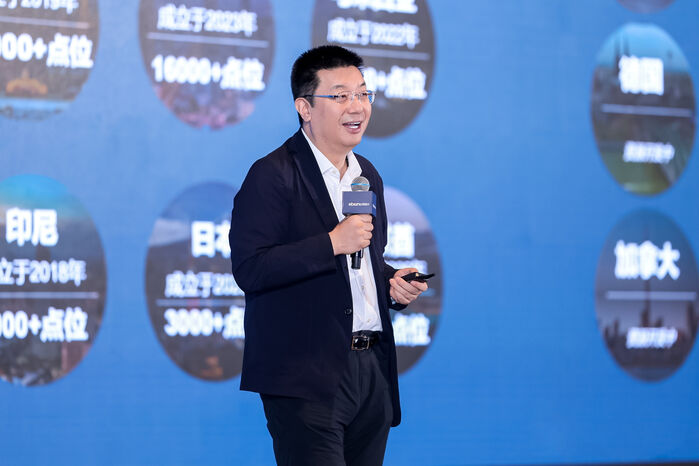
Jason Jiang, Chairman, President and Chief Executive Officer of Focus Media
01 Global expansion is about replicating underlying logic, not surface models
Jiang does not shy away from his earlier hesitation about globalization.
When Focus Media listed on the NASDAQ in 2005, U.S. investors repeatedly asked: Why has no similar model emerged in the U.S.? At the time, he explained that "U.S. residential buildings are low-rise," and thus concluded the U.S. market was not suitable for Focus Media's model. Looking back years later, he admits this judgment was limited by his existing experience, causing Focus Media to miss a window for overseas expansion.
The significance of this review is not just about whether Focus Media should have entered the U.S. earlier, but about how a company understands "model replicability." In the past, when Chinese companies discussed going global, they would first ask whether the market was large enough, whether channels were mature, and whether there were similar local products. Focus Media's overseas expansion, however, first looks for another set of conditions: whether the urban population is highly concentrated, whether middle-class groups cluster in apartment buildings, office towers and commercial centers, whether media locations can achieve sufficient density, and whether the company is willing to bear the long-term investment required in the initial stage of network building.
In 2017, Focus Media first entered South Korea. It has since gradually expanded its network to Southeast Asia, the Middle East, Japan and Australia. According to the company's annual report, as of March 31, 2026, Focus Media's overseas subsidiaries operate approximately 167,000 elevator TV media devices and around 24,000 elevator poster media assets.
Jiang summarizes this overseas strategy as "capturing the core lifestyle circles of capital cities": prioritizing entry into cities with the highest concentration of purchasing power, using office towers, apartment buildings, shopping malls and supermarkets as anchors to increase reach density among core demographic groups. In other words, what is being replicated overseas is not a rigid organizational structure, but the underlying model of "achieving location density first, then building scale efficiency."
This also explains why Jiang views elevator media as a business that is "difficult at first, easy later." Once the network crosses a critical threshold, new clients can be served on the existing infrastructure. But before reaching that threshold, companies must endure a lengthy construction cycle.
02 Focus Media sells not ad slots, but the attention of urban dwellers
Jiang says Focus Media has only done "one round of R&D" which it has refined for more than 20 years. That R&D was not about hardware technology, but about recombining attention scenarios. Before founding Focus Media, he worked in advertising agency services for a decade, and had long wanted to enter the TV advertising sector, but lacked the access to do so. Later, he realized that the most valuable part of TV was not the "television" itself, but its ability to capture attention in a closed space through consistent content. As a result, Focus Media moved TV's communication logic from the living room to elevator entrances: instead of chasing landmark locations or occasional foot traffic scenarios, it targets the mandatory routes people take to go to work and home every day.
This model rests on four core elements: mandatory exposure, closed environment, high frequency, and complete messaging. Mandatory exposure ensures consistent reach, the closed environment reduces attention distraction, high frequency builds memory, and the short but unskippable dwell time allows a complete brand message to be received. Individually, none of these elements are new; combined, they turn urban daily routines into a scalable media resource.
More importantly, this medium is not content-centric. Over the past 20 years, consumers' information and entertainment portals have shifted from television to long-form video, then to short-form video, with content platforms constantly changing. But the physical routes people take to work and home have not disappeared in tandem. This has given Focus Media a stability that is relatively independent of content cycles.
Still, stability does not mean no evolution is needed. In the past, Focus Media's judgment of whether a building was suitable for advertising relied more on housing prices, commercial district positioning and manual experience. Today, the company lists "tailored advertising per building," "large-scale precision targeting," and post-launch data feedback as key directions of its digital capabilities in its annual report. Jiang also notes that Focus Media is working with internet platforms and data technology companies to better identify demographic structures, optimize building selection, and track changes in search, browsing and conversion after ad exposure. Today, Focus Media's elevator media not only boasts unique advantages of "high reach, high attention, high frequency, and high completion rate," but has also achieved industry-leading intelligent digital service capabilities of "precision targeting, attribution tracking, interactive features, and continuous optimization" through multiple scenario innovations.
This means offline media and digital marketing are not an either-or choice. What Focus Media is trying to build is a closed loop of "centralized brand seeding + digital validation": driving broad awareness on the front end, and using data on the back end to determine whether reach has translated into active search and transaction conversion.
03 Traffic solves reach, brands solve preference
Jiang's assessment of the current consumer market is straightforward: as demographic dividends fade, online customer acquisition costs rise, and platform algorithms become increasingly opaque, the room for growth relying solely on paid traffic is narrowing.
This does not mean companies no longer need traffic, but that the role of traffic in operations is changing. In the past, traffic arbitrage opportunities could directly drive sales, allowing companies to first buy exposure and then optimize conversion. But as more merchants compete for the same group of users, traffic costs erode profits, and short-term conversions rarely translate into long-term assets.
Jiang summarizes this difference as "products finding people" versus "people finding products." The former relies on platforms pushing products to potential consumers, while the latter means consumers have formed clear awareness and will actively search for and choose a specific brand. Traffic solves one-time reach, while brands solve sustained preference.
In his view, many companies cutting brand investment when facing performance pressure essentially reverses cause and effect. A brand is not an add-on separate from sales; it is the reason consumers "choose you over others." Channels, distribution and traffic operations are responsible for amplifying this reason, which ultimately translates into sales and profits. If companies only track clicks, conversions and ROI without establishing a clear reason for consumers to choose them, they will only be forced to constantly patch problems at the outcome level.
But Jiang also emphasizes that a brand cannot compensate for a flawed product. "The product is the 1 in front, and the brand is the 0s that come after." If a product does not solve real consumer needs, the wider its promotion, the bigger its problems will be amplified.
He therefore breaks down brand growth into two steps. The first step is to achieve "value upgrading" for the product: instead of just adding specifications and costs, companies need to identify functional, emotional or identity value that consumers can perceive and are willing to pay for. The second step is to condense this value into a clear, differentiated, and memorable message.
At the 2026 Global New Brand AI Competitiveness Private Board, co-hosted by Ebrun and Focus Media, Jiang explained this approach using partner cases including Baixiang, Weilong, and Taranis: companies should not first decide how much to spend on advertising, but first identify the most worthy aspect of their product to amplify. For example, whether a product delivers clearer quality assurance, solves a specific consumer anxiety, or occupies a yet untapped usage scenario. Only when that core value is clear can advertising become an effective amplifier.
One metric he repeatedly emphasizes is active search. Compared to immediate transactions driven by a single exposure, whether consumers remember the brand, whether they search for it actively, and whether search volume grows sustainably are much closer indicators of whether the "people finding products" dynamic has formed. For companies, this means brand budgets should not be evaluated solely by last-click transactions, but also by whether they expand the user base, improve subsequent conversion rates, and gradually reduce reliance on paid traffic.
04 Chinese brands going global need to shift from selling products to building awareness
If the domestic market is transitioning from a traffic dividend era to a brand compound interest era, Jiang believes Chinese companies' global expansion has reached a similar inflection point.
In the past, Chinese manufacturers quickly entered global markets relying on supply chain efficiency and price advantages, but low prices can only help companies open a door, they cannot automatically form a long-term moat. On one hand, platform traffic, promotional discounts and channel subsidies can drive sales in the short term. On the other hand, if the only thing consumers remember is "cheap," companies will struggle to command premiums, and will find it difficult to support local channels, service networks and sustained investment.
Jiang summarizes this difference as three transitions: from solely emphasizing cost-effectiveness to upgrading product value, from selling unbranded goods to building brand mindshare, and from over-relying on in-platform traffic to driving off-platform awareness and social consensus.
Anker is an example he cites repeatedly. In the charging accessories category, where supply chains are mature and similar products abound, consumers are willing to choose a higher-priced brand not just for its specifications, but to reduce the cost of quality judgment and after-sales decision-making. In other words, a brand provides certainty. What Chinese companies can truly bring to global markets should not only be production efficiency, but also value propositions that are understood and trusted by local consumers.
But brand globalization cannot simply copy Chinese advertising campaigns. While fundamental user values may be universal, local media structures, residential patterns, channel relationships and cultural contexts are not identical. Focus Media's choice of local partners overseas and its priority on covering core business districts in capital cities illustrates that globalization is not just translating domestic solutions into another language, but retaining the underlying mechanism while rebuilding a local execution system.
At this level, Focus Media's overseas expansion and Chinese brands' globalization are mutually reinforcing: Focus Media needs Chinese global brands as early clients, while Chinese brands need communication networks that are closer to local consumers' living spaces. Jiang introduced at the event that Focus Media's overseas client base currently consists of Chinese global brands, international brands, and local brands. This structure shows that Focus Media wants to be more than just an overseas advertising channel for Chinese clients; it aims to become part of the local urban lifestyle ecosystem.
05 The next competition is about the "algorithm of consumer sentiment"
Jiang likes to contrast the "algorithm of consumer sentiment" with platform algorithms. Platform algorithms excel at identifying who might buy and how to improve single conversion rates. The algorithm of consumer sentiment, however, addresses a different question: why do consumers remember you, why do they trust you, and why do they actively seek you out among many options?
The two are not conflicting. Mature companies need traffic operations as well as channel efficiency. But when all competitors can learn the same traffic purchasing methods, the competitive edge brought by tactics will quickly narrow. Brand awareness, user trust and stable consumer associations, by contrast, require longer time to build.
This is also the question Focus Media itself must answer. Its past moat came from urban location density and offline reach efficiency, while future growth depends on three things: whether it can replicate its network scale overseas, whether it can use data to prove the correlation between advertising and business outcomes, and whether it can evolve from a media resource provider to a core infrastructure for brand growth.
As traffic becomes more expensive and channels more fragmented, companies increasingly need to give consumers a clear reason to choose them. Products deliver tangible value, brands articulate that value clearly, and channels deliver that value to consumers. Only when all three are in place can a company truly navigate market cycles.
Over the past 23 years, Focus Media has validated a media model. What Jiang wants to continue to prove is something even harder to quantify: in a world of constantly changing algorithms, consumer sentiment remains the most stable, and most important long-term investment for any business.
[Copyright Notice] Ebrun advocates respecting and protecting intellectual property rights. Without permission, no one is allowed to copy, reproduce, or use the content of this website in any other way. If any copyright issues are found in the articles on this website, please provide copyright questions, identification, proof of copyright, contact information, etc. and send an email to run@ebrun.com. We will communicate and handle it in a timely manner.
Translated by AI. Feedback: run@ebrun.com