
Alibaba.com President Zhang Kuo: Global E-commerce AI Workbench Accio Work Enables Merchants to Control Their Entire Business with One Agent
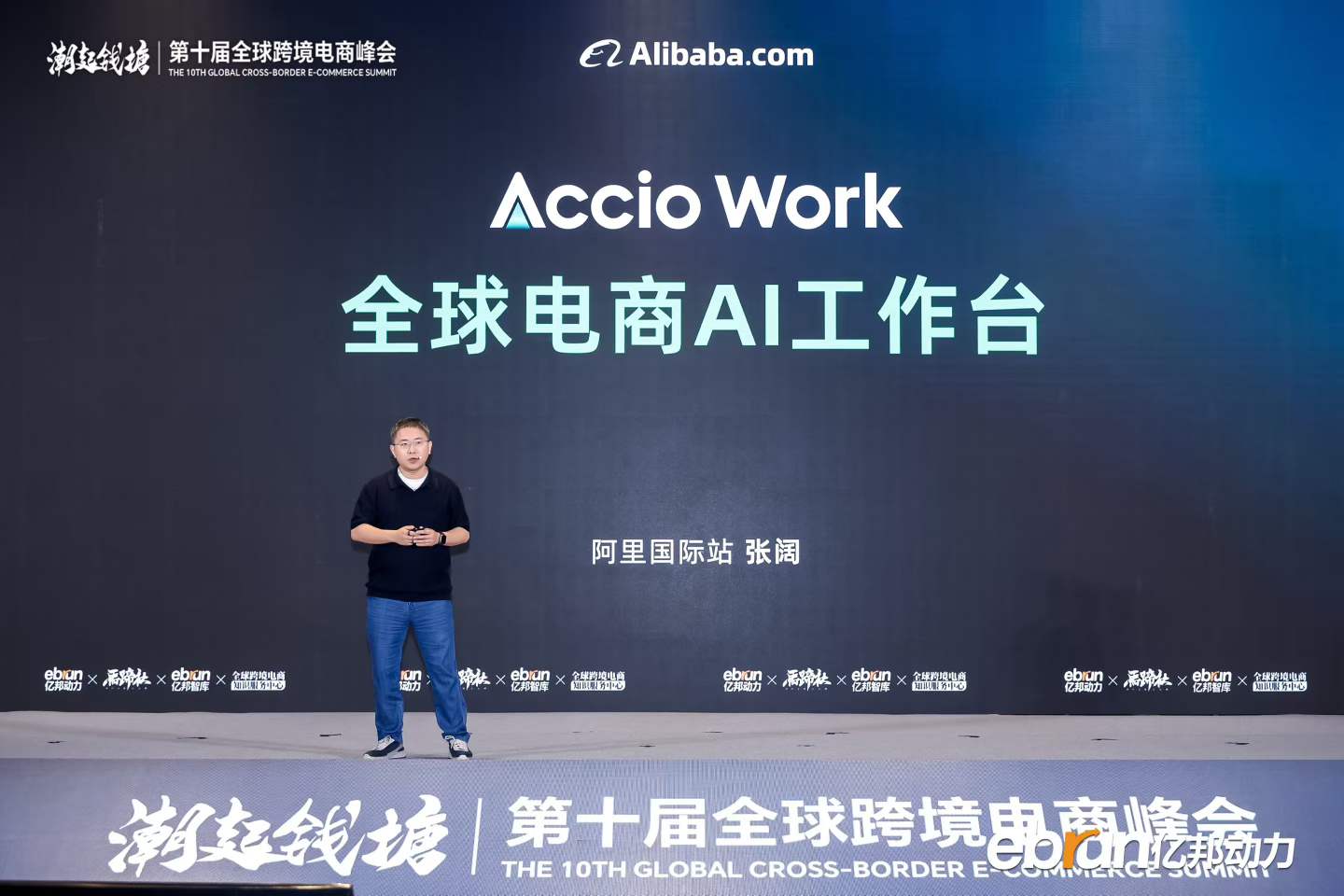
At the recently held '10th Global Cross-Border E-commerce Summit and 2026 Globalization New Brand AI Competitiveness Conference,' Zhang Kuo, Vice President of Alibaba Group and President of Alibaba.com, delivered a speech titled 'Accio Work: The Global E-commerce AI Workbench.'
Zhang Kuo believes that the foreign trade chain is long, decision-making costs are high, and there are many comparative dimensions. Relying solely on an AI chatbot that can answer questions cannot solve the overall efficiency improvement problem for merchants. AI needs to understand the e-commerce business and autonomously, systematically advance the trade process. B2B business is striding towards A2A, meaning Agent-to-Agent interaction to complete the entire process of sourcing, procurement, and more.
Building on this, the global e-commerce AI workbench Accio Work aims to extend the autonomous and intelligent capabilities already applied in foreign trade to domestic and global mainstream e-commerce platforms. With three core capabilities—automatic customer service, multi-platform analytics, and multi-platform product listing—it aims to connect the 'operational fragments' scattered across different platforms by merchants, allowing them to control their entire business through a single AI workbench.
Furthermore, Zhang Kuo proposed that judging whether a company has become an AI Native organization should not just focus on time saved, but on whether AI drives per capita revenue growth, improves decision-making speed and quality, and the extent and coverage of processes reaching L4 automation (where AI is the primary executor of work, and humans evaluate AI's actions).
(Note: This article is a preliminary transcript, edited and organized by Ebrun without altering the original meaning.)
The following is the dialogue record:
01 B2B Will Ultimately Evolve into A2A, AI Begins to Autonomously Advance Foreign Trade Processes
Let me introduce myself first. My name is Zhang Kuo. I joined Alibaba in 2001 and have served at Alibaba for 16 years. The first seven years were spent in Taobao and Tmall working on domestic e-commerce, witnessing the explosive growth of China's e-commerce alongside domestic merchants. At that time, I was responsible for merchant platforms and tools, and experienced the daily process with merchants from store opening, product selection, and operations to supply chain management. From 2017 to the present, I have been serving at Alibaba.com. Alibaba.com focuses on cross-border B2B business, which was also Alibaba's first business.
From domestic e-commerce to cross-border trade, although the business model has changed significantly, if you spend every day with merchants, you'll find many pain points in the overall operation process are similar. Whether it's supply chain management, user acquisition, order conversion, or achieving scale and profitability, these are not just issues of running a single store, but about mastering the entire business. Especially now, as more and more merchants begin cross-platform operations.
Starting in March this year, we further upgraded the original purchasing agent Accio to Accio Work, officially launching it in April. We hope to leverage Alibaba's e-commerce experience and Agent models to first fully expand automation capabilities in the foreign trade sector. Next, we aim to connect this set of autonomous and intelligent capabilities to mainstream e-commerce platforms in China and globally, truly helping merchants achieve 'sell globally with one click.'
First, let's look at the foreign trade business discussed today. From April to June (the entire second quarter), China's export growth rate reached 20%; in June, the export growth rate reached 27%. The core contributors include both the upstream and downstream AI industry chain and the 'new three' that have driven China's exports in the past: electric vehicles, new energy, and energy storage. Meanwhile, consumer goods and industrial products also saw 15% growth.
According to Alibaba.com data, whether it's traditional major consumer markets like the US, or markets like Spain, Italy, France, and Brazil, the platform's GMV has maintained a high growth rate. An important driver of this growth is the increasing global use of diverse search methods: people express needs using long text, but also take photos and upload PDFs for multimodal searches. According to Alibaba.com data, multimodal searches have grown by over 100% this year, with more and more global demand entering China.
We started digital trade in 1999. Looking back, one summary of foreign trade is: every decision in foreign trade is expensive. Compared to domestic e-commerce, the cost differences in foreign trade orders are significant; from communication and sourcing to sample orders and repeat orders, there are many intermediate steps. Therefore, the foreign trade chain is long, decisions are costly, and each decision requires referencing many data dimensions.
This means that overall efficiency improvement in foreign trade cannot be solved simply by providing an AI robot, a Robot that can answer questions. AI needs a comprehensive understanding of the e-commerce business and then systematically advance the trade process step by step.
In the past, we mostly embedded AI into different aspects of merchants' daily operations, having AI assist humans in completing tasks. Today, we have upgraded the purchasing agent Accio to Accio Work, hoping to help merchants autonomously complete work through a true AI Agent. B2B business is striding towards A2A, meaning Agent-to-Agent interaction to complete the entire process of sourcing and procurement.
In the past, a global buyer had to first write procurement requirements, then repeatedly copy and paste, searching for suppliers to contact; due to different time zones, they also endured long waits. After multiple rounds of back-and-forth communication, the buyer had to organize supplier information themselves, finally resulting in a very complex spreadsheet.
Through the Accio Sourcing Toolkit (an AI autonomous sourcing agent plugin on Accio Work), buyers can hand over products of interest along with requirements like custom specifications and tiered pricing to the Agent. The Agent can handle price inquiries and terms communication, follow up on supplier commitments, and can simultaneously communicate with up to 20 suppliers. The buyer still controls the manufacturing process, final pricing, and negotiation direction, while the Agent works 24/7 to continuously organize information and synchronize progress until procurement is complete.
Global demand has always existed, but in the past foreign trade process, human energy was consumed in constant copying, pasting, and waiting. An important opportunity AI brings is to intelligently advance the decision-making in foreign trade—characterized by long chains, high costs, and multi-dimensional comparative analysis—step by step.
Since its launch in May 2025, Accio had over 10 million monthly active overseas users by March 2026. More and more global small and medium-sized buyers and sellers are starting to use AI to solve language, time zone, and other issues in foreign trade, allowing AI to automatically understand the needs of both buyers and sellers and advance orders.
The second curve we observe is the daily Token usage by merchants. In the Agent era, the number of users is already a secondary indicator; more important is the depth of product usage by users. From July 2025 to July 2026, Accio's Token consumption increased tenfold; even from June to July, the Token cost per single task decreased by 50%. This benefits from both the rapid evolution and improved cost-effectiveness of global AI models, as well as our work in Harness engineering, agent management, and memory management.
On one hand, more people are using AI; on the other hand, the depth of usage is also increasing. Next, we hope to continue driving down costs, making the product truly affordable for more people. For today's foreign trade merchants, AI is no longer just a trial tool but is becoming an important part of daily work.
It has been about 122 days since Accio Work was launched, with approximately 100 iterations. Currently, the product covers PC desktop, Web, and mobile. The PC side allows real-time control over products and data processes, while the Web side can execute 24/7 in the cloud. We hope to cover the round-the-clock needs of foreign trade buyers and sellers through continuous iteration.
02 One Agent Connects Various Links in Foreign Trade Operations: Automatic Customer Service, Multi-Platform Data Analysis, Multi-Platform Product Listing
In the more complex processes, more expensive decisions, and more multi-dimensional comparisons of foreign trade, we have already helped merchants improve operational efficiency through AI's intelligence, autonomy, and high efficiency. The next step is to extend Accio Work's capabilities to domestic and global mainstream e-commerce platforms, allowing more merchants to reuse this set of intelligent capabilities.
The first type of capability is automatic customer service.
Automatic customer service in foreign trade is not just about having merchants stay by their computers or phones to reply to customers promptly; more importantly, it's about understanding the needs behind the customer. What kind of customer are they? What is the scale of their business? What risks might this order bring? Only by integrating this information can merchants provide customized responses, and Chinese suppliers can secure truly profitable orders based on understanding user needs.
Merchants can first upload their own knowledge base, so that every response during buyer-seller communication is generated based on the merchant's own knowledge and corpus. When a large number of buyers flood in, the boss is most concerned about the buyer's background, real needs, and budget; business supervisors need to understand the daily responses of sales staff and identify areas for improvement. These are the conversion tasks a foreign trade company must handle daily.
Today, we use AI to identify high-value users, helping merchants better engage and convert them. This is a barrier we first broke through in the foreign trade sector. We believe this capability is equally applicable to domestic trade merchants, such as 1688 merchants. All trade involves complex processes like order follow-up, conversion, and price comparison. Facing multi-dimensional, long-cycle decisions, AI can quickly help merchants handle problems.
The second type of capability is multi-platform data analysis.
I know a female entrepreneur who has operated on Alibaba.com for many years. She originally produced Go-to-Market promotional materials for domestic real estate projects, then transitioned to foreign trade. Over time, her store gradually became a 'department store': she could take on any buyer's demand. But if asked about the long-term, sustainable growth positioning of her enterprise, she found it difficult to answer. Later, she approached a consulting firm, which quoted 300,000 RMB.
Ultimately, she chose to use Accio Work to analyze each client, examining profit status, trends, and business possibilities from dimensions like different countries and different orders. Through this, she found her market, clarified which developing markets and clients she could serve, and solidified this as the long-term direction for her business.
When merchants sell globally, they need to continuously make decisions for clients in different countries and of different scales. They don't just need to close a single deal; they need to manage a business that can sustain profitability and generate compound interest for the future.
Next, we will not only continue to deepen the business data analysis capabilities within Alibaba.com but also hope to integrate more platforms, providing real-time alerts to help bosses accelerate decision-making. Currently, platforms like Alibaba.com, Taobao, Tmall, 1688, and Shopify are already integrated; the next step will involve integrating domestic and international mainstream platforms like Amazon, Douyin, and Pinduoduo, helping merchants truly understand 'where this business should go.'
The third type of capability is multi-platform product listing.
Bosses who have operated on Alibaba.com know that managing 'products' well is difficult in itself; managing the supply chain while ensuring listed products are understood by consumers and purchasers in different global regions is an even greater challenge.
A boss making distribution boxes once told me he had over 100 products. In the past, if he wanted to uniformly change a specification, for example, changing the logistics size to 85 cm across the board, the entire company would spend at least a few days. Now, using Accio Work, he just needs to say one sentence, and all products can be updated within half a day at most.
We hope Accio Work can understand both product specifications and the attributes of different platforms and buyers, then generate corresponding product descriptions based on different B2B, B2C platforms, countries, and languages, enabling one-click publishing of good products to major global platforms.
Platforms like Alibaba.com, Taobao, 1688, and overseas independent store platforms like Shopify and SHOPLINE have very different requirements for products and merchants. The core role of AI is to help merchants understand each platform's rules, manage multi-platform products, and seize traffic and user opportunities on different platforms.
Automatic customer service, multi-platform data analysis, and multi-platform product listing all address the 'operational fragments' merchants face daily on major e-commerce platforms. We hope to use Accio Work to truly connect these fragments, allowing merchants to control their entire business through one Agent. Currently, Accio Work is gradually integrating with e-commerce and media platforms in regions like the US, Europe, Latin America, and Southeast Asia, helping merchants manage their inventory, brand, and user base well.
03 AI Native Organization Judgment Criteria: Efficiency, Decision-Making, and Autonomy
Returning from the AI e-commerce platform to the enterprise itself, how can merchants truly manage an AI Native organization well? A very big question is: How exactly do we quantify whether an organization has become an AI Native organization? Based on our own operational practice, we offer three observation dimensions.
First, look at efficiency. Efficiency is not just about saving time; more importantly, it's about increasing revenue. We need to look at an enterprise's per capita revenue scale to judge whether AI truly drives core business growth. This is the first core measurement angle.
Second, look at decision-making, especially the speed and quality of decisions. How long did it take in the past to discover an important problem or solve a difficult problem? How long does it take now?
For foreign trade merchants, understanding clients, business opportunities, and the specific needs behind each inquiry was very time-consuming and energy-draining in the past; today, AI makes this information more accessible. All buyers and sellers should clearly quantify their business opportunities: Where are the most core opportunities currently? What scale and degree can each order achieve?
Third, look at autonomy. How many processes in the enterprise have truly reached L4 automation? The so-called L4 automation means the primary executor of the work is AI, and the human's most core work is to evaluate the actions performed by AI, judging whether they are done correctly. Through continuous incentives and penalties, AI Agents and business processes run more smoothly, achieving better results.
When an enterprise shows significant improvement in efficiency, decision-making, and autonomy, we can consider that an AI Native organization is gradually forming within its business.
Alibaba.com is one of the earliest digital e-commerce platforms and also one of the earliest to experiment with AI applications. Today, we hope to help global e-commerce merchants embrace the AI era together through Accio Work. Thank you all.
[Copyright Notice] Ebrun advocates respecting and protecting intellectual property rights. Without permission, no one is allowed to copy, reproduce, or use the content of this website in any other way. If any copyright issues are found in the articles on this website, please provide copyright questions, identification, proof of copyright, contact information, etc. and send an email to run@ebrun.com. We will communicate and handle it in a timely manner.
Translated by AI. Feedback: run@ebrun.com