
Amazon China Vice President Qiu Sheng: AI is Rewriting the Underlying Logic of Cross-border E-commerce Growth
[Ebrun Original] On July 23, at the Ebrun "2026 Globalization & New Brand AI Competitiveness Conference", Qiu Sheng, Vice President of Amazon China and Head of Asia Pacific Market and Business Development for Amazon Global Selling, delivered a speech titled "AI Acceleration: Unleashing New Cross-border Potential".
Qiu Sheng stated that AI is evolving from a point solution to a foundational capability that is reconstructing the growth logic of cross-border e-commerce. As consumer shopping behaviors, enterprise product innovation, and business decision-making models change, cross-border sellers need to shift from relying on experience and execution to leveraging AI to enhance their capabilities in insight, decision-making, and global operations.
Qiu Sheng believes that cross-border e-commerce is ushering in a new AI-driven paradigm for global e-commerce.
In his view, the core change brought by AI is not merely efficiency improvement, but rather driving cross-border enterprises from "tool application" to "business re-engineering". Whether it's the incremental upgrade of traditional sellers or the AI-native path of new-generation enterprises, the ultimate goal is deep integration with AI. Specifically, AI is profoundly reshaping the entire cross-border e-commerce value chain across five domains: product innovation, operational automation, intelligent decision-making, efficiency enhancement, and compliance and security.
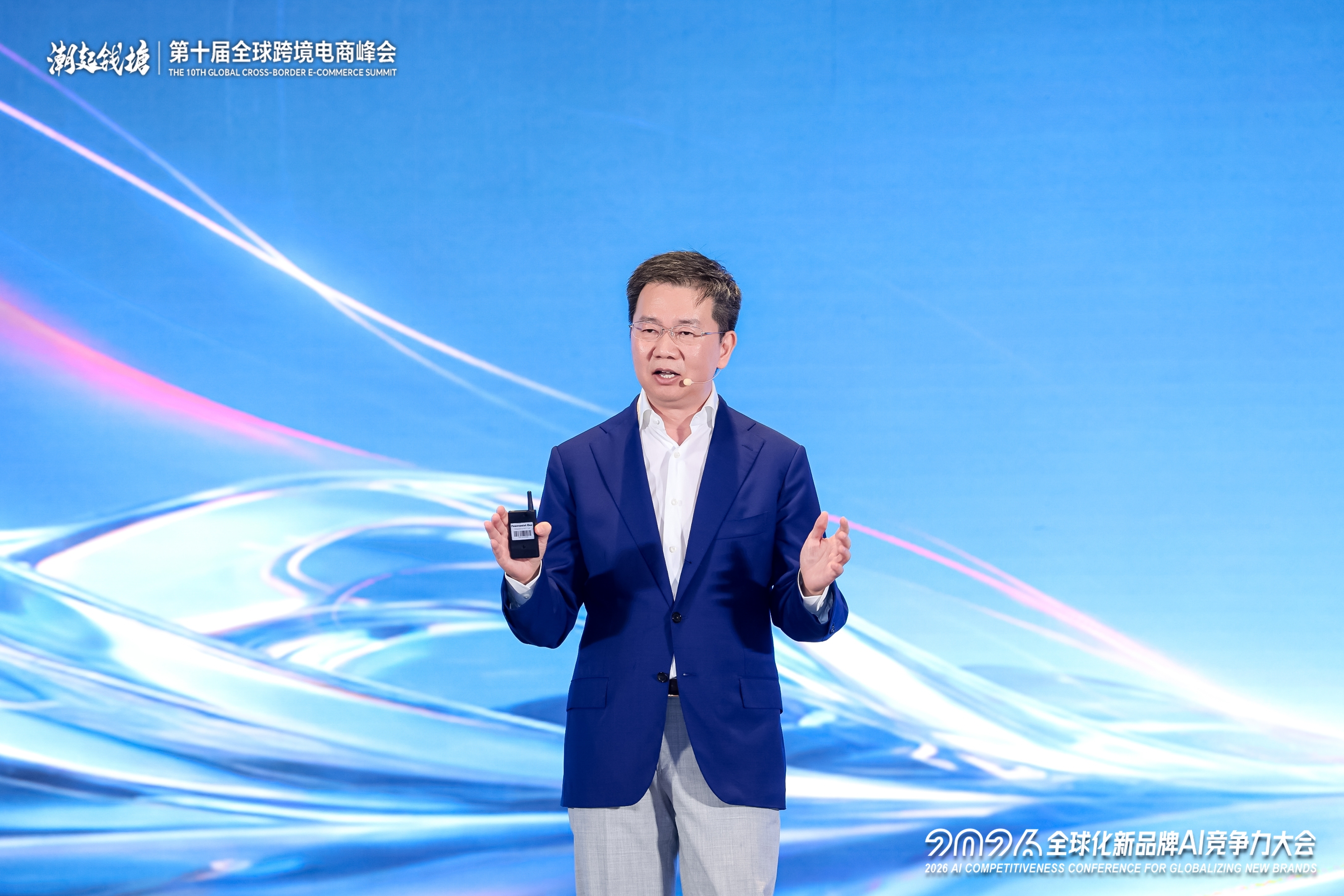
This article is compiled from the speaker's on-site presentation, with edits made without altering the original meaning.
The following is a transcript of the speech:
Hello everyone, I am Qiu Sheng, from Amazon. It is a great honor to return to Hangzhou once again.
Every time I come back to Hangzhou, I have a profound realization: Hangzhou is not only famous for its fine tea and beautiful scenery but has also produced a large number of daring and hard-working cross-border e-commerce sellers. Each visit, I can feel a certain drive—the determination of everyone to take their business to every corner of the world.
Today's conference theme is AI competitiveness. Over the past year, whenever I communicated with sellers, the conversation almost always ended up on AI. There is a shared feeling: this wave of AI is arriving fast and strong. It is not just helping us with minor fixes; it is redefining the cross-border e-commerce track.
01
AI is Rewriting the Growth Logic of Cross-border E-commerce
I would like to first share an observation: cross-border e-commerce is welcoming a wave of structural opportunity.
In April this year, Amazon CEO Andy Jassy mentioned in his letter to shareholders: "Every consumer experience will be reinvented with AI." A year or two ago, many might have been skeptical of this statement, but today, it is becoming a reality. AI is not just providing a tool option; it is rewriting the underlying logic of cross-border e-commerce growth.
We can look at this change from both the demand side and the supply side.
First, the demand side. By the end of last year, over 300 million people globally had used Amazon's AI shopping assistant to aid their purchase decisions. Data shows that consumers using the AI shopping assistant have a 60% higher conversion rate than those who haven't used it.
More noteworthy than the numbers is the change in consumer behavior itself. In the past, consumers were "searching for products"; now, more and more consumers are "describing their needs."
For example, to buy a pair of Bluetooth earphones before, a user would input keywords and then compare various parameters themselves. Now, more and more people directly tell the AI: "I want a pair of Bluetooth earphones suitable for running, with good noise cancellation, and under 500 RMB." The rest of the work is completed automatically by the AI.
This means consumption is shifting from active searching to demand expression, and the shopping decision-making journey is being significantly shortened.
Now, the supply side. Last year, Amazon third-party sellers created over 12 million product listings—that is, product detail pages—using generative AI. More and more Chinese sellers are targeting the global market, relying on Amazon Global Selling's cross-border supply chain system. "Launching globally from day one" is transitioning from a vision to reality.
AI is accelerating this process, and a new paradigm is taking shape: AI-driven global e-commerce.
In this paradigm, the role of sellers is also changing. In the past, sellers were bogged down by a large number of repetitive tasks, whether it was editing copy, monitoring inventory, or adjusting ads, all requiring significant effort. Now, AI has taken over a considerable portion of the execution work, allowing sellers to evolve from operators to decision-makers, and from single-site managers to global business architects.
Currently, over 82% of Chinese sellers have integrated AI into their business processes, with another 16% of sellers building their own AI workflows, even enabling AI Agents to perform tasks end-to-end automatically.
Therefore, AI is evolving from a tool to an assistant and further becoming a "partner" for sellers.
02
From Product to Compliance: AI Penetrates the Entire Cross-border Business Chain
Next, I would like to discuss, through five real seller stories, the changes AI is bringing to various links of the cross-border e-commerce chain.
The first story is about product innovation.
In our research, 64% of Chinese sellers listed consumer insights and product selection as the areas they most look forward to AI empowering. Hangzhou-based brand Merach made a very interesting attempt.
Many of us may have had this experience: on impulse, we buy a treadmill. Enthusiasm runs high for the first few days, but it gradually becomes idle. The problem is, the treadmill itself is silent. It doesn't know how you are training or if you are training correctly. Once the novelty wears off, it's naturally hard for users to persist.
Merach wanted to solve the problem of "fitness equipment turning into a clothes rack." They first used Amazon's Opportunity Explorer to identify users' real needs from massive data: consumers don't need equipment with more functions; they need a coach who trains with them and guides them.
So, they "installed a brain" into the fitness equipment, developing the AI fitness assistant "MIA." This AI assistant is backed by tens of millions of exercise sample data points. When a user starts cycling, it monitors heart rate and exertion in real-time; when it detects a decline in the user's stamina, it automatically adjusts resistance to help the user transition smoothly; after a set of training, it provides suggestions for the next set based on the user's performance; after the entire training session, it can generate a recovery plan.
A piece of cold training equipment thus becomes an always-online smart coach. For users, the effect is tangible: average training duration increased by 3.2 times.
This case reminds me of a saying: when AI truly understands the user, it's like having a personal coach by your side all the time.
The second story is about intelligent decision-making.
Seller friends probably know that the hardest part of business is often not execution, but decision-making and finalizing choices. Which target audience for a new product, what features it should have, what price to adopt—these series of questions largely relied on experience and judgment in the past.
But experience, while useful when it works, can turn into inventory when it doesn't.
Laser engraving machine brand xTool took a new path in decision-making. They developed a "Voice of Customer" AI system. On one side, it aggregates real usage data from over 400,000 connected devices globally; on the other side, it compiles 210,000 pieces of real feedback from user communities. Then, through AI, it automatically distills product feature priorities and price sensitivity.
Based on this, they use Amazon's Brand Analytics to validate search terms and then conduct A/B pricing tests through the Manage Your Experiments tool. Product selection and pricing thus shifted from repeated trial and error to being evidence-based. Ultimately, the repurchase rate for their new products increased to over 40%.
xTool's transformation illustrates a principle: when data can replace experience, decision-making is no longer a gut-feeling gamble but something you can be confident about.
The third story is about operational automation.
Influencer marketing is an important means for sellers to expand into new sites, but those who have actually operated it know that finding influencers is a bit like searching for a needle in a haystack. Companies need to find influencers truly aligned with their brand from thousands of creators in different countries, then connect, communicate, and negotiate cooperation one by one—a process that was almost entirely manual in the past.
After integrating AI capabilities, one operations staff can now negotiate cooperation with hundreds of influencers in a month, which was unimaginable before. When AI puts operations into "autopilot," humans only need to take the wheel at critical junctures.
The fourth story is about full-chain efficiency improvement.
Gaming peripheral brand GameSir encountered a typical challenge during multi-store, multi-site expansion: it wasn't a lack of traffic or demand, but a lack of sufficient manpower.
One team needed to simultaneously monitor the backends, customer service, data, and listing adaptations for over a dozen sites, each task being very labor-intensive. Opening a new site meant almost redoing all these tasks.
GameSir's approach was to use AI to reconstruct their multi-site operations system.
On the user side, they use the AI shopping assistant to perform adaptation checks on listings for different sites, making them more aligned with local consumers' search habits and expressions. On the operations side, with the help of seller assistants and canvas tools, operational data analysis that used to take one to two hours can now yield results in tens of seconds. On the customer service side, the AI intelligent customer service provides timely responses in multiple languages, reducing consumer waiting time from the previous 4 hours to 15 minutes.
With AI support, the number of sites GameSir operates increased from 8 to 16, while the team size did not expand proportionally.
This case shows that the bottleneck of business expansion appears to be manpower, but the root cause is actually human efficiency. AI is precisely filling this gap in human efficiency.
The fifth story is about compliance and security.
Compliance is a link that cross-border sellers often overlook, yet it is extremely critical. Its difficulty lies in an almost zero tolerance for error: a missing declaration, an error in a customs clearance document—light cases result in fines, severe cases lead to customs detention. What companies lose is not just money, but also time and reputation.
In the past, many sellers solved problems after they occurred: appealing after account anomalies, troubleshooting after logistics snags. But AI is turning risk control from post-event remediation to pre-event prevention.
Clean energy brand Green Source Technology was also once deeply troubled by compliance issues. Manual customs document errors leading to customs detention, delayed response to logistics anomalies, incorrect freight template configurations—each was a lesson learned with real money.
Later, they built an AI automation system deeply integrated with Amazon's logistics system. From generating customs documents, monitoring logistics anomalies to updating freight templates, everything is completed automatically by AI, ultimately achieving zero customs detention.
The significance of this change is that compliance, which used to rely on closing the stable door after the horse has bolted, can now be done by preparing for rain before it comes.
03
AI Drives Global E-commerce into a New Stage
Reviewing these five stories, they collectively point to five trends in the application of AI across the entire cross-border e-commerce chain.
First, product innovation is shifting from following hot products to using AI to define categories. Second, business decision-making is shifting from relying on experience to letting data speak. Third, operational automation is shifting from using point tools to using AI to run the entire process. Fourth, efficiency improvement is shifting from relying on adding manpower to leveraging AI to drive scale. Fifth, security and compliance are shifting from post-event remediation to pre-event management.
These five trends are not isolated from each other; they are interconnected and mutually reinforcing. Today, AI is no longer just a tool in a single link; it is reshaping the entire business chain.
Of course, different sellers have different starting points, and their paths to adopting AI also vary.
Some sellers have been deeply involved in the industry for many years and are gradually introducing AI into their existing businesses for incremental upgrades. This is the incremental path for AI, and it is the path most sellers are taking today.
Other new-generation sellers build their business systems with AI as the foundational capability from day one of their venture. This is the native path for AI, where the organization is leaner and the development pace is faster.
These two paths have different rhythms, but the direction is the same. Regardless of which path is chosen, what I want to say is that no seller needs to walk alone. Because behind every seller, there are the joint efforts of Amazon and service provider partners.
Amazon's investment in AI is ongoing. In 2026, Amazon's capital expenditure is projected to reach $200 billion, with the vast majority invested in the AI field. We aim to build an AI capability foundation for sellers covering the entire chain from user insights, product selection, listings, logistics, advertising, to compliance, making it simpler and more efficient for everyone to participate in global competition with the help of AI.
At the same time, the capabilities and value of service provider partners are also crucial. Here, I would also like to take this opportunity to extend an invitation to service provider partners: we welcome more service providers who understand cross-border and AI to join the Amazon Service Provider Network. Amazon provides the foundation, service providers inject expertise; only by combining these two forces can we truly empower every seller with tailored strategies.
Friends, the curtain on the AI era has just risen.
We often say that Amazon is always in "Day 1." Facing the changes brought by AI, this "Day 1" feeling is particularly strong.
Amazon is willing to work with everyone to make good use of this AI accelerator, unleash the new cross-border potential of Chinese brands, and help them walk more steadily and run faster on the global stage.
[Copyright Notice] Ebrun advocates respecting and protecting intellectual property rights. Without permission, no one is allowed to copy, reproduce, or use the content of this website in any other way. If any copyright issues are found in the articles on this website, please provide copyright questions, identification, proof of copyright, contact information, etc. and send an email to run@ebrun.com. We will communicate and handle it in a timely manner.
Translated by AI. Feedback: run@ebrun.com