
Crossing into Printing, xTool Surpasses ¥100 Million on First Day, Enters Thousands of Brand Stores, Aims Beyond 'Laser Engraving Leader'
[Ebrun Original] This year, the personal creative tools sector has seen a series of successes. In 3D printing, Creality successfully went public, and Flashforge secured the largest single funding round in the industry in recent years. The laser engraving niche has also witnessed a landmark event—xTool officially submitted its prospectus to the Hong Kong Stock Exchange on New Year's Day this year, aiming to become the "first consumer-grade laser engraving stock."
xTool was not the earliest company to venture into consumer-grade laser engravers, but it has become a pioneer in this niche. Its first product, the M1, innovatively integrated laser cutting, laser engraving, and blade cutting functions into a single device. With its innovative technology, it raised $2.6 million on Kickstarter, topping that year's laser category crowdfunding list. Now, the company's annual revenue has exceeded ¥2 billion, and xTool has become synonymous with the laser engraving track.
The prospectus shows that in the first nine months of 2025, 97% of xTool's revenue came from overseas. The United States contributed over half of the revenue, with Europe accounting for 30%. The domestic market and regions like Southeast Asia were grouped into the remaining 15%. However, in the first quarter of this year, xTool's domestic market performance saw explosive growth, with revenue nearly doubling.
Recently, Ebrun conducted a dialogue with Liu Qiang, xTool's Head of Product and Technology for China, attempting to answer: How does xTool, with 97% of its market overseas, plan to tackle the domestic market? How should market education be conducted in a Chinese market lacking a strong maker culture? After achieving a 47% market share in the laser engraving sector (according to Frost & Sullivan data, based on GMV for the first nine months of 2025), how will xTool find its second growth curve?
01 "High-Spec, Affordable" New Product Breaks Through the Domestic Market; UV Printer Poised to Become the Second Growth Curve
xTool's predecessor was Makeblock, whose main business was STEAM educational robots, including the Laserbox for teaching scenarios. Impacted by the pandemic and the "Double Reduction" policy, Makeblock's education line once faced difficulties.
In 2021, during an overseas inspection, xTool's founder and CEO, Wang Jianjun, discovered that Europe and America had a strong "workshop culture," but makers lacked a consumer-grade laser engraver suitable for home use, sparking the idea to pivot.
The company's first laser engraver was the D1, a first-generation consumer-grade device weighing just over 10 pounds with an open-frame, detachable structure. Compared to industrial-grade laser engravers weighing dozens of kilograms and nearly impossible to place in homes, the D1 was somewhat revolutionary. The success of this product led the company to formally establish the xTool brand. "Even now, you can see similar D1-style frame structures on e-commerce platforms, so the D1's emergence, in a way, accelerated the rapid growth of consumer-grade lasers," Liu Qiang stated.
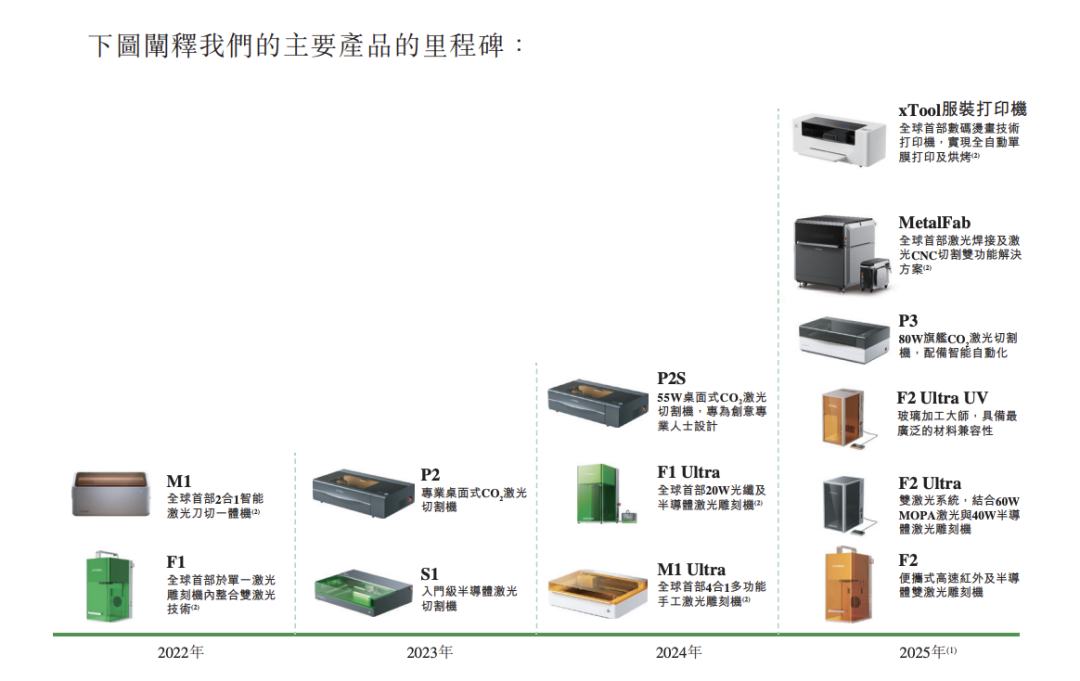
xTool's main product milestones in the prospectus
The D1 made the company realize the vast potential of the laser engraving track, but the xTool M1 truly fired the first shot. Launched in 2022, the M1 innovatively combined laser and blade cutting functions into one. It could cut traditional hard materials like wood, paper, and acrylic, as well as soft materials like heat transfer film, leather, and felt. The M1 became a classic model, still on sale today, with some studios continuing to use it.
The M1 raised over $2.6 million on Kickstarter, ranking first in platform laser crowdfunding that year and seventh in the technology category. xTool also launched it globally. "At the time, no company in the industry had made a similar product. It had strong product appeal both overseas and domestically," Liu Qiang explained.
Currently, xTool's main product lines include the F series for basic laser cutting and engraving, the M series integrating laser and blade cutting, and the currently primary marking machine, the P series. The F series comprises six products catering to needs like relief engraving, color engraving, internal engraving, and fast marking.
According to Liu Qiang, the usage scenarios and user groups for each product line differ: "The M series is used more for crafts, like making doll clothes, and can also be used for inkjet coloring of doll clothes. Scenic spot commemorative coins can use the F series for fast relief engraving on metal surfaces. B2B clients like personal studios and advertising agencies use the professional P series cutters more."
In May this year, xTool launched a new product, the M2, which, on top of laser and blade cutting, integrated color inkjet printing, achieving a "print, engrave, cut" three-in-one functionality. Notably, 70% of M2 users are beginners, making it a product that brings laser engraving to the masses. The M2 features auto-focus, a dual-camera real-time preview system, and a series of automation technologies that effectively lower the barrier to entry and simplify the tedious parameter adjustment process.
Moreover, with a price of just over ¥3,000, the M2 has achieved great success in the domestic market due to its high cost-performance and ease of use, with single-product sales already reaching half of last year's total domestic sales.
In the prospectus, xTool clearly positions itself as a "premium tech consumer brand," with product average selling prices (ASPs) 10%-30% above the industry average, and the ASP for laser personal creative tools exceeding ¥20,000. It can be said that the M2's pricing represents a shift from its past positioning.
Liu Qiang stated that the M2 is a "high-spec, affordable" product. "The M2 actually incorporates the latest technology, bringing down features previously only found in high-end models costing tens of thousands. Our original intention is to democratize high-end technology, allowing everyone to enjoy the joy of creation." However, he emphasized, "The M2 is just to lower the barrier to creation. xTool's future focus will remain on developing industry-leading software, hardware, and ecosystems. We won't engage in price wars."
If the M2 initially cracked open the domestic market by lowering the price point, the UV printer is poised to become xTool's second growth curve. "In the desktop laser field, we hold about a 47% market share, which is essentially the industry ceiling. So, we are actively seeking a second growth curve," Liu Qiang remarked.
As early as June last year, xTool launched its first apparel printer, formally crossing from laser engraving into the printing field. This apparel printer integrated the printing, powdering, shaking, and baking steps of traditional DTF (Direct-to-Film) printing into an automated process, gaining a 12.7% share in the global DTF niche market within months and topping the market share ranking.
DTF printing differs from UV printing; it's a white ink heat transfer process, where ink is first printed onto a film and then transferred onto fabrics like clothing. UV printing is direct-to-garment digital printing, requiring no transfer and forming in one step.
In July this year, xTool officially launched its first UV printer, the xTool O1. The O1 integrates four printing capabilities—UV, DTF, DTG (Direct to Garment), and UV DTF (crystal label)—into a single device, marking xTool's further expansion into full-color, multi-material printing.
Under the overseas DTC sales model, the O1 achieved first-day sales exceeding ¥100 million, setting xTool's record for fastest new product sales to break ¥100 million since its founding and also breaking the industry record for first-day sales of a new product, achieving great success.
Regarding the choice to expand into UV printing rather than 3D printing or other product lines, Liu Qiang explained: "The drawback of lasers is they can't add color. UV printing complements that by adding coloring capability. UV printing and laser engraving are complementary. We believe it has vast market potential and imagination."
02 Entering Brand Stores for Personalized Customization, Accelerating Domestic Market User Education
In the prospectus, xTool does not disclose specific performance contributions or percentages for the Chinese market, grouping it with regions like Southeast Asia into the remaining 15%. However, Liu Qiang shared a data point: the domestic market has been nearly doubling month-on-month this year, and the contribution from offline brand stores is expected to surpass that of online C2C users.
For a long time, China has lacked the "workshop culture" prevalent in Europe and America. Users have limited imagination regarding laser engravers, naturally leading to lower C2C sales. Taking 3D printing, another part of the "maker trifecta," as an example, the transition from industrial to consumer grade also underwent a lengthy market education process. In the domestic market, laser engraving is at a stage similar to 3D printing a decade ago when it was just emerging.
Brand stores are a special type of user xTool has identified for the still-nascent domestic market.
They are difficult to serve, require significant upfront investment, need dedicated engineer testing, and require software and integrated screens. However, once a successful partnership is established, it becomes a necessity, gradually driving stable growth. "Last year, we focused on infrastructure, building personalized solutions. This year, we've seen an explosion, with geometric growth compared to last year," Liu Qiang said.
Beyond profitability, the more implicit and far-reaching significance of entering brand stores lies in user education. "Brand stores are naturally the closest touchpoint to consumers. Through in-store customization, more consumers can directly experience the value brought by personalized services. We believe that as more brands join, personalized customization will further become a standard capability for retail stores and gradually integrate into consumers' daily shopping experiences."
Currently, xTool's laser engravers and personalized solutions have been deployed in two to three thousand brand stores globally, with nearly 1,000 in China. Through laser engravers and accompanying integrated screens and software, consumers can imprint their favorite patterns on various products like electronics, jewelry, cosmetics, cups, ceramics, shoes, clothing, and bags. xTool has partnered with over 200 brands, including Huawei, VIVO, Lefant, Stanley, Starbucks, Nike, Decathlon, MAC, and more.
According to Liu Qiang, xTool's first brand store partnership was with the American cup brand Stanley. At the end of 2024, Stanley planned a 14-day pop-up event at One Avenue Qianhai in Shenzhen and wanted to introduce on-site customization services. xTool's personalized solution significantly sped up the custom pattern process. Originally, online customization took a week; now, in-store completion takes just tens of seconds. During the event, store foot traffic surged, social media buzz attracted a continuous stream of consumers, daily engraved cups exceeded 200, and sales nearly doubled.
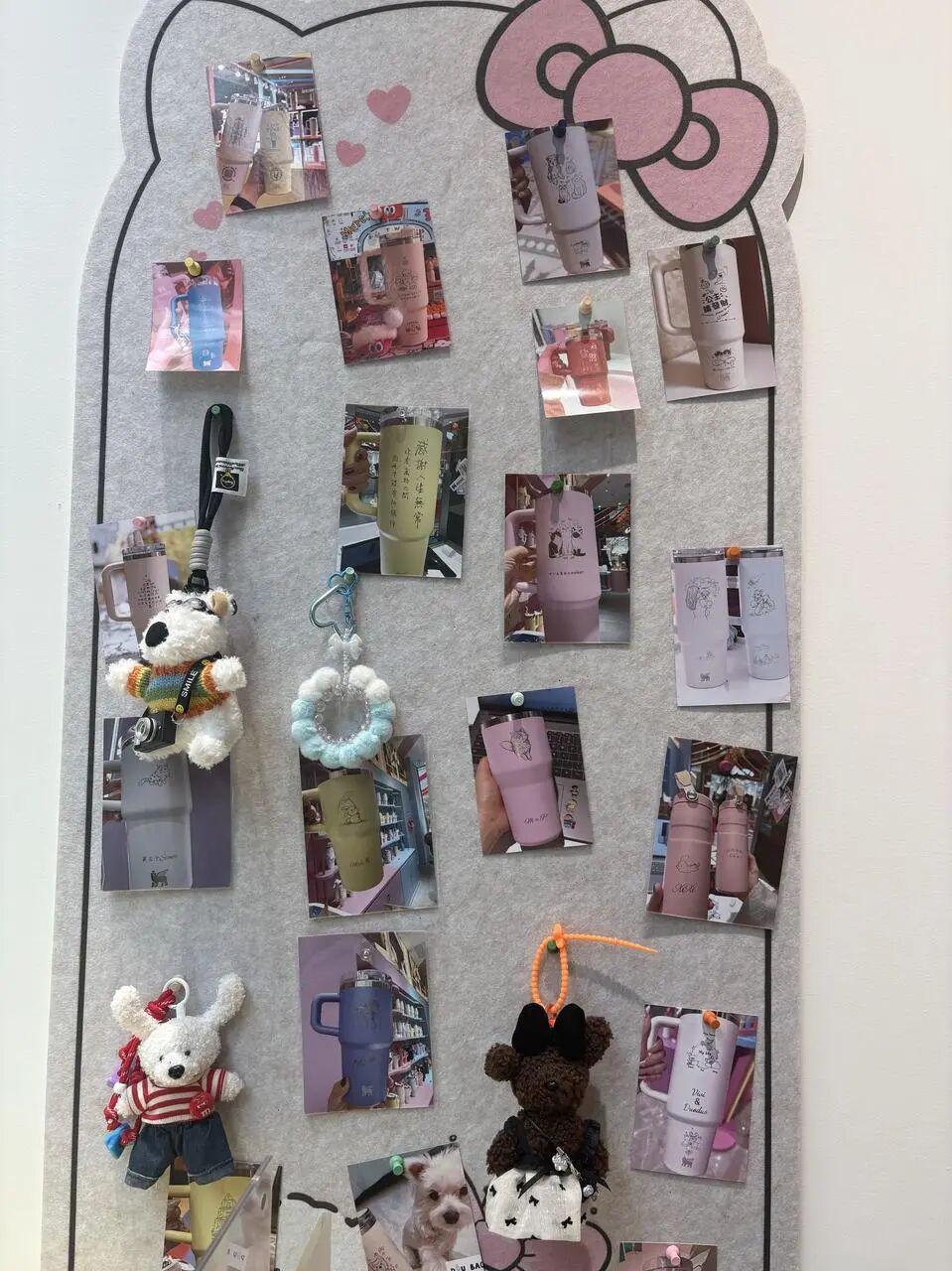
Photos of user-customized cups displayed on the wall of a Stanley store
While laser engravers have a high fit with brand offline stores, they are indeed more challenging to serve than C2C consumers. First, mass engraving in a short timeframe heavily tests product stability. "Huawei might engrave one or two hundred earphones a day, but a C2C user engraves at most 10 a day. Mass production is more suited to industrial-grade equipment, which requires our consumer-grade products to have industrial-grade stability," Liu Qiang stated.
Second, to ensure consumers can engrave normally in stores, xTool needs to add testing phases before delivery. A team of dozens of engineers tests various products from brands, even different colors of the same product, and then integrates the test parameters into the screens. This ensures consumers can print their desired patterns within tens of seconds. The higher the price point and the more precious or fragile the product, the higher the testing requirements. Liu Qiang mentioned that before delivering to the luxury brand Dior, they went through three rounds of testing to ensure successful engraving on gold and silver jewelry.
Additionally, the range of cooperable categories is limited by process and material constraints. Laser engraving is not omnipotent; for example, engraving some mobile phone glass back covers can lead to cracking. This is determined by the nature of lasers and is difficult to avoid. However, as products iterate, the types of cooperable brands will increase. For instance, stores originally partnered with xTool used thermal laser sources, which could cause burnt, blackened edges unsuitable for high-value products like jewelry. Now, with the new-generation cold laser machine, the F2 Ultra UV, engraving edges are cleaner, like a blade cut, making it suitable for jewelry brands.
xTool's newly launched first UV printer, the O1, can add color without damaging the product surface, further ensuring customization safety. Liu Qiang said, "Using lasers, poor engraving can lead to warranty issues, but UV doesn't damage any surface material, so we don't worry about that. This also gives us the confidence to expand into more cooperative categories."
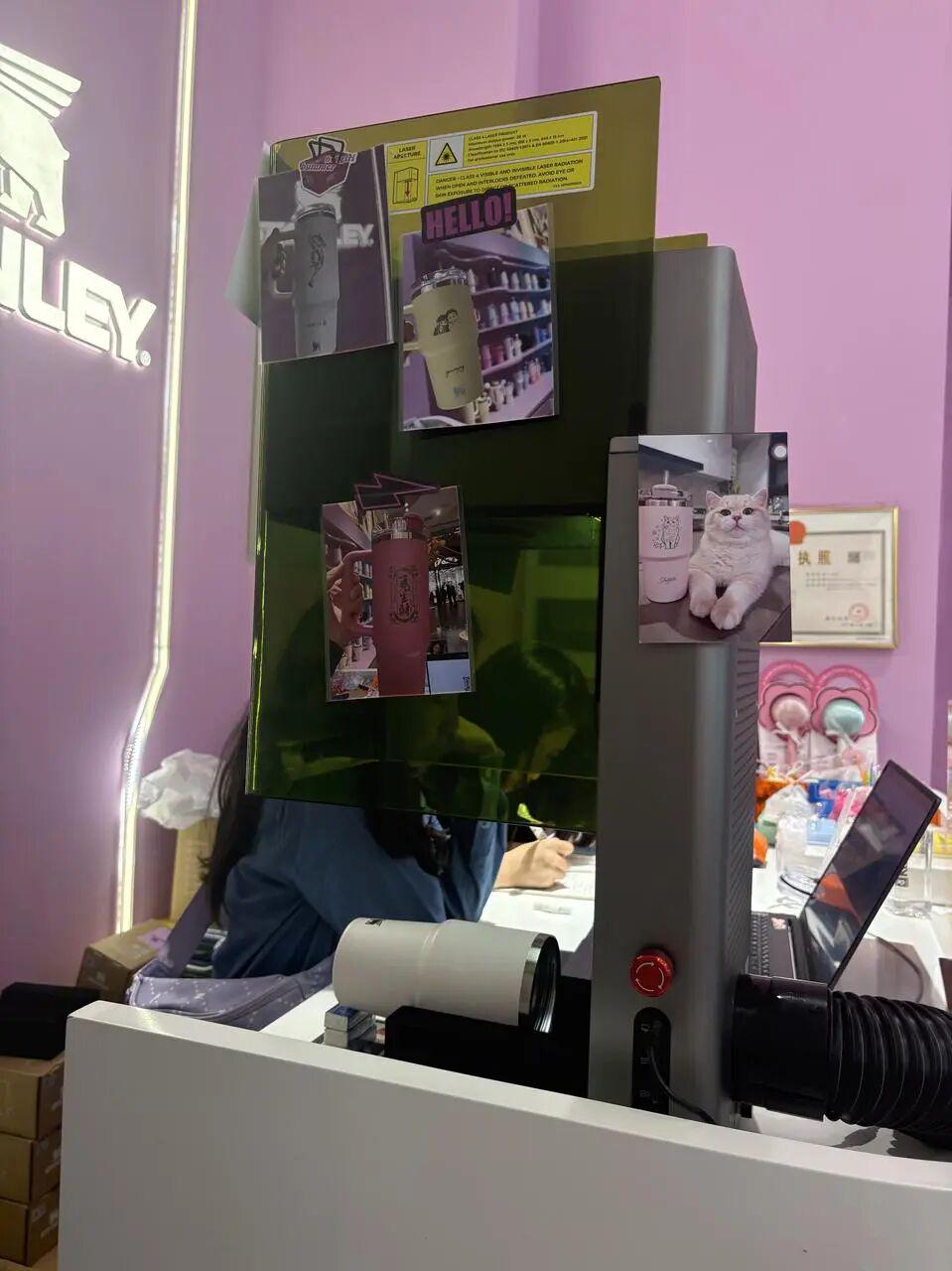
xTool engraving machine in a Stanley store
Finally, there's software support. According to Liu Qiang, all xTool engravers used in stores are equipped with integrated screens similar to ordering kiosks, with an extremely low barrier to use. Consumers can choose patterns from a gallery or upload their own images; AI then generates patterns suitable for engraving. Moreover, because the in-store usage environment is more complex than C2C users operating software on a computer—such as network signal delays due to crowds or new uncertainties from outdoor environments—xTool is continuously improving the brand store experience by adding casings to screens, equipping cooling devices, and network communication tools.
From a regional market perspective, China is the absolute leader in brand store partnerships, accounting for over half of the partnered stores. Part of the reason is that Chinese stores are closer to the company headquarters, making equipment deployment and debugging more convenient without the need for logistics transportation. Currently, xTool is also expanding into more overseas stores. According to Liu Qiang, xTool internally rates brands based on market coverage, categorizing them as global brands, regional brands, and Chinese brands. Overseas, they focus more on deploying in global brand stores, while in China, they partner more with Chinese brands.
"The customization solutions are already mature; it's just a matter of sharing parameters. Once it works in one place, rolling it out globally is a natural process. For example, after introducing Decathlon in China, we are now expanding into Southeast Asia," he said.
03 Software Ecosystem Builds Core Moat; "10,000 Stall Plan" Supports SMB Users
xTool's marketing in the domestic market can be described as "restrained." Unlike overseas, they rarely advertise on social media or offline billboards. "We don't proactively invest too many resources in marketing; we still focus on honing product strength and user education," Liu Qiang remarked.
He believes that sales driven purely by fandom culture are not desirable; they hope users purchase because the product genuinely helps their business, not due to endorsement effects. "If you buy it and it just collects dust at home, we still make money, but that money isn't sustainable. If I sell 10,000 units, I can only sell 10,000. But if they are used, even if I only sell 1,000 units, a few more are added daily, growing to 10,000. We think that's a healthier model."
A recent activity that could be considered marketing was participating in tech blogger "He Kexun's" "Smart Home Appliances & Renovation Live Testing Special" during the 618 shopping festival. "He Kexun" selected five products from those offered on the Tmall platform, and xTool was one of them. Liu Qiang was invited to demonstrate and review the product live, representing a case of gaining organic traffic through product strength.
Maker tools are highly community-driven products. A good community ecosystem can help a brand build word-of-mouth within the circle, thereby gaining more organic traffic. xTool also places great importance on community ecosystem building. Its user community, Atomm, already has 212,000 registered users, 40,000 works, 640,000 monthly visits, and has established 470 offline communities in 32 countries.
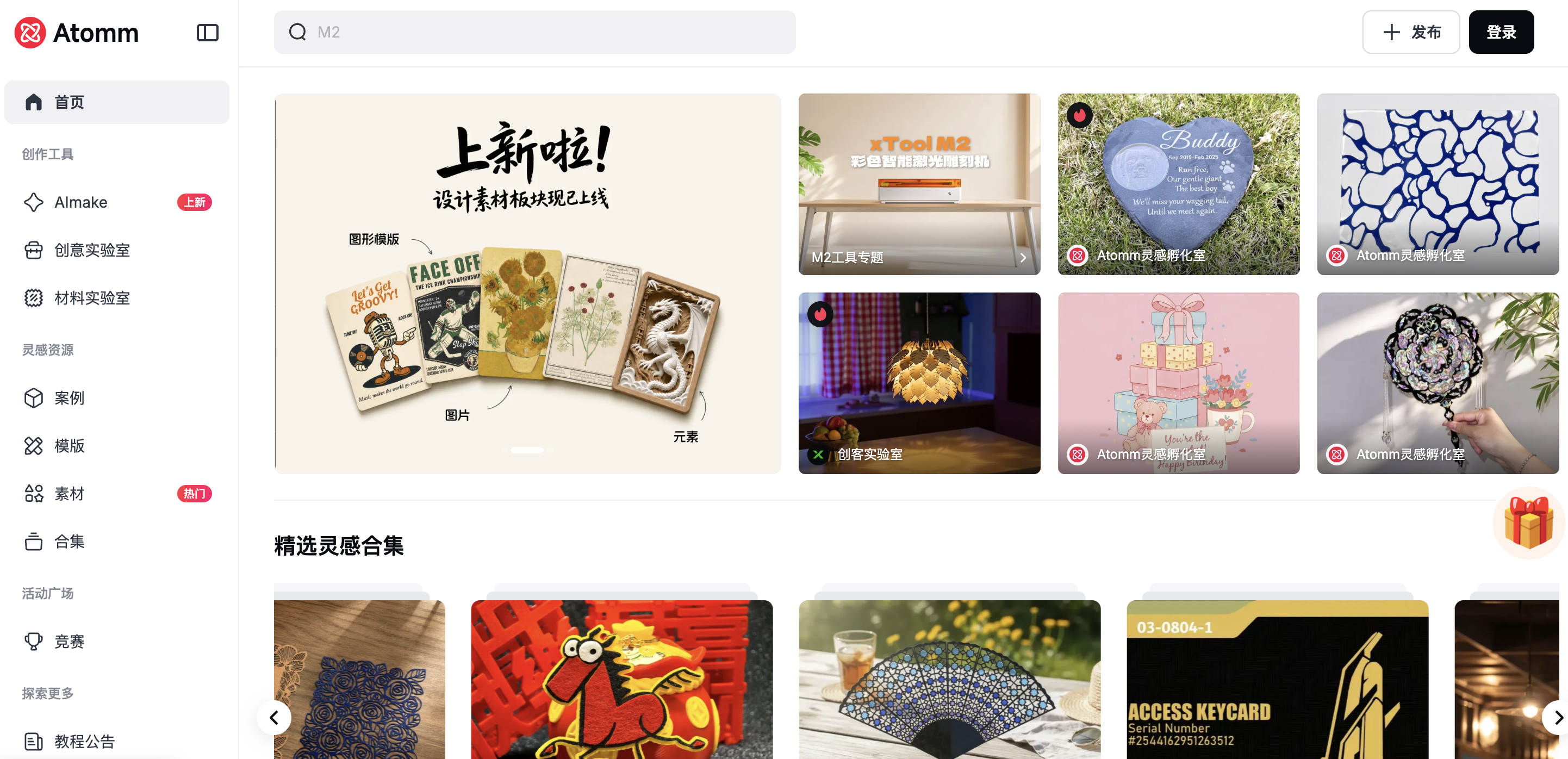
The Atomm community
Atomm boasts a vast library of design templates, simplifying the creation process to just placing material, dragging images, and one-click processing. Additionally, users can exchange usage experiences and design insights, upload design works, and learn product tutorials. Now, Atomm also integrates an AI maker with text-to-image generation capabilities. Points needed to generate images can be earned by participating in case creation, joining official events, or purchasing directly.
Besides the user community, xTool also has official social groups domestically. Purchasing users join official WeChat groups where excellent design cases are shared periodically, design competitions are held, and rewards are distributed.
"Hardware is easily imitated and copied. The software ecosystem is our core moat. Companies without sufficient scale may not be able to invest enough manpower and resources to build their own user community," Liu Qiang stated.
The high price point of ¥10,000-20,000 inevitably positions its products as productivity tools, not toys. Currently, xTool mainly has three user types: C2C users, SMB users (Small and Medium-sized Businesses), and brand stores.
SMB users are a very important user group for xTool, and the company does not hesitate to invest resources to support them. This year, xTool launched the "10,000 Stall Plan," aiming to support 10,000 users to become "stall owners," providing them with promotional resources, consumables, model parameters, and other support. Liu Qiang stated that the 10,000 Stall Plan aims both to help users create value with their purchased products—whether for profit or public welfare—and to serve as market education, allowing more people to see laser engraving.
In fact, to better validate and understand the laser engraving customization market, xTool employees have personally set up stalls. In 2023, they sold customized leaf specimens at an exhibition in Shenzhen, transforming portraits into engraveable patterns printed onto leaves to make exquisite specimens that could even show through light. In four days, they achieved ¥130,000 in sales, covering the cost of one machine, with excellent results.
But Liu Qiang said such success is not easily replicable; it requires a venue with sufficiently high foot traffic. According to his observation, customized products in the domestic market are mostly sold online. Consumer awareness of offline stalls is lower than overseas, which is what the "10,000 Stall Plan" aims to promote. "Overseas, there are some charity-themed tours, like setting up stalls to donate to a school, including in Hong Kong. So overall, it's easier to sell at stalls overseas."
xTool's own stall-setting was also to explore the market on behalf of users first. They share their stall experiences in the community, such as how to process images, what patterns are popular, and what types of consumers prefer which patterns.
"I think rather than investing in advertising, it's better to invest that money in users, helping them use the product better. If they use it well, the content they produce in the community is also a form of marketing. We prefer to invest in that direction," Liu Qiang concluded.
Ebrun continues to track and report on this development. To learn more information related to this article, please scan the QR code to follow the author on WeChat.

[Copyright Notice] Ebrun advocates respecting and protecting intellectual property rights. Without permission, no one is allowed to copy, reproduce, or use the content of this website in any other way. If any copyright issues are found in the articles on this website, please provide copyright questions, identification, proof of copyright, contact information, etc. and send an email to run@ebrun.com. We will communicate and handle it in a timely manner.
Translated by AI. Feedback: run@ebrun.com